
The AI Chapter Book Generator
For a Child's First Real Book
Short chapters a 7-year-old finishes in one proud sitting. Vocabulary tuned to the reading age. A hero who can be your actual kid.
The format between picture books and middle grade, generated complete: story arc across chapters, consistent characters, a warm ending, cover designer, and print-ready PDF and EPUB export. Free to start, full commercial rights.
Quick Answer
An AI chapter book generator writes complete short-chapter books for newly independent readers, roughly ages 6 to 10: the format between picture books and middle grade. Inkfluence AI plans the story arc across short chapters a child finishes in one sitting, tunes vocabulary and sentence length to the reading age, keeps characters consistent chapter to chapter, and exports print-ready PDF and EPUB for Amazon KDP. The free plan writes 5 chapters with no card, which gets you well into a first chapter book, with full commercial rights on every plan.

Picture book, early reader, chapter book, middle grade: the ladder, defined
"Chapter book" gets used loosely, but in children's publishing it is a specific rung on a ladder, and matching the rung to the reader is most of the craft. Here is the ladder as publishers use it:
| Format | Typical age | Who reads it | Shape |
|---|---|---|---|
| Picture book | 2-6 | Adult reads TO child | ~14 illustrated spreads, a few lines each |
| Early reader | 5-7 | Child, with help nearby | Controlled vocabulary, big type, pictures on most pages |
| Chapter book | 6-10 | Child, alone and proud | Short chapters, fast plots, occasional spot art |
| Middle grade | 8-12 | Confident reader | Full novels, deeper themes, rare illustration |
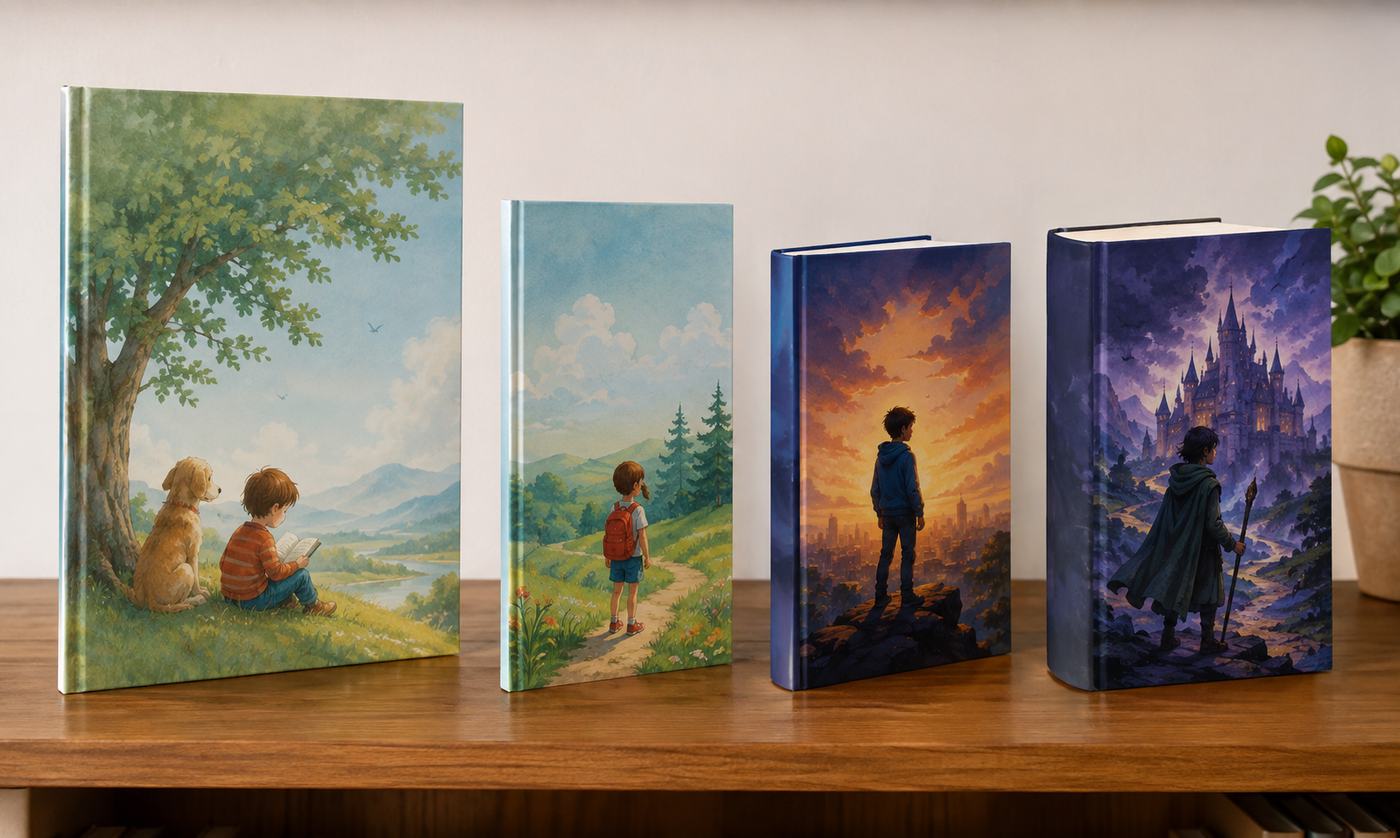
Inkfluence covers the whole ladder: picture-book mode for the bottom rungs, the kids' story engine for early readers and chapter books, and the full fiction engine when your reader graduates to novels. Word counts for each rung, from the sources publishers use, are in children's book word count by age.
What makes a chapter book work (and how the generator handles it)
The chapter is the pacing unit (a craft rule the wider story engine applies at every length). A newly independent reader measures progress in chapters finished, so each one needs a small complete shape: a goal, a complication, and an ending that tugs toward the next chapter without frustrating a reader who stops there for the night. Inkfluence plans the arc across chapters before writing, so the middle does not sag and the ending resolves warmly rather than abruptly.
Vocabulary is calibrated, not dumbed down (the bands are mapped in the children's book guide). The difference between writing for 7 and writing for 10 is sentence length, clause complexity, and how much is spelled out versus trusted to the reader, and the generator adjusts all three from the age you give it. Characters stay consistent because continuity is carried between chapters: names, traits, and what has already happened.
And everything is editable. Generate the book, then change any sentence, rename anyone (there is a one-click character rename), regenerate a chapter, or add a spot illustration inside a chapter via the illustration generator, in one consistent style, before exporting.
The reading-level dial, in detail
"For a 7-year-old" is doing more work than it looks. Between 6 and 10, three things change fast, and the generator moves all three together when you name the age. Sentence length: a 6-year-old reads best in short, single-clause sentences with the occasional longer one for rhythm, which is also why picture books hand the visual half to art; a 10-year-old handles subordinate clauses without noticing. Vocabulary: not baby words versus big words, but how many unfamiliar words per page a reader can absorb before frustration beats momentum, and whether they are decodable from context. Trust: how much the text spells out versus leaves for the reader to infer, which is the real difference between writing for 7 and writing for 10.
Chapter shape changes too (the full age-band craft lives in our children's book guide). Early chapter books run very short chapters with one event each, because "I read a whole chapter" is the engine of the whole enterprise. By 9 or 10, chapters lengthen and start carrying two beats. The generator sizes chapters to the age, and you can adjust the count with the slider if your reader is between rungs.
Everything stays editable afterwards, which matters for real readers who are never exactly their age's median: bump a word down here, split a sentence there, and the book meets your actual child instead of a statistic.
How eight chapters stay one story
The classic failure of chat-generated chapter books is chapter five forgetting chapter two: the dog changes name, the lost key is found twice, the villain's motive resets. It happens because each chunk is generated fresh with a summary at best. Inkfluence writes fiction sequentially with continuity carried forward: what happened, who knows what, what was promised to the reader, and each chapter is written against that record rather than against a vibe (for longer fiction the same machinery grows into a full story bible).
The arc is planned before chapter one, so the middle does not wander: every chapter has a job (setup, complication, the low point, the turn), which is why the endings land resolved instead of stopping. Character names and traits persist, and if you rename the hero after your own kid, the one-click character rename updates every mention across the book.
None of this needs managing; it is how the fiction engine works. Your part is the idea, and the fun part: reading the draft with the reader it was made for and tuning it together, which for many families quietly becomes the actual point.
When to graduate to middle grade
The signals are reliable (and the novel-length question has its own answer): your reader finishes chapter books in a day and asks for longer; they start caring why characters do things, not just what happens; and they stop needing the safety of a guaranteed warm ending every thirty pages. That is middle-grade readiness, roughly ages 8 to 12, and the same platform follows them there: full novels with deeper structure via the fiction engine, which brings story bibles, character arcs, and real plot machinery.
Until then, resist the urge to level up early; there is a whole storybook shelf below this rung too. A confident reader devouring "easy" books is building the habit that makes every future book possible; a struggling reader pushed into middle grade learns that books are work. The chapter book years are for volume, delight, and series binges, which is exactly what generation at this cost makes practical.
Chapter books are a series business
Look at any child's shelf: chapter books come in numbered rows. Industry data consistently puts children's books at nearly a third of all print book sales, and the early-reader shelf is where that volume is most series-driven. Readers this age re-buy the world they already love, which makes chapter books one of the friendliest categories for self-publishers: your marketing for book three is book one. Inkfluence's series tool expands a finished book into a multi-volume series with the same cast, and the cover designer keeps a consistent series look.
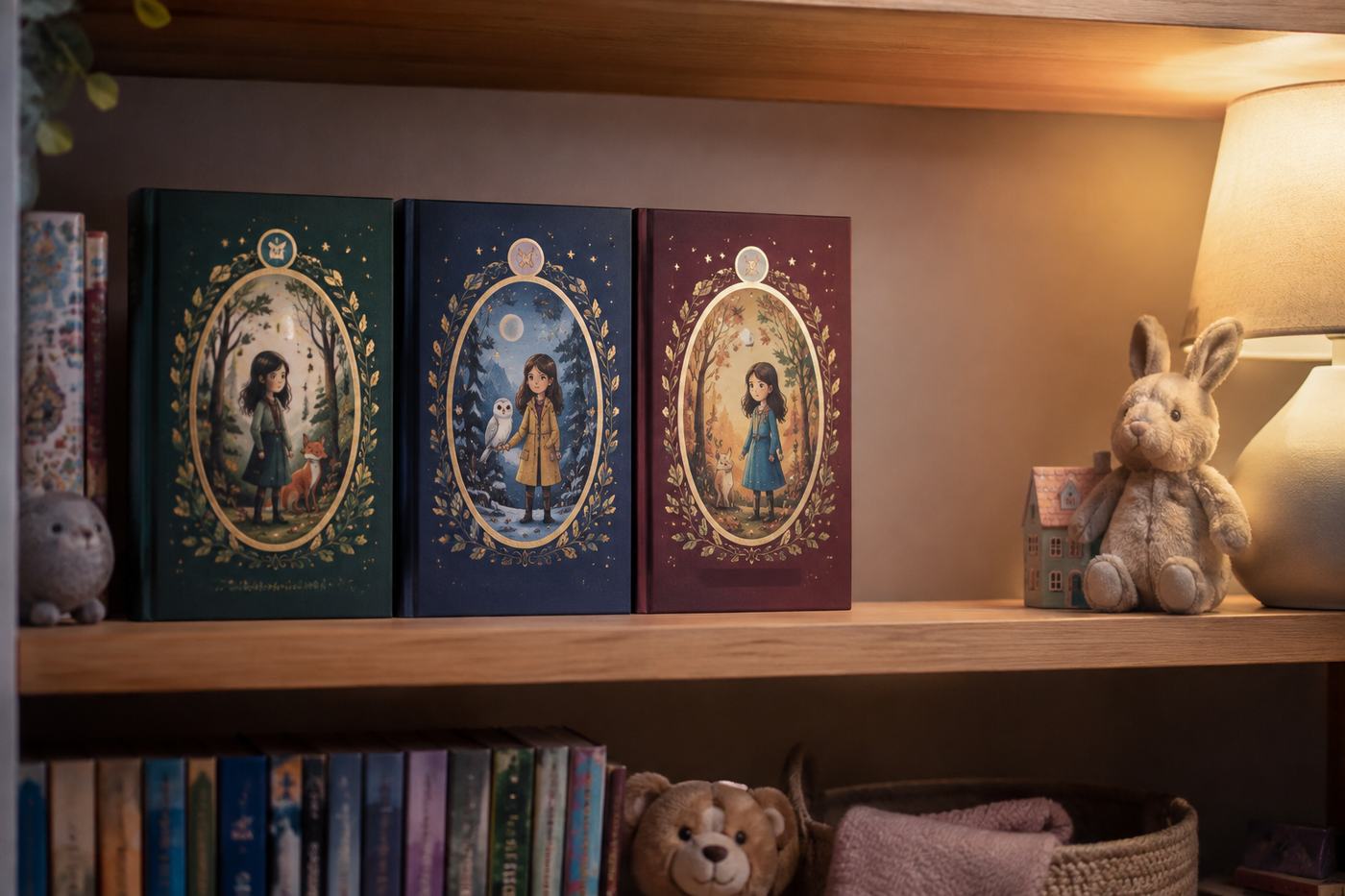
Publishing works like any kids' book: print-ready PDF or EPUB to KDP with the AI disclosure answered honestly, or digital editions on Etsy and Gumroad.
From one sentence to book one of a series: a worked example
The prompt (built the way our outline thinking teaches): "Book one of a series for a 9-year-old: twins find a door in the library that opens somewhere different every chapter." Here is what the engine does with it. The arc gets planned first: the door discovered (setup), the rule learned the hard way (every visit costs something small), the complication (the door starts appearing at school), the low point (one twin trapped as it closes), the turn and the rescue, and an ending that resolves this book while leaving the door, importantly, still there. Eight short chapters, each one complete enough to be a proud stopping point.
The writing lands at the 9-year-old setting: sentences with room to breathe, a running joke that compounds (the library cat is unimpressed by every world), vocabulary that stretches without stalling. Continuity rides forward chapter to chapter, so the flashlight borrowed in chapter two is the flashlight that matters in chapter six.
Then the series moves: a cover designed to become a numbered set, a title shaped for sequels ("The Library Door: The Winter World" writes itself, though the title generator will argue alternatives), and when book one lands with its reader, the series tool expands the premise with the same cast. Total human input for book one: the sentence above, an evening of reading and edits, and the fun argument about what is behind the door in book two.
Chapter book prompts that hook readers-alone
The formula for this age: a hero their age, a mission with stakes they feel, and something funny that repeats. Copy and adapt:
"A chapter book for a 7-year-old: Maya and her robot dog investigate why every left shoe in town is going missing."
Mystery + absurdity: the reliable engine of first chapter books (and of stories generally).
"For an 8-year-old who loves football: Sam is the smallest player on the team the season the goalkeeper moves away."
Their hobby + an underdog arc: instant identification.
"A funny school story for ages 6 to 9: the class hamster is definitely, probably, almost certainly a secret agent."
School settings sell to this age because school is their whole world.
"Book one of a series for a 9-year-old: twins find a door in the library that opens somewhere different every chapter."
Built for sequels: the premise IS the series engine.
Younger reader? The same one-line format works in the storybook generator and picture book maker.
Who makes chapter books, and why
Parents of reluctant readers
The kid who "hates reading" usually hates the available books (a pattern first-time authors in our community mention constantly). A story starring them, their dog, and their obsession converts more readers than any reading chart. Editable text means you can tune difficulty page by page.
Teachers and tutors
Decodable-friendly stories on the exact theme a class is studying, at the exact level a reading group needs, with the class's names in it if you like. Print a set, done by Monday; pairs naturally with the lesson plan generator.
KDP publishers
Early-reader shelves are series territory with loyal repeat buyers. One validated premise, consistent covers, and a book-a-month cadence is a real catalogue strategy at this production cost; the publishing path is mapped for Kindle publishers.
Chapter book generator FAQ
What is a chapter book, exactly?
A chapter book is the format between picture books and middle grade: written for roughly ages 6 to 10, divided into short chapters a newly independent reader can finish in one sitting, with simple vocabulary, a fast-moving plot, and only occasional illustrations. It is the format of a child's first 'real book with chapters', which is why the category has such loyal readers.
What does an AI chapter book generator do?
It writes a complete chapter book from your idea: a story arc planned across short chapters, age-banded vocabulary and sentence length, characters kept consistent from chapter to chapter, and a warm, resolved ending. Inkfluence AI generates the whole book from one prompt, then lets you edit every line, design a cover, and export print-ready PDF and EPUB.
How long should a chapter book be?
Typical published chapter books run short chapters a young reader can finish in a sitting, with total lengths well below middle-grade novels. Inkfluence defaults to around 8 short chapters at a few hundred words each for this age band, and you control the chapter count with a slider.
How is this different from a picture book generator?
A picture book is 14 or so illustrated spreads with a few read-aloud lines each, written for an adult to read TO a child. A chapter book is written for the child to read alone: more words, fewer pictures, short chapters as the pacing unit. Inkfluence has dedicated modes for both, so pick the one matching the reader's age.
Can I add illustrations to a chapter book?
Yes. Chapter books traditionally have occasional spot illustrations, and you can generate an image inside any chapter, in a consistent style across the book. It stays a text-first format though; if you want a picture on every page, that is picture-book mode.
Can it write a series?
Yes, and series are how chapter books actually succeed: young readers who finish book one demand book two. Keep the same character descriptions in your prompts, or duplicate the first book as a starting point, and expand a book into a series with the series tool.
What reading levels does it target?
Describe the reader's age ('for a 7-year-old reading alone') and the vocabulary, sentence rhythm, and chapter length adapt. The kids' writing engine spans toddler read-alouds through confident readers around age ten.
Is it free to try?
Yes: the free plan writes 5 chapters (plus 5 more monthly) with no card, which is most of the way through a first draft. Full commercial rights on every plan. The honest free-tier breakdown is on our free children's book generator page.
Can I publish it on Amazon KDP?
Yes. Export a print-ready PDF or EPUB and publish; chapter books are a busy KDP category with dedicated early-reader shelves. Amazon requires AI-content disclosure during setup, a form answer that does not block publishing.
Can my child be the main character?
Yes, and for this age band it is magic: a 7-year-old reading a chapter book where the hero has their name, their dog, and their exact bike is a 7-year-old who finishes books. Describe them in the idea and the story builds around them.
How does it keep the story consistent between chapters?
Fiction generates sequentially with continuity carried forward: what happened, who knows what, and what was promised to the reader. Chapter five remembers chapter two, which is exactly what chat-window generation loses.
Can teachers use it for classroom reading?
Yes, and many do: stories on the exact theme a class is studying, at the level a reading group needs, with editable text for tuning difficulty. Print a set or share the PDF; you own the rights on every plan.
What makes a chapter book different from an early reader?
Early readers (roughly 5-7) use controlled vocabulary, large type, and pictures on most pages, with an adult nearby. Chapter books (6-10) are the next rung: full pages of text in short chapters, occasional art, read alone. The generator writes both; the age you give it picks the rung.
Can I get an audiobook of the chapter book?
Yes. Any finished book can become an audiobook with 49 narrator voices, which for this age doubles as read-along support: the child follows the text while the narration carries them past hard words.
Related tools and guides
AI Picture Book Maker
One rung down the ladder: illustrated books for ages 2-8.
AI Storybook Generator
Bedtime storybooks with your child as the hero.
Free AI Children's Book Generator
The honest free-tier breakdown: 5 chapters covers most of a first chapter book.
How to Write a Children's Book
The full craft guide across every age band.
AI Story Writer
The general story engine behind it all.
Best AI Children's Book Creators
The 2026 comparison across 11 tools.
Their first "I read it myself" book
Short chapters, the right words for their age, and a hero who might just share their name. Free to start.
Write a Chapter Book