
We Analyzed 47,424 AI-Generated Books: What People Actually Create in 2026
A first-party look at 47,424 books written with AI. Practical guides lead, fiction is the single biggest genre, romance is the breakout, one in six books is not in English, and PDF dominates exports. Here is what people really make with AI.
Updated figures are available. This analysis covered 47,424 books and is kept as published in June 2026. The corpus has since passed 100,000. The current counts, recounted on 15 September 2026 across 102,854 books and now including median length and completion rate for nineteen genres, are on AI Book Writing Statistics 2026.
Quick Answer
Across 47,424 books written with Inkfluence AI, practical how-to guides are the most common type, but fiction is the single largest genre at roughly one in six books. Self-improvement (personal development, workbooks, health) is the next big block, romance is the standout fiction category, and one in six books is written in a language other than English. When people export, PDF wins by a wide margin. In short: people use AI far more for useful, finishable non-fiction and genre fiction than for the literary novel most headlines imagine.
Everyone has an opinion about what AI is doing to books. Far fewer people have looked at what folks actually create when you hand them a capable writing tool and get out of the way. We did, across 47,424 real books.
This is first-party data: every number below comes from books made on Inkfluence AI, not a survey or a press estimate. It is one of the larger public windows into what people make with an AI ebook generator rather than what they say they would make. The headline is simple: the reality is more practical, more global, and more genre-driven than the "robots writing novels" story suggests. It is aggregate data only, with nothing that identifies any individual writer or their content.
AI book creation by the numbers
47,424
books written with Inkfluence AI analysed
~1 in 6
books is fiction, the single largest genre
Romance
the biggest fiction sub-genre
~1 in 6
books written in a language other than English
~89%
of exported books are saved as PDF
42%
of all books are exported at least once
Direct answers about what people write with AI
What do people write most with AI?
Practical how-to guides are the most common single book type on Inkfluence AI, followed closely by fiction. Useful non-fiction (guides, personal development, business, health) makes up the majority of all books created.
Do people write fiction with AI?
Yes, a lot. Fiction is the single largest genre at roughly one in six of all 47,424 books, and romance is the biggest fiction sub-genre. Most are chapter-by-chapter stories built with an AI novel writer, not one-off short pieces.
Is AI book writing only in English?
No. About one in six books on Inkfluence AI is written in a language other than English, led by French, Spanish, Portuguese, and Arabic. AI book creation is a global behaviour, not an English-only one.
What format do people export AI books to?
PDF dominates. Of books exported with Inkfluence AI, PDF accounts for far more than DOCX and EPUB combined, because most people want a finished, shareable document they can sell, print, or hand out.
Is most AI book creation fiction or non-fiction?
Non-fiction overall. Once you add guides, personal development, business, health, cookbooks, workbooks, and study guides together, useful non-fiction outweighs fiction on Inkfluence AI, even though fiction is the single largest individual genre.
Do people actually finish AI books?
About two in five books are exported at least once. Many more stay in progress, because writing with Inkfluence AI is iterative: people draft, edit, and remix before committing to a final file.
What people write: the genre breakdown
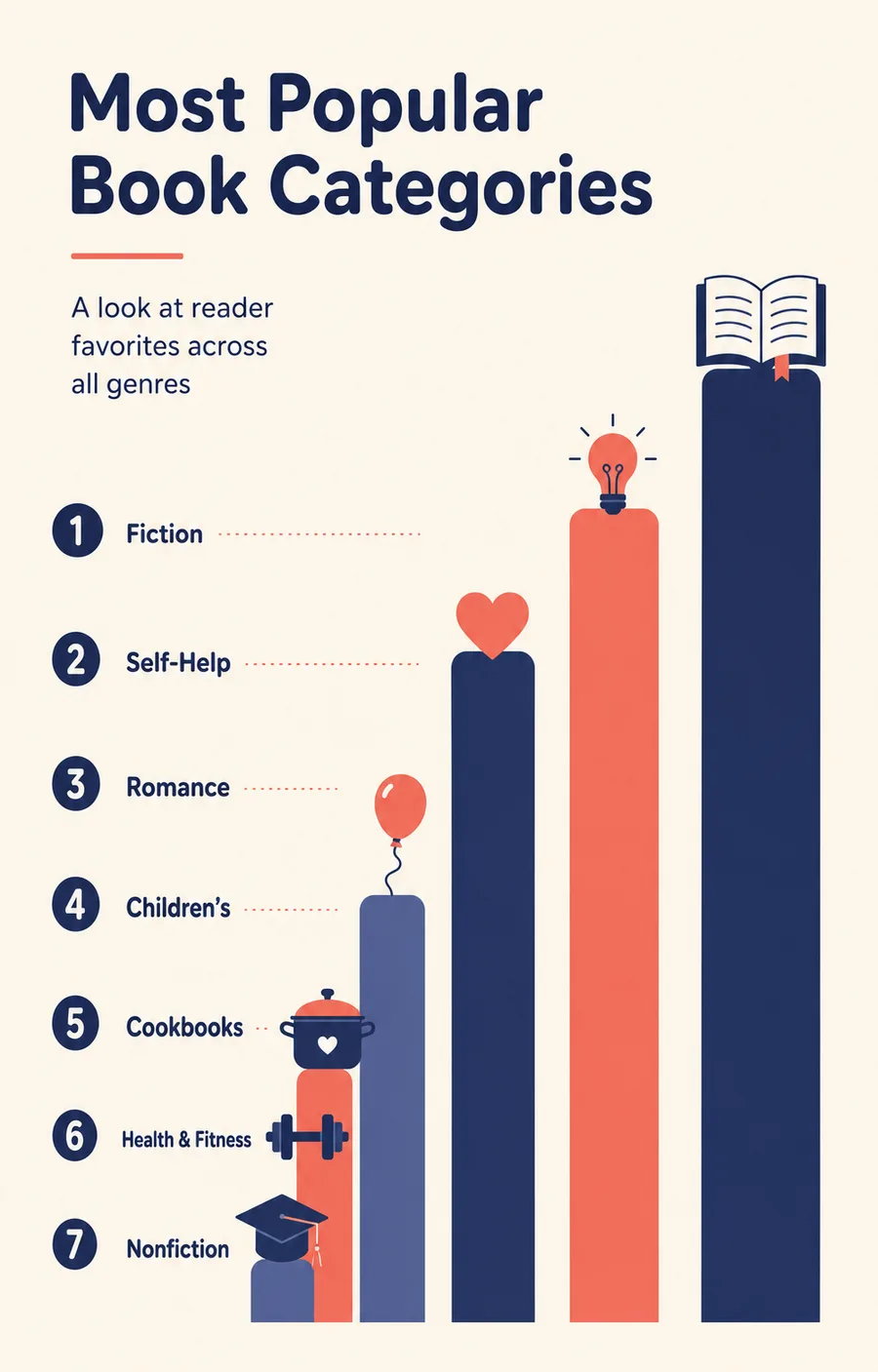
Here is the distribution of the most common book types across all 47,424 projects. Practical and self-improvement non-fiction leads, but fiction is right behind it and is the largest single creative category.
| # | Book type | Category | Share |
|---|---|---|---|
| 1 | How-to / practical guide | Non-fiction | 18.4% |
| 2 | Fiction (chaptered) | Fiction | 16.5% |
| 3 | Personal development | Self-help | 7.3% |
| 4 | Romance novel | Fiction | 5.7% |
| 5 | Exploratory non-fiction | Non-fiction | 3.8% |
| 6 | Workbook | Practical | 3.1% |
| 7 | Children's fiction | Fiction | 3.1% |
| 8 | Recipe book / cookbook | Practical | 3.0% |
| 9 | Health guide | Non-fiction | 2.9% |
| 10 | Study guide | Education | 2.8% |
| 11 | Religious / devotional | Non-fiction | 2.3% |
| 12 | Biography | Non-fiction | 1.3% |
Fiction is bigger than people think
The tidy narrative is that AI is for cranking out non-fiction filler while real authors guard the novel. The data disagrees. Group the creative categories together and fiction is the single largest genre, roughly one in six of every book made. People are clearly comfortable using an AI novel writer for full, chaptered stories, not just outlines or scene fragments.
Romance is the breakout. As a standalone category it is the largest fiction sub-genre, which matches the wider publishing world, where romance has long been the best-selling and most prolific fiction market. If you write in that space, a dedicated AI romance novel writer handles the beats and relationship arcs that the genre lives on. Children's fiction is the other surprise in the top ten: parents, teachers, and first-time authors use AI to create illustrated stories for a specific kid, something that was effectively impossible to commission before. If you want a sense of what sells, our guide to ebook ideas that sell in 2026 lines up well with what people are already writing.
What ties the fiction numbers together is length. The dominant fiction type is chaptered, multi-part work, not the single short story you might expect people to dash off for fun. That is a meaningful signal, because the hard part of fiction has never been writing one good scene, it is sustaining character, tone, and plot across dozens of chapters without contradicting yourself. The fact that so many writers are completing long-form fiction with AI says the tooling has crossed a threshold: continuity tracking and chapter-aware generation now hold a story together well enough that finishing a novel feels achievable rather than aspirational. That single shift, from "AI helps me brainstorm" to "AI helps me finish," is what the genre data is really measuring.
The self-improvement engine
Behind the practical-guide lead sits a clear theme: people use AI to build things that help them or their audience do something. Personal development, workbooks, health guides, study guides, and day-by-day challenges together form a huge block of activity. These are not vanity projects. A workbook with exercises or a study guide with practice questions is a tool, and the workbook generator and study guide generator exist precisely because that structure is hard to write by hand.
The same instinct shows up in teaching and food. Educators lean on the lesson plan generator to turn a topic into a teachable sequence, and home cooks and creators use the cookbook generator to assemble recipe collections worth keeping. The common thread across all of it is finishability: people reach for AI most when a book has a clear structure that is tedious to produce manually, and they want it done well, fast.
AI book writing is global
About one in six books is written in a language other than English. After English, the most common languages are French, Spanish, Portuguese, and Arabic, with a long multilingual tail behind them. That share is higher than what you see if you only look at the books people choose to publish publicly, which skew English. In other words, AI is quietly lowering the barrier to writing a book in your own language, in places where local-language publishing tools have always been thin. A capable AI book writer that handles non-English drafting is a bigger deal abroad than most English-language coverage notices.
The makeup of that international slice is telling too. The leading non-English languages are not a random spread, they track large, fast-growing creator economies: French and Spanish across Europe and the Americas, Portuguese driven heavily by Brazil, and Arabic across the Middle East and North Africa. These are markets where demand for digital books and courses is rising quickly but where polished local-language authoring software has lagged. For a creator in those regions, the difference between "I have an idea for a book" and "I have a finished book" used to be a translator, an editor, and a formatter. Compressing that into a single tool changes who gets to publish at all, and the data suggests people are already taking the opportunity.
How people finish and export
Roughly two in five books are exported at least once, and when they are, PDF is the runaway choice, accounting for far more exports than DOCX and EPUB put together. That tells you what people want at the finish line: a clean, shareable, printable document they can sell, hand to a client, or upload, which is exactly what the PDF generator produces with a linked table of contents and proper formatting.
The flip side is just as interesting: the majority of books are not exported, at least not yet. A lot of creation is iterative. People draft, remix, and revise inside the tool before committing to a final file, which fits the picture of AI as a working surface rather than a one-shot vending machine. If your aim is a sellable product, our roundup of the best free AI book writing tools covers which ones actually export something you can publish.
What it means if you want to write one
Three practical takeaways fall out of the data. First, the easiest wins are structured non-fiction: a how-to guide, workbook, or study guide in a topic you already know plays directly to AI's strengths and to what readers buy. Second, genre fiction is wide open, romance and children's stories especially, and a chaptered tool handles continuity far better than a chat assistant. Third, do not assume English. If your audience speaks another language, that is an under-served market and the same tools work.
If you are starting from zero, the free AI book writer lets you draft a first book without committing anything, and the broader question of whether AI can carry a full-length story is covered in can AI write a novel.
Key takeaways
- Practical, structured non-fiction is the most common and easiest thing to make with AI, and the easiest to sell.
- Fiction is bigger than the headlines suggest, the single largest genre, with romance leading and children's books a surprise top-ten entry.
- One in six books is written in a language other than English, so the opportunity is global, not English-only.
- PDF dominates exports, which means most people want a finished, sellable document rather than a reflowable e-reader file.
- Most creation is iterative: people draft and revise inside the tool, so AI reads as a co-writing surface, not a one-click factory.
Methodology
We analysed 47,424 books created with Inkfluence AI as of June 2026. Genre figures use the structured content type assigned to each book; the freeform category labels tell the same story. Language is detected per book, export format reflects the last format a book was exported to, and counts are by distinct project, not chapters or words. Numbers are a snapshot and will shift as more books are written. This is aggregate data only: no private content, account details, or personal information is included, and nothing identifies an individual writer.
Frequently asked questions
What do people write most often with AI?
Practical how-to guides are the most common single book type, followed closely by fiction. Grouped together, useful non-fiction (guides, personal development, business, health, study guides) makes up the majority of the 47,424 books in our data.
Is fiction popular for AI writing?
Yes. Fiction is the single largest genre at roughly one in six books, and most are full chaptered stories rather than short fragments. A continuity-aware AI novel writer is what makes multi-chapter fiction practical.
What is the most popular fiction genre for AI?
Romance is the largest fiction sub-genre in our data, mirroring its dominance in mainstream publishing. The AI romance novel writer is built around the beats and relationship arcs the genre depends on.
Do people write non-English books with AI?
Yes. About one in six books on Inkfluence AI is written in a language other than English, led by French, Spanish, Portuguese, and Arabic. AI book creation is a global behaviour.
What format do people export AI books to most?
PDF by a wide margin. Of all exports, PDF far outnumbers DOCX and EPUB combined, because people want a finished, printable, shareable file. The PDF generator produces one with a linked contents page.
How many AI books actually get finished?
Roughly two in five books are exported at least once. The rest stay in progress, which reflects how iterative AI writing is: people draft and revise inside the tool before committing to a final file.
What is the easiest type of book to write with AI?
Structured non-fiction is the easiest win: a how-to guide, workbook, or study guide on a topic you already know. The clear structure plays to AI's strengths and matches what readers buy.
Can AI write a full-length book, not just an outline?
Yes. The data shows most projects are full chaptered books, not outlines. Tools that generate complete chapters from an outline, like the AI book writer, are what made that normal.
Are AI cookbooks and children's books common?
Surprisingly so. Recipe books and children's fiction both rank in the top ten book types. The cookbook generator and children's book creator exist because those formats are tedious to build by hand.
Is AI replacing authors?
The data suggests augmentation more than replacement. People use AI to finish books they would otherwise abandon, and the heavy use of editing, remixing, and revising inside the tool points to a co-writing workflow rather than a one-click factory.
What sells best among AI-created books?
Our data covers what people create, not sales, but the heavy lean toward practical guides, self-help, and romance lines up with the best-selling categories in self-publishing. See ebook ideas that sell in 2026 for the demand side.
Where can I see what fanfiction writers create with AI?
We broke that out separately in what 2,200 AI fanfiction writers actually write about, with the full ranked list of the most popular fandoms.
Related guides

Founder, Inkfluence AI
Sam is the founder of Inkfluence AI. He built the platform to make book creation accessible to everyone - from first-time authors to seasoned publishers.
Helpful links
Ready to Create Your Own Ebook?
Start writing with AI-powered tools, professional templates, and multi-format export.
Get Started FreeRelated Articles
 AI Writing
 Best AI for Editing a Book (2026): 9 Tools Compared by Editing Job
Which AI should edit your manuscript? We compare ProWritingAid, Grammarly, AutoCrit, Sudowrite, Novelcrafter, ChatGPT, Claude, the free checks in Google Docs and Word, and Inkfluence AI by the job each does best: grammar, line editing, story feedback, or editing and publishing in one place. Prices checked 2 October 2026.
 Self-Publishing
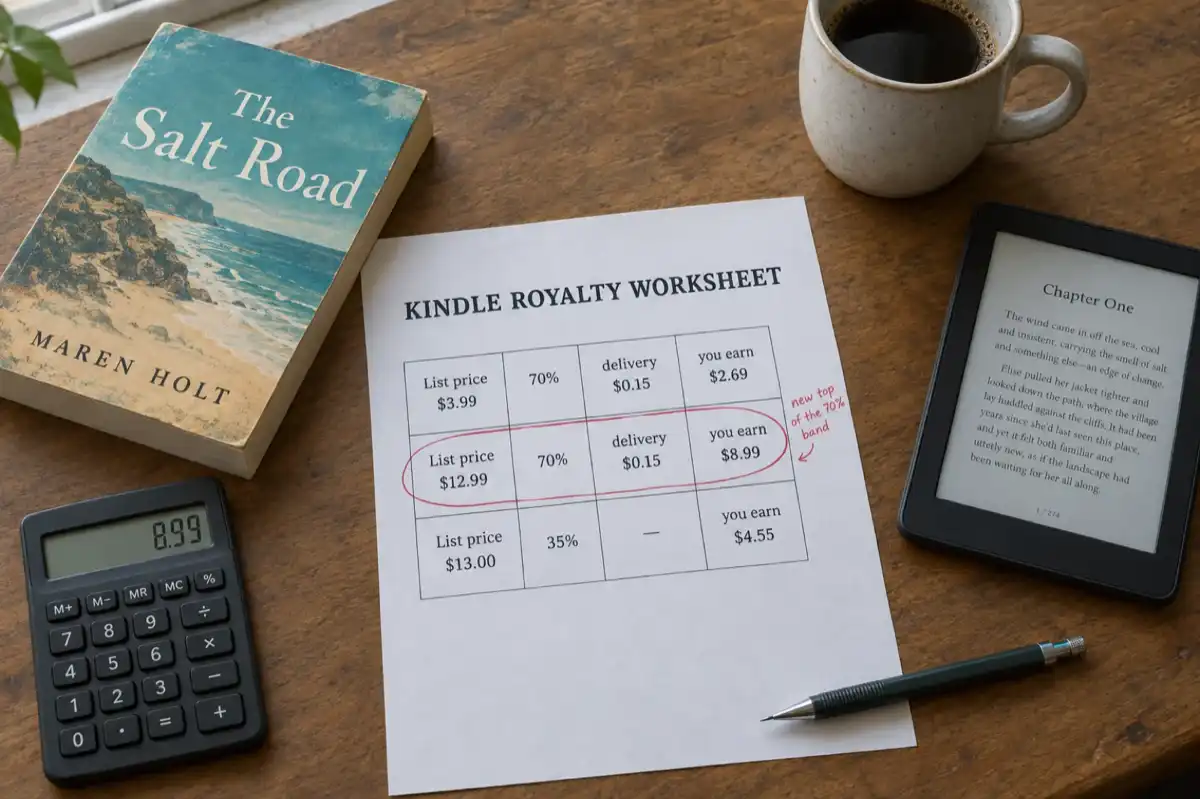
 KDP Royalties 2026: The 70% Band Now Runs to $12.99
Since 7 July 2026 Amazon KDP pays 70% on Kindle ebooks priced from $2.99 to $12.99, up from $9.99. What the change means for your price, how the delivery charge and the $13 cliff work, and what paperbacks, hardcovers and Kindle Unlimited pay, with worked examples.
 Guides
 Selling AI Coloring Books on Amazon KDP: The 2026 Rules, Specs, and Math
Are AI coloring books allowed on KDP? Yes, with disclosure. The part nobody covers: the AI workflow that passes review, style consistency across 30 pages, the interior specs that cause rejections, and the royalty ladder that decides your price.
Get ebook tips in your inbox
Join creators getting weekly strategies for writing, marketing, and selling ebooks.