
Best Book Affiliate Programs in 2026: Rates, Cookies, and What Actually Pays
Eight book and ebook affiliate programs compared on the numbers that matter: commission rate, cookie window, and whether the payout recurs. Amazon pays 4.5% once; the best book-adjacent programs pay 25-50% recurring.

Quick Answer
The best book affiliate program depends on what your audience does with books. For audiences that read: Bookshop.org pays 10-15% per sale and Amazon Associates pays 4.5% with a 24-hour cookie. For audiences that write and publish: book-creation software pays far more, because subscriptions recur. Inkfluence AI's affiliate program pays 30% recurring for 12 months with a 30-day cookie, Kit pays 50% in year one, and Sudowrite pays 25% recurring. One referred software subscriber typically out-earns dozens of one-time book sales.
Most "book affiliate program" lists rank retailers. That misses the structural point: a book is a $15-$25 one-time purchase paying a single-digit percentage once, while the tools people use to write and publish books are subscriptions paying 25-50% every month. This guide covers both sides honestly, with verified rates and cookie windows, so you can match the program to what your audience actually does with books.
The Eight Programs, Compared
| Program | Commission | Recurring? | Cookie | Best for |
|---|---|---|---|---|
| Inkfluence AI | 30% | Yes, 12 months | 30 days | Audiences who write, self-publish, or sell ebooks |
| Kit (ConvertKit) | 50% year one, then tiered | Yes | 90 days | Author-newsletter and creator audiences |
| Sudowrite | 25% | Yes, 12 months | 30 days | Fiction-writer audiences |
| Bookshop.org | 10% (15% enhanced) | One-time | Session-based | Reader audiences who support indie bookstores |
| Audible (via Amazon) | $5 trial / $10 membership bounty | One-time bounty | 24 hours | Audiobook-listener audiences |
| Libro.fm | 10% per sale, 30% new memberships | One-time | 30 days | Audiobook listeners who prefer indie bookstores |
| Barnes & Noble | 5% | One-time | 1 day | US reader audiences loyal to B&N |
| Amazon Associates (books) | 4.5% | One-time | 24 hours | High-volume review sites |
Rates verified August 2026 against each program's published terms. Programs change terms; always confirm on the official page before applying.
1. Inkfluence AI: Best for Audiences Who Write Books
If your audience includes indie authors, self-publishers, coaches, or anyone selling ebooks and lead magnets, an AI ebook affiliate program pays on a different scale than book retail. Inkfluence AI pays 30% recurring commission on every payment a referred customer makes for up to 12 months, with a 30-day cookie, monthly PayPal payouts, and a $25 minimum. The product converts because it covers the whole workflow: writing, cover design, audiobook narration with 49 voices, and KDP-ready export. Dedicated playbooks exist for bloggers, YouTubers, podcasters, and newsletter creators.
- Commission:30% of every payment for up to 12 months
- Cookie:30 days
- Payout:Monthly via PayPal, $25 minimum
- Approval:Fast; no minimum audience size
- Refund handling:Commission claws back only if the customer refunds inside Stripe's 60-day window; locked after that
Two things make this program convert beyond the rate. First, the product has a real free tier (5 chapters plus 5 more monthly, no credit card), so your link asks readers to try something, not buy something; the commission arrives when they upgrade. Second, the audience match is unusually wide: the same link works in content about writing a first book, building a lead magnet, self-publishing on KDP, or turning a book into an audiobook, because the product covers that whole span.
Verdict: the highest-leverage pick on this list for any audience that writes, publishes, or sells books; the recurring structure does the compounding for you.
2. Kit: Best for Author-Newsletter Audiences
Kit (formerly ConvertKit) is the email platform of choice for authors building a reader list, and its affiliate terms are among the most generous in SaaS: 50% commission for the first 12 months, tiered recurring rates after that, and a 90-day cookie. It is not a book product, but every serious author audience overlaps with it, which makes it a natural second program to run alongside a book-tool program rather than instead of one.
- Commission:50% for the customer's first 12 months, then tiered recurring (10-20%) at Bronze/Silver/Gold status
- Cookie:90 days
- Payout:Monthly
- Approval:Open program; audience quality matters more than size
The 90-day cookie deserves more attention than the headline rate: for evergreen content, it roughly triples the window in which your influence still pays compared to a standard 30-day program, and it is nine times Amazon's. If you publish author-platform content (email list building, launch strategy, reader magnets), Kit converts on posts that are years old.
Verdict: the strongest raw numbers in this comparison; run it alongside a book-tool program, not instead of one.
3. Sudowrite: Best for Fiction-Writer Audiences
Sudowrite pays 25% recurring for 12 months through Rewardful with a 30-day cookie. Its audience fit is narrower than a general book tool (literary and genre fiction writers who care about prose craft), but within that niche it converts well. If your content is fiction-craft focused, it belongs in your mix; our AI writing affiliate program comparison covers where it ranks against seven other tool programs.
- Commission:25% recurring for up to 12 months per customer
- Cookie:30 days
- Payout:Via Rewardful
- Approval:Open signup through their Rewardful page
Verdict: the right second program for fiction-craft channels; too narrow to be the anchor.
4. Bookshop.org: Best for Reader Audiences
Bookshop.org pays 10% per sale, with up to 15% for affiliates in its enhanced program, and the purchase supports independent bookstores, which matters to a lot of reader audiences and can lift click-through on its own. The payout is one-time, and books are low-ticket, so this is a volume play: it suits book-review sites, BookTok-adjacent blogs, and reading-list newsletters rather than author-focused channels.
- Commission:10% per sale; up to 15% in the enhanced shared-revenue program
- Cookie:Session-based on standard links
- Payout:Regular payouts once approved
- Approval:Open to creators; bookstores get a separate, richer tier
The under-used feature is the custom shop page: you can build themed booklists (every book you have reviewed, a genre starter kit, a "books that made me a better writer" list) and earn on anything bought from the page. For creators with deep back-catalogues of book content, one well-linked shop page out-earns scattered individual links.
Verdict: the best retail option for reader audiences, and the indie-bookstore story lifts click-through on its own.
5. Audible: Best for Audiobook-Listener Audiences
Audible pays flat bounties through Amazon Associates: typically $5 for a trial signup and $10 for a paid membership. Bounties beat 4.5% book commissions per conversion, but they are one-time, and the 24-hour cookie applies. Worth running if your audience listens; if your audience makes audiobooks, tool programs pay more (and our own program covers audiobook creation as part of the same referral).
- Commission:Flat bounty, typically $5 per free trial and $10 per paid membership
- Cookie:24 hours
- Payout:Through Amazon Associates
- Approval:Requires an approved Amazon Associates account
Verdict: worth adding for listener audiences; bounties beat book percentages per conversion but pay once.
6. Libro.fm: The Indie Alternative for Audiobook Audiences
Libro.fm is to Audible what Bookshop.org is to Amazon: the same catalogue category, with profits shared with independent bookstores. The affiliate terms are published plainly on their affiliates page: 10% on audiobook and credit-bundle sales, 30% on new memberships, with a 30-day cookie, which is thirty times Audible's window.
- Commission:10% on audiobooks and credit bundles; 30% on new memberships
- Cookie:30 days
- Payout:Via their affiliate platform
- Approval:Application reviewed; content creators and bookish accounts accepted
Verdict: for values-driven listener audiences, the longer cookie and membership rate make this the better audiobook program; Audible wins only on brand recognition.
7. Barnes & Noble: The US Retail Alternative
Barnes & Noble runs its affiliate program at around 5% on books, slightly better than Amazon's 4.5%, with device-accessory commissions running higher. The catch is a 1-day cookie and a US-centric audience. It earns its place for content aimed at readers who deliberately shop B&N (Nook owners, in-store pickup audiences) rather than as anyone's primary program.
- Commission:About 5% on books; up to 10% on device accessories
- Cookie:1 day
- Payout:Via the affiliate network
- Approval:Standard network application
Verdict: a situational add for US reader audiences; the 1-day cookie keeps it from being more.
8. Amazon Associates: The Default, and Why It Underpays
Amazon pays 4.5% on physical books with a 24-hour cookie. A $20 book earns you $0.90, once. The honest case for it: universal trust, everything-in-cart attribution within the window, and no approval friction per book. The honest case against it: it is the lowest rate and shortest window on this list, so it works only at serious traffic volume. Most book bloggers run Amazon links as the baseline and layer a recurring program on top for the audience segment that writes.
- Commission:4.5% on physical books
- Cookie:24 hours (session-extended only if the item is added to cart)
- Payout:Monthly, ~60 days in arrears
- Approval:Easy to join; account closed if no qualifying sales in 180 days
Verdict: keep it as the baseline, never as the strategy.
The Structural Math: One-Time vs Recurring
The rate is not the decision; the structure is. A $20 book at 4.5% pays $0.90 once. A referred software subscriber on a $19.99/mo plan at 30% pays every month they stay subscribed, for up to 12 months. That is why a small author-focused audience routinely out-earns a much larger reader audience in affiliate terms: the reader audience buys books, the author audience buys tools. Our companion piece on why recurring programs win runs the retention math in detail across three scenarios.
Same 1,000 Clicks, Three Very Different Outcomes
To make the structures concrete, take 1,000 clicks from a book-interested audience and run them through each program type with stated assumptions: a 2% purchase rate on retail links, a 2% signup rate on tool links, and referred subscribers staying an average of 6 months. Change the assumptions and the totals move, but the ratios barely do.
| Structure | What 1,000 clicks produce | The math |
|---|---|---|
| Retail (4.5%, one-time) | 20 book sales | 20 x $20 x 4.5% = $18, once |
| Bounty ($10, one-time) | 20 memberships | 20 x $10 = $200, once |
| Recurring (30% of $19.99/mo) | 20 subscribers, 6-month average stay | 20 x $6 x 6 months = $720, arriving month after month |
Same clicks, same conversion rate, a 40x spread between the weakest and strongest structure. This is the whole argument for anchoring on a recurring program and letting retail links play the supporting role.
How Book Affiliate Cookies Actually Work
The cookie window decides how much of your influence you actually get paid for, and the programs above span the whole spectrum. Amazon and Audible attribute for 24 hours after the click: if your reader saves the recommendation for the weekend, you earn nothing. Bookshop.org attributes by shopping session on standard links, so the purchase generally has to happen in the visit you started. The tool programs run 30-day windows, and Kit runs 90, which means a reader who clicks in January and subscribes in March still pays you.
The practical rule: match the cookie to your content type. Social posts and live mentions convert inside 24 hours, so short windows cost them little. Evergreen content (reviews, comparison posts, YouTube tutorials, podcast back-catalogues) keeps sending clicks for months, and most of those visitors do not buy on the first visit. The longer the shelf life of your content, the more a short cookie quietly taxes you, and the stronger the case for anchoring on a 30-plus-day program.
Disclosure: The One Rule Every Program Shares
Every program on this list requires you to disclose the affiliate relationship, and in the US the FTC requires it regardless of what the program says: disclosures must be clear, conspicuous, and placed before the link, not buried in a footer. The FTC's Disclosures 101 guide is short and worth reading once. A single plain sentence ("I earn a commission if you buy through links on this page") satisfies both regulators and readers, and disclosed links convert essentially the same as undisclosed ones; trust compounds the same way commissions do.
The Content That Actually Converts for Book Programs
Program choice sets the ceiling; content format sets how close you get to it. Four formats do most of the earning in this niche:
- The honest review. One tool or retailer, used for a real project, with what worked and what did not. Highest trust per visitor, and the format AI search engines quote most often when they answer "is X worth it" questions.
- The versus post. Two programs or tools your audience is already torn between. Buyers at this stage are one click from converting, which is why comparison posts out-earn broader listicles per visitor.
- The resource page. A "tools and books I recommend" page linked from every post and your bio. Low effort, compounds forever, and long cookies make it disproportionately valuable.
- The tutorial. "How I wrote and published an ebook in a weekend" with the tool linked in context. The recommendation is embedded in proof, not asserted, so it converts without selling.
Whatever the format, the disclosure sentence goes at the top, and the link goes where the reader has just seen the reason to click.
How to Choose (and Combine) Programs
- Audience reads books: Bookshop.org first (rate + values story), Amazon as the fallback for titles Bookshop lacks.
- Audience listens: Audible bounties, plus a tool program if any of them create.
- Audience writes or self-publishes: a recurring ebook-tool program as the anchor (this is where an ai ebook affiliate setup earns its keep), Kit for the newsletter layer, Amazon links only where a physical book genuinely fits the content.
- Mixed audience: run one program per intent. The mistake is running only Amazon because it is familiar; the 24-hour cookie quietly discards most of your influence.
Promote a Tool Your Audience Will Actually Keep
The Inkfluence AI affiliate program pays 30% recurring for 12 months with a 30-day cookie and monthly payouts. Approval is fast, and there are ready-made playbooks for blogs, YouTube, newsletters, and podcasts.
Frequently Asked Questions
What is the best book affiliate program overall?
For reader audiences, Bookshop.org: 10-15% per sale beats Amazon's 4.5% and the indie-bookstore angle converts. For author and self-publishing audiences, recurring tool programs pay on a different scale: Inkfluence AI at 30% recurring for 12 months, Kit at 50% in year one, Sudowrite at 25% recurring. Match the program to what your audience does with books.
How much does Amazon pay for book affiliate sales?
4.5% on physical books, with a 24-hour cookie. A $20 book pays $0.90. Anything else the visitor buys inside the 24-hour window is also commissioned, which is where most Amazon book-affiliate income actually comes from.
Is there a good ebook affiliate program?
Ebook retail programs are scarce because most ebooks sell through Amazon at low rates. The stronger play for ebook-focused audiences is the creation side: Inkfluence AI's program pays 30% recurring on the tool people use to write, format, and sell their own ebooks, with a 30-day cookie and monthly payouts. Details and signup at the affiliate program page.
Do book affiliate programs pay recurring commission?
Retailers (Amazon, Bookshop.org) pay one-time, because books are one-time purchases. Recurring commission comes from subscription products in the book world: writing software, email platforms, and audiobook services. That structural difference, not the headline rate, decides lifetime earnings per referral.
Which book affiliate program has the longest cookie?
Kit at 90 days, then the 30-day group (Inkfluence AI, Sudowrite, Libro.fm). Amazon and Audible run 24 hours, Barnes & Noble one day, and Bookshop.org attributes by shopping session. For evergreen content, the cookie window matters more than a point or two of commission, because most readers do not buy on the visit where they click.
What are the best affiliate programs for authors specifically?
Authors recommending to other authors convert best on the tools they visibly use: a book-writing platform (Inkfluence AI, 30% recurring), an email platform (Kit, 50% year one), and optionally a craft tool for fiction audiences (Sudowrite, 25%). Retail programs fit author audiences poorly; writers buy fewer books through links than readers do, but they subscribe to tools for years.
Is Libro.fm or Audible better for affiliates?
On the terms, Libro.fm: 30% on new memberships against Audible's flat $10 bounty, and a 30-day cookie against 24 hours. Audible wins on brand recognition and conversion friction (many listeners already have Amazon accounts). If your audience skews indie-bookstore or values-driven, Libro.fm; if it is a mainstream podcast audience, Audible's familiarity usually nets out ahead.
Do I need a website to join these programs?
No. Every program on this list accepts creators on other surfaces: YouTube channels, newsletters, podcasts, and social profiles. What reviewers actually check is whether your audience matches the product and whether your content looks real. A single genuinely useful review or tutorial is a stronger application asset than a thin website.
Can I promote multiple book affiliate programs at once?
Yes, and you usually should: none of these programs are exclusive. The clean pattern is one retail program for reading recommendations and one recurring tool program for creation content, each linked only where the intent matches.
Related Resources

Founder, Inkfluence AI
Sam is the founder of Inkfluence AI. He built the platform to make book creation accessible to everyone - from first-time authors to seasoned publishers.
Helpful links
Ready to Create Your Own Ebook?
Start writing with AI-powered tools, professional templates, and multi-format export.
Get Started FreeRelated Articles
 Publishing
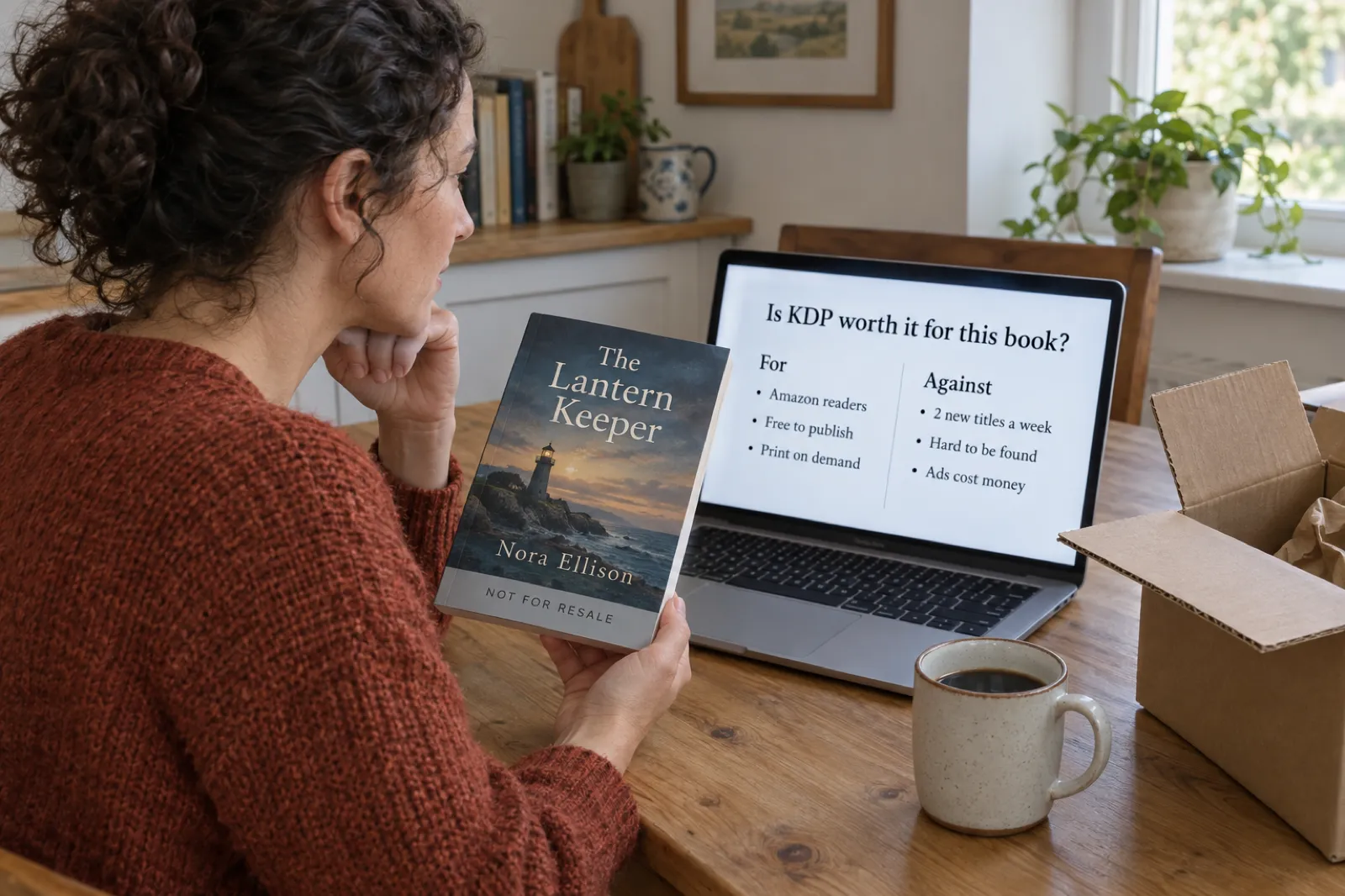
 Is KDP Worth It in 2026? An Honest Verdict by Book Type
A dated verdict for novels, non-fiction, picture books, coloring books, journals and family books: what changed on KDP in 2026, what publishing really costs, what most authors earn, when Etsy, Gumroad or going wide fits better, and a checklist that picks the route for your book.
 Publishing
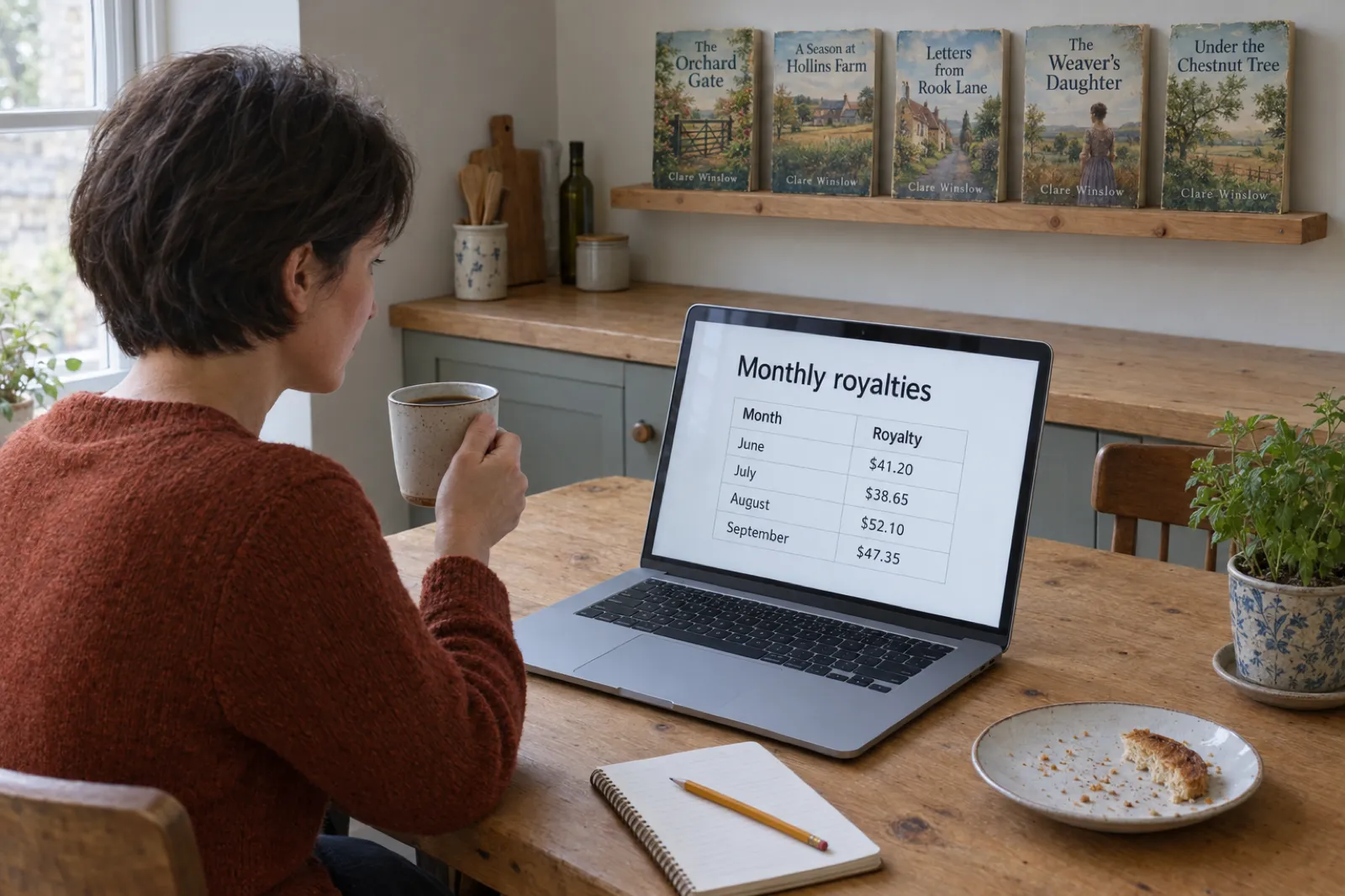
 How Much Do KDP Authors Make? Real 2026 Numbers, by Format and Catalogue Size
Most KDP authors earn under $100 a month and a minority earn a living. The 2026 survey numbers, what one copy earns in each format under KDP's new rules, why most books sell little, and what changes it, with an estimator for your own catalogue.
 Publishing
 KDP Picture Book Bleed and Canvas Size for Illustrators (8.5 x 8.5, 8 x 10, 8.5 x 11), 2026
The exact KDP page size with bleed, canvas pixels for Procreate, Photoshop and Canva, two-page spread sizes, safe areas and the four-sided bleed mistake, with a free calculator for every picture book trim.
Get ebook tips in your inbox
Join creators getting weekly strategies for writing, marketing, and selling ebooks.