
How to Write a Cookbook with AI
From your favourite recipes to a finished cookbook. AI handles the formatting, chapter structure, and headnotes while you bring the culinary expertise and personal stories.
Quick Answer
To write a cookbook with AI, describe your concept (cuisine, audience, recipe count) in a detailed premise. Inkfluence AI generates a structured outline with chapter groupings, then writes each chapter with formatted recipes including ingredient lists, step-by-step instructions, cooking times, headnotes, and serving sizes. Edit the draft to add your personal stories and food photos, then export as a print-ready PDF or Kindle EPUB. The platform supports all cookbook types: recipe collections, meal prep guides, dietary cookbooks, cultural cuisine, baking books, and family heritage collections. Free to start with 5 chapters.
Searching for how to write a cookbook with AI, AI recipe book creator, or cookbook writing software? This guide covers everything from structuring your recipes to publishing on Amazon KDP.
What Does AI Cookbook Writing Actually Mean?
AI cookbook writing uses artificial intelligence to generate formatted recipes, structure chapters, write headnotes, and produce the supporting text that turns a recipe collection into a proper cookbook. You provide the culinary concept and creative direction. The AI handles the time-consuming formatting work. Tools like Inkfluence AI's cookbook generator are purpose-built for this workflow.
This is not about replacing cooking expertise. The best AI-generated cookbooks start with real culinary knowledge: recipes you have tested, flavour combinations you understand, and cooking techniques you can explain. The AI accelerates the process of turning that knowledge into a structured, publishable book. Think of it as having a sous chef who specialises in book formatting rather than cooking.
A typical workflow looks like this: you write a 2-3 sentence premise describing your cookbook (cuisine, audience, recipe count, chapter themes), the AI generates a structured outline, you edit the outline to match your vision, the AI writes each chapter with formatted recipes and headnotes, and you personalise the draft with your voice, stories, and photos in the built-in editor before exporting.
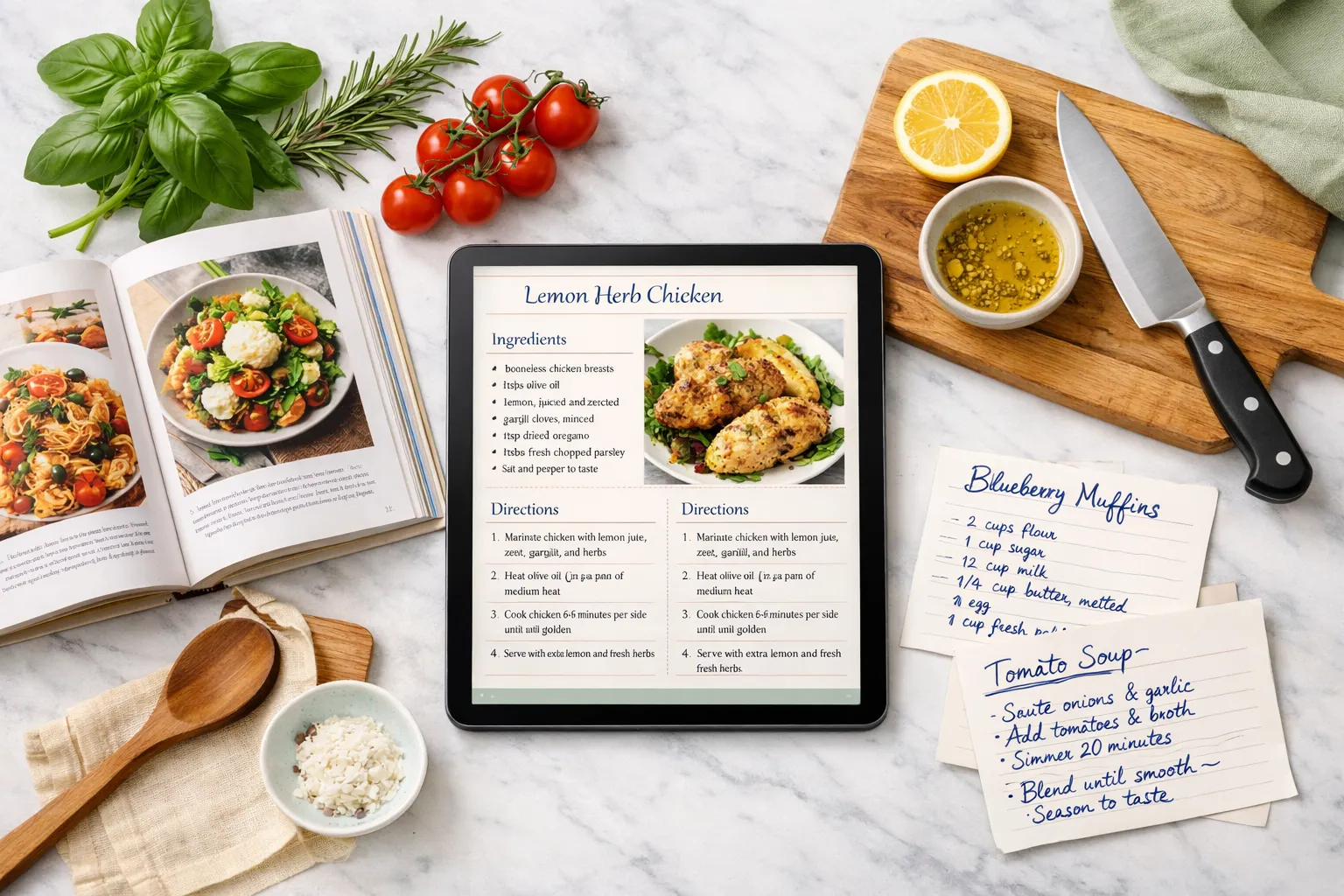
How AI Recipe Formatting Works
AI cookbook generators parse your premise to determine recipe style, then apply standardised formatting to every recipe: title, headnote (1-3 sentences of context or story), ingredient list with measurements, numbered step-by-step instructions, cooking time, prep time, total time, serving size, and optional notes (substitutions, storage, dietary labels). This consistency is the main advantage over manually formatting recipes. A 40-recipe cookbook that would take days to format by hand is structured automatically. The built-in editor lets you adjust any element after generation.
The Cookbook Market in 2026
Cookbooks remain one of the most consistently profitable ebook categories on every platform.
$4.1B
global cookbook and recipe content market (2025)
Top 5
non-fiction KDP category by unit sales year over year
$2.99-$12.99
sweet spot pricing for digital cookbooks on KDP (70% royalty tier)
72%
of cookbook buyers purchase based on niche topic, not author name
Why cookbooks are perfect for AI-assisted writing
Cookbooks follow highly structured, repeatable patterns: recipe title, headnote, ingredient list, step-by-step instructions, cooking time, serving size, and tips. This structure is exactly what AI excels at generating consistently. The AI handles the formatting and organisation while you bring the tested recipes, personal stories, and food photography that make readers buy your book. Combined with AI-generated cover art and one-click PDF export, you can go from recipe collection to published book in a single weekend.
Every Cookbook Type Supported
Your cookbook style is defined by your premise, not your plan. Every format below works on the free tier. See the AI Cookbook Generator tool page for the full feature breakdown.
Recipe Collection
Classic cookbook format with themed recipes, headnotes, and cooking tips organised by chapter.
Meal Prep and Batch Cooking
Weekly prep plans, storage instructions, reheating guides, and shopping lists for busy schedules.
Baking and Pastry
Breads, cakes, pastries, and desserts with precise measurements, technique notes, and troubleshooting tips.
Dietary and Allergen-Free
Gluten-free, dairy-free, keto, paleo, low-FODMAP, and other dietary restriction cookbooks.
Cultural and Regional Cuisine
Italian, Mexican, Thai, Indian, Japanese, or any regional food tradition with authentic recipes and context.
Family and Heritage Recipes
Preserve and share family recipes across generations with stories, origins, and personal memories.
Quick and Easy Weeknight Meals
30-minute dinners, one-pot meals, and simple recipes for time-pressed home cooks.
Seasonal and Holiday Cooking
Recipes organised by season or holiday with menus, timelines, and entertaining tips.
Healthy Eating and Nutrition
Whole-food recipes with nutritional guidance, macro breakdowns, and health-focused meal plans.
BBQ and Grilling
Outdoor cooking recipes with rub recipes, smoking guides, temperature charts, and technique breakdowns.
Plant-Based and Vegan
Entirely plant-based recipes with protein-pairing tips, substitution guides, and nutritional notes.
Entertaining and Party Food
Appetisers, cocktails, dinner party menus, and buffet spreads with timing and prep-ahead notes.
What the AI Generates for Each Recipe
Every recipe in your cookbook includes these elements automatically. Edit, reorder, or remove any of them in the built-in editor.
Specify preferences in your premise: "Include nutritional info and wine pairings for each recipe. Difficulty rating on a 1-5 scale."
The Anatomy of a Recipe Readers Can Actually Cook From
Cookbook buyers judge one thing above all: did the recipe work in my kitchen? Every recipe in your book should carry the same six parts in the same order, because consistency is what makes a collection feel professional.
1. Headnote (2-4 sentences)
Why this recipe exists: the story, the occasion, or the trick that makes it work. This is where your voice lives and the part readers quote.
2. Yield, time, and difficulty
Serves how many, active vs total time, and an honest difficulty. Underestimating time is the fastest way to a bad review.
3. Ingredients in order of use
Listed in the order the method touches them, with prep built into the line ("1 onion, finely diced"), so the cook never meets a surprise.
4. Numbered method steps
One action per step, with sensory checkpoints ("until golden and nutty-smelling, 3-4 minutes") rather than times alone.
5. Storage and swaps
How long it keeps, how to reheat, and the two or three substitutions people will ask about anyway (dairy-free, gluten-free, missing spice).
6. The test-kitchen pass
Before publishing, cook your own recipes as written, or have a friend cook them cold. Every ambiguity they hit is an edit. AI drafts the structure; your kitchen validates it.
Which Cookbook Niches Authors Actually Pick
A first-party cut from our platform data (August 2026): about half of the cookbooks made on Inkfluence AI target a specific diet or cuisine rather than general home cooking. Among the cookbooks with an identifiable niche, here is how the field splits.
1 in 5
Meal prep and quick budget cooking
The leading niche among cookbooks with an identifiable niche. Weeknight speed and cost per serving are the promises authors build books around.
18%
Baking and desserts
Close behind meal prep among niched cookbooks. Sweet collections travel well as gifts and lead magnets, which keeps this share high.
4 to 1
Diet and lifestyle over cuisine
Among cookbooks with an identifiable niche, diet and lifestyle books (high-protein, vegan, keto) outnumber ethnic cuisine cookbooks roughly 4 to 1.
And yes, the appliance trend is real: the corpus includes 45 air fryer cookbooks and counting. The takeaway for your book: pick one constraint your reader lives with (a diet, a budget, a machine, a schedule) and let it shape every recipe. See the best ebook niches guide for how niche choice plays out beyond cookbooks.
How to Write a Cookbook with AI in 4 Steps
From your recipe concept to a published cookbook in hours, not months. See the full ebook workflow for a deeper look at each stage.
Describe Your Cookbook Concept
Enter your cookbook idea as a detailed premise. Include the cuisine type, target audience, number of recipes, dietary focus, and any specific themes. Example: 'A Mediterranean cookbook with 40 quick weeknight dinners for families, all under 30 minutes, with shopping lists and meal prep tips. 12 chapters.'
Edit the Chapter Outline
The AI generates a structured outline with chapter titles and recipe groupings. Reorder chapters, rename sections, add or remove recipe categories. This is your most important editing step because the outline controls the entire book structure.
Generate and Personalise
The AI writes each chapter with formatted recipes (ingredients, steps, times, servings), headnotes, and cooking tips. Use the built-in editor to add your personal stories, tested modifications, food photos, and family anecdotes.
Design, Export, and Publish
Generate a professional cover with the AI cover designer. Export as PDF for direct sales or print-on-demand, or EPUB for Amazon KDP. Cookbooks priced at $4.99 to $9.99 sit comfortably inside the 70% KDP royalty tier, which runs $2.99 to $12.99.
Digital Cookbook Formats Compared
Inkfluence AI exports both PDF and EPUB. Here is when to use each format.
| EPUB (KDP) | Print-on-Demand | ||
|---|---|---|---|
| Best for | Direct sales, Gumroad, website | Amazon Kindle, Apple Books | Physical copies via KDP Print |
| Layout control | Exact layout preserved | Reflows to screen size | Fixed layout (PDF-based) |
| Food photos | Full quality, exact placement | Embedded, reader-resized | Full quality, CMYK colour |
| Recipe tables | Precise formatting | May reflow on small screens | Precise formatting |
| Royalties | 100% (your platform) | 35-70% (Amazon) | ~30-40% after print costs |
| Reader access | Instant download | Kindle store discovery | Ships in 3-5 days |
| Inkfluence export | Free plan | Creator plan ($9.99/mo) | Use PDF for KDP Print |
| Ideal cookbook size | Any length | 30-100 recipes | 50+ recipes (unit economics) |
Most cookbook authors start with PDF for direct sales and EPUB for KDP. See the ebook creation guide for a full export walkthrough.
Cookbook Publishing Formats Explained
Digital cookbooks are published in three main formats: PDF for direct sales with exact layout control and full-quality food photography; EPUB for Kindle and Apple Books distribution with reflowable text; and print-on-demand via KDP Print for physical copies shipped to buyers. Most successful cookbook authors publish in all three. Inkfluence AI exports PDF (free tier) and EPUB (Creator plan), and the PDF can be uploaded directly to KDP Print for physical distribution. For cookbook-specific KDP keyword optimisation, target niche-specific terms like "air fryer meal prep cookbook" rather than broad terms like "cookbook."
Inkfluence AI vs ChatGPT for Writing Cookbooks
ChatGPT can generate individual recipes. Inkfluence AI produces a complete, formatted cookbook. See our full comparison guides for deeper analysis.
ChatGPT
- Can generate individual recipes on demand
- Flexible follow-up tweaking
- Widely available
- Loses context between recipe sessions
- No structured cookbook outline system
- No PDF or EPUB export
- No cover designer or recipe formatting
- Manual copy-paste to assemble the book
Inkfluence AI
- Structured outline then chapter-by-chapter drafting
- Context memory across all chapters
- Consistent recipe formatting throughout
- PDF and EPUB export included
- AI cover designer built in
- Built-in rich text editor for personalisation
- Free plan, paid plans from $9.99/month
The key difference: Inkfluence AI produces a complete, formatted cookbook with consistent recipe styling. ChatGPT produces individual text blocks you have to format and assemble manually.
Traditional Cookbook Writing vs AI-Assisted
Where the time actually goes when writing a 40-recipe cookbook
| Task | Traditional | With Inkfluence AI | Time Saved |
|---|---|---|---|
| Recipe formatting (40 recipes) | 8-12 hours | Automatic | ~10 hours |
| Chapter outline and structure | 3-5 hours | 5 minutes + editing | ~4 hours |
| Headnotes and intro text | 6-10 hours | Auto-generated, 1-2 hrs editing | ~7 hours |
| Ingredient list standardisation | 4-6 hours | Automatic | ~5 hours |
| Cover design | $200-500 or 3-5 hours DIY | AI cover designer (minutes) | ~4 hours or $300+ |
| PDF/EPUB formatting | 4-8 hours (manual or Vellum) | One-click export | ~6 hours |
| Total production time | 4-8 weeks | 1-3 days | 80-90% |
Time not saved: recipe testing, food photography, personal story writing. Those are the parts only you can do.
Pricing for Cookbook Authors
Start free. Upgrade when you need more chapters or Kindle-ready EPUB output. Full pricing details.
| Feature | Free | Creator $9.99/mo | Premium $19.99/mo |
|---|---|---|---|
| Chapters | 5 + 5/month | 35/month | Unlimited |
| Smart Continue / day | 3 | Unlimited | Unlimited |
| PDF export | Included | Included | Included |
| EPUB (for KDP) | -- | Included | Included |
| AI cover generator | Basic | AI-generated | AI-generated |
| Audiobook generation | -- | -- | Included |
| Custom branding | -- | -- | Included |
| Credit card required | No | Yes | Yes |
Cookbook Prompt Templates
Copy and adapt these premise prompts for popular cookbook categories. The more specific your premise, the better the recipes. For more prompt ideas, browse our prompts for book writing guide.
Family Recipe Collection
"A family cookbook preserving 40 traditional Italian-American recipes passed down through three generations. Include headnotes with the story behind each dish, classic ingredient lists with modern substitutions where helpful, and tips for scaling recipes for large family gatherings. Organise by course: appetisers, pastas, mains, sides, and desserts. 10 chapters."
Key elements: cultural context, family narrative, course organisation, scaling tips
Meal Prep Guide
"A weekly meal prep cookbook for busy professionals who want to cook once on Sunday and eat well all week. 35 recipes that store and reheat well, with shopping lists, prep timelines, storage instructions, and reheating guides for each recipe. Focus on high-protein, balanced meals under $10 per serving. 8 chapters organised by prep day workflow."
Key elements: batch cooking focus, storage instructions, budget constraint, workflow structure
Plant-Based Cookbook
"A plant-based cookbook for people transitioning from a standard diet to fully vegan eating. 50 recipes that taste indulgent, not restrictive. Cover breakfast, lunch, dinner, snacks, and desserts. Include protein-pairing notes, nutritional highlights, and ingredient substitution guides for common allergens (soy-free, nut-free, gluten-free alternatives). 12 chapters."
Key elements: transitional audience, indulgent focus, allergen alternatives, nutritional context
Holiday Baking
"A holiday baking cookbook with 45 recipes for Christmas, Thanksgiving, Easter, and everyday celebrations. Cover cookies, cakes, pies, breads, and candy. Include make-ahead timelines, freezing instructions, packaging and gifting tips, and difficulty ratings for each recipe. Warm, nostalgic tone with baking science notes for tricky recipes. 12 chapters."
Key elements: seasonal organisation, make-ahead planning, difficulty ratings, warm tone instruction
Regional Cuisine
"An authentic Thai cookbook for home cooks who want to go beyond pad thai and green curry. 40 recipes covering northern, southern, central, and Isaan regional cuisines. Include ingredient glossaries for hard-to-find items with accessible substitutions, technique guides for wok cooking and curry paste making, and cultural context for each dish. 10 chapters organised by region."
Key elements: regional depth, ingredient glossary, technique guides, cultural context
Paste any of these into Inkfluence AI, edit the details to match your recipes, and generate your outline in seconds.
Who Writes Cookbooks with AI?
Anyone with recipes worth sharing and a concept worth publishing
Food Bloggers
Compile your best-performing recipes into a structured ebook. Sell on your site or use as a lead magnet for your email list. Your audience already trusts your recipes.
Home Cooks
Turn your family recipe collection into a polished cookbook. Perfect for sharing with relatives, giving as gifts, or preserving recipes for future generations. Start with the free plan.
Professional Chefs
Package your restaurant or catering recipes into a cookbook. Build your personal brand, attract new clients, and create an additional revenue stream outside the kitchen.
Health and Nutrition Coaches
Create diet-specific recipe books for your clients. Paleo, keto, anti-inflammatory, FODMAP-friendly cookbooks that complement your coaching programmes. See also: AI health book generator.
KDP Publishers
Cookbooks are a top-5 KDP non-fiction category. Produce niche recipe ebooks efficiently and build a catalogue. Use KDP SEO tools to optimise your listings.
Cooking Class Instructors
Compile your class recipes into a companion cookbook your students can buy. Pair with a course outline for a complete digital product suite.
How to Write a Cookbook with AI: The Complete Process
Digital cookbooks are one of the most profitable ebook categories, and AI makes the publishing process accessible to anyone with recipes worth sharing. Here is exactly how to do it.
Step 1: Choose Your Cookbook Niche
The most successful digital cookbooks serve a specific audience with a specific need. "Mediterranean recipes" is too broad. "30-minute Mediterranean dinners for families with picky eaters" is a cookbook people will buy. Define who your reader is, what problem your cookbook solves (saving time, dietary compliance, learning a cuisine), and what makes your approach different. Browse the best cookbook niches for 2026 below for demand data, or explore 150+ ebook ideas for broader inspiration.
Step 2: Plan Your Recipe Selection
Before touching the AI, decide which recipes go in your book. The best cookbooks have a clear organisational logic: by meal type, by ingredient, by season, by difficulty, or by cooking method. Aim for 30 to 60 recipes for a standard digital cookbook. Write a list of recipe names and which chapter each belongs to. This becomes the backbone of your premise. Use the outline generator to structure your chapter plan.
Step 3: Write a Detailed Premise
The quality of your AI cookbook is directly proportional to the quality of your premise. Include: cuisine type, audience, number of recipes, chapter organisation, dietary focus, tone (casual home cook vs professional chef), what extras to include (nutritional info, wine pairings, prep-ahead notes), and recipe count. See the prompt templates above for examples you can adapt.
Step 4: Test, Edit, and Personalise
This is the most important step. The AI generates correctly formatted recipes with plausible measurements, but you must test-cook the recipes that matter most(especially baking, where precision is critical). Use the built-in editor to adjust quantities, add your personal headnotes, insert food photography, and rewrite any instructions that do not match how you actually cook the dish. The personal touches are what separate a forgettable recipe dump from a cookbook readers recommend.
Step 5: Cover, Export, and Sell
Generate a professional cover using the AI cover designer. Food photography on the cover sells cookbooks, so consider uploading your own hero photo. Export as PDF for direct sales on Gumroad, or EPUB for Amazon KDP. Cookbooks priced at $4.99 to $7.99 hit the sweet spot for digital sales. You can also use a free mini-cookbook as a lead magnet to grow your food blog or cooking class email list.
Ready to turn your recipes into a cookbook?
Start Writing FreeBest Cookbook Niches to Sell Online in 2026
The cookbook market rewards specificity. Broad cookbooks compete against celebrity chefs with massive audiences. Niche cookbooks compete against far fewer titles and attract buyers actively searching for that exact topic. For a deeper dive into niche selection, see our best ebook niches guide.
Air Fryer Recipes
Consistently the highest-search-volume kitchen appliance niche. Sub-niches: air fryer meal prep, air fryer for one, healthy air fryer dinners.
Budget Meal Prep
Cost-of-living pressure drives demand. Books with per-serving cost breakdowns and shopping lists outsell generic budget cooking titles.
Sourdough and Fermentation
Artisan bread and fermented foods remain popular. Detailed technique guides with troubleshooting sections perform well.
One-Pot and Sheet Pan Meals
Minimal cleanup is a strong selling point. Recipes centred around a single cooking vessel or method with fast weeknight timing.
Cultural Fusion Cooking
Korean-Mexican, Japanese-Italian, Indian-Southern. Fusion niches have low competition and high curiosity-driven purchases.
Allergen-Free Baking
Gluten-free, nut-free, egg-free baking for parents and people with dietary restrictions. Highly underserved with strong buyer intent.
For more ideas, see our 50+ Low-Competition Ebook Niches guide, browse 150+ Ebook Ideas That Sell, or read the full cookbook writing blog post for more niche-selection strategies.
Cookbook Monetisation Strategies
There are five primary ways to monetise a digital cookbook in 2026: (1) sell the EPUB on Amazon KDP at $4.99-$9.99 for 70% royalties (the tier runs to $12.99); (2) sell the PDF directly on Gumroad (about $7.90 of a $9.99 sale after fees) or your website; (3) use a free mini-cookbook (5-10 recipes) as a lead magnet to build an email list; (4) bundle the cookbook with a cooking course or meal plan subscription; (5) create a print-on-demand edition via KDP Print for readers who prefer physical books. The most profitable approach combines direct sales, KDP, and a free lead magnet funnel. For KDP keyword optimisation, target niche terms like "keto air fryer cookbook" rather than "cookbook."
Cookbooks on Inkfluence AI: The Real Numbers
What the creation data says: as of August 2026, authors have created nearly 2,200 recipe books on Inkfluence AI. Cookbooks are one of the most reliably-selling specialised formats because buyers use them repeatedly rather than reading once.
The pattern among finished cookbooks: one tight theme per book (one diet, one cuisine, one constraint), self-contained recipe chapters that generate in parallel, and consistent formatting carried automatically through export.
Write Your Cookbook Today
Free plan. No credit card. From your favourite recipes to a published cookbook in hours, not months.
Frequently Asked Questions
Can AI write real recipes with accurate measurements?
How do I structure a cookbook with AI?
Will my AI-generated cookbook look like every other AI cookbook?
Can I include photos in my AI-generated cookbook?
What cookbook formats can I export?
Is this free to use?
How many recipes should a cookbook have?
Can I organise recipes by category, meal type, or season?
Does the AI generate headnotes for each recipe?
Can I create a cookbook in a language other than English?
How do I sell my AI-generated cookbook?
Is the content original? Will I own the rights?
Related Tools
AI Cookbook Generator
Full cookbook creation tool with recipe formatting
AI Book Writer
All genres and book types in one platform
AI Ebook Generator
Create ebooks and guides from your ideas
Lead Magnet Generator
Free mini-cookbook as an email list builder
AI Audiobook Generator
Narrate your cookbook introductions and tips
AI Book Cover Generator
Design a professional cookbook cover
AI Health Book Generator
Nutrition and wellness guides for health-focused cookbooks
AI PDF Ebook Maker
Export print-ready PDFs for KDP and IngramSpark
More Writing Guides
Step-by-step AI writing guides for every genre
Related Reading
Guides for cookbook authors and food content creators
How to Write a Cookbook with AI (Full Guide)
Deep dive into planning, generating, and publishing professional recipe books with AI assistance.
Read guide50+ Low-Competition Ebook Niches for 2026
Find high-demand, low-competition niches including cookbook sub-categories with strong buyer intent.
Read guide17 Ebook Ideas That Actually Sell in 2026
Proven ebook formats and topics with real buyer demand - including recipe collections and food content.
Read guide