
How to Write a Travel Guide with AI
Compile destination itineraries, local tips, accommodation tiers, and practical logistics into a publishable travel book. AI generates the structured framework while you add the insider knowledge that makes a guide worth reading.
Quick Answer
To write a travel guide with AI, describe your destination, target traveller, and trip style. Inkfluence AI has a dedicated travel guide blueprint that generates structured chapters covering destination overviews, transport logistics, neighbourhood breakdowns, day-by-day itineraries, accommodation by budget tier, food and dining, attractions, day trips, packing lists, and safety notes. The AI generates a full outline, then writes each chapter. You add local knowledge, insider tips, and personal recommendations in the built-in editor. Design a cover with the AI cover designer, then export as PDF for your travel blog or EPUB for Amazon KDP. Free to start.
Searching for how to write a travel guide, AI travel guide creator, or create a travel book with AI? This guide covers everything from choosing a destination niche to publishing your travel guide on Amazon KDP.
What Makes a Great Travel Guide?
A great travel guide is not a Wikipedia summary of a destination. It is the friend who has been there and tells you where to actually eat, which neighbourhood to book your hotel in, what scam to watch for at the airport, and which "must-see" attraction is genuinely worth the queue. The structure is practical: how to get there, how to get around, where to stay at your budget level, what to do each day, and what to know before you go.
Travel guides sell around the trip, with demand spiking before summer and holiday periods. The $7.8 billion travel guidebook market is shifting rapidly toward digital formats, growing at 9.2% annually. Using tools like the AI travel guide creator, you provide the destination knowledge while the AI handles the structural consistency across chapters - transport sections, accommodation tiers, itinerary formatting, and budget breakdowns.
What AI cannot replace is the local perspective. The cafe that does not appear on TripAdvisor, the shortcut from the station to the old town, the fact that the museum is free on the first Thursday of each month. You bring the insider knowledge. The AI ensures every chapter follows a professional, reader-friendly structure that covers everything a traveller needs. This division is what makes AI-assisted travel guide writing so effective.
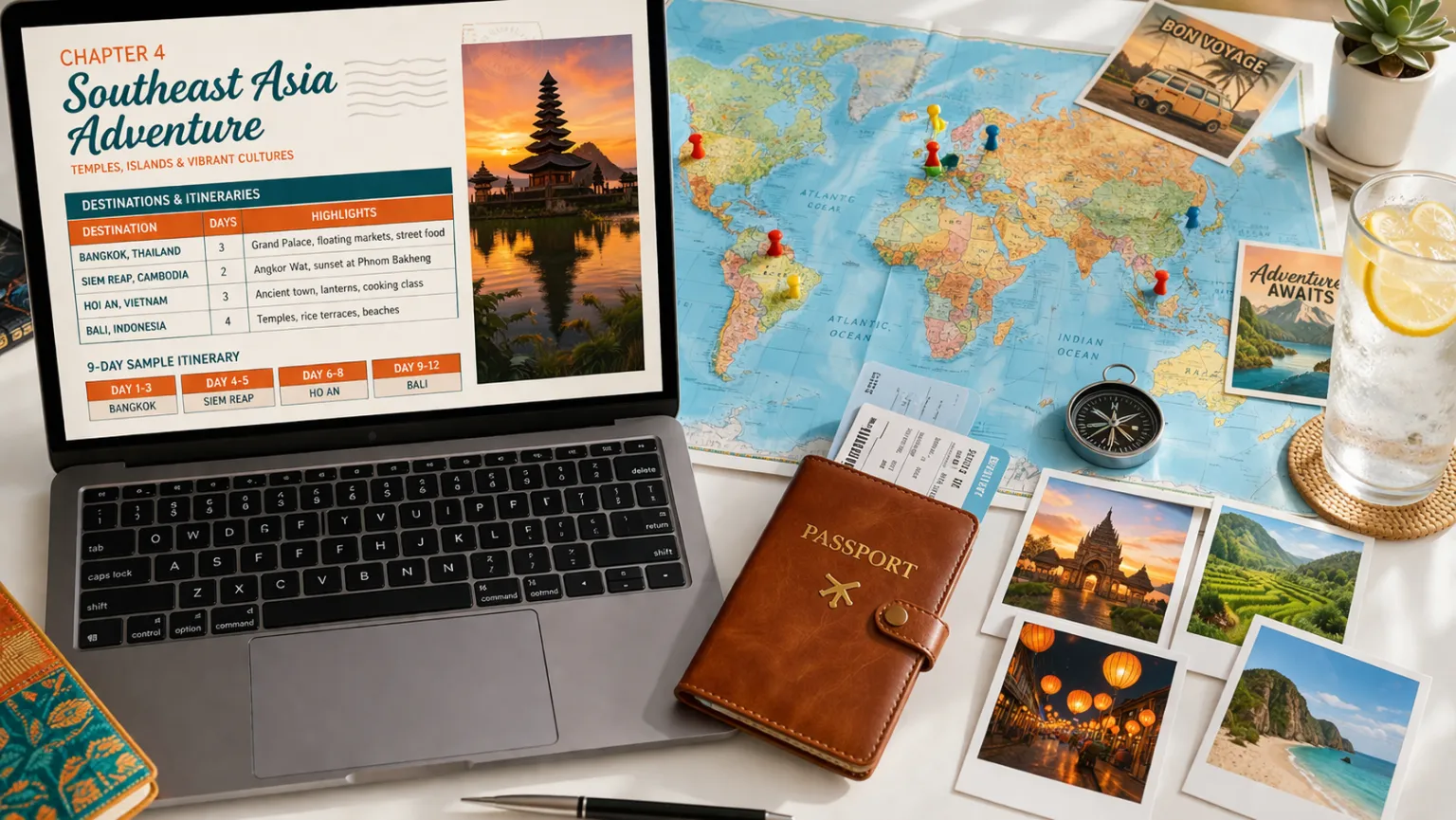
What the Travel Guide Blueprint Includes
Every guide generated with the travel guide blueprint includes these structured sections. Customise and expand in the built-in editor.
Destination Overview
History, culture, climate, best time to visit, and what makes this destination special. Sets expectations and builds excitement.
Getting There and Around
Flights, trains, buses, local transport options, taxi tips, airport transfers, and getting oriented on arrival.
Neighbourhood Guides
Area-by-area breakdown with character descriptions, best for (nightlife, families, budget, luxury), and walking routes.
Day-by-Day Itineraries
Structured daily plans with morning, afternoon, and evening activities. Transport between stops. Budget and luxury alternatives.
Accommodation by Budget Tier
Budget, mid-range, and luxury options with neighbourhood recommendations, price ranges, and booking tips for each tier.
Food, Dining, and Markets
Local cuisine, must-try dishes, restaurants by price range, street food spots, food markets, and dietary accommodation.
Attractions and Hidden Gems
Top attractions with honest assessments (worth it vs overrated), plus local favourites and off-the-beaten-path discoveries.
Day Trips, Safety, and Packing
Excursions from the base city, safety and scam advice, packing lists tailored to climate and activities, and visa information.
Travel Guide Chapter Structure
A professional travel guide follows a consistent chapter structure that mirrors the traveller's journey. Each destination chapter in Inkfluence AI includes: (1) Destination overview with history, culture, climate, and best time to visit, (2) Getting there and around covering transport logistics and local transit, (3) Neighbourhood guide with area descriptions, character, and where to base yourself by traveller type, (4) Day-by-day itinerary with morning/afternoon/evening activities and transport between stops, (5) Accommodation tiers spanning budget, mid-range, and luxury with neighbourhood recommendations, (6) Food and dining from street food to fine dining with local specialties, (7) Attractions and hidden gems with honest assessments and insider tips, (8) Practical information including packing lists, safety, scams, and visa details. A city guide typically runs 8-12 chapters (20,000-40,000 words).
The Travel Guide Market
Travel guides are one of the most consistently profitable ebook niches with year-round demand and strong seasonal peaks.
$7.8B
Travel guidebook market (digital growing 9.2%/yr)
3
Places to sell one guide: Etsy and Gumroad from the app, Amazon KDP by upload
8-12
Chapters per city guide (ideal structure)
Peak
June-August demand spike (vacation planning)
Why travel guides are ideal for AI-assisted creation
Travel guides have the most structured format of any practical non-fiction. Every chapter follows a predictable pattern: overview, logistics, places, activities, dining, accommodation, practical tips. This structural consistency is what AI excels at - generating 8-12 chapters that cover all the bases without gaps. The author's irreplaceable contribution is local knowledge: which side street has the best tacos, which "top-rated" hotel is actually overpriced, what time to arrive at the popular market before it gets crowded. This clean division (AI handles structure, you handle insight) means travel guides are among the fastest books to create. Combined with seasonal demand you can plan around (the ebook niche library ranks travel by share and momentum) and multiple sales channels (KDP, travel blogs, Gumroad), travel guides are one of the highest-ROI book projects you can create with AI.
Every Travel Guide Type Supported
Each type uses the travel guide blueprint with structure adapted to the traveller. See the AI Travel Guide Creator for the full feature breakdown.
City Guides
Neighbourhood breakdowns, attractions, food scenes, transport logistics, and day-by-day itineraries for a single city. The most popular travel guide format on Amazon.
Regional Itineraries
Multi-city routes, road trips, and area explorations. Cover 3-7 destinations with travel connections, timing, and suggested routes between each stop.
Budget Travel
Cost breakdowns, free activities, cheap eats, hostel guides, and money-saving strategies. Backpackers and budget travellers search for these obsessively before every trip.
Digital Nomad Guides
Coworking spaces, internet reliability, cost of living, visa logistics, community hubs, and neighbourhood guides for remote workers. Fastest-growing travel niche.
Food Tourism
Restaurant guides, street food tours, market maps, cooking class recommendations, and regional cuisine deep dives. Food is the number one travel interest for millennials.
Solo Female Travel
Safety-focused guides with solo-friendly accommodation, transport safety, cultural etiquette for women, and community-building tips. Significantly underserved despite massive demand.
Adventure and Hiking
Trekking routes, outdoor itineraries, gear checklists, difficulty ratings, and off-the-beaten-path destinations. Detailed trail guides with elevation, distance, and supply points.
Family Travel
Kid-friendly attractions, family accommodation, stroller accessibility, meal planning for picky eaters, and age-appropriate itineraries. Parents plan months ahead and buy guides early.
Weekend Break Planners
Compact 2-3 day guides for quick getaways. Friday evening to Sunday evening format. Perfect for couples and city professionals. High repeat-purchase rate.
Country Overviews
Comprehensive guides covering highlights, visa info, regional breakdowns, cultural primers, and suggested routes. Larger projects best suited for experienced travel writers.
Honeymoon and Couples
Romantic restaurants, luxury and boutique accommodation, couples activities, sunset spots, and anniversary trip planning. Premium pricing accepted by this audience.
Expat Relocation
Moving logistics, visa processes, housing markets, healthcare, schooling, banking, and daily life setup for people relocating to a new country. High-value, evergreen content.
Guest Guidebooks
The welcome book a holiday-let host leaves for guests: the local chapters (where to eat, walks, day trips, getting around) written in the travel format, the house pages typed by the host. The Airbnb guidebook maker plans both.
What Each Chapter Covers
Every travel guide chapter generated by AI includes these elements. Customise in the built-in editor.
Type-specific additions: city guides add neighbourhood maps and walking routes, budget guides add cost breakdowns and free activities, digital nomad guides add coworking reviews and internet speeds, food guides add market schedules and cooking class recommendations.
How to Write a Travel Guide with AI in 4 Steps
From your destination to a published guide. See the travel guide creator for the full tool walkthrough.
Choose Your Destination and Angle
A travel guide needs a specific destination AND a specific angle. 'A guide to Italy' is too broad. 'A 10-day food lover's guide to Bologna, Modena, and Parma - the Emilia-Romagna triangle' has a buyer. Define: which city, region, or route? Who is the traveller (budget backpacker, foodie, digital nomad, family)? What trip length? The narrower your focus, the more useful and findable your guide becomes.
Generate Your Outline and Structure
Enter your premise into the travel guide blueprint and the AI generates a structured outline: destination overview, getting there and around, neighbourhood guides, day-by-day itineraries, accommodation by budget tier, food and dining, attractions, day trips, and practical information. Review the chapter flow. Does it follow the logic of arriving, orienting, exploring, and departing? Reorder sections to match how a traveller actually experiences the destination.
Generate Chapters and Add Local Knowledge
The AI generates all chapters simultaneously since each section is self-contained. Each chapter follows the travel guide blueprint with structured subsections. Use the built-in editor to add what separates a good guide from a generic one: the restaurant the locals actually eat at, the neighbourhood tourists miss, the scam to watch for at the train station, the best time of day to visit each attraction. Your local knowledge is the value readers pay for.
Design, Export, and Publish
Design a cover that signals the destination and travel style - study top-selling guides in your niche on Amazon. Use the AI cover designer. Export as PDF for your travel blog or Gumroad (where travel guides sell well). Export as EPUB for Amazon KDP. Consider AI audiobook narration for travellers who want destination briefings during flights or commutes.
Travel Guide Formats and Length
Choose the right scope for your destination and audience
| Format | Chapters | Word Count | Best For |
|---|---|---|---|
| Weekend Break | 5-7 | 8,000-15,000 | Quick city getaways. Lead magnets, travel blog freebies. PDF on Gumroad $3.99-$5.99 |
| City Guide | 8-12 | 20,000-40,000 | Single-city deep dive. Best starting point for first-time travel authors. Amazon KDP $5.99-$9.99 |
| Regional Route | 10-15 | 30,000-50,000 | Multi-city itineraries, road trips. Covers 3-7 destinations with travel connections between them |
| Country Overview | 15-20 | 50,000-80,000 | Comprehensive country guides. Premium product for experienced travel writers. $9.99-$14.99 |
| Niche Travel | 8-12 | 15,000-30,000 | Digital nomad, food tourism, budget, solo female. Focused guides that rank well for specific search terms |
Start with a city guide or niche travel book to test your audience. Expand to a series covering multiple cities or a comprehensive regional guide based on reader feedback.
Travel Guide Monetisation Strategies
Travel guides have more monetisation paths than most book types. Amazon KDP remains the largest market - city guides priced $5.99-$9.99 with Kindle Unlimited driving passive reads. Direct sales via your travel blog or Gumroad typically earn higher margins ($7.99-$14.99 per guide with no Amazon royalty split). Lead magnets work well: offer a free weekend guide as an email opt-in, then sell the full city guide to subscribers. Series strategy: create guides for 3-5 related destinations (e.g., "Southeast Asia Budget Series: Bangkok, Hanoi, Bali, Chiang Mai") and cross-sell between them. Annual updates create a repurchase cycle and reset Amazon visibility. Audiobook versions via AI narration serve travellers who want destination briefings during flights. Browse travel ebook ideas for 10 proven travel guide concepts.
Adding Local Knowledge to AI Travel Guides
The best travel guides combine AI-generated structure with personal insider knowledge. Use Inkfluence AI to generate the chapter framework (logistics, itineraries, budget tables, packing lists) then add what only you know: the restaurant that does not appear on Google Maps, the timing trick for avoiding queues, the neighbourhood locals prefer over the tourist version. Fact-check actively - prices, opening hours, and visa rules change. Include a "last verified" date for time-sensitive details. Layer recommendations by traveller type: budget, mid-range, and splurge options for each section. Add seasonal context - the same destination is a different experience in January versus July. Personal photography, hand-drawn maps, and curated playlists elevate the guide from useful to memorable. Edit everything in the built-in editor and export as a print-ready PDF.
Inkfluence AI vs ChatGPT for Travel Guides
ChatGPT can draft a destination overview. Inkfluence AI produces a complete, structured, export-ready travel guide.
ChatGPT
- Good for brainstorming destinations and angles
- Quick single-section drafts
- No travel-specific blueprint or itinerary format
- Chapters lose structure after 3-4 prompts
- No PDF or EPUB export
- No cover design or formatting
- No accommodation tiers or budget breakdowns
- Manual copy-paste into Word or Google Docs
Inkfluence AI
- Dedicated travel guide blueprint
- Structured itinerary format built in
- Accommodation tiers and transport logistics
- PDF and EPUB export built in
- AI cover designer included
- AI audiobook narration available
- Built-in editor for adding local tips
- Full commercial rights included
See the AI Travel Guide Creator for a full walkthrough.
Pricing for Travel Guide Authors
Start free. The free plan covers a short weekend guide or mini city sampler. Full pricing details.
| Feature | Free | Creator $9.99/mo | Premium $19.99/mo |
|---|---|---|---|
| Chapters | 5 + 5/month | 35/month | Unlimited |
| Travel guide blueprint | Included | Included | Included |
| PDF export | Included | Included | Included |
| EPUB (for KDP) | -- | Included | Included |
| AI cover generator | Basic | AI-generated | AI-generated |
| Audiobook generation | -- | -- | Included |
| Custom branding | -- | -- | Included |
| Ideal for | Weekend guides | City guides | Country guides + audio |
Travel Guide Premise Templates
Copy and adapt these premise prompts for popular travel guide types. The more specific your destination and traveller, the stronger each chapter.
Budget City Guide
"A budget traveller's guide to Lisbon, Portugal for solo backpackers and budget-conscious couples in their 20s and 30s. 7-day itinerary covering Alfama, Bairro Alto, Belem, Sintra day trip, and the LX Factory. Focus on: free walking tours, cheap eats under 10 euros, hostel and budget hotel recommendations by neighbourhood, public transport vs walking routes, pasteis de nata taste test across 5 bakeries, sunset spots, nightlife on a budget, and common tourist traps to avoid. Include a daily budget breakdown (30-50 euros/day target). Honest, fun, like advice from a friend who lived there for a year. 10 chapters, 25,000 words."
Key elements: specific city, budget focus, named neighbourhoods, daily cost target, day trip
Digital Nomad Guide
"A digital nomad's guide to Chiang Mai, Thailand for remote workers planning a 1-3 month stay. Cover: visa options (tourist visa, education visa, Thai Elite), coworking spaces with honest reviews (Punspace, CAMP, Yellow, Hub53), internet speeds by neighbourhood, monthly cost of living breakdown (rent, food, transport, coworking), neighbourhood guide (Old City vs Nimman vs Santitham), apartment hunting (how to find monthly rentals on arrival), food scene (5-baht sticky rice to rooftop restaurants), weekend trips (Pai, Doi Inthanon, Chiang Rai), health insurance and hospital options, and community (meetups, running groups, language exchanges). Practical and specific. 10 chapters, 28,000 words."
Key elements: remote work focus, visa logistics, coworking reviews, monthly cost breakdown
Food Tourism Guide
"A food lover's guide to Tokyo, Japan covering the best eating experiences across every budget level. Structure by food type: sushi (from conveyor belt to Tsukiji counter), ramen (6 regional styles and where to find each), izakaya culture (how to order, what to expect, 10 recommendations), street food (Ameya-Yokocho, Takeshita, festival stalls), department store basement food halls (depachika guide), Michelin affordable dining, kissaten coffee culture, and convenience store gems (the best 7-Eleven finds). Include a food-focused 5-day itinerary, dietary restriction survival guide (vegetarian in Tokyo, halal options, allergies), and basic food Japanese phrases. 12 chapters, 35,000 words."
Key elements: food-first structure, budget range, cultural context, dietary accommodation
Family Travel Guide
"A family travel guide to Barcelona, Spain for parents with children aged 3-12. Cover: kid-friendly attractions (Park Guell, Aquarium, Tibidabo, Barceloneta beach), family-friendly neighbourhoods for hotels (Eixample, Gothic Quarter), restaurants that actually welcome children (not just tolerate them), stroller accessibility for key routes, avoiding the midday heat (siesta timing, pool time, indoor options), day trips (Montserrat, PortAventura, beach towns), managing jet lag with small children, and family-sized apartment rentals vs hotels. Include a rainy day plan, a 7-day family itinerary with realistic timing (not 5 museums in one day), and an age-appropriate packing list. 10 chapters, 22,000 words."
Key elements: age range specified, realistic pacing, stroller logistics, rainy day alternatives
Weekend Break Guide
"A weekend guide to Edinburgh, Scotland for couples looking for a 3-day getaway. Friday evening arrival to Sunday evening departure. Cover: where to stay for romance (boutique hotels in New Town and Old Town with honest price comparisons), Friday evening plan (arrival, dinner, whisky bar), Saturday full day (Royal Mile, Arthur's Seat, Dean Village, dinner reservation), Sunday half day (Stockbridge market, coffee, brunch, departure logistics). Include rain contingency for every outdoor plan (this is Edinburgh), a whisky tasting guide, best views for photos, and seasonal adjustments (summer festivals vs winter Christmas markets). Compact, practical, zero filler. 7 chapters, 12,000 words."
Key elements: exact timeframe, couples audience, weather contingency, seasonal adaptation
Paste any of these into the travel guide creator, customise the details, and generate your outline in seconds.
Who Writes Travel Guides?
Anyone with destination knowledge, a passion for travel, or a specific perspective worth sharing
Travel Bloggers
Turn your most popular destination posts into a comprehensive guide. Your blog drive traffic; an ebook captures revenue. Sell directly to your audience or use as a lead magnet for email subscribers. See the ebook guide for format options.
Expats and Long-Term Residents
You know your adopted city better than any guidebook author passing through for a week. Write the guide you wish you had when you arrived: real neighbourhood advice, bureaucracy survival, and the places only locals know.
Tour Guides and Local Experts
Package your daily tour knowledge into a book travellers can keep. Walking tour leaders, food tour guides, and adventure operators have expertise that translates directly into valuable guide content.
Digital Nomads
Write guides for the cities you have lived and worked in: coworking reviews, visa logistics, internet reliability, cost of living. The digital nomad guide niche is growing faster than any other travel category. A natural side project that earns between city hops.
KDP Side-Hustlers
Travel guides are a proven KDP niche with steady demand. Research trending destinations, create focused guides (budget, food, weekend break), and build a portfolio. See best ebook niches for market data on travel guide categories.
Travel Agencies and Tourism Boards
Create branded destination guides for your clients or region. A professional PDF guide builds authority and gives potential travellers a tangible reason to book with you. Distribute as a free download or premium offering.
How to Write a Travel Guide: The Complete Process
Travel guides occupy a unique space in publishing. Unlike most books that readers consume in a few sittings, a travel guide is a tool. Readers refer to it repeatedly - on the plane, at the hotel, walking through a neighbourhood, choosing a restaurant. That reference-tool nature is what makes the structure so critical. A well-structured guide means the reader finds what they need in seconds. A poorly structured one gets abandoned for Google. Here is how to write one that travellers actually use.
Step 1: Pick a Destination and Define Your Angle
The most common mistake is going too broad. "A guide to Spain" competes with Lonely Planet. "A 10-day food lover's road trip through Andalusia" competes with almost nobody. Pick a city, region, or route. Then pick an angle: budget, food, family, digital nomad, adventure, weekend break, honeymoon. The intersection of a specific destination and a specific traveller type is where guides sell. Check Amazon KDP to see what already exists - if there are 50 generic Paris guides but zero food-focused Paris guides, that is your opening. Browse ebook ideas for 10 proven travel guide concepts.
Step 2: Generate and Refine Your Outline
Enter your premise into the travel guide blueprint and the AI generates a structured outline. Review the chapter flow. A good travel guide follows the logic of the journey: arrival and orientation first, then area-by-area exploration, followed by practical reference sections (accommodation, food, safety). Day-by-day itineraries sit near the middle where readers want actionable plans. Use the outline editor to reorder, merge, or split chapters until the flow matches how a real traveller would use the guide.
Step 3: Generate Chapters and Layer in Local Knowledge
The AI generates all chapters simultaneously because each section of a travel guide is self-contained - the food chapter does not depend on the transport chapter. Use the built-in editor to add what no AI can generate: the restaurant where the owner makes pasta by hand at 6am and you can watch if you ask nicely, the bus route that Google Maps does not know about, the view from the third floor of that free museum nobody visits. Honest opinions matter too: which famous attraction is genuinely worth the two-hour queue, and which one you can skip.
Step 4: Add Practical Details Readers Rely On
The difference between a guide someone buys and a blog post they skim is practical specificity. Include opening hours, price ranges (not exact prices - they change), booking requirements, seasonal closures, dress codes, and realistic travel times between locations. Budget breakdowns per day are extremely valuable. Packing lists tailored to climate and activities. Scam warnings specific to the destination. These details are what justify the $5.99-$9.99 price tag.
Step 5: Design, Publish, and Plan Your Update Cycle
Design a cover that immediately communicates the destination - study top-selling guides in your niche on Amazon. Use the AI cover designer. Export as PDF for your blog or Gumroad. Export as EPUB for Amazon KDP. Before you set a price, how to sell travel guides compares what each store keeps and how to write the listing. Travel guides need updates more than most books - plan an annual refresh (prices, closures, new openings) which also resets your Amazon listing freshness. Consider a series strategy: if your Lisbon guide sells, follow with Porto, the Algarve, and Madeira. For audio-first travellers, generate an audiobook version they can listen to on the flight.
Ready to create your travel guide?
Start Writing FreeBest Travel Guide Niches in 2026
The travel guide market rewards specificity. Generic country guides compete with established publishers. Focused guides for specific traveller types in specific destinations find eager buyers with minimal competition. See best ebook niches for broader market data - travel guides peak in June-August as vacation planning ramps up.
Digital Nomad City Guides
The fastest-growing travel niche. Remote workers research cities months before relocating. Cover coworking, internet, cost of living, visa, community. Series format (one city per guide) builds a library. See ebook ideas for 10 travel concepts.
Solo Female Travel
Massive demand, significantly underserved. Safety-focused with solo-friendly accommodation, transport safety, cultural etiquette, and community-building. Every destination needs one. Women share these guides actively in Facebook groups and forums.
Food Tourism Guides
Food is the number one travel interest for millennials and Gen Z. City-specific food guides covering restaurants, street food, markets, and cooking experiences. Cross-links naturally with the cookbook guide for recipe-focused readers.
Budget Backpacker Guides
Backpackers research obsessively before trips. Daily budget breakdowns, hostel reviews, free activities, cheap transport hacks. Southeast Asia, Central America, and Eastern Europe have the highest demand. Price low ($3.99-$5.99) for volume.
Weekend Break Series
Short, actionable guides for 2-3 day trips. High repeat-purchase rate (readers buy one, then buy every city in the series). European cities, US city breaks, and Asian weekend getaways. Low word count (8,000-15,000) means fast creation.
Expat Relocation Guides
High-value guides covering visa processes, housing, healthcare, schooling, banking, and daily life logistics. Buyers are making a major life decision and will pay premium prices ($9.99-$14.99). Evergreen content with annual updates.
Travel Guides on Inkfluence AI: The Real Numbers
The honest numbers from inside the platform: as of August 2026, authors have created 497 travel guides on Inkfluence AI. Travel is one of the platform\'s specialised niches, far smaller than how-to or fiction, which cuts both ways: fewer competing titles, and readers who buy for one specific trip rather than browsing.
The structural advantage of the genre: travel-guide chapters are self-contained (one place, one day, one theme per chapter), which makes them fast to generate, easy to update when details change, and natural to sell as focused single-destination guides rather than doorstop compendiums.
Create Your Travel Guide Today
Free plan. No credit card. Dedicated travel blueprint. From destination to published guide in days.
Frequently Asked Questions
Can AI write a travel guide?
How long should a travel guide be?
Do I need to visit the destination to write a travel guide?
What sections should a travel guide include?
Is this free to use?
Can I sell travel guides created with AI?
What travel guide niches sell best?
How do I structure itineraries in my guide?
Can I include maps and images in my travel guide?
How often should I update my travel guide?
Can I write a travel guide in another language?
What is the difference between a travel guide and a travel memoir?
Related Tools
AI Travel Guide Creator
Dedicated travel guide blueprint
AI Ebook Generator
Full ebook creation with 33+ blueprints
AI Book Cover Generator
Professional cover design
AI Audiobook Generator
Narrate your guide with AI
AI PDF Ebook Maker
Professional PDF export
Lead Magnet Generator
Free guides for email subscribers
AI Cookbook Generator
Complement food tourism guides
Book Outline Generator
Structure your guide chapters
More Writing Guides
Step-by-step AI writing guides for every genre
Related Reading
Guides and resources for travel guide authors
150+ Ebook Ideas That Sell
Browse profitable travel ebook topics including 10 proven travel guide concepts with demand data and competition analysis.
Browse ideasBest Ebook Niches for 2026
Travel guides peak June-August in seasonal demand data. See competition and profitability analysis for travel niches.
See nichesEbook Creation Guide
The complete process for creating and publishing any ebook, including formatting, cover design, and distribution channels.
Read guideTravel Guide Video Walkthrough
Eight minutes: a week in the south of France for couples goes from a one-line brief to a covered, exported guide.
Watch the video