For Horror Authors

AI Writing Software Built for Horror

Hold a single dread tone across 80,000 words. Pace the monster reveal so it lands instead of leaks. Track sensory specificity, point-of-view limits, and what the reader knows versus what the protagonist knows. Purpose-built for psychological, supernatural, gothic, cosmic, slasher, and quiet horror.

If you searched for AI horror novel writer, ai writer for horror series, gothic horror ai, or slow-burn horror novel ai, this is the workflow that ships a finished horror novel without the tone slipping in chapter twelve.
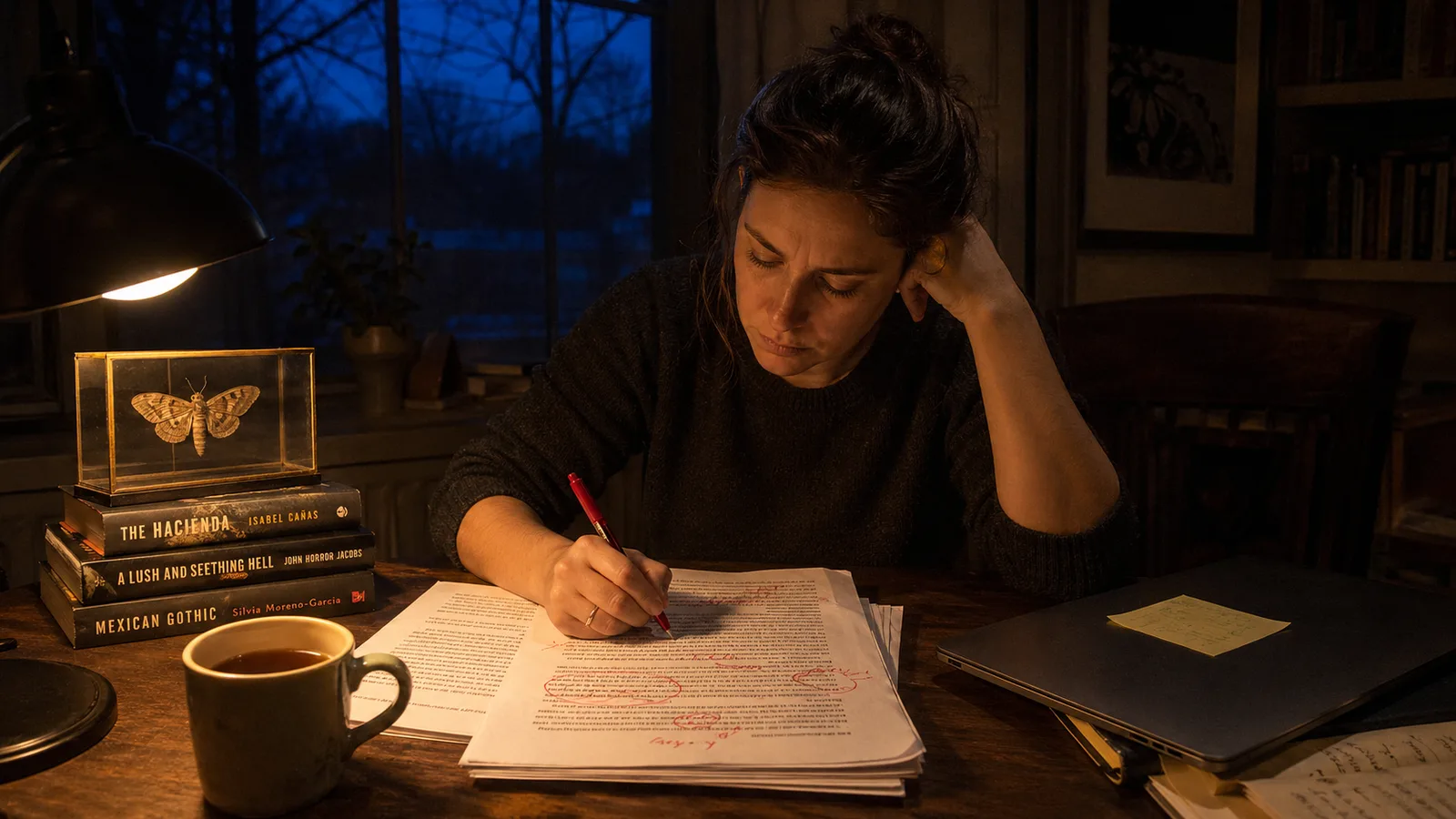
A horror novelist at work in a dim study after dark: a woman in her 30s sits at a wooden desk lit only by a single warm lamp, leaning over a printed manuscript page with annotations in red pen, a closed laptop showing a chapter outline beside her, a stack of paperback horror novels visible at the desk edge, a half-full cup of black tea, a moth pinned in a small glass case, soft shadows in the corners of the room, the window behind her showing a cold blue evening, candid lifestyle photo, no text overlays, no logos, realistic skin texture.
SM By Sam May Founder, Inkfluence AI Updated April 2026

AI writing software for horror authors is a purpose-built platform that holds a single dread tone across an 80,000-word novel, paces reveals so the monster is felt before it is seen, and exports a KDP-ready EPUB plus cover in one workflow. Inkfluence AI is a free-to-start horror novelist tool with story-bible-locked tone consistency, six horror subgenre blueprints (psychological, supernatural, gothic, cosmic, slasher, quiet), and ACX-spec audiobook narration on a single subscription starting at $9.99/mo (compared with $144+ when stacking separate tools for draft, cover, AI-narrated audiobook, and EPUB conversion). The story bible re-injects sensory details, point-of-view rules, and reveal pacing into every chapter prompt so chapter twenty-three lands the dread chapter four set up.

See Real AI-Generated Books

Flip through actual pages created by Inkfluence AI - professionally formatted and export-ready.

Previewing: The Tiny Launch Kit

Loading preview...

Page 1 of 12
Swipe to browse
Professional formatting
Branded cover
Table of contents
Export PDF or EPUB

Slow-burn-aware, reveal-paced, point-of-view-disciplined

AI writing software for horror authors that actually keeps the dread tone

Why horror is the hardest genre for generic AI chatbots

Horror is the genre where tone is the entire product. A thriller can survive a tonally lukewarm chapter; a horror novel cannot. Generic chatbots like ChatGPT and Claude default to a friendly, helpful, slightly explanatory voice. That voice is poison for horror. By chapter five, the dread has flattened into competent but tonally generic prose, and the reader stops being scared. Inkfluence AI runs a persistent story bible with tone-anchor passages and sensory rules that re-inject the dread register into every chapter prompt. The first 500 words of chapter twenty-two reads like the first 500 words of chapter one. Our ranked 2026 comparison of eight AI novel writers benchmarked tone-hold across genre fiction and horror is where the gap between purpose-built tools and chatbots is widest.

Pacing the reveal: when the reader sees the monster

The single most important craft decision in horror is when the reader sees the threat clearly. Too early and the rest of the book is anticlimactic. Too late and the reader gives up. The classic shape is: chapters one to three the threat is implied (a smell, a sound, a wrong shadow). Chapters four to ten it is glimpsed. Chapters eleven onward it is partially revealed but never fully understood until the climax. Generic AI chatbots do not understand this pacing. They will describe the monster in chapter two and have nothing left to escalate to in chapter twenty. Our story bible includes a reveal-pacing schedule keyed to the chapter outline, so each chapter draft reads what the reader is supposed to know at this point and writes accordingly. For broader continuity sweeps the novel editor flags premature reveals against the bible.

Ready to create your first ebook?

Go from idea to finished, exportable ebook in minutes. No writing experience required.

Start Creating Free

Horror subgenres in 2026: psychological, supernatural, gothic, cosmic, slasher, quiet

Horror is not one genre. The blueprint for a 75,000-word psychological horror novel is wildly different from a 35,000-word slasher novella. Psychological horror (Tremblay, Aviv, parts of King) leans on unreliable narrators, ambiguous threat, and sustained dread. Supernatural and paranormal (King, Hill, LaValle) anchors a clear monster but holds back the rules. Gothic (du Maurier, Moreno-Garcia, Grady Hendrix in mode) is setting-driven, often a haunted house or family seat, with slow accretion of wrongness. Cosmic and Lovecraftian (Langan, Cisco) deals in scale that breaks the protagonist. Slasher (Jones, Tudor) runs short and brutal at 30,000 to 60,000 words. Quiet horror (Aickman, modern Tremblay) works almost entirely through implication. Inkfluence supports all six with subgenre-tuned chapter pacing, reveal scheduling, and tonal anchors. Slasher novellas in particular are a strong indie KDP format with high read-through rates.

Sensory specificity is what makes horror feel real

Horror lives in concrete sensory detail. Generic AI prose summarises ("she felt afraid"). Effective horror dramatises ("she could hear her own pulse in her teeth, and the corridor was so quiet she could hear the lightbulb hum twenty feet away"). The story bible holds a sensory anchor list per setting: the smell of this house, the sound of this corridor, the texture of this object, the temperature of this room. Each chapter prompt re-injects the relevant anchors, so the threat-house in chapter eighteen smells the way the threat-house in chapter four smelled. The protagonist hears the same lightbulb hum. The dread compounds because the senses do. How to avoid generic AI output covers the show-versus-tell calibration in more depth.

See what Inkfluence AI can do

Explore our tools, see real output examples, and find the right workflow for your needs.

Indie horror on Amazon KDP: the novella economy

Horror is one of the rare genres where the novella (25,000 to 50,000 words) is commercially viable on KDP. Slasher and supernatural-horror novellas at $2.99 with quarterly release cadences sit on the upper edge of horror best-seller lists routinely. Kindle Unlimited skews horror heavily, which means page-read royalties on novella-length work are competitive with novel-length royalties because reader completion rates are higher. The KDP horror category tree splits into Horror > Occult, Supernatural, Ghosts, Psychological, Vampires, Werewolves, Demons & Devils, and several genre-adjacent slots. For indie horror specifically, the novella plus series cadence beats the standalone novel for revenue. See our low-competition niche guide for KDP slot analysis. Inkfluence supports both the 80,000-word novel format and the 30,000 to 50,000 novella format with structure templates tuned to each.

Series-level horror: keeping the rules of the haunting consistent

Horror series are increasingly common in indie publishing. A haunted-house series, a small-town occult series, a slasher villain series, a supernatural-investigator series. The continuity demands are different from epic fantasy: the bible is smaller (maybe 2,000 to 5,000 words even across multiple books) but the rules are stricter. If the ghost has a specific weakness in book one, it has the same weakness in book three. If the monster cannot enter unless invited in book two, that rule still applies in book four. Generic AI chatbots routinely violate these rules across books because they have no memory of book one when drafting book three. Inkfluence persists the bible across project duplication so the rules of the haunting carry forward intact. For multi-book workflows specifically see our book series writer.

Point of view discipline: what the reader knows versus what the protagonist knows

Horror lives or dies on POV discipline. First-person horror means the reader cannot know anything the protagonist does not know. Third-person-limited means each scene anchors to one head and the reader feels the limit of what is seen. The classic mistake new horror writers make, and that AI chatbots make even more often, is leaking information from a non-POV character into a POV chapter. The protagonist could not know the antagonist is in the basement. The narrator should not tell the reader either. Inkfluence story bible flags POV per chapter and the chapter prompt explicitly enforces what is knowable. This is the single most common reason untrained AI horror prose feels off, even when the sentences are competent.

Editing a horror first draft into your voice: the four-to-six-hour rule

Plan four to six hours of editing per horror novel after the AI draft is in. Where to focus: Tone audit: read each chapter opening aloud. Confirm the dread register holds. Anywhere the prose starts sounding helpful or explanatory, rewrite. Reveal-pace audit: trace what the reader knows at each chapter break. Confirm the curve of revelation matches the bible. Sensory specificity: circle every "she felt afraid" or "it was scary" and replace with concrete sensory detail (sound, smell, temperature, body). POV bleeds: read every chapter checking that nothing is described that the POV character cannot know. Final 200 words of every chapter: these are the cliffhangers. They should pull the reader into the next chapter. Three to five rewrite passes on each. The opening 500 words and final 500 words: the most important words in the novel. Five rewrite passes. For voice and continuity sweeps, our novel editor flags drift against the bible.

80,000

words of horror novel supported with persistent dread-tone continuity

6 subgenres

tuned blueprints: psychological, supernatural, gothic, cosmic, slasher, quiet

$9.99

full horror novel cost on the Creator plan, vs $144+ on tool-sprawl alternatives

Why horror drafts collapse (and what actually breaks)

The specific failure modes horror authors hit with generic AI chatbots.

Tone flattens to helpful chatbot by chapter 5

Horror tone collapses fast under generic AI. The dread goes flat by chapter five and the rest of the book reads competent but unscary. Story-bible tone anchors hold the register.

The monster gets revealed in chapter 2

Generic chatbots describe the threat too early because they do not know reveal pacing. By chapter twenty there is nothing left to escalate to. The bible schedules reveals against the chapter outline.

POV bleeds leak information the protagonist cannot know

First-person horror only works if the reader knows what the protagonist knows. Untrained AI routinely tells the reader the antagonist is in the basement when the protagonist is upstairs.

Sensory anchors rebuild themselves every chapter

The threat-house smelled like wet copper in chapter four; in chapter eighteen it smells like nothing at all. Sensory anchor lists in the bible keep the dread compounding.

From premise and dread map to KDP in 30 days

A solo horror novelist workflow that ships a real book, not a bloated draft that stops scaring after chapter five.

1

Build the dread-tone bible and reveal schedule

Days 1-2: define tone anchors (a sample chapter opening that nails the register), sensory anchors per setting, point-of-view rules, and the reveal-pacing schedule against the chapter outline.

2

Generate the chapter outline for your subgenre

Days 2-3: pick a horror subgenre blueprint and generate the chapter outline. Slasher novella, psychological novel, gothic, cosmic, supernatural, or quiet. Outline reflects reveal pacing.

3

Draft chapters sequentially with tone discipline

Days 4-18: generate each chapter sequentially. The bible re-injects tone anchors, sensory rules, and reveal-state at each chapter prompt. POV is locked. The dread compounds.

4

Self-edit for tone, reveal pace, and POV bleeds

Days 19-25: read end to end. Tone audit per chapter opening. Reveal-pace audit against the bible. Hunt POV bleeds where the reader knows things the protagonist cannot. Sensory specificity sweep.

5

Cover, format, and publish to KDP

Days 26-30: design the KDP-spec cover, export EPUB and PDF, upload to Amazon KDP with AI disclosure, set pricing ($2.99 to $4.99 for indie horror), pick two horror categories.

What a horror-native AI tool gives you

Architectural features no general-purpose chatbot ships out of the box.

Dread-Tone-Locked Story Bible

Tone anchors, sensory rules, reveal pacing, and POV discipline persist across every chapter generation. Chapter 22 reads like chapter 1.

  • Tone register holds across 80,000 words
  • Sensory specificity per setting locked at the prompt level
  • Reveal pacing keyed to the chapter outline

Horror Subgenre Blueprints

Psychological, supernatural, gothic, cosmic, slasher, and quiet-horror blueprints tuned for chapter pacing, reveal cadence, and reader expectations.

  • Psychological: unreliable narrator, sustained dread, ambiguous threat
  • Slasher: 30k-60k novella structure, brutal pacing, body-count escalation
  • Gothic: setting-driven slow accretion of wrongness

KDP Horror Bundle

EPUB plus JPG cover at Amazon's 1600x2560 spec, one click. ACX-compliant audiobook for Audible. No Calibre, no separate cover designer, no separate audiobook service.

  • EPUB + PDF + DOCX export
  • KDP-spec cover output
  • ACX-compliant audiobook narration

AI writing software for horror authors vs generic AI chatbots

Why a horror-aware tool beats a repurposed chatbot once the dread has to hold for 200 pages.

Capability Inkfluence AI (horror-native) ChatGPT / Claude (generic)

Persistent dread-tone story bible

Tone anchors injected into every chapter prompt Drifts to helpful chatbot voice by chapter 5

Reveal-pacing schedule

Bible tracks what the reader should know per chapter Describes the monster in chapter 2, nothing to escalate to

Horror subgenre blueprints

Psychological, supernatural, gothic, cosmic, slasher, quiet Manual prompt engineering every chapter

Sensory anchor consistency

Per-setting smell, sound, texture, temperature locked Re-imagined chapter by chapter, rarely consistent

POV-bleed prevention

Bible flags POV; prompts enforce knowability rules Routinely leaks non-POV information into POV chapters

Series-level rule continuity

Project duplication preserves bible across books Start over per book, monster rules drift

Novella structure (25k-50k)

Tuned blueprint for slasher and supernatural novellas No format awareness, defaults to novel pacing

KDP-ready EPUB + cover export

One click, JPG at 1600x2560 Copy-paste to Word, convert with Calibre, design cover elsewhere

ACX-spec audiobook output

Built in, meets Amazon Audible spec Export manuscript, buy separate AI narration service ($99-$299) or human ACX narration ($1,000-$4,000+)

Cost to produce a horror novel

$9.99 one month $144 to $371 with AI-narrated audiobook, $1,144+ with human ACX narration

What You Can Create

The Psychological Horror Novel

Unreliable narrator, ambiguous threat, sustained dread across 75,000 words. The reader is never sure whether the protagonist is being haunted or losing their mind. Tone-hold is the entire job.

Example: an 80k-word first-person psychological horror with an unreliable narrator and a final-chapter reveal that recontextualises the entire book

The Gothic Haunted-House Novel

Family seat or remote house as the antagonist. Slow accretion of wrongness across 70,000 words. Sensory anchors per room locked from chapter one to climax.

Example: a 75k gothic haunted-house novel with five named rooms, each with its own sensory profile maintained across the manuscript

The Slasher Novella Series

Quarterly cadence at 30,000 to 50,000 words per novella. Recurring villain or premise. KDP and KU page-read royalties on shorter horror are competitive with novel-length work.

Example: a four-novella slasher series at quarterly cadence, each book 35,000 words, shared villain with consistent kill-rule

The Cosmic Horror Novel

Scale that breaks the protagonist. Threat is implied throughout, partially revealed in act three, never fully understood. The horror is in what the reader cannot quite know.

Example: a 75k Lovecraft-mode cosmic horror with a small town as the entry point and an entity whose nature is hinted at across nine partial reveals

Frequently Asked Questions

Everything you need to know.

What horror subgenres does this tool support?
Six core subgenres with dedicated blueprints: psychological horror (unreliable narrator, sustained dread, ambiguous threat), supernatural and paranormal (clear monster with held-back rules), gothic (setting-driven slow accretion of wrongness), cosmic and Lovecraftian (scale that breaks the protagonist), slasher (30,000 to 60,000 word novellas with brutal pacing), and quiet horror (almost entirely implication). Each blueprint reflects reader expectations for chapter length, reveal cadence, and tone register.
How does AI keep horror tone consistent across an 80,000-word novel?
The story bible includes tone anchors (sample passages that nail the register) and sensory rules (per-setting smell, sound, temperature, texture). Both are re-injected into every chapter prompt. Chapter twenty-two reads like chapter one because the bible is being read each time. Generic chatbots without this drift to a friendly explanatory voice by chapter five and the dread flattens.
What is reveal pacing and why does it matter for horror?
Reveal pacing is the curve of how much the reader knows about the threat across the novel. Classic horror shape: chapters one to three the threat is implied (smell, sound, wrong shadow), chapters four to ten it is glimpsed, chapters eleven onward partially revealed but never fully understood until the climax. AI without reveal pacing describes the monster in chapter two and has nothing to escalate to in chapter twenty. Inkfluence schedules reveals against the chapter outline so the bible knows what the reader is supposed to know at this point.
Is the slasher novella format viable on KDP in 2026?
Yes, and it is one of the strongest indie horror formats. Slasher and supernatural-horror novellas at 30,000 to 50,000 words priced at $2.99 with quarterly release cadences sit on the upper edge of horror best-seller lists. Kindle Unlimited skews horror, which means page-read royalties on novella-length work are competitive with novel-length royalties because completion rates are higher. The novella plus series cadence beats the standalone novel for indie horror revenue.
How does AI keep POV discipline in first-person horror?
The story bible flags POV per chapter and the chapter prompt explicitly enforces what is knowable. The protagonist cannot know what the antagonist is doing in another room, and the narrator should not tell the reader either. Untrained AI routinely leaks non-POV information ("meanwhile, in the basement, the figure stirred") into first-person horror chapters. Inkfluence chapter prompts forbid this against the bible.
Can I write a horror series and keep the rules of the haunting consistent across books?
Yes. The story bible persists inside a project, and you can duplicate projects with the bible intact for book two and beyond. If the ghost has a specific weakness in book one, it has the same weakness in book three. If the monster cannot enter unless invited in book two, that rule still applies in book four. Generic AI chatbots routinely violate these rules because they have no memory of book one when drafting book three.
How long should a horror story bible be?
For a single 80,000-word horror novel, the bible should run 1,500 to 3,500 words across tone anchors, sensory rules, reveal schedule, POV rules, and named cast. For a series spanning multiple books, plan 3,000 to 6,000 words. Horror bibles are smaller than fantasy bibles because horror is rules-light and tone-heavy. The biggest leverage comes from the tone anchors (a 200-word sample passage in your target register) and the reveal schedule.
Can AI write horror in my voice?
Partially. The AI adapts to the register, pacing, and vocabulary of any sample chapters you provide, but voice in horror is made of micro-decisions about word choice and rhythm that the first draft will not perfectly capture. Plan on editing every chapter opening and every dread beat to bring the prose fully into your voice. Most horror authors report 65 to 80 percent of the AI draft works as-is and the remaining 20 to 35 percent is where the book becomes theirs. Horror is more voice-sensitive than most genres.
What KDP categories should an indie horror author pick?
Selecting two of the ten available KDP categories is the single highest-leverage discoverability decision an indie horror author makes. The horror tree splits into Horror > Occult, Supernatural, Ghosts, Psychological, Vampires, Werewolves, Demons & Devils, and several adjacent slots. Pick one category where you can realistically rank top-100 and a second where the absolute top-10 is reachable. Slasher and supernatural slots are usually less crowded than the broad Horror parent category.
Can I publish AI-assisted horror novels on Amazon KDP?
Yes. Amazon KDP permits AI-generated and AI-assisted content with disclosure during the publishing flow. See the <a href="https://kdp.amazon.com/en_US/help/topic/GVBQ3RM2QCZPZE6W" target="_blank" rel="noopener">current KDP AI guidelines</a>. Disclosure does not affect eligibility for the 70% royalty tier (list prices $2.99 to $9.99) or KDP Select enrolment. Our export produces a KDP-uploadable EPUB plus a JPG cover at Amazon's 1600x2560 spec, ready to upload in one click.
How much editing does an AI-drafted horror novel need?
Plan four to six hours of editing per horror novel. Highest-leverage focus areas: tone audit (each chapter opening read aloud, confirm the dread register holds), reveal-pace audit (trace what the reader knows per chapter, match it to the bible), sensory specificity sweep (replace any "she felt afraid" with concrete sensory detail), POV bleed hunt (nothing the protagonist cannot know should appear in their chapters), final 200 words of each chapter (cliffhangers, three to five rewrites each), and the opening or closing 500 words of the novel (five rewrite passes).
What is the best free AI for writing horror in 2026?
Inkfluence AI's free tier leads in free-plan generosity (5 chapters to start plus 5 every month, full commercial rights, PDF export) because most competitor free tiers cap at a few hundred words or lock export behind a paywall. NovelAI and Sudowrite are the next tier down, both paid, neither horror-tuned. ChatGPT and Claude free tiers can draft chapters but the dread tone collapses fast without a story bible. Our <a href="/best-ai-novel-writer-2026" class="text-indigo-600 underline-offset-4 hover:underline">ranked comparison of 8 AI novel writers</a> covers the full breakdown.

Explore More Use Cases

AI Book Writer

The full AI book writer with continuity tracking so dread, foreshadowing, and reveals carry across chapters

AI Novel Writer

The dedicated novel-writing workflow with story bible and fiction blueprints

Best AI Novel Writer 2026

Eight tools ranked and compared across novel-specific criteria

Best Novel Writing Software 2026

Sister listicle with the real per-novel cost table including hidden API fees

AI Story Bible Generator

Free tool that builds character bible, world rules, tone anchors, and reveal schedule in one click

AI Character Bible Generator

Free tool that builds a complete character profile (voice, motivation, flaw, backstory, three-beat arc) for any role in your horror cast

AI Mystery & Thriller Writer

Mystery and thriller pacing for horror-mystery and slow-burn thriller-horror hybrids

AI True Crime Writer

True-crime adjacent horror, real-event-style horror, and unreliable-narrator memoir-horror

AI Book Series Writer

Multi-book horror series with shared rules and recurring villains

AI Chapter Generator

Generate single chapters with full story-bible continuity

AI Novel Editor

Continuity sweep, voice consistency, and POV-bleed checks for horror specifically

For Fantasy Authors

Sister page for fantasy-horror and dark-fantasy crossover writers

For Sci-Fi Authors

Sister page for cosmic-horror and sci-fi-horror crossover writers

For Novelists

General novelist workflow including non-horror genres

For Series Authors

Multi-book continuity for horror series and rapid-release horror serials

For Fiction Authors

General fiction workflow including short stories and novellas

For First-Time Authors

Writing your first horror novel with guided AI assistance

Book Outline Generator

Free 10-chapter outline tool across eight genres including horror

AI Novel Generator for KDP

Indie-novel-to-KDP workflow with horror subgenre support: slasher novellas at 30k-50k, supernatural horror novels, gothic, cosmic, and quiet horror with Kindle Unlimited pricing strategy

Start your horror novel today

Free plan gives you 5 chapters plus 5 every month, full commercial rights, and PDF export. The story bible holds your tone anchors, sensory rules, and reveal pacing across the whole novel. No credit card required.