

Quick Answer (October 2026)
GPT-6.1 Terra is the best GPT model for most writing. It is the only current OpenAI model that OpenAI describes for "clear, natural writing", and it is in ChatGPT Work from the Plus plan ($20 a month). Use GPT-6.1 Sol for long, structured work such as outlines and reports. ChatGPT Free and Go ($8 a month) get Luna. To write a whole book, Inkfluence AI handles the outline, chapters, story bible, cover and KDP files.
OpenAI replaced almost its whole lineup between July and October 2026. The GPT-5.6 family arrived on 9 July, GPT-6 Astra on 3 September, GPT-6 Sol and Luna on 22 September, GPT-6.1 Sol on 29 September and GPT-6.1 Terra on 26 October. GPT-5.5 left ChatGPT on 14 October. Most advice online names models that are gone.
This guide sticks to what OpenAI itself publishes about each current model: which ChatGPT plan includes it, what it costs, how much text it handles, and what it is for. Every OpenAI fact was checked on OpenAI's own pages on 31 October 2026; sources are at the end.
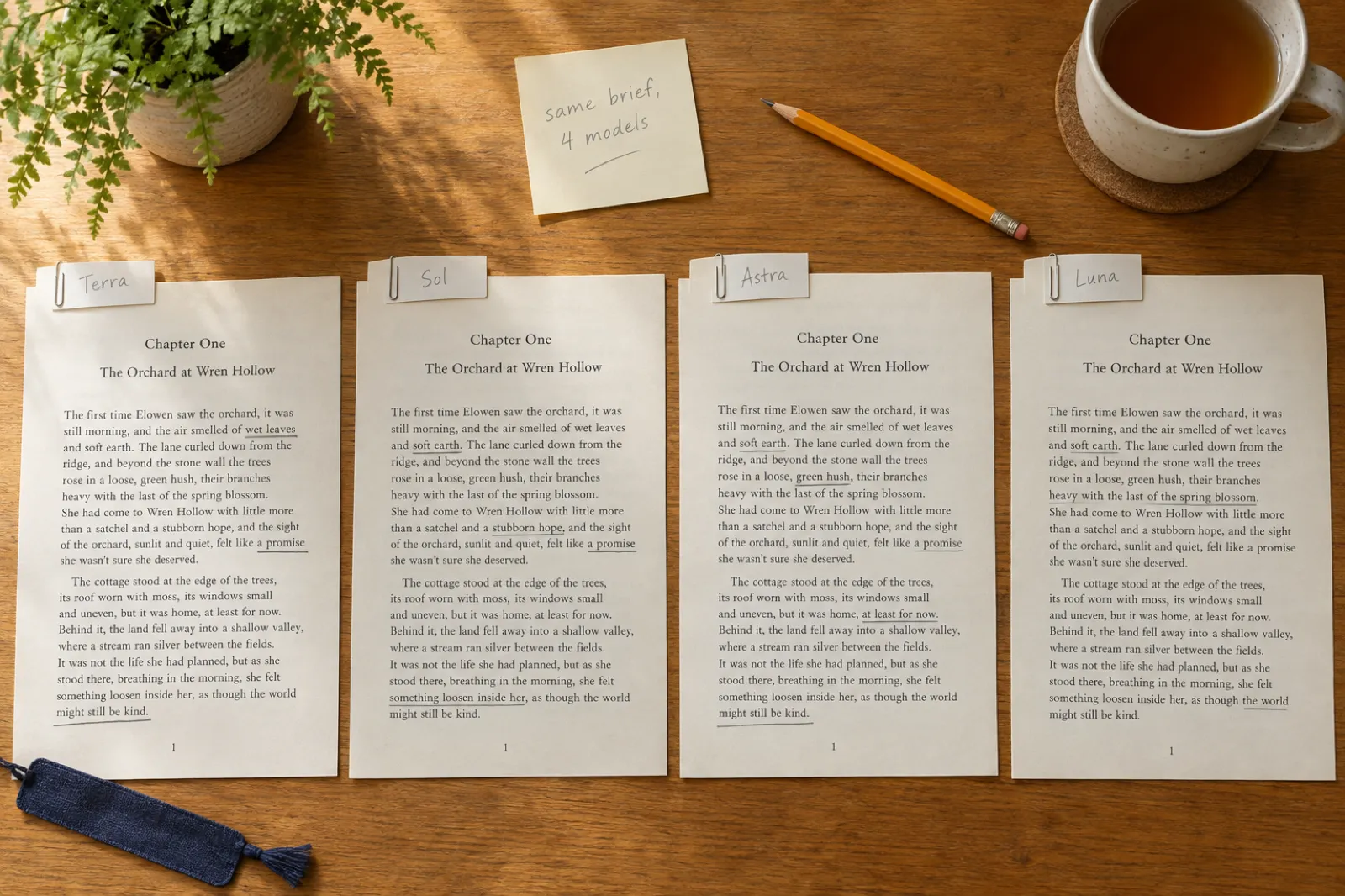
One thing to know up front: OpenAI makes no claim about fiction or storytelling for any current model. Its only writing claim is for GPT-6.1 Terra ("clear, natural writing"). We have not run our own prose tests for this guide, so there is no fiction leaderboard here, just the facts that decide which model fits your plan, your budget and the length of what you are writing.
GPT for writers at a glance (checked 31 Oct 2026)
4
current flagship models: GPT-6 Astra, GPT-6.1 Sol, GPT-6.1 Terra, GPT-6 Luna
922K tokens
most input any of them takes on the API, about 690,000 words
128K tokens
longest single reply, about 96,000 words, reasoning included
Luna
the model on ChatGPT Free and Go; Terra, Sol and Astra start at Plus
Which GPT model for which writing job (October 2026)
Start here if you only need the answer for one kind of writing. The "why" column only uses what OpenAI publishes; plan access is from OpenAI's ChatGPT pricing and model pages on 31 October 2026.
| Writing job | Best pick | Why | Plan needed |
|---|---|---|---|
| A whole book, fiction or non-fiction | Inkfluence AI | Outline, chapters with continuity, a story bible that updates as the book grows, an editor, a cover designer, then PDF, EPUB, DOCX and a KDP package in one place | Free to start (5 chapters, plus 5 a month) |
| Clear prose in a chat: chapters, articles, newsletters | GPT-6.1 Terra | OpenAI's only writing claim: "clear, natural writing"; it lists "draft and revise text" as a use | Plus $20/mo and up (ChatGPT Work) |
| Novels and short fiction in a chat | Terra to draft, 6.1 Sol to plan | No fiction claim exists for any model; Terra carries the writing claim, Sol the reasoning | Plus and up; Luna on Free |
| Outlines, long reports, structured non-fiction | GPT-6.1 Sol | "Near-Astra performance for complex work at a lower cost"; OpenAI's suggested model for Plus users and above | Plus and up |
| Editing a full manuscript in one go | GPT-6.1 Sol | Up to 922,000 input tokens on the API; 500K by default in ChatGPT Work and Codex | Plus and up, or API |
| Research carried through to a finished document | GPT-6 Astra | OpenAI lists "research, and document creation" among its uses; also the dearest by far | Plus (5 to 45 messages per 5 hours) or Pro |
| Free-plan writing and bulk short copy | GPT-6 Luna | "Focused, high-volume tasks, including summarization"; $0.10 / $0.50 per million tokens | Free, Go $8/mo, or API |
If you take one thing from the table: the model matters less than your plan and the length of the job. Free and Go users write with Luna; Plus users pick Terra for prose and Sol for structure. Once the job is a whole book, the hard part becomes keeping 20 or 30 chapters consistent and getting them into a file a store will accept, which is a workflow problem more than a model problem.
Writing a book, not a chat reply?
Inkfluence AI plans the chapters, writes them with the earlier ones in mind, tracks your characters, and exports a finished book. No model to pick, no copy and paste.
Start your book freeThe current GPT lineup for writers (October 2026)
These are the four flagship models on OpenAI's models page, with ChatGPT access from OpenAI's pricing and model pages. Every figure was checked on 31 October 2026.
| Model | In ChatGPT | API price per million tokens (input / output) | OpenAI's description |
|---|---|---|---|
| GPT-6 Astra Released 3 Sep 2026. Knowledge to 30 Apr 2026. |
Plus (limited), Pro, Business | $10 / $50 | "Our most capable model for the most demanding work" |
| GPT-6.1 Sol Released 29 Sep 2026. Knowledge to 30 Apr 2026. |
Plus, Pro, Business | $2 / $10 | "Near-Astra performance for complex work at a lower cost" |
| GPT-6.1 Terra Released 26 Oct 2026. Knowledge to 1 Jun 2026. |
Plus, Pro, Business (ChatGPT Work) | $1 / $5 | "A fast, efficient model for visual reasoning, precise computer use, and clear, natural writing" |
| GPT-6 Luna Released 22 Sep 2026. Knowledge to 18 May 2026. |
Free, Go, Plus and up | $0.10 / $0.50 | "Our most efficient model for focused, high-volume tasks" |
Notes: all four list a 1,050,000-token context window, at most 922,000 input tokens, and at most 128,000 output tokens per reply on the API. Prompts over 272,000 input tokens cost more (on Astra, "2x input and cache rates and 1.5x output for the full request"). Release dates are from OpenAI's API changelog.
Older models still around. GPT-6 Sol is still on the API at $2 / $10, and the GPT-5.6 family is still listed with a February 2026 knowledge cutoff. GPT-5.6 Sol's promotional price of $4 / $20 runs "at least through Nov 21, 2026" and is still twice GPT-6.1 Sol. There is little reason to start new writing on an older model.
For Claude and Gemini, see the cross-vendor guide to the best AI models for novel writing and our sister guide to the best Claude model for writing.
What changed in 2026 (dated, from OpenAI's own pages)
- 9 July: GPT-5.6 Sol, Terra and Luna released.
- Early August: GPT-5.6 Luna became the default ChatGPT model on Free and Go.
- 3 September: GPT-6 Astra released, OpenAI's new top model.
- 22 September: GPT-6 Sol and GPT-6 Luna released, Luna at $0.10 / $0.50 per million tokens.
- 29 September: GPT-6.1 Sol released.
- 14 October: GPT-5.5 retired from ChatGPT, ChatGPT Work and Codex on every plan.
- 26 October: GPT-6.1 Terra released, in ChatGPT Work from Plus up.
If a guide you are reading recommends GPT-4o, GPT-5 or GPT-5.5 for writing, it predates all of this.
Best GPT model for creative writing and fiction
Here is everything OpenAI says about how the current models write, quoted from its model pages and guides:
- GPT-6.1 Terra: "A fast, efficient model for visual reasoning, precise computer use, and clear, natural writing." Its model page lists "draft and revise text" as a use, and OpenAI's ChatGPT model guide suggests it for "drafting proposals".
- GPT-6 Astra: listed for "complex reasoning, coding, computer use, research, and document creation." OpenAI's prompting guide adds two habits writers should know: "GPT-6 Astra tends to use lists, tables and Markdown to make responses scannable", and "It is also more likely to ask for clarification where earlier models would make assumptions."
- GPT-6.1 Sol: no writing claim. Its uses are "complex coding, computer use, and professional work."
- GPT-6 Luna: no writing claim. OpenAI suggests it for "focused, high-volume tasks, including summarization, extraction, and focused coding."
That is the whole list. None of it mentions fiction, dialogue, character voice or pacing, so any confident fiction ranking you read elsewhere is that site's opinion or its own test.
What the facts do support:
- Draft with Terra on Plus or above. It is the only model OpenAI pitches for natural writing, the newest (knowledge to 1 June 2026), and it can run with no reasoning, so replies come back fast while you try three openings.
- Plan with Sol. An outline, a clue-and-payoff plan or a check of chapter 12 against chapters 1 to 11 is reasoning work, and Sol is OpenAI's suggested model for complex work.
- Watch Astra's formatting habit. A model that leans on lists and Markdown turns a scene into a report unless you ask for prose; the prompts section has OpenAI's fix.
- Judge with your own pages. Give two models the same scene brief and the same style sample and read both. Our guide on how to evaluate AI fiction quality lists what to look for, from repeated phrases to point-of-view slips.
Romance, fantasy, mystery and other genre fiction
No GPT model is tuned for a genre; the meet-cute, the magic system's rules and the fair clue go in your prompt or outline. Book tools build them in: see the AI romance novel writer, the AI fantasy novel writer and our roundup of the best AI story generators.
Best GPT model for writing a book
For book-length work, the question is whether the model can see the whole book while it writes, how much it can write in one reply, and what a long book costs. Here are the numbers.
How long are real books written with AI?
We measured this. In a sample of 1,200 books finished on Inkfluence AI in the 30 days to 9 October 2026 (picture books and colouring books excluded), the median book was 9,232 words, one book in ten passed 24,000 words, and the longest one in a hundred passed 82,000 words. The longest book in the sample ran to 114,790 words. For a wider view, see our AI book writing statistics and how many words are in a novel.
What fits in a GPT model's context
OpenAI's rule of thumb is that "1 token is approximately 4 characters or 0.75 words for English text", about 1.33 tokens per word. Every current flagship accepts up to 922,000 input tokens; above 272,000, the whole request is billed at the long-context rate.
| Book | Tokens (about 1.33 per word) | Share of the 922K input limit | Share of the 272K standard-price limit |
|---|---|---|---|
| Typical AI-written book (our median) 9,232 words |
~12,300 | 1.3% | 4.5% |
| Longer guide or novella (our top 10%) 24,137 words |
~32,200 | 3.5% | 12% |
| Short commercial novel 50,000 words |
~66,700 | 7.2% | 25% |
| Long novel (our top 1%) 82,518 words |
~110,000 | 12% | 40% |
| Longest book in our sample 114,790 words |
~153,100 | 17% | 56% |
| Epic fantasy 200,000 words |
~266,700 | 29% | 98%: add any instructions and it crosses |
Tokens needed to hold the whole book
OpenAI's 0.75 words per token. Long-context pricing starts at 272,000 tokens, just past the longest bar. All of these fit within the 922K input limit.
Bar width = tokens divided by 266,700. Source: Inkfluence AI sample of 1,200 finished books, 30 days to 9 Oct 2026; OpenAI's token conversion.
So on the API, every current GPT model holds even the longest book in our sample with most of its input limit to spare; only an epic plus instructions crosses the 272K price line. In the ChatGPT app the working window is smaller and depends on your plan and mode (OpenAI lists the figures in its help centre; Free gets the smallest). In ChatGPT Work and Codex, GPT-6.1 Sol uses "a default context window of 500K tokens."
Holding a book is not the same as writing one
Three limits matter more than the input size:
- One reply tops out at 128,000 tokens, about 96,000 words, and that includes reasoning: OpenAI says reasoning tokens "still occupy space in the model's context window and are billed as output tokens." Astra and Sol always reason, so their visible replies are always shorter than the cap. OpenAI recommends "reserving at least 25,000 tokens for reasoning and outputs".
- A reply that runs out of room can come back empty. OpenAI warns a response can end incomplete with no visible output, and you still pay for the tokens. One chapter per request avoids this.
- Usage limits, not tokens, run out in ChatGPT. OpenAI's estimates for Plus are 15 to 160 GPT-6.1 Sol messages, 35 to 285 Terra messages and 5 to 45 Astra messages per five hours. Pasting a whole manuscript into every message uses those up quickly.
A workable way to write a book in ChatGPT
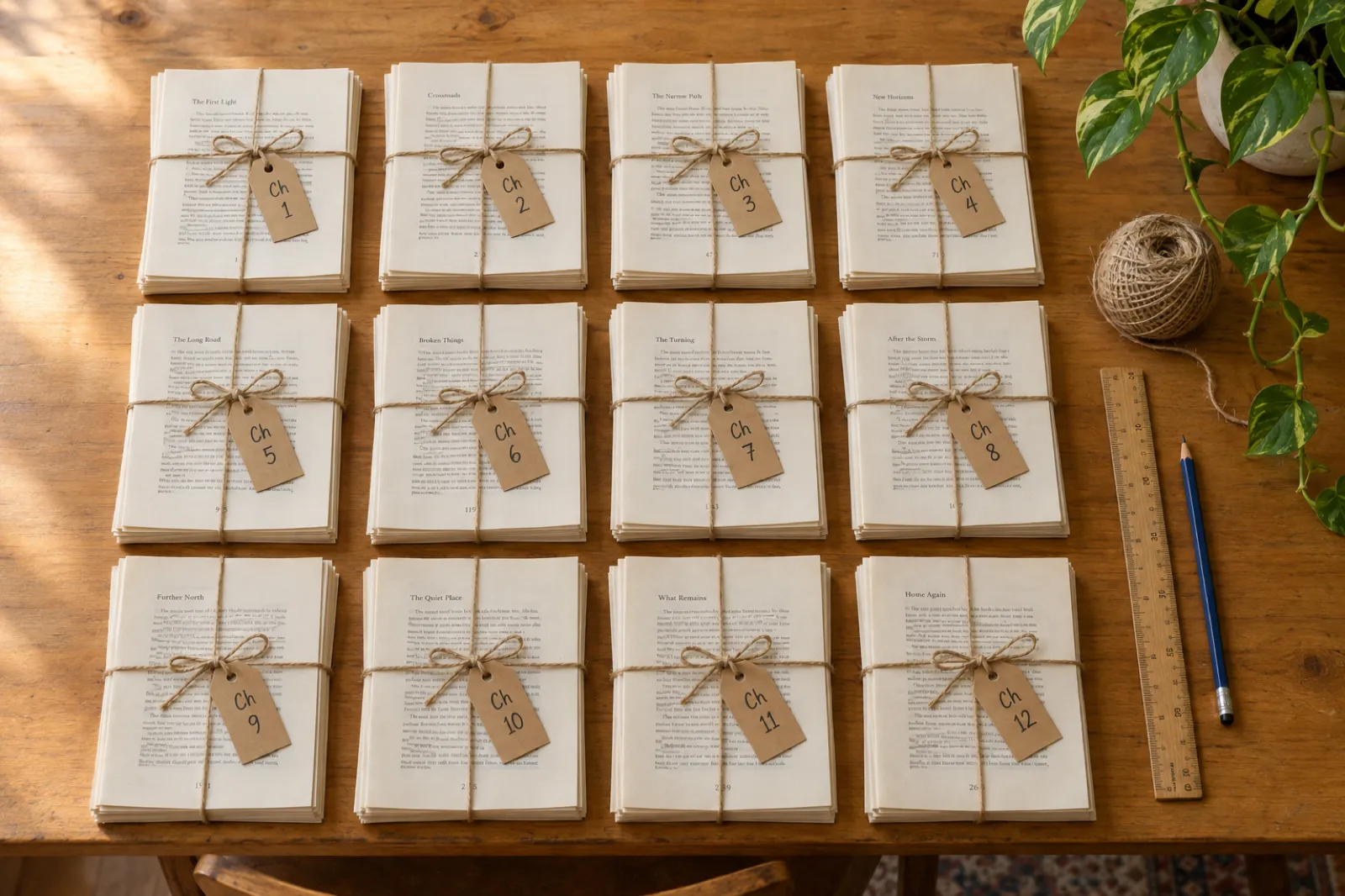
- Outline with Sol, one paragraph per chapter saying what changes. Our free book outline generator gives you a starting structure.
- Put the outline, a character list and a page of your prose in a ChatGPT Project.
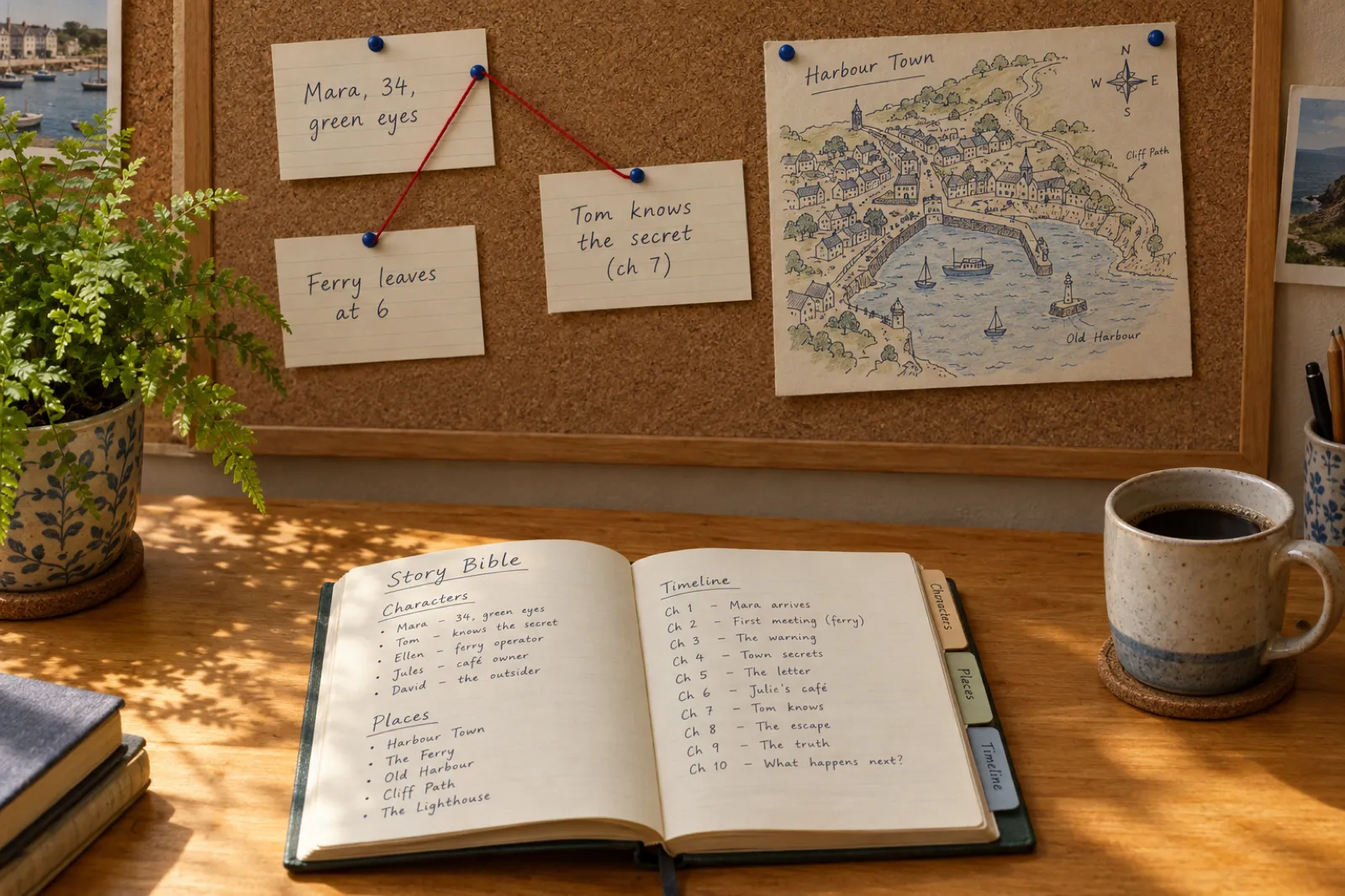
- Keep a running facts list, a simple story bible: names, places, who knows what, what has happened. Update it after every chapter.
- Draft one chapter per chat with Terra, from the outline entry, the facts list and the previous chapter's last page.
- Every few chapters, give Sol the full draft and the facts list and ask for a continuity check. Our guide to AI continuity checking covers what to ask for.
It works, with a lot of copying and pasting. For a free route built for whole books, see how to write fiction with AI for free.
Why a whole book needs more than a chat model
A chat window is the right place to think out loud and rework a passage you are stuck on. It is a weak place to manage a 30-chapter manuscript, because you become the project manager. Four jobs land on you that no model choice fixes:
1. Continuity across chapters
Who knows the secret by chapter 7, what colour the boat is, which reveal has already happened. A model only knows what you paste in, so you carry the facts between chats.
2. Structure
Each chapter needs its own job. In non-fiction that means a different example and method per chapter; in fiction, one main event per chapter, in order. Chat drafts tend to repeat.
3. Export
Thirty chats are not a book. You still need one file with a title page, contents, chapter styling, and a valid EPUB for e-readers.
4. Cover and KDP files
A paperback needs an interior PDF at your trim size and a full cover wrap with a spine sized to the page count. A chat model does not produce either.
For writing a whole book, Inkfluence AI is our pick, and it is built for exactly that job:
- Outline first. You describe the book, it plans the chapters, and you edit the outline before any chapter is written.
- Chapters with continuity. Fiction chapters are written in order, each with the earlier chapters in mind, so the plot builds rather than repeats. Non-fiction chapters are each given their own method, example person and opening at outline time, so chapter 6 does not retell chapter 2. See how outlining and writing chapters in sequence works.
- A story bible that keeps up. For fiction, characters, places and what has happened so far are tracked as the book grows, and you can open and edit the Story Bible in the editor, for example to fix a name before the next chapter.
- Editing in the same place. A chapter editor and an AI editing assistant for chat, quick edits and reviews.
- Cover and store files. A cover designer for the front, back and spine, an AI book cover generator, and a one-click KDP package with the paperback interior, the full cover, and the Kindle files.
- What comes next. The AI book series writer, translation and audiobooks are in the same app.
Plain limits: the free plan gives 5 chapters to start plus 5 a month, with PDF export (carrying a small Inkfluence credit). EPUB, DOCX and the KDP package come with Creator ($9.99 a month, 35 chapters) or any credit pack (15 credits for $9.99); Premium ($19.99 a month) has unlimited chapters. Length is set by the number of chapters, usually 1,000 to 2,000 words each. See the pricing page and our Inkfluence AI vs ChatGPT comparison.
Write the whole book, not just the next reply
Outline, chapters in order, a story bible that keeps up, a cover, and a finished file at the end. Free to start, no credit card.
Start your book freeTerra vs Sol vs Astra for writing
This is the choice most Plus users face, so here it is on OpenAI's published facts:
| GPT-6.1 Terra | GPT-6.1 Sol | GPT-6 Astra | |
|---|---|---|---|
| Writing claim from OpenAI | "clear, natural writing"; "draft and revise text" | None | None; listed for "document creation" |
| API price per million tokens | $1 in / $5 out | $2 in / $10 out | $10 in / $50 out |
| Reasoning settings | none to max (default medium) | low to max (default medium) | low to max |
| Plus messages per 5 hours (OpenAI estimate) | 35 to 285 | 15 to 160 | 5 to 45 |
| Knowledge cutoff | 1 Jun 2026 | 30 Apr 2026 | 30 Apr 2026 |
| Best writing use | Chapters, articles, rewrites, everyday prose | Outlines, long reports, whole-manuscript edits | Heavily researched documents |
On the API, Sol costs twice Terra per token and Astra five times Sol; in ChatGPT the gap shows up in how fast you hit your five-hour limit.
When Terra is enough. Anything where the sentences matter more than the plan: a chapter from a clear outline, a newsletter, five versions of an opening line. OpenAI says to "start at medium" reasoning on Terra and raise it only if the gain is worth the time.
When to switch to Sol. When the job is mostly thinking: planning a plot, restructuring a non-fiction book, or reporting what contradicts what across a manuscript. OpenAI points Plus, Pro and Business users to GPT-6.1 Sol as their main model in ChatGPT Work.
Is GPT-6 Astra worth it for writing?
For most writers, no. The facts:
- Price: $10 / $50 per million tokens, five times GPT-6.1 Sol, which OpenAI calls "near-Astra performance".
- Access: an estimated 5 to 45 messages per five hours on Plus; Pro plans start at $100 a month and "currently have no five-hour limit."
- Style habits: by OpenAI's account it leans on lists and Markdown and asks clarifying questions more often, both of which work against flowing prose by default.
Where it may earn its price: a research-heavy non-fiction chapter or a report built from many sources, which is the work OpenAI lists it for. For a novel's chapters, Terra and Sol are the better buys.
Best GPT model for essays, academic and non-fiction writing
For essays, papers and non-fiction chapters, use GPT-6.1 Sol to plan the argument and draft, and GPT-6.1 Terra to make it read well. In argument-led writing the hard part is the reasoning; the final pass is about clarity, which is what OpenAI built Terra for.
Three cautions that apply to every GPT model:
- Knowledge cutoffs. Astra and Sol know the world to 30 April 2026, Luna to 18 May and Terra to 1 June. Anything after that needs a source you supply or a web search, and every citation should be checked against the original.
- State the point early. OpenAI's own style prompt for its newest models says: "Make sure to state the main point clearly and early" and "Prefer active voice and direct statements." That is good advice for any essay.
- Your institution's rules come first. Many universities restrict AI-written work.
For non-fiction books, structure matters more than any one paragraph: each chapter needs its own job, its own examples and no repeats. Our comparison of the best AI for writing non-fiction covers tools that plan that for you, and the AI chapter generator drafts one chapter at a time from your outline.
Best GPT model for everyday writing: emails, posts and copy
For emails, social posts and newsletters, use Terra on Plus and up and Luna on Free and Go. Switch to Sol for the email that needs careful thinking, and to Luna for a lot of short pieces quickly.

On the API the gap is large: 1,000 short pieces of about 150 words, each from a 300-token prompt, have a list-price floor of about $0.13 on Luna, $1.30 on Terra, $2.60 on 6.1 Sol and $13 on Astra.
Luna and Terra can run with reasoning set to "none", so those floors are close to the real bill; Sol and Astra always reason, and reasoning is billed as output. Batch and Flex processing take 50% off for work that can wait.
Need the book around the copy?
If the short pieces are for a book (a blurb, chapter summaries, a store description), Inkfluence AI writes the book and keeps everything in one project, with a book description generator built in on paid plans.
Try Inkfluence AI freeWhat it costs: ChatGPT plans vs the API
ChatGPT charges a monthly plan with usage limits; the API charges per token. Most writers use ChatGPT.
ChatGPT plans (checked 31 October 2026)
| Free and Go | Plus | Pro | |
|---|---|---|---|
| Price | $0; Go $8/month | $20/month | From $100/month |
| Models for writing | Luna (GPT-5.6 Luna default in Chat; GPT-6 Luna in the desktop app as it rolls out) | GPT-6.1 Sol, GPT-6 Luna; GPT-6.1 Terra and GPT-6 Astra in ChatGPT Work | Everything in Plus |
| Usage | Not published | Five-hour limits (estimates above) | "Currently have no five-hour limit" |
Pro has tiers from $100 a month; Ultrafast mode for Astra and 6.1 Sol is on the $500 Pro tier. Business costs $20 per user a month billed annually (2 users or more), or $25 billed monthly. US prices; they vary by country.
API cost of drafting an 80,000-word novel
Assumptions, stated so you can redo the sums: 80,000 words at 1.33 tokens per word is about 106,700 output tokens. Written as 30 chapters with a 12,000-token prompt each (outline, notes, the end of the previous chapter), that is 360,000 input tokens. No reasoning tokens, no rewrites, list prices.
| Model | Output (106,700 tokens) | Input (360,000 tokens) | Floor per draft |
|---|---|---|---|
| GPT-6 Astra | $5.33 | $3.60 | ~$8.93 |
| GPT-5.6 Sol (older, promo price) | $2.13 | $1.44 | ~$3.57 |
| GPT-6.1 Sol | $1.07 | $0.72 | ~$1.79 |
| GPT-6.1 Terra | $0.53 | $0.36 | ~$0.89 |
| GPT-6 Luna | $0.05 | $0.04 | ~$0.09 |
Cost floor for one 80,000-word draft (API list prices)
Bar width = cost divided by the Astra figure. Prices from OpenAI's API pricing page, 31 Oct 2026.
Treat these as floors. Real runs cost more: reasoning is billed as output (Astra and Sol always reason), authors regenerate chapters, and pasting the manuscript into each request multiplies the input bill. For example, sending a 110,000-token draft with each of 30 chapter requests to GPT-6.1 Sol adds 3.3 million input tokens, about $6.60, unless you use prompt caching, which OpenAI prices at 5% of the normal input rate on that model. Our AI cost calculator runs these numbers for your own book, and the real cost of bring-your-own-key vs all-included tools compares API billing with a flat plan.
The token bill is the small part. The large part is your time: carrying the outline between chats, keeping the facts current, fixing contradictions and formatting a store-ready file.
Prompts that make any GPT model write better
When a GPT-6 model is reasoning, OpenAI says to remove temperature and top_p from API requests, and Astra and Sol cannot turn reasoning off, so "turn the temperature up" no longer works for livelier prose. Prompting is the lever. From OpenAI's own guide for its newest models:
- Ask for paragraphs. OpenAI's suggested style prompt opens: "Default to using clear, concise paragraphs, each developing one main idea." For fiction, add your point of view and tense.
- Limit lists. "Use lists only when the information is genuinely parallel, sequential, or easier to compare." OpenAI also notes: "If your application needs prose with less formatting, specify that preference." This matters most on Astra.
- Name the phrases you do not want. OpenAI's own example bans "slop words or phrases like "Bottom Line:" in conclusions, "delve," "foster," "leverage,"" and says: "Do not use concluding summary statements." Every writer has a list like this; put yours in the prompt.
- Tell Astra to get on with it. Because Astra asks for clarification more often, OpenAI suggests telling it to infer intent and present a result for review rather than asking first. For a chapter, that means: "Make reasonable choices and write the full chapter."
- Show a sample and ask for the length. Paste a page of your own prose and ask the model to match its rhythm, not its content. OpenAI's guide gives no word targets, so state the length you want.
From draft to Amazon KDP: what a chat model leaves to you
If the book is going to Amazon, three more jobs follow the writing, whichever model you used.
- Disclose AI-generated content. Amazon's content guidelines define AI-generated text as content "created by an AI-based tool", which stays AI-generated "even if you applied substantial edits afterwards", and ask you to "inform us of AI-generated content" when you publish. Text you wrote yourself and only improved with AI is "AI-assisted" and needs no disclosure. Our guide to the KDP AI disclosure policy explains the line, and whether AI-written books can be copyrighted covers ownership.
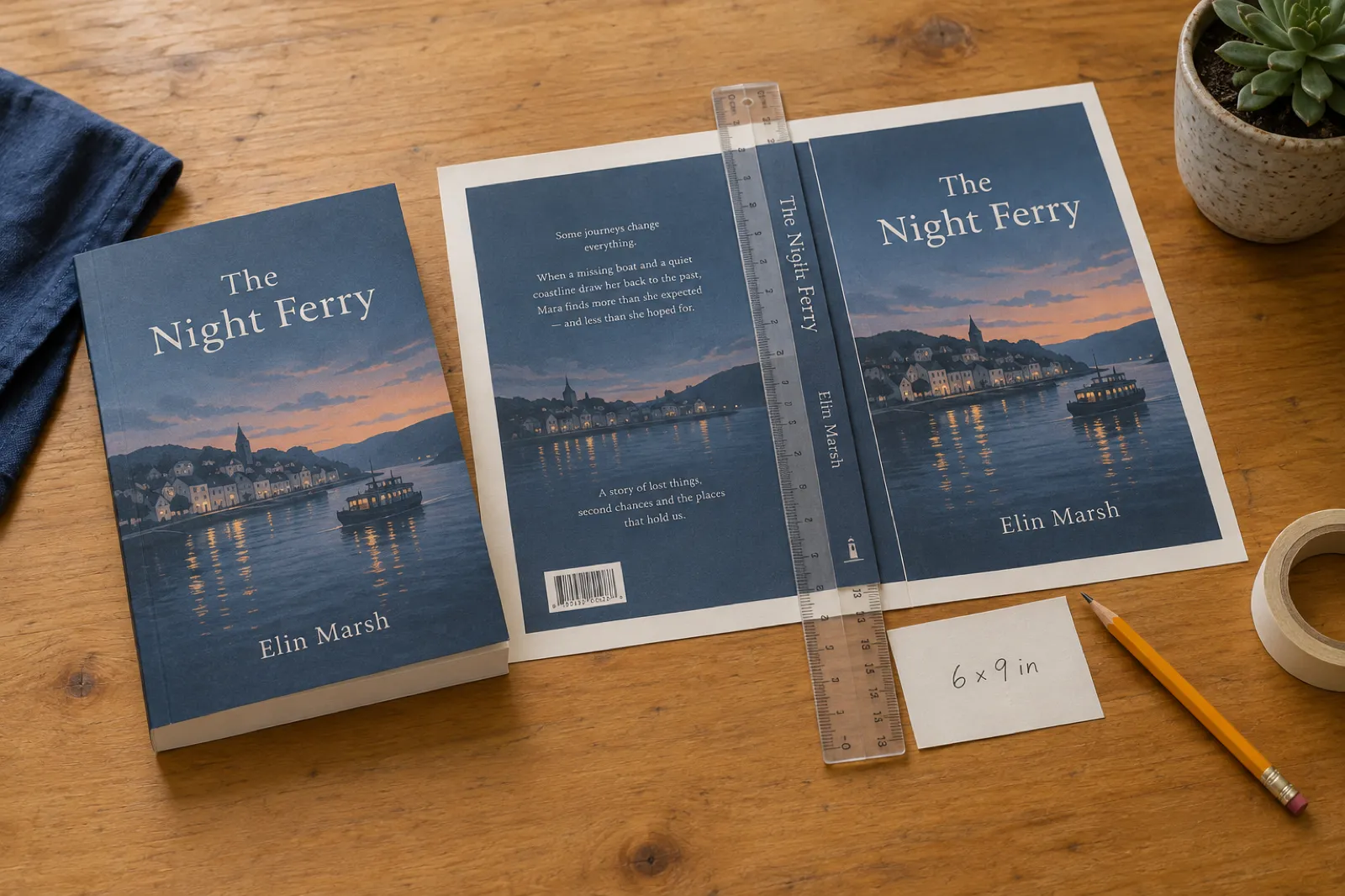
- Build the paperback interior. A print-ready PDF at your trim size (6 x 9 inches is the usual novel trim), with margins that grow with the page count, and bleed only when pictures run to the page edge. See how to format a book for Kindle and our KDP paperback template.
- Make the cover wrap. Front, spine and back as one PDF, with a spine width that depends on the final page count, plus a separate front cover image for the Kindle edition.
In Inkfluence AI, Export, then KDP, then Export KDP Package gives you one zip with each file named for the KDP box it goes in (paperback manuscript, full cover, Kindle cover and manuscript) plus a READ ME FIRST, built to the book's real page count.
Skip the formatting week
Write the book, design the cover, and download every KDP file in one zip. Start free; the KDP package comes with Creator or any credit pack.
Make your book in Inkfluence AIPutting it together
On Free or Go, write with Luna. On Plus, draft with GPT-6.1 Terra, plan and edit with GPT-6.1 Sol, and keep GPT-6 Astra for research-heavy documents, which is how OpenAI itself positions the three. For a whole book, the bottleneck is keeping the outline, the facts and 30 chapters in step, then turning them into store-ready files. That is where a book tool earns its place. Our round-ups of the best AI for writing novels and the best AI book writing software cover the dedicated tools in more depth.
Ready to write the book?
Describe your idea, review the outline, and get chapters written in order with a story bible that keeps track. Start free with 5 chapters.
Write your book with Inkfluence AIFrequently asked questions
What is the best GPT model for writing?
As of 31 October 2026, GPT-6.1 Terra is the best GPT model for most writing. It is the only current OpenAI model described for "clear, natural writing" and costs $1 / $5 per million tokens on the API. In ChatGPT it is in ChatGPT Work on Plus ($20 a month) and higher plans. For long, structured documents, use GPT-6.1 Sol.
Which GPT model is best for creative writing and fiction?
OpenAI makes no fiction or creative-writing claim for any current model. GPT-6.1 Terra carries the only writing claim ("clear, natural writing"), so it is the sensible model for drafting scenes, with GPT-6.1 Sol for planning the plot and checking chapter plans. Test both on the same scene brief first.
Is GPT-6 Astra worth it for writing?
For most writing, no. Astra costs $10 / $50 per million tokens, five times GPT-6.1 Sol and ten times Terra, and Plus users get an estimated 5 to 45 Astra messages per five hours. It can earn its price on a heavily researched report; for chapters and everyday prose, Terra or Sol is the better buy.
Which GPT model is best for writing a book?
For drafting chapters, GPT-6.1 Terra; for the outline and for editing across a whole manuscript, GPT-6.1 Sol. Every current GPT model takes up to 922,000 input tokens on the API, about 690,000 words, so even a long novel fits. A reply is capped at 128,000 tokens including reasoning, so books are still written chapter by chapter. For a whole book with outline, continuity and export handled for you, a book tool such as Inkfluence AI is the better fit.
What GPT model do ChatGPT Free and Go users get?
Luna. OpenAI's release notes say GPT-5.6 Luna became the default ChatGPT model on the Free and Go plans in August 2026, and OpenAI's pricing page lists GPT-6 Luna for Free and Go in the desktop app, subject to rollout. Go costs $8 a month. GPT-6.1 Sol, GPT-6.1 Terra and GPT-6 Astra start at Plus ($20 a month).
Is GPT-6.1 Terra or GPT-6.1 Sol better for writing?
Terra for prose, Sol for structure. OpenAI describes Terra as "a fast, efficient model for clear writing" and Sol as offering "near-Astra performance for complex work at a lower cost". Terra costs half as much per token and can run with no reasoning, which keeps drafting fast; Sol is better for outlines, long reports and whole-manuscript edits.
Can ChatGPT write a whole book?
Yes, in pieces. A whole novel fits in a current GPT model's API context, but each reply tops out at 128,000 tokens including reasoning, and the ChatGPT app gives each plan a smaller working window than the API. Writing one chapter per chat with an outline and a running facts list works. A dedicated AI novel writer automates the outline, the facts list and the export.
What is the best GPT model for essays and non-fiction?
GPT-6.1 Sol for argument-led pieces and long chapters, GPT-6.1 Terra for polishing the prose. Check every fact: OpenAI lists knowledge cutoffs of 30 April 2026 for Astra and Sol, 18 May 2026 for Luna and 1 June 2026 for Terra, so anything later needs a source you supply or a web search.
Sources
All OpenAI facts in this guide come from OpenAI's own pages, each checked on 31 October 2026.
- Models overview: developers.openai.com/api/docs/models, checked 31 Oct 2026
- GPT-6 Astra model page: developers.openai.com/api/docs/models/gpt-6-astra, checked 31 Oct 2026
- GPT-6.1 Sol model page: developers.openai.com/api/docs/models/gpt-6.1-sol, checked 31 Oct 2026
- GPT-6.1 Terra model page: developers.openai.com/api/docs/models/gpt-6.1-terra, checked 31 Oct 2026
- GPT-6 Luna model page: developers.openai.com/api/docs/models/gpt-6-luna, checked 31 Oct 2026
- Using GPT-6 (style prompts, reasoning settings): developers.openai.com/api/docs/guides/latest-model, checked 31 Oct 2026
- API pricing: developers.openai.com/api/docs/pricing, checked 31 Oct 2026
- API changelog (release dates): developers.openai.com/api/docs/changelog, checked 31 Oct 2026
- Key concepts (tokens per word): developers.openai.com/api/docs/concepts, checked 31 Oct 2026
- Reasoning models: developers.openai.com/api/docs/guides/reasoning, checked 31 Oct 2026
- ChatGPT pricing (plans, models, usage estimates): learn.chatgpt.com/docs/pricing, checked 31 Oct 2026
- ChatGPT models guide: learn.chatgpt.com/docs/models, checked 31 Oct 2026
- ChatGPT What's new: learn.chatgpt.com/docs/whats-new, checked 31 Oct 2026
- Amazon KDP content guidelines (AI disclosure): kdp.amazon.com/en_US/help/topic/G200672390, checked 31 Oct 2026
- Book-length figures: Inkfluence AI, sample of 1,200 books finished in the 30 days to 9 Oct 2026, excluding picture and colouring books; word counts summed from chapter text.
Related reading
Best Claude model for writing
The sister guide for Claude models.
Best Gemini model for writing
The sister guide for Gemini models.
Best AI models for novel writing
GPT, Claude and Gemini for fiction.
Inkfluence AI vs ChatGPT
Book tool vs chat assistant.
Inkfluence AI vs Claude
Book tool vs Claude.
AI ebook generator vs ChatGPT
What a book-built tool adds.
AI tools for authors vs ChatGPT
Where author tools go further.
Best AI tools for long novels
Tools that finish 70,000-word books.
Best AI for editing a book
Line edits and consistency.
Best AI ebook generators
Ranked ebook tools.
AI novel writer
Outline, chapters, story bible.
AI book translator
Your book in another language.
AI audiobook generator
Narrate your finished book.

Founder, Inkfluence AI
Sam is the founder of Inkfluence AI. He built the platform to make book creation accessible to everyone - from first-time authors to seasoned publishers.
Helpful links

Ready to write your own book?
Write with AI, make it yours, and export PDF, EPUB and KDP-ready files from one project.
Keep reading
 AI Writing
Which Gemini Model Is Best for Writing? Gemini 4 Argon, 3.1 Pro, 3.8 Flash and Flash-Lite Compared (October 2026)
Which Gemini model should you write with in October 2026? Gemini 4 Argon, 3.1 Pro, 3.8 Flash and Flash-Lite compared on what Google actually publishes: which Google AI plan includes each one, context per plan, API prices, reply limits and what Google says each is for. Plus Gemini Storybook for children's stories, the maths of fitting a whole book, and when a book tool is the better pick.
 AI Writing
NaNoWriMo Alternatives 2026: Every November Writing Challenge, and Which Ones Allow AI
NaNoWriMo closed in 2025, but November is still novel month. Here is every 2026 challenge that replaced it, with dates, goals, prizes, age limits and the one thing other lists leave out: what each challenge says about AI. Plus a word-count planner, a Preptober plan for the last few days of October, and two honest 30-day plans: one for the challenge, one for an AI-assisted November that ends with a published book.
 AI Writing
Prix Pascal: The New Literary Prize for Novels Written with AI, and How to Enter by 30 November 2026
France's new Prix Pascal is a literary prize that asks entrants to say how they used AI instead of hiding it. The rules in plain English, what 300,000 characters means in words and chapters, the technical file, and a five-week plan to submit a French novel on time.

Get ebook tips in your inbox
Join creators getting weekly strategies for writing, marketing, and selling ebooks.