
· Sources checked 22 Oct 2026
Book Publishing Services: What They Sell, What It Costs, and What to Check Before You Pay
By Sam May, Founder of Inkfluence AI
Quick answer
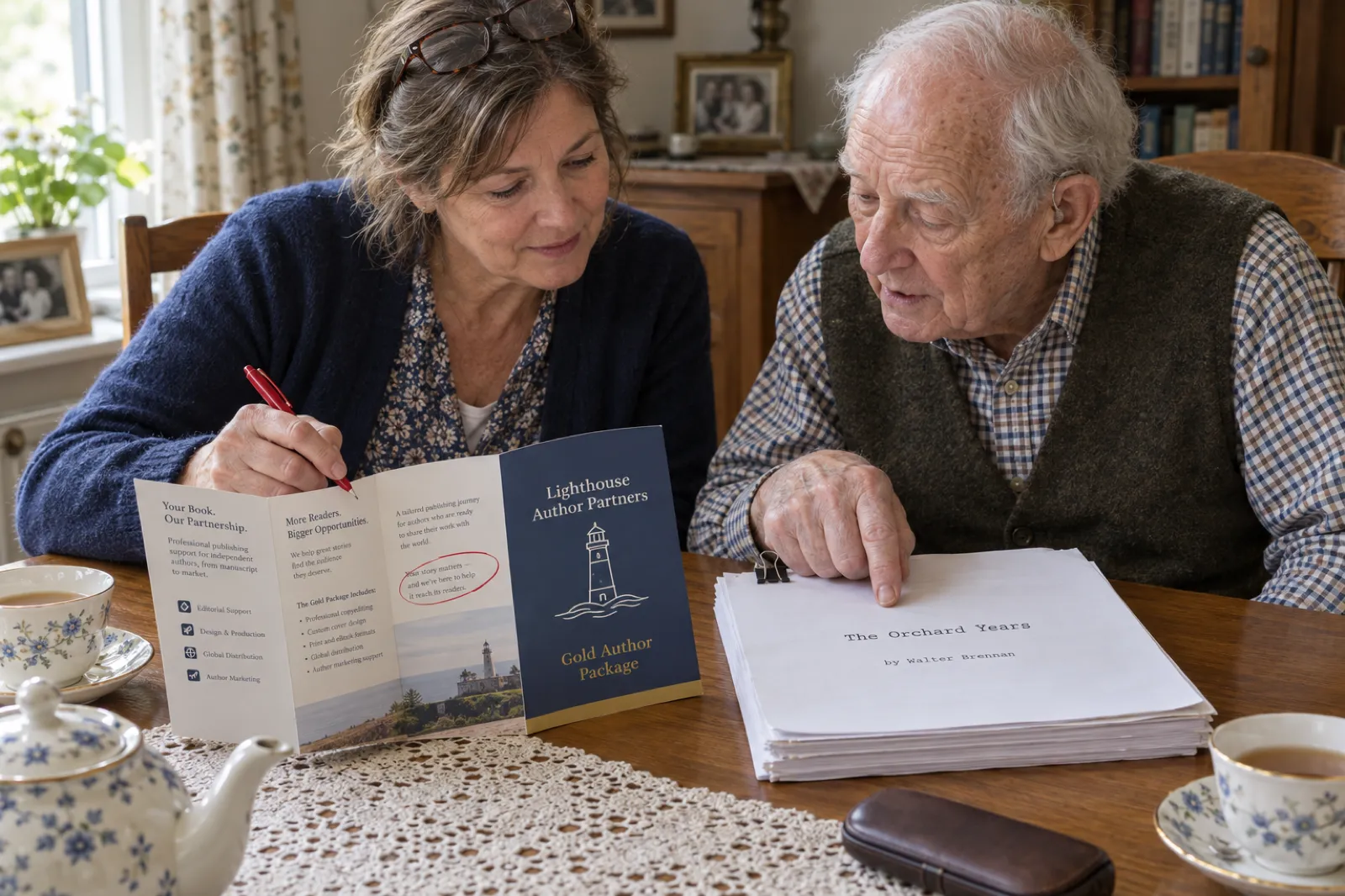
Book publishing services sell editing, cover design, formatting, an ISBN and the setup of your book on stores like Amazon KDP, often bundled into a package with marketing extras. Every one of those jobs can be bought separately or done yourself, and publishing on KDP itself is free, so a fair offer is one where you keep your rights, your Amazon account and all of your royalties. Use the checker below to see which parts of an offer are normal, which to ask about, and which to walk away from.
$0
to open a KDP account and publish a book on Amazon. KDP calls its tools "free and simple".
$3.40
KDP printing cost of a 200-page black-and-white paperback (Amazon.com, before shipping and tax).
60%
KDP paperback royalty at $9.99 or more on Amazon.com, minus printing. It is paid to the account holder.
$930
Median price of a professional cover design (Reedsy, Aug 2026), the line packages most often bundle.
Check a publishing offer
Have the brochure, quote or contract in front of you. Tick what the package includes, then answer the eight questions about the terms. You get a plain verdict on each answer and what the same work costs bought separately or done yourself. It runs in your browser; nothing is sent anywhere.
You are asked to pay
-
Same work, hired separately
-
Done yourself
-
Verdict
Answer the questions above to see a verdict.
| Item in the package | Hired separately | Done yourself |
|---|
Rates, checked 22 Oct 2026 unless marked: editing at the Editorial Freelancers Association 2026 median ranges for fiction (nonfiction runs higher; see our book editing cost guide, checked 13 Oct 2026); cover design median and interior formatting average from Reedsy (updated 13 Aug 2026); one ISBN from Bowker, $125 (checked 13 Oct 2026); marketing $60 to $1,500 (Reedsy); author copies at KDP's Amazon.com printing cost for a black-and-white paperback at a regular trim, before shipping and tax. "Done yourself" counts one month of Inkfluence AI Creator ($9.99) whenever an editing, cover or formatting item is ticked. The verdicts are general guidance, not legal advice; a contract is worth reading with someone you trust.
The six ways a book gets published
"Book publishing services", "self-publishing companies" and "author services" are marketing words, not legal categories. Under them sit six models, and the difference between them is who pays whom. Jane Friedman, whose publishing paths chart has been updated every year since 2013, says her chart's logic "is driven primarily by how the money works". That is the right way to sort any offer you are holding.
1. DIY self-publishing
You publish through the platforms directly: Amazon KDP, IngramSpark, Draft2Digital and others. Setting a book up on KDP and IngramSpark is free; Draft2Digital now charges new accounts a one-off $20. You do the work or hire help, and you own everything.
2. Freelancers you hire yourself
Still self-publishing, but you pay individual editors, cover designers or formatters, found directly or through a marketplace such as Reedsy. You pay for work, not for "publishing", and you still upload to your own accounts.
3. Assisted self-publishing ("author services")
A company sells a package that bundles the jobs and handles the upload. Good ones itemise prices, put the book in your name and take no share of sales. Writer Beware's summary: buying a package "may be easier but can be expensive".
4. Hybrid publishers
They charge a fee, sign an exclusive contract, and say they are selective. Writer Beware: "The only thing you can know for sure about a self-styled hybrid is that it will charge you a fee."
5. Vanity (subsidy) presses
They charge to produce a book and publish nearly anything. Some, Writer Beware notes, "require you to buy a quantity of finished books". Many earn their money from authors rather than from readers.
6. Traditional publishers
They pay you. Writer Beware puts it simply: "There's no cost to the author: the publisher takes on the entire financial risk." Most take submissions only through a literary agent, and they choose very few books.
Publishing models compared: who pays, who owns, who earns
The six models side by side. Package and hybrid prices vary too much for one figure, so the table quotes each source's own range.
| Model | Who pays whom | Typical cost to you | Rights | Royalties | Control and pace |
|---|---|---|---|---|---|
| DIY on KDP, IngramSpark, Draft2Digital | Stores pay you | $0 to publish; you choose any spending. Draft2Digital: $20 once, $12 a year under $100 of sales | All yours | KDP: 60% of a paperback's price minus printing (at $9.99 or more), 35% or 70% on ebooks | Full control. KDP says books appear on Amazon in about 72 hours |
| Hired freelancers | You pay each freelancer; stores pay you | Reedsy: $2,940 to $5,660 for a fully professional book (Aug 2026) | All yours | All yours | Full control; weeks to months, set by the freelancers' calendars |
| Assisted self-publishing | You pay the company; stores should pay you | "Cost varies" (Friedman); a few hundred dollars to tens of thousands | Should stay yours; check the contract | "The best services do not take a cut of sales" (Friedman) | Shared; set by the company's schedule |
| Hybrid publisher | You pay the publisher; it pays you a royalty | "Low four figures to well into the five figures" (Friedman); $25,000 is her rule of thumb with a print run | Exclusive contract | A share, usually higher than traditional | Shared; often many months |
| Vanity press | You pay; sometimes you also buy copies | A fee "to produce a book" (SFWA), plus any required copies | Often exclusive | A share set by the press | Limited; the press sets price and design |
| Traditional publisher | Publisher pays you | Nothing. "The author does not pay for editing, design, printing" (Friedman) | Licensed to the publisher, usually long term | Advance, then royalties once it earns out | Least control; the longest road, usually with an agent first |
Sources: KDP help and home page, Draft2Digital FAQ, Reedsy cost to self-publish (updated 13 Aug 2026), Jane Friedman's Key Book Publishing Paths 2025-2026 (updated 8 Jul 2026), SFWA Writer Beware. All read 22 Oct 2026. Full list under Sources.
Three of these models leave the book entirely in your hands, and two of those cost nothing to publish. For the KDP and IngramSpark trade-off itself, our IngramSpark vs KDP comparison shows what each pays per copy, and the self-publishing statistics page shows how many authors now take the do-it-yourself road.
How money should flow: towards the author
Writers' advocates have repeated one rule for decades: in publishing, money flows towards the author. A publisher pays you for the right to sell your book. A service you hire is paid once for a defined piece of work, and then your book earns for you. Problems start when both happen at once, when a company charges you up front and then also keeps part of what the book earns, or holds your book so you cannot leave.
Paying for work is not the problem. Editors, cover designers and formatters are skilled people and deserve their fees. The question is whether the payment buys work at a fair price, with the results handed to you, or whether it buys a relationship in which the company keeps control of the book. Jane Friedman draws the line clearly: "The best services do not take a cut of sales or pay royalties. Author earns 100 percent net on book sales."
On Amazon the money trail is easy to follow. KDP pays royalties to the bank account in the KDP account that published the book. A paperback earns 60% of its list price minus printing at $9.99 or more on Amazon.com (50% below that), and an ebook 35% or 70% depending on the option you choose. Our KDP royalties guide works through the examples, and the royalty calculator does the sums for any price. Whoever holds the account holds the money and the sales reports, so that is the single most important question to ask any service that promises to publish your book on Amazon.
What a package buys you, line by line
Take any publishing package apart and you find the same nine lines. Here is what each one is, what it costs when you buy it on its own, and how you can do it yourself. The prices are for a reference book of 80,000 words, about 200 printed pages, with 25 author copies. The full cost of publishing, with a calculator for your own book, lives on our how much it costs to publish a book page; editing rates by type and genre are in the book editing cost guide, which these figures come from.
| Line | Bought on its own | Source | Do it yourself |
|---|---|---|---|
| Developmental edit | $2,400 to $2,800 | EFA 2026 median, fiction | Whole-book review with an editorial letter (Creator) |
| Copyedit | $1,600 to $2,160 | EFA 2026 median, fiction | Chapter reviews with fixes you apply or dismiss |
| Proofread | $960 to $1,600 | EFA 2026 median, fiction | Proofread on a selection, then read your own proof copy |
| Cover design, front, spine and back | $930 | Reedsy median, Aug 2026 | Cover designer, including the paperback full wrap |
| Interior formatting, print and ebook | $800 | Reedsy average, Aug 2026 | KDP package: print interior PDF and Kindle EPUB |
| ISBN | $125 | Bowker, one ISBN, US | Free KDP ISBN for the paperback |
| Store setup and distribution | $0 to $20 | KDP and IngramSpark free; Draft2Digital $20 once | Your own KDP account, free |
| Marketing package | $60 to $1,500 | Reedsy marketing range, Aug 2026 | Description, launch list and your own outreach |
| Author copies | $85 | KDP printing cost, before shipping and tax | Order at printing cost from your KDP account |
| All nine lines | $6,960 to $10,020 | Sum of the rows | $94.99: one month of Creator plus printing for 25 copies |
Editing: EFA 2026 median ranges for fiction (via our editing guide, checked 13 Oct 2026). Cover and formatting: Reedsy's median and average (updated 13 Aug 2026). ISBN: Bowker, US (checked 13 Oct 2026). Author copies: KDP printing cost, $3.40 each, shipping and tax extra. Nonfiction editing costs more per word.
Editing: the line most worth paying for
Editing is real work and usually where a package's price goes. There are three kinds. A developmental edit looks at the whole book: structure, order, what is missing. A copyedit fixes grammar, consistency and word choice line by line. A proofread is the last check on the laid-out pages. At the EFA's 2026 median ranges for fiction, a copyedit of 80,000 words costs $1,600 to $2,160; all three edits together are about $5,000 to $6,600. Ask any package exactly which of the three it includes. "Editing" in a brochure can mean a light proofread.
An AI first pass is the cheapest way to find out what the book actually needs. Our AI manuscript editor reviews chapter by chapter, and on Creator a whole-book review writes an editorial letter naming the three or four themes that matter most, which you can take to a human editor so you buy only the edit you need. For structure, the AI developmental editor page shows what that kind of read looks like.
Cover, formatting and ebook conversion
Reedsy puts the median professional cover at $930 and interior design at about $800 on average, adding that interior design "can usually be done for free" with software. A paperback cover is three panels, back, spine and front, and the spine width depends on the page count and paper; our KDP cover size and spine width guide shows the maths. The ebook is a separate EPUB file. Formatting tools such as Atticus and Vellum make the interior, and the book formatting software comparison sets them side by side with Inkfluence AI.
ISBN and distribution: usually free
KDP gives you a free ISBN for paperbacks and hardcovers. KDP's help page is clear about the limits: "Free ISBNs from us can only be used on KDP", and "the imprint will appear as 'Independently published.'" To use your own imprint, or to sell the same edition through IngramSpark, buy your own; one costs $125 from Bowker in the US. Our guide do you need an ISBN covers every country. Setting the book up on KDP and IngramSpark is free, so a package that charges for "distribution" is charging for the time it takes to fill in forms you can fill in yourself.
Marketing extras and author copies
This is where packages differ most from buying the work separately. Writer Beware says "almost all self-publishing service providers sell marketing services and packages", and that for writers "they are rarely worth their often exorbitant price tags." Press releases, book videos, award entries and trade-fair stands cost the provider little and are hard to measure. Reedsy's marketing range of $60 to $1,500 covers what tends to work, such as a strong description and targeted ads; our ebook marketing guide covers them.
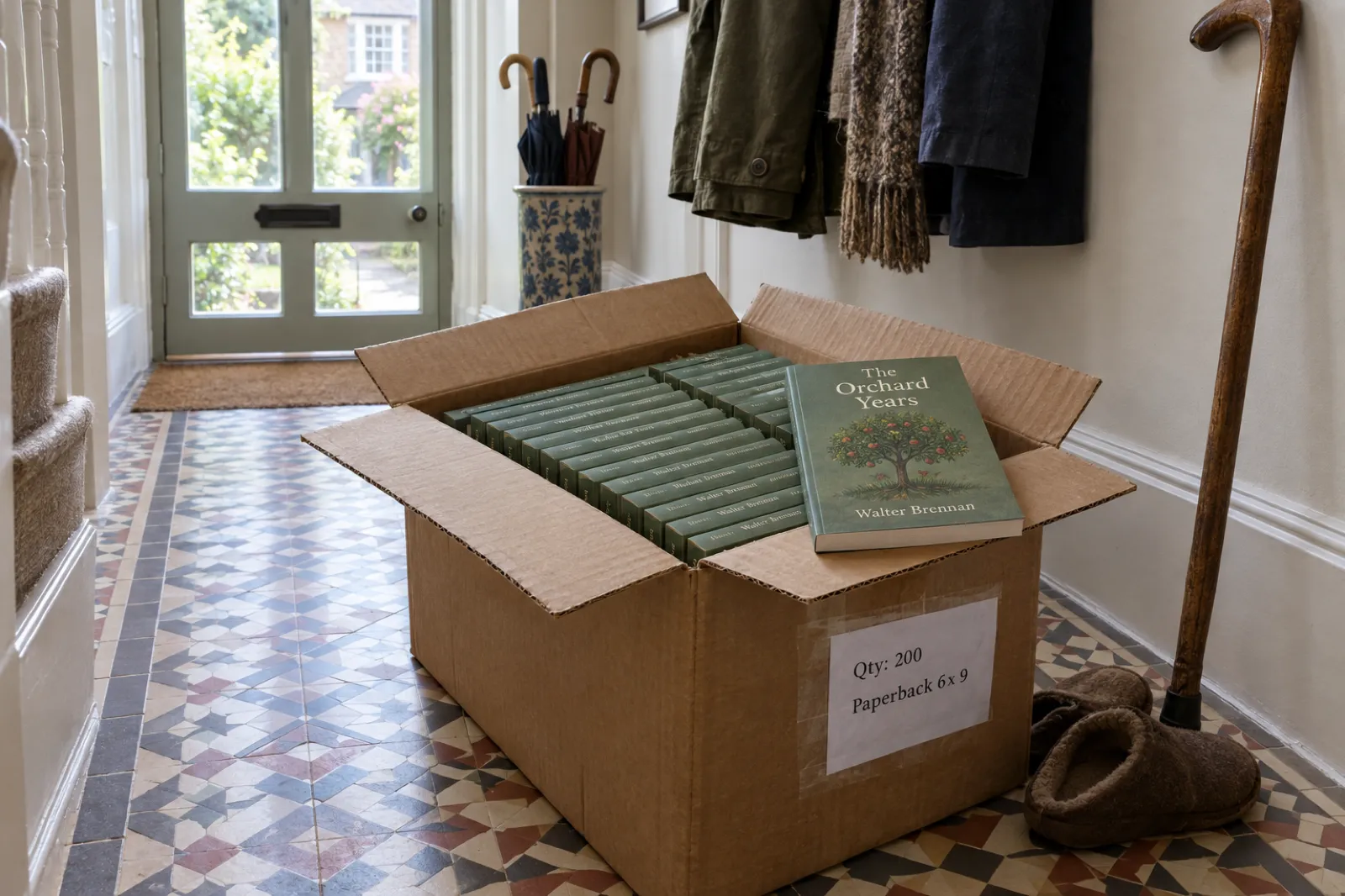
Author copies are where the money is easiest to check. On KDP you order copies of your own book at printing cost plus shipping and tax: KDP's help says "The author price can be calculated by multiplying the printing cost for your book in your selected marketplace" by the number of copies. A 200-page black-and-white paperback prints for $3.40 on Amazon.com. If a package sells you copies at $10 or $15 each, you can see the markup at once.
Red flags to check before you pay anyone
None of these alone proves a company is dishonest. Each is a pattern the watchdogs report again and again.
- They found you. The Authors Guild's first rule of thumb: "if someone solicits you out of the blue with an offer that seems too good to be true, it probably is." Traditional publishers "rarely approach authors out of the blue", least of all about a book already on Amazon.
- The price only appears on a call. ALLi's 2026 scam guide lists vague pricing, held back until a sales call, as a way to commit you emotionally before you see the numbers. Writer Beware: "The exact amount you are expected to pay should be stated at the outset (and included in the contract)".
- The discount expires today. "Legitimate services don't need to rush you," says ALLi. Sleep on any offer for a week.
- A publisher that wants money. "Traditional publishers will not ask you to pay them up front" (Authors Guild). If a company calls itself a publisher and asks for a fee, it is a paid service, and you should judge it as one.
- Guarantees. Bestseller status, a set number of sales, a film option, a review in a famous paper. ALLi: "No one can guarantee this."
- Your royalties, shared. A fee up front plus a share of sales means paying twice.
- The book in their Amazon account. You cannot see sales and depend on them to pay you.
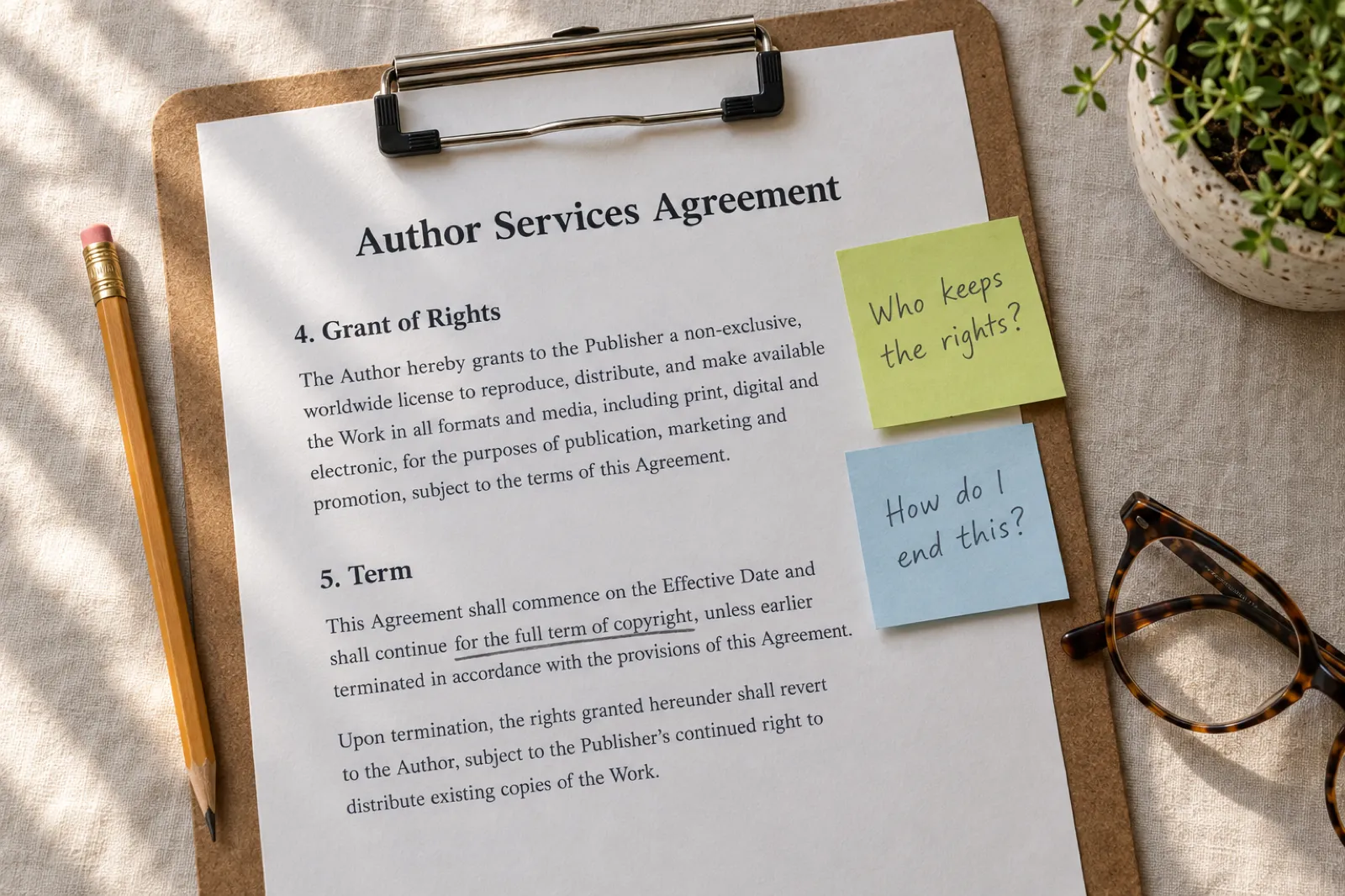
- Rights for life. A paid service holding exclusive rights for the full term of copyright, with no clear exit.
- Copies you must buy. A required purchase of your own books, often above printing cost.
- Reviews only on one site. ALLi warns that pages of five-star reviews on a single review site, with no independent mentions anywhere else, prove little.
A last pattern hurts people twice. ALLi describes "victim retargeting": after a bad experience, someone posing as a law firm or an investigator offers to recover the lost money, for a fee. Genuine help does not ask for money up front.
Where to check a company before you sign
Four organisations do this work for free. A ten-minute search of all four is the cheapest insurance an author can buy.
Writer Beware (SFWA)
Sponsored by the Science Fiction and Fantasy Writers Association, it investigates and exposes bad practice across publishing. Search its blog for the company's name and read its pages on vanity and hybrid publishers and on self-publishing. Complaints go to beware@sfwa.org.
ALLi Watchdog Desk
The Alliance of Independent Authors rates self-publishing services from Excellent (Partner) through Recommended, Mixed and Caution to Watchdog Advisory. The ratings are, in ALLi's words, "the informed opinion" of its Watchdog Desk, and you can write to the desk about any service in confidence.
The Authors Guild
Its "Avoiding Publishing Scams" guide (April 2026) explains impersonation, fee-for-review offers and lookalike email addresses, and it asks authors who have met a scam to email staff@authorsguild.org. It is pressing governments to protect "especially elderly and vulnerable authors".
The FTC
In the US, report fraud and bad business practices at ReportFraud.ftc.gov. In July 2026 the FTC finalised a $1.5 million order settling allegations that a self-publishing course company misled buyers about how much they would earn, a reminder that earnings promises deserve proof.
Look for a pattern across several sources rather than one angry review. Complaints on Writer Beware, a Caution or Watchdog Advisory rating from ALLi and a sales script that matches the red flags above tell you something. Itemised prices, sample books you can buy and a contract that leaves your rights alone describe a different kind of business.
Publishing on Amazon yourself: what it actually takes
"Amazon book publishing services" sell something Amazon gives away. KDP's home page describes "free and simple tools to self-publish your book" and says books "appear on Amazon stores around the world in 72 hours." You "retain ownership of your content", and KDP "gives you control over your book's content, design, price, audience, and advertising." Here is the whole job, checked against KDP's help pages on 22 Oct 2026.
- Open the account. KDP's setup page: "start by signing in to kdp.amazon.com using your Amazon customer account." Then enter author, payment and tax information. Use the author's own Amazon account and bank details. There is no fee.
- Finish the manuscript. Edit it, decide on the trim size (6 x 9 inches suits most nonfiction and memoir; see the trim size guide) and settle the page count.
- Make three files. A print interior PDF with the right margins, a full wrap cover PDF (back, spine and front) sized to that page count, and an EPUB for the Kindle edition. Our guide to formatting a book for KDP lists the requirements.
- Set up the paperback. On your Bookshelf, enter title, author, description and keywords, choose the free KDP ISBN or enter your own, upload the interior and cover, and set the price. The book description generator helps with the back-cover text that also goes on the Amazon page.
- Order a proof. KDP says ordering a proof "is not mandatory, although it gives you the option to see your book in person before publishing." For a first book, it is worth every cent. Proofs cost printing plus shipping.
- Publish, then add the ebook. Set up the Kindle edition with the EPUB and the same details. If you used AI to write or edit, answer KDP's AI content question honestly; our KDP AI disclosure guide explains what it asks.
KDP limits new titles to two per format each week, which no first-time author will meet. If a title is held back, our guide to why KDP rejected a book covers the usual causes. The long version of this checklist, with screenshots, is the step-by-step KDP self-publishing guide, and the paperback publishing lesson follows a book from export to print. To reach bookshops and libraries as well, set up IngramSpark alongside KDP; its cost calculator shows the printing and fees.
Where Inkfluence AI fits: the best do-it-yourself route
Inkfluence AI is a tool, not a publisher. It does the work that most packages charge for, editing help, the cover, the formatting and the files, and leaves the publishing, the account and the money with you. You upload the files to your own KDP account; Inkfluence takes no rights and no share of royalties. Here is what it does for an author who already has a manuscript, checked in our product on 22 Oct 2026.
Bring the manuscript in
Import a Word document, PDF, EPUB or plain text file and it is split into chapters in the editor. Word files with Heading 1 for chapter titles come in cleanest. The import walkthrough shows it start to finish.
Edit with AI Assist
Review a chapter for clarity, pacing, repetition, continuity and grammar, then apply or dismiss each fix. Proofread any passage. On Creator and Premium, a whole-book review writes an editorial letter. The AI book editor page shows a real review.
Design the cover
The cover designer makes the front cover and, for the paperback, the full wrap: back cover with your description, a spine sized to the page count and paper, and bleed. See the AI book cover generator.
Export the KDP package
One download with the print interior PDF at your trim size with mirrored margins, the full wrap cover PDF, the front cover image and the Kindle EPUB, plus a note saying which file goes in which KDP slot. Any paid plan or credit pack unlocks it.
Add an audiobook
Narrate the book with AI voices: 15 audiobook chapters a month on Creator and 30 on Premium. The AI audiobook generator page has samples.
Pay a small, known price
Creator is $9.99 a month ($89 a year); Premium is $19.99 a month ($179 a year). The free plan covers 5 chapters and PDF export, enough to try the editor on a real book. Credit packs start at $9.99. Full details on pricing.
Put the two side by side. The example package in the checker charges $4,000 for a copyedit, proofread, cover, formatting, ISBN and Amazon setup on a 60,000-word memoir. Bought from freelancers at published rates, that work costs about $3,775 to $4,695, so $4,000 is not outrageous if the work is good and the terms are fair. Done here, with one month of Creator and the free KDP ISBN, the same list costs $9.99, and the book is in the author's own account from day one. For an outline of the whole route from idea to bookshelf, the self-publishing guide puts every step in order.
When a paid professional is worth it
Doing it yourself is not always right. Pay a person when:
- The structure is in doubt. If readers lose the thread, or you are unsure the chapters are in the right order, a human developmental editor's judgement is worth the money. An AI review first tells you whether you need one.
- The prose is the point. Literary fiction and poetry, where every sentence carries voice, benefit most from a skilled line editor.
- The facts carry risk. Medical, legal or financial content, or a memoir that names living people, deserves an expert's read and sometimes legal advice.
- The cover must compete. In crowded genres such as romance or thrillers, a genre-specialist designer knows what sells. Hire one for the cover and do the rest yourself.
- Time matters more than money. Some authors simply would rather pay. That is a fair choice when the work is itemised, the price is known and the book stays in your name.
In every case, hire the person for the job, not a package for the whole book. A freelancer you choose for one job gives you that job's files and nothing to unpick later. Our real cost of publishing breakdown shows three realistic budgets, from almost nothing to a fully professional release, and the AI beta reader page explains a cheap way to hear how readers react before you spend on an editor.
Helping an older relative publish their book
Many first books come late in life: a memoir, a family history, poems, or the novel someone has carried for fifty years. Those authors are also who paid offers aim at; the Authors Guild names "especially elderly and vulnerable authors" as the group it wants protected. A family can help without taking over, keeping the book and the decisions with its author.
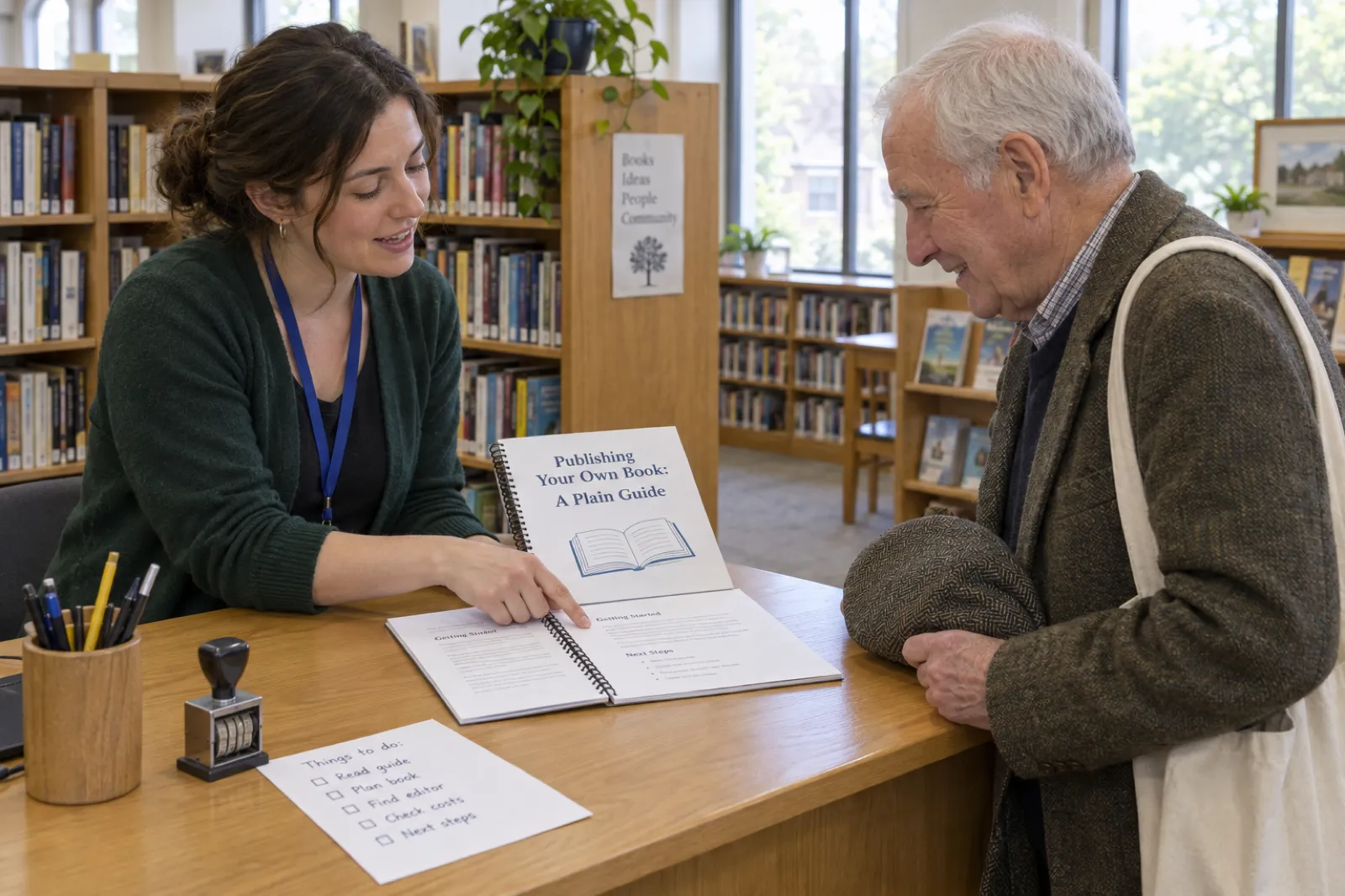
- Ask what they want. Copies for the family, a book on Amazon, or both? A few printed copies for grandchildren need no publisher at all: our guide to printing one copy of a book covers the options, and the book for grandparents page shows a gift version.
- Read any offer together, slowly. Use the checker on this page with the brochure on the table. Agree a rule: nobody signs or pays on the day of a call.
- Keep the account in their name. Open the KDP account with the author's own Amazon login and bank details. Sit beside them; do not use your own account. Turn on two-step sign-in with their phone.
- Keep copies of everything. The manuscript, every edited version, the cover files and the final PDFs, saved in two places.
- Agree a budget first. Decide how much is worth spending, and on what, before anyone calls with an offer.
- Hold the proof copy together. Order a proof before publishing. Seeing the book in print is often the moment that matters most.
If the book is a life story, our guide to writing a memoir with AI helps shape recorded memories and old notes into chapters, and the first-time authors page gathers the beginner guides in one place.

If you have already paid a publishing company
Many authors who pay for a package are happy with the book. If you are unsure what you bought, these steps put you back in control.
- Ask for the list in writing. Every item you paid for, its status and its delivery date.
- Ask for the files. The edited manuscript, the print-ready interior PDF, the cover files and the ebook. If you own them, you can publish them anywhere later.
- Ask where the book lives. Which Amazon account, whose ISBN, and who sets the price. If it is in their account, ask how and when royalties are reported and paid.
- Read the exit clause. How the contract ends, and what you get back when it does.
- If something is wrong, act quickly. Contact your card issuer about a disputed charge, and report the company to Writer Beware, the ALLi Watchdog Desk, the Authors Guild and, in the US, ReportFraud.ftc.gov.
- Ignore recovery offers. Anyone who contacts you offering to get your money back for a fee is a second scam, not help.
If you take the book back, you can republish it yourself from the files. A new edition under your own account needs its own ISBN (KDP's free one is fine), and the ebook launch checklist covers the relaunch.
Book publishing services: frequently asked questions
What do book publishing services do?
They sell the jobs that turn a manuscript into a book on sale: editing, cover design, formatting for print and ebook, an ISBN, setup on stores such as Amazon KDP and IngramSpark, and often marketing extras and printed copies, separately or as one package. Every job can also be bought from a freelancer or done yourself, and the stores charge nothing to set a book up.
How much do self-publishing services cost?
Packages run from a few hundred dollars to tens of thousands. Jane Friedman's 2025-2026 publishing paths chart says paid and hybrid publishing costs vary from low four figures to well into five figures. Bought separately, the main jobs for an 80,000-word book cost about $6,960 to $10,020 at published freelance rates (editing at EFA 2026 medians, cover and formatting at Reedsy's figures). Done yourself on KDP with Inkfluence AI, the same jobs cost one month of Creator at $9.99 plus printing for any copies you order.
Is it worth paying a company to publish my book on Amazon?
Paying for skilled work such as editing or a cover can be worth it. Paying someone to "publish on Amazon" usually is not, because the publishing itself is free: a KDP account costs nothing, KDP gives a free ISBN for paperbacks, and the upload takes an afternoon. If you do pay, make sure the book goes into your own KDP account so that Amazon pays your royalties to you.
How do I know if a publisher is a scam?
Check how money flows: the Authors Guild says traditional publishers will not ask you to pay up front. Warning signs include a price revealed only on a sales call, a discount that expires today, guaranteed sales, a required purchase of your own books, a cut of royalties on top of a fee, and an offer out of the blue. Search the name on Writer Beware and check the ALLi service ratings before paying.
What is the difference between a vanity press and a hybrid publisher?
Both charge the author. Writer Beware (SFWA) defines a vanity or subsidy publisher as one that charges a fee to produce a book, and notes that some require you to buy a quantity of finished books. A hybrid publisher also charges and takes an exclusive contract, but is selective about what it publishes and earns from both services and book sales. The label alone tells you little: judge the contract, the price, the rights and who owns the accounts.
Do I need an ISBN to publish on Amazon?
A Kindle ebook needs none. A KDP paperback or hardcover needs one, and KDP gives you one free; it shows the imprint as "Independently published" and works only on KDP. To use your own imprint or sell the same edition through IngramSpark, buy your own: one ISBN costs $125 from Bowker in the US.
Who should own the KDP account?
The author. Amazon pays royalties to the bank account in the KDP account and shows the sales reports there. If a service publishes your book in its own account, you depend on it to pass on what you earned. If someone sets up an account for you, change the password and check that the bank and tax details are yours.
What does Inkfluence AI charge, and does it take royalties?
Inkfluence AI is a writing and formatting tool, not a publisher. The free plan covers 5 chapters and PDF export. Creator is $9.99 a month ($89 a year) and Premium $19.99 a month ($179 a year); the KDP export package (print interior PDF, full wrap cover PDF and Kindle EPUB) comes with any paid plan or credit pack. You upload the files to your own KDP account and keep all rights and all royalties. Inkfluence takes no share of sales.
I already paid a publishing company. What should I do now?
Ask in writing for an itemised list of what you paid for, copies of every file, and which Amazon account and ISBN the book uses. If something is wrong, contact your card issuer promptly and report the company to Writer Beware (beware@sfwa.org), the ALLi Watchdog and ReportFraud.ftc.gov. Ignore anyone who offers to recover the money for a fee.
Can an older first-time author self-publish on their own?
Yes, with a little help on the first upload. It takes an Amazon account, a finished manuscript, a cover and a few form fields on KDP. A family member can sit alongside while the author keeps the account, the decisions and the royalties, and a printed proof lets the author check the book in hand.
Sources
Read on 22 Oct 2026 unless another date is shown. Quotations are from these pages. Platform terms and prices change; if a figure here and the platform's own page disagree, the platform's page wins.
- Writer Beware overview, SFWA: vanity publishers "concealing their fees, breaking contract terms"; hybrid publishers.
- Writer Beware: Vanity, Subsidy and Hybrid Publishers (page updated 27 Dec 2025): definitions, required copy purchases, "no cost to the author" in commercial publishing, stating fees at the outset.
- Writer Beware: Self-Publishing (page updated 28 Dec 2025): packages, marketing services "rarely worth their often exorbitant price tags", free options.
- Writer Beware blog: search for any company by name.
- ALLi: How to Spot a Publishing Scam in 2026 (1 Jun 2026): manufactured reviews, pressure, vague pricing, guarantees, victim retargeting.
- ALLi Service Ratings and ALLi Watchdog: rating categories, confidential enquiries.
- Authors Guild: Avoiding Publishing Scams (2 Apr 2026): unsolicited offers, no upfront payment to traditional publishers, elderly authors.
- Jane Friedman: The Key Book Publishing Paths 2025-2026 (updated 8 Jul 2026): paid and hybrid cost ranges, "the best services do not take a cut of sales".
- FTC press release, 2 Jul 2026: final order over self-publishing earnings claims. ReportFraud.ftc.gov for reports.
- KDP home page: free tools, 72 hours, ownership and control. Set up your KDP account.
- KDP: What is an ISBN and imprint? (free ISBN, KDP only, "Independently published").
- KDP: Paperback royalty (60% at $9.99 or more on Amazon.com, 50% below), eBook royalties (35% and 70%), Paperback printing cost ($1.00 + $0.012 a page, black ink, regular trim), author copy pricing, Create a book (proofs, weekly title limits).
- Draft2Digital FAQ: $20 activation fee, $12 annual fee under $100 of sales, about 10% of retail, no rights acquired.
- Reedsy: How much does it cost to self-publish a book? (updated 13 Aug 2026): $2,940 to $5,660 total, $930 median cover, $800 average interior design, $60 to $1,500 marketing.
- Editing rates: Editorial Freelancers Association 2026 Rate Chart, as compiled in our book editing cost guide (checked 13 Oct 2026). ISBN prices: Bowker, via our ISBN guide (checked 13 Oct 2026).
Amazon, Kindle and KDP are trademarks of Amazon.com, Inc. IngramSpark, Draft2Digital, Reedsy, Atticus and Vellum are trademarks of their owners. Inkfluence AI is an independent tool and is not affiliated with or endorsed by any of them. This page is general information, not legal or financial advice.
Related guides and tools
How Much Does It Cost to Publish a Book?
The publishing cost calculator for your own book.
Book Editing Cost 2026
EFA, Reedsy and CIEP rates by edit type and genre.
How to Self-Publish on Amazon KDP
The full walkthrough, account to live book.
Do You Need an ISBN?
Free KDP ISBNs against buying your own, by country.
Book Royalty Calculator
What each store pays you per copy.
IngramSpark Cost Calculator
Printing, author copies and fees for bookshop distribution.
IngramSpark vs KDP
Which platform pays more for which book.
Self-Publishing Guide
Every step from idea to bookshelf, in order.
AI Manuscript Editor
Review an existing manuscript chapter by chapter.
AI Book Cover Generator
Front cover and paperback full wrap.
The Real Cost of Publishing a Book
Three realistic budgets, line by line.
KDP Select vs Wide Distribution
Amazon only, or every store.
Your book, your account, your royalties.
Edit the manuscript, design the cover and export the files KDP asks for, then publish under your own name. Free to start; Creator is $9.99 a month when you are ready for the KDP package.
Start your book on Inkfluence AI