
Quick answer (checked 13 November 2026)
- Cheapest to start: Amazon Ads for Kindle books ($1 minimum daily budget), Etsy Ads for printables and downloads (pay per click, daily budget up to $25 when you start) and BookBub Ads (campaigns from about $10).
- Cheapest clicks from outside a store: Meta (Facebook and Instagram) traffic ads, at a $0.60 average click and $0.34 for Arts & Entertainment in WordStream's 2026 US benchmarks.
- Most expensive per click: Google search ads, $5.42 on average ($1.63 for Arts & Entertainment).
- Highest minimum: TikTok, where a campaign's daily budget must exceed $50.
- Pinterest publishes no prices: you set the budget and bids, so test small.
- The number that decides all of it is your break-even cost per click. Work yours out below.
Ads only pay off on a product people want, with a page that sells it. Inkfluence AI is the best way to make that product: it writes the whole ebook, workbook or guide from an outline you approve, designs the cover, and exports the PDF, EPUB and KDP files each store asks for, so your ad budget goes on selling instead of producing. What it does, and its limits.
Make my product free"Low-cost advertising" means two different things, and mixing them up is how small sellers lose money. One is a low minimum: how little you can spend to run a test at all. The other is a low cost per sale: how much each buyer costs you once the test is running. A platform with a $1 minimum can still lose money on every click, and a platform with a $50 minimum can be profitable. This guide covers both for the seven platforms most sellers of ebooks, printables, templates and courses ask about, and gives you a calculator for the second one. If you are still choosing a product, fitness and mental health digital product ideas covers one of the simplest niches to start in.
Every cost on this page comes from a dated source: the platform's own help pages, BookBub's published price table, or WordStream's annual benchmark reports, which are built from samples of real US campaigns. Where a platform publishes nothing, we say so and explain how to find your own number with a small test, rather than repeat a figure nobody can check. All sources were read on 13 November 2026 and are listed at the end.
Disclosure: Inkfluence AI is our product. It makes ebooks, workbooks, covers and audiobooks; it does not sell advertising, and we earn nothing from any platform named here.
The one number that decides: your break-even cost per click
Every ad platform sells you attention, priced per click or per thousand views. What you can afford to pay depends on two things you already know or can measure: what you keep from one sale, and how many clicks it takes to make one.
- What you keep per sale is your price minus the store's cut. A Kindle ebook between $2.99 and $12.99 on the 70% royalty keeps 70% of the list price, less a small delivery charge. An Etsy digital download in the US keeps about 90.5% of the price, less $0.45 in fixed fees. A Gumroad direct sale keeps about 87.1%, less $0.80.
- Your conversion rate is the share of ad clicks that buy. It depends on your page, your price and how well the ad matches the product. Nobody can tell you yours in advance; a test of a few hundred clicks will.
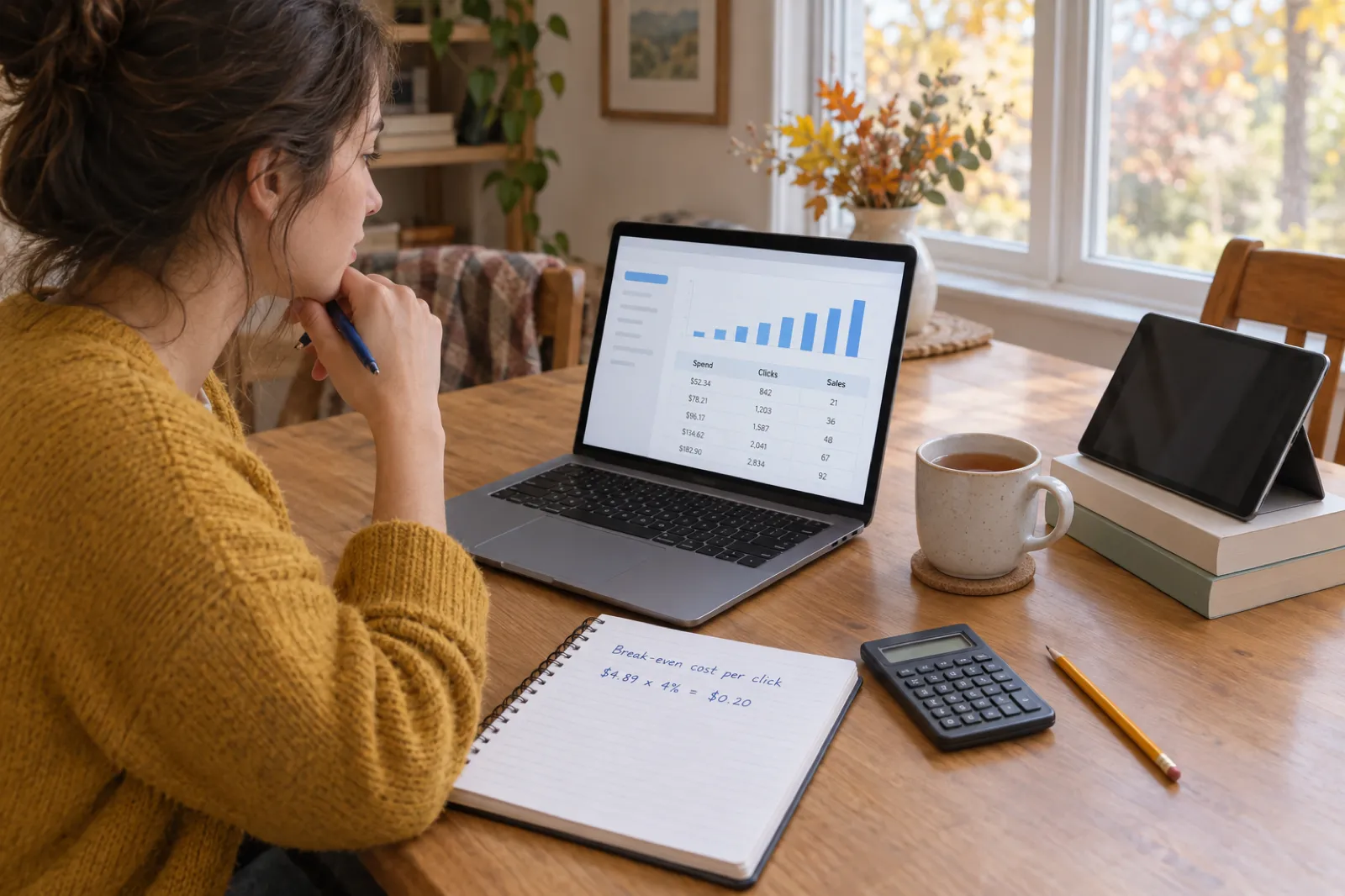
Multiply the two and you have your break-even cost per click (CPC). If you keep $4.89 a sale and 4 in 100 clicks buy, each click is worth about $0.20 to you. Pay $0.20 and you break even. Pay $0.25 and you lose about $0.05 every click, whichever platform you are on. The same sum works for platforms that charge per thousand views: divide what you paid by the clicks you got, and compare.
Two more figures fall out of the same inputs. Cost per sale is your CPC divided by your conversion rate. Break-even ROAS (return on ad spend, revenue divided by ad spend) is your price divided by what you keep: the ROAS at which ads pay for themselves and nothing more. Platforms show ROAS in their reports, so it helps to know your line before you open them.
Break-even ad cost calculator
Pick a store to fill in its fees, or type your own. Then enter your price, your conversion rate and the cost per click you are paying or expect to pay. It runs in your browser and nothing is sent anywhere. The starting values are an example, a $6.99 Kindle ebook, not a benchmark: replace them with your own numbers.
Max cost per click
$0.20
Break-even: pay less than this
Break-even ROAS
1.43
Revenue per $1 of ads to break even
Profit per 100 clicks
-$5.43
At your cost per click
You keep per sale
$4.89
Cost per sale: $6.25
At $0.25 a click you lose about $0.05 per click. Bring the cost per click under $0.20, raise the price, or improve the page so more clicks buy.
KDP's 70% royalty also deducts a delivery charge per megabyte; add it as a fixed fee if you know it. Etsy's figures leave out VAT on fees and Offsite Ads. Gumroad and Payhip leave out sales tax, which is added on top of your price.
Make a product worth advertisingThe seven platforms at a glance
How each platform charges, the smallest test it allows, and what cost data is published. Read on each platform's own pages, or in the named benchmark report, on 13 November 2026.
| Platform | How you pay | Smallest test | Published cost data |
|---|---|---|---|
| Amazon Ads (Kindle and print books) | Per click | $1 a day minimum for Sponsored Products | No typical CPC published; you set a bid |
| Etsy Ads (downloads, printables) | Per click | A daily budget you set, up to $25 at the start; 15 days after opening a shop | None: Etsy says CPC varies by listing and placement |
| Meta (Facebook, Instagram) | Per click or per 1,000 views | A small daily budget | WordStream 2026: $0.60 average traffic click, $0.34 Arts & Entertainment |
| Per click, per 1,000 views or per video view | A budget you choose | None published | |
| BookBub | Featured Deal: flat fee. Ads: per click or per 1,000 opens | Ads from about $10; deals from $122 | Full Featured Deal price table by category |
| Google Ads | Per click | A daily budget you set | WordStream 2026: $5.42 average search click, $1.63 Arts & Entertainment |
| TikTok | Per click, per 1,000 views or per result | Over $50 a day per campaign, over $20 per ad group | None published by TikTok |
What a click costs where benchmarks exist
WordStream publishes the most widely used annual benchmarks for Meta and Google ads, from samples of US campaigns (1,377 Facebook traffic campaigns from April 2025 to June 2026; 13,474 Google search campaigns from April 2025 to March 2026, reported as medians). There is no "ebooks" category; the closest are Arts & Entertainment, Shopping, Collectibles & Gifts, and Education & Instruction. Treat them as a starting expectation, not a promise.
Average cost per click, US, WordStream 2026 benchmarks
Sources: WordStream, Facebook Ads Benchmarks 2026 (traffic objective) and 2026 Google Ads Benchmarks (search). Medians and averages from US campaigns; your costs will differ.
The gap is the point. A Google search click costs roughly nine times the average Meta traffic click, because someone searching has told Google what they want. That intent is worth paying for when you sell something people search for by name, and wasteful when you sell a $7 printable that nobody types into Google. Hold the bars against your calculator result: if your break-even CPC is $0.20, even the cheapest category average is above it, and you need either a better-converting page, a higher price, or a channel that costs nothing.
1. Amazon Ads: the first test for any Kindle or print book
If your product is a book on Amazon, start here. Your ad appears on Amazon's own search results and product pages, in front of people who are already shopping for books. Amazon's FAQ says Sponsored Products is open to KDP authors from the KDP dashboard, charges only when someone clicks, and has a minimum daily budget of $1.00. That makes it the lowest minimum of any platform in this guide.
Two details from the same FAQ matter on a small budget. First, the daily budget is an average across the calendar month: Amazon's example is that a $100 daily budget can spend up to $3,100 in a 31-day month, so a single day can run over. Second, "daily budgets are not paced throughout the day", so a small budget can be gone by mid-morning. Amazon does not publish a typical cost per click for books, and it does not state a minimum bid in that FAQ. The suggested bid in your campaign is the best guide you have; compare it with your break-even figure before you accept it.
What changed in November 2026: Amazon Ads no longer shows estimated KENP royalties in its reports. Since an update on 11 November, Kindle Unlimited results appear as "qualified borrows" and estimated royalties for those borrows. If your book is in Kindle Unlimited, page reads still pay you, but you now have to work out what they are worth yourself. Our November self-publishing news covers the change and shows the arithmetic, and why KENP page reads dropped explains the separate KDP reporting change in October.
When Amazon Ads works: a book whose cover, title and description already convert, priced so the royalty leaves room. The 70% royalty band on Amazon.com now runs from $2.99 to $12.99 (it stopped at $9.99 until July 2026), which gives a $10.99 or $12.99 book a far better break-even bid than before; see KDP royalties in 2026 and the royalty calculator. A series helps most: one click on book 1 can lead to sales of books 2 and 3, which the single-sale calculator does not count. Before you pay for a click, get the listing right with our guide to KDP SEO and the book description generator.
2. Etsy Ads: pay per click inside Etsy search
For printables, planners, templates and ebooks sold as digital downloads, Etsy Ads puts your listings higher in Etsy's own search, category and Market pages. Etsy's help page sets out the rules: a 15-day wait after opening a shop, a daily budget you set, and a starting maximum daily budget of $25 for every seller, recalculated weekly from what you spend. You are charged only when someone clicks, and "your cost per click can vary for each listing and each time it appears in search results." Below a $25 maximum, every listing runs on the "Efficient spending" strategy; at $25 or more you can choose "Greater visibility" or "Lower click cost" per listing.
Etsy publishes no typical cost per click, so the only honest way to find yours is a small test. Etsy itself recommends running a strategy for at least 30 days before judging it, and says plainly that ads "are unlikely to turn a low-demand listing into a top seller."
Do not confuse Etsy Ads with Offsite Ads. Offsite Ads are Etsy's own adverts for your listings on other sites. You pay nothing up front, but when one leads to a sale Etsy takes a further 15% of the order (12% once your shop has passed $10,000 in sales in the past 365 days), capped at $100 an order. On a $7 printable that is $1.05 on top of the usual fees. Run your numbers in the Etsy fee calculator, and see the holiday changes for digital sellers, including Share & Save, which refunds the full 6.5% transaction fee on sales from your own links until 4 January 2027. That is free promotion, and it beats paying for clicks.
3. Meta ads (Facebook and Instagram): the cheapest clicks you can buy
Meta is where most digital sellers buy traffic from outside a store, and the 2026 benchmarks show why. In WordStream's report (updated 15 September 2026), the average cost per click for Facebook traffic campaigns across all industries fell to $0.60, from $0.70 a year earlier. Arts & Entertainment was the cheapest category at $0.34; Shopping, Collectibles & Gifts was $0.59, and Education & Instruction $0.70. The average click-through rate for traffic campaigns was 1.93%.
The catch is intent. Someone scrolling Instagram did not ask for your ebook, so a smaller share of clicks will buy than on Amazon or Etsy, where the shopper was already searching. That is why Meta suits products with a strong picture or a strong promise: a planner, a recipe collection, a workbook that solves a named problem. It also suits free lead magnets: WordStream's average cost per lead for Facebook lead campaigns was $27.39 across industries and $14.59 for Arts & Entertainment. A short free guide that builds an email list, then sells to it, often beats sending cold clicks to a paid product. Our lead magnet generator and the guide to a lead magnet that converts cover that route.
For video ads, a short vertical clip of the product being used (pages being turned, a planner being filled in) is the usual starting point. Inkfluence AI's video studio turns a book into a vertical MP4 with captions and a voice, made from the book's own words and pictures; it is on Creator (20 videos a month) and Premium (60).
4. Pinterest ads: no price list, so test small
Pinterest is a search engine for ideas, and digital products such as planners, printables, recipe books and craft guides fit it well. On cost, Pinterest says only that "you have complete control over how much you want to spend": you set a budget and either set your own bids or let its automatic bidding decide. Awareness campaigns bid by impression (CPM) or video view (CPV). It publishes no typical cost per click and no minimum we could find, so any figure you see quoted is someone else's account, not Pinterest's.
The cheap way in is to pin first and pay later. Pins stay findable for months, and an organic pin that already gets saves and clicks tells you which image and headline to promote. Once one pin is clearly working, promote that pin with a small daily budget for a week, and compare its cost per click with your break-even figure. For what to make in the first place, see the best digital product niches for 2026 and digital product ideas.
5. BookBub: Featured Deals for discounted books, and BookBub Ads
BookBub is the one platform here built only for books, and it sells two different things.
Featured Deals are placements in BookBub's daily deal emails for a discounted or free ebook. You apply, BookBub's editors decide, and if you are chosen you pay a flat fee set by category, deal price and regions. BookBub publishes the whole table with the average clicks recent deals received. A few rows, for all regions in US dollars, read on 13 November 2026:
| Category | Free deal | $0.99 deal | Clicks, paid deals (25th to 75th percentile) |
|---|---|---|---|
| Business | $304 | $379 | 1,050 to 1,900 |
| Advice and How-To | $629 | $784 | 2,000 to 3,700 |
| Cooking | $700 | $863 | 2,500 to 4,100 |
| Fantasy | $467 | $586 | 1,600 to 3,500 |
| Contemporary Romance | $620 | $765 | 2,300 to 4,400 |
| Thrillers | $762 | $948 | 3,100 to 6,500 |
| Children's | $122 | $152 | 135 to 295 |
Divide the fee by the clicks and a Featured Deal is often among the cheapest clicks a book can buy: a $379 Business deal at 1,050 to 1,900 clicks works out at roughly $0.20 to $0.36 a click. The catch is the price: those clicks land on a book selling at $0.99 or free, so the deal pays through what follows, such as later books in a series, Kindle Unlimited reads and a bigger readership, not through the discounted sales themselves. BookBub notes the click ranges are not a guarantee.
BookBub Ads are self-serve ads at the foot of the same emails and on BookBub's site. BookBub's support page explains the pricing: you bid per thousand impressions (an opened email counts as one) or per click, you pay the second-highest bid when you win, and "you can run a campaign with a budget of just $10 or over $1,000." They are a good fit for full-price books whose readers resemble a known author's: you can target readers who follow that author.
6. Google Ads: expensive clicks, strong intent
Google search ads show your product to people typing a matching search, which is the strongest intent you can buy outside a store. It is also the dearest: WordStream's 2026 Google benchmarks (updated 16 September 2026) put the average cost per click at $5.42 across industries, with Arts & Entertainment the cheapest at $1.63, Shopping, Collectibles & Gifts at $4.14 and Education & Instruction at $4.81.
Run those through the calculator and the problem is plain. A $19 Gumroad guide that keeps about $15.75 a sale needs better than a 10% conversion rate to afford a $1.63 click. That rules Google out for most low-priced downloads. It can work for higher-priced products (a $49 course, a $99 template bundle), for searches with your product's exact name in them, and for searches nobody else is bidding on. For an ebook on Amazon, the shopper is usually on Amazon already, so Amazon Ads reaches them for less.
7. TikTok ads: the highest minimum
TikTok's help centre (last updated July 2026) sets the floor: a daily budget must exceed $50 at campaign level and $20 at ad group level. A lifetime budget follows the same rule: for an ad group running 31 days, TikTok's own example is at least $620. That is the highest minimum of the seven platforms by a long way, and TikTok publishes no typical cost per click.
For a seller testing on a small budget, the cheaper route is organic: post the same short videos you would advertise, see which one people watch to the end and comment on, and only then put money behind a proven video. BookTok recommendations are mostly organic in the first place. When you do pay, keep the TikTok guidance in mind: budget changes of no more than 30% to 40% at a time, no more often than every two days.
Which platform for which product
Match the platform to where your buyer already is. This is our suggestion from the costs and rules above, not a ranking from any platform.
| You sell | Start with | Then try | Why |
|---|---|---|---|
| A Kindle ebook or paperback | Amazon Ads | BookBub Ads; a Featured Deal for a series | Shoppers are already on Amazon; $1 minimum |
| Printables, planners, templates on Etsy | Etsy Ads | Etsy search intent; pins drive traffic for months | |
| A PDF guide or workbook on Gumroad, Payhip or your site | Meta traffic ads | Cheapest outside clicks; low store fees leave room | |
| A free lead magnet | Meta lead ads | You pay per email address, then sell to the list | |
| A higher-priced course or bundle | Google search | Meta retargeting | Intent justifies the price of a click |
| A book series, first book discounted | BookBub Featured Deal | Amazon Ads on book 1 | Cheap clicks; profit comes from books 2 and 3 |
Where you sell decides your fees as much as your ads. Our guide to where to sell ebooks compares the stores, and Etsy vs Gumroad covers the two most common choices for downloads. The Gumroad fee calculator and Payhip fee calculator give you the exact per-sale figure to put in the calculator above.
How to test any platform on a small budget
Where a platform publishes no price, a short test finds yours. This is the method we suggest; it is ours, not any platform's.
- Fix the page first. Cover, title, first lines of the description, price, preview pages. An ad cannot rescue a page that does not sell.
- Work out your break-even CPC with the calculator, using a cautious conversion rate (if you have no data, assume a low one and let the test correct it).
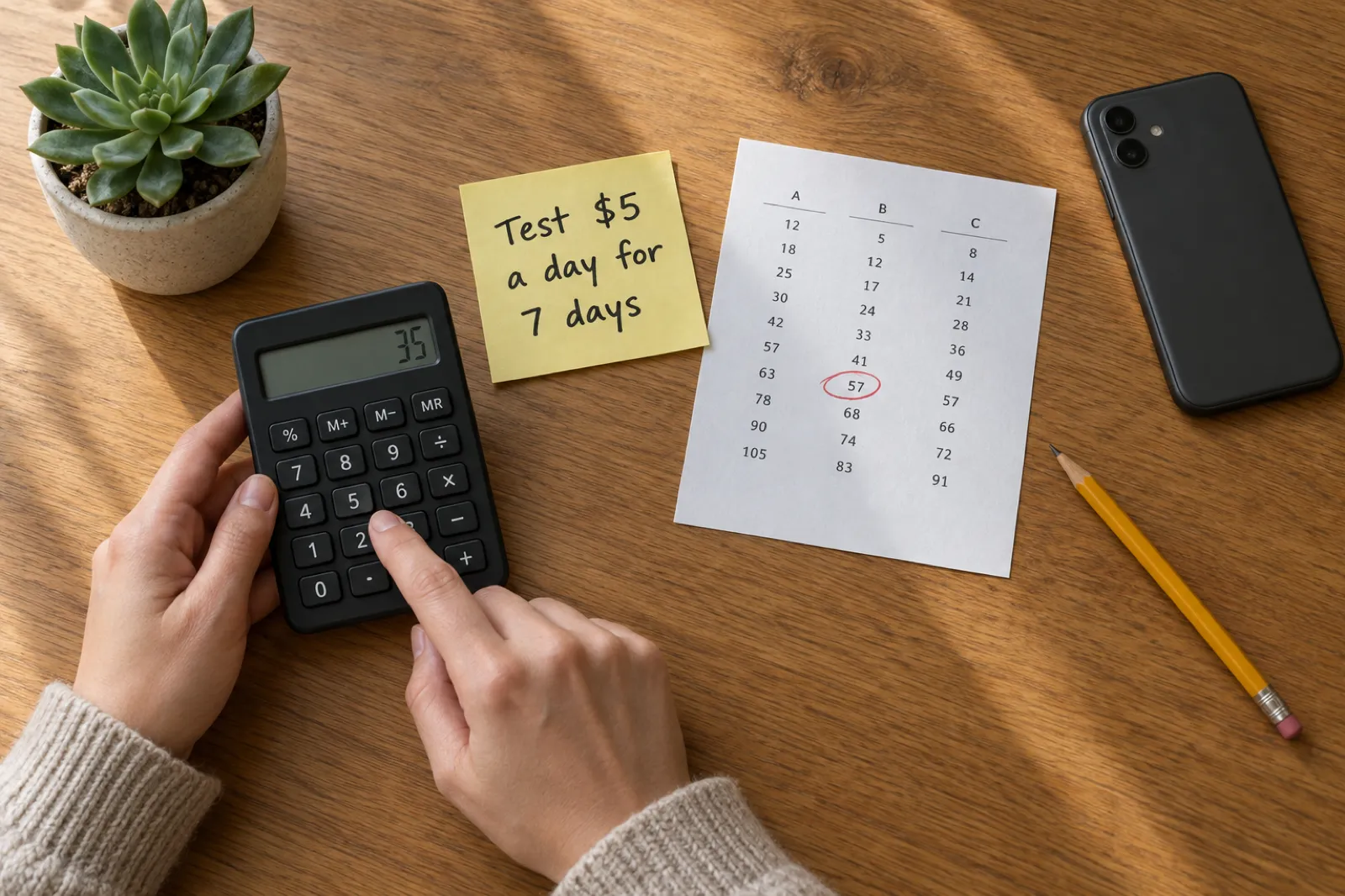
- Set a fixed test budget you can afford to lose, such as $5 a day for 7 days where the platform allows it. Write it down before you start.
- Run one product, one audience, two ads. Change one thing between the two (the image or the headline), so the result tells you something.
- Set a stop rule. If you have paid for three times as many clicks as one sale should take (for a 4% conversion rate, 75 clicks) with no sale, stop and fix the page or the ad, not the budget.
- Judge on cost per sale, not clicks. Compare your real cost per sale with what you keep per sale. Keep what beats break-even; cut the rest.
- Count what comes after. Page reads, later books, email sign-ups and repeat buyers are real value the first sale does not show. Note them, but do not let them excuse a test that only loses.
Three worked examples
Example inputs, chosen to show how the sums move. Put your own numbers in the calculator.
A $4.99 Kindle ebook on Amazon Ads
At the 70% royalty the author keeps about $3.49 a sale before the delivery charge. If 10 in 100 ad clicks buy, the break-even bid is $0.35 a click. At $0.30 a click, 100 clicks cost $30 and bring 10 sales worth $34.90: a profit of $4.93 per 100 clicks, each sale costing $3.00 in ads. Break-even ROAS: 1.43. Raising the price to $6.99 or $9.99, still inside the 70% band, would widen that margin more than any bid change.
An $8 printable planner on Etsy Ads
A US Etsy shop keeps about $6.79 of an $8 download after the 6.5% transaction fee, 3% + $0.25 processing and the $0.20 listing fee. At a 3% conversion rate the break-even CPC is $0.20; at $0.20 a click, 100 clicks earn just $0.37, which is break-even territory. A sale through Offsite Ads would cost another $1.20 (15%), which is why sellers watch which channel each order came from.
A $19 PDF guide on Gumroad with Meta ads
A direct Gumroad sale keeps about $15.75 after Gumroad's 10% + $0.50 and card processing. At a 4% conversion rate the break-even CPC is $0.63, and at $0.60, the average 2026 Facebook traffic click, 100 clicks make $3.00. Same product, same platform: at a 2% conversion rate the same 100 clicks would lose $28.50. The page matters as much as the bid.
A better page beats a bigger budget
Every example above turns on the conversion rate. A clear cover, a full description and a complete, well-structured product move it more than any bid. Inkfluence AI writes the book, designs the cover and drafts the store description in one place.
Build my product page assetsFree promotion to run before you pay for anything
The cheapest advertising is the kind you do not pay for. Before any of the platforms above, these cost only time:
- Get found in store search. On Amazon, the title, subtitle, seven keyword fields and categories decide whether shoppers see you at all: KDP SEO. On Etsy, titles and tags do the same job; see selling ebooks on Etsy.
- Pin the product. A few pins a week with clear product photos keep working for months.
- Post short videos. The same clip you would advertise, posted organically, tells you which one deserves a budget.
- Build an email list with a free sample or short guide, then announce each launch to people who asked to hear from you. The ebook launch checklist sets out the order.
- Use the store's own free tools: Etsy's Share & Save, KDP's free promotions or Countdown Deals for books in KDP Select, and pre-orders.
Our complete ebook marketing strategy covers each of these in depth, and how to sell your ebook walks through the first sales.
Make a product worth advertising with Inkfluence AI
An ad buys a visit. The product and its page decide whether the visit becomes a sale. That is where we can help, and it is why we think Inkfluence AI is the best place to make the ebook, workbook or guide you plan to advertise.
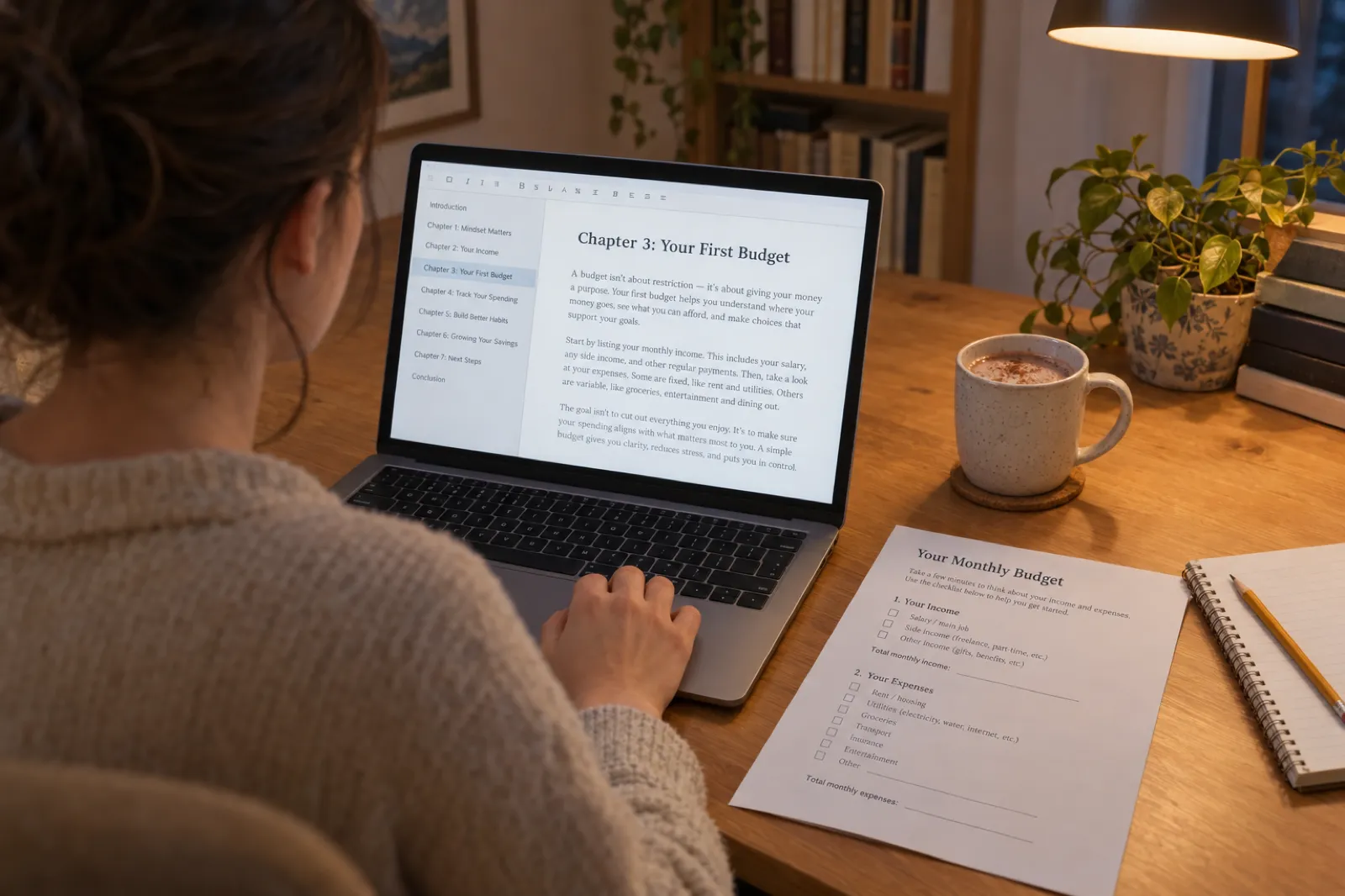
- It writes the whole book. Describe your idea, review and edit the chapter outline, then it writes every chapter to match: how-to guides, workbooks, recipe books, planners, lead magnets, novels and more. See the AI ebook generator and the workbook generator.
- It makes the files each store wants. PDF for Etsy, Gumroad and Payhip; EPUB and a KDP package (a print-ready interior and a full wrap cover) for Amazon; DOCX for editing.
- It makes the things ads need. AI covers, a store description written from your chapters, and short vertical videos of the book for Reels, TikTok and Shorts.
- The limits, plainly. The free plan writes 5 chapters a month and exports PDF with a small Inkfluence AI credit. EPUB, DOCX and the KDP package come with Creator ($9.99 a month), Premium ($19.99) or a credit pack (15 credits for $9.99, paid once). Creator includes 35 chapters, 10 AI covers and 20 videos a month; Premium has no monthly chapter limit, with 30 covers and 60 videos. We do not print or ship books, and we do not run your ads.
For what sells, read ebook ideas that sell and making money selling AI ebooks, and check pricing for every allowance.
Write my ebook freeSix mistakes that make cheap ads expensive
- Judging on cost per click. A $0.10 click that never buys is dearer than a $1 click that does. Cost per sale is the number.
- Forgetting the store's cut. A $9.99 ebook does not earn $9.99. Use what you keep per sale in every sum.
- Advertising the wrong product. Ads amplify what already works. Promote the listing with the best organic conversion, not the one you most want to sell.
- Changing everything at once. New image, new headline, new audience and new budget on the same day teach you nothing.
- Stopping too early, or too late. A handful of clicks proves nothing; hundreds with no sale prove a lot. Set the stop rule before you start.
- Mixing up platform fees. Etsy Ads (which you pay per click) and Offsite Ads (a share of the sale) are different charges. So are BookBub Ads and Featured Deals.
Spend the budget on selling, not on making
Write the book, design the cover and export every file in one place, then put your ad money behind a finished product. Start free with 5 chapters, no card.
Start my productFrequently asked questions
What is the cheapest way to advertise an ebook or digital product in 2026?
The cheapest test is on the platform where your buyers already search. Amazon Ads lets KDP authors run Sponsored Products from a $1 daily budget, Etsy Ads charges only for clicks with a daily budget you set (up to $25 a day when you start), and BookBub Ads campaigns can run on a budget as small as $10. For outside traffic, WordStream's 2026 benchmarks put the average Facebook traffic click at $0.60 and Arts & Entertainment at $0.34, against $5.42 for the average Google search click. What decides "cheap" is your break-even cost per click, which the calculator on this page works out.
How much should I pay per click for ebook ads?
No more than your break-even cost per click: what you keep from one sale multiplied by your conversion rate. A $6.99 Kindle ebook at the 70% royalty keeps about $4.89 before delivery costs. If 4 in 100 clicks buy, you break even at about $0.20 a click. Pay more than that and every sale loses money, unless page reads, a series or an email list make up the gap.
Are Amazon ads worth it for a single ebook?
They can be, if the book page converts and the price leaves room. A low-priced single ebook keeps little per sale, so the break-even bid is small. Ads usually work better on a series or a Kindle Unlimited book, where one click can lead to several sales or many pages read. Start at a small daily budget, track cost per sale against your royalty, and remember that Amazon Ads no longer estimates KENP royalties in its reports.
How much does a BookBub Featured Deal cost?
It depends on the category, the deal price and the regions. On 13 November 2026 BookBub's pricing page listed, for all regions, a $0.99 deal at $379 in Business, $586 in Fantasy, $765 in Contemporary Romance, $863 in Cooking and $948 in Thrillers. A free deal costs less. BookBub chooses which books it features, so you apply rather than buy.
What is the minimum budget for TikTok ads?
TikTok's help centre (updated July 2026) says a daily budget must exceed $50 at campaign level and $20 at ad group level. That makes it the highest minimum of the platforms in this guide. Organic TikTok videos cost nothing, and many sellers test there first.
Do Etsy Ads work for digital downloads?
They can, and you only pay when someone clicks. Etsy says new shops wait 15 days before starting, every seller starts with a maximum daily budget of $25, and ads work best on listings that already get interest. Etsy does not publish a typical cost per click. Remember the separate Offsite Ads fee: 15% of the order (12% once you pass $10,000 in a year) when a sale comes from Etsy's own ads on other sites.
What is a good ROAS for digital products?
ROAS is revenue divided by ad spend. Your break-even ROAS is your price divided by what you keep per sale: on a $9.99 product that keeps $8.49 after fees, it is about 1.18. Anything above it is profit before your own time; anything below it loses money. Low-fee products (your own site, Payhip, Gumroad) break even at a lower ROAS than a Kindle ebook at 70%.
Should I run ads before I have reviews?
Usually not. Ads send people to your page; the page has to sell. Get the cover, description and first pages right, collect a few honest reviews, then pay for clicks. On Etsy, the help page says the same thing in its own words: ads are unlikely to turn a low-demand listing into a top seller.
Sources
All read on 13 November 2026. If a platform's own page and this one disagree, the platform's page wins.
- Amazon Ads, Frequently asked questions (cost, Sponsored Products minimum daily budget, KDP authors, daily budgets over a month)
- Etsy Help, How to Set Up and Manage an Etsy Ads Campaign; Offsite Ads and fees as on our Etsy fee calculator
- WordStream (Susie Marino), Facebook Ads Benchmarks 2026, updated 15 September 2026
- WordStream (Susie Marino), 2026 Google Ads Benchmarks, updated 16 September 2026
- Pinterest Business, Advertise on Pinterest ("How much do Pinterest Ads cost?")
- BookBub Partners, Featured Deals Pricing and Statistics (USD, all regions) and BookBub Support, How are ads priced?
- TikTok Business Help Center, About budgets for ads in TikTok Ads Manager, last updated July 2026
- Amazon KDP Help, eBook Royalty Options (70% band $2.99 to $12.99 on Amazon.com)
- Gumroad and Payhip fees as on our Gumroad and Payhip fee calculators
Related reading
- Self-publishing news, November 2026: the Amazon Ads KENP change
- The best digital product niches for 2026
- Profitable digital product niches
- How to sell AI-generated books on Etsy
- How to sell ebooks on Amazon
- AI book cover generator: the image every ad uses

Inkfluence AI Team
Tips, tutorials, and strategies from the Inkfluence AI team to help you write, publish, and sell ebooks faster.
Helpful links

Ready to write your own book?
Write with AI, make it yours, and export PDF, EPUB and KDP-ready files from one project.
Keep reading
 Selling
Fitness and Mental Health Digital Product Ideas for 2026 (and Where to Sell Them)
25 fitness and mental health digital product ideas for 2026: trackers, journals, workbooks, challenge guides and plans, with the easiest ones for beginners, where each sells best on Etsy, Gumroad, Payhip or KDP, what you keep per sale, the health-claim and AI rules to follow, and an idea picker.
 Publishing
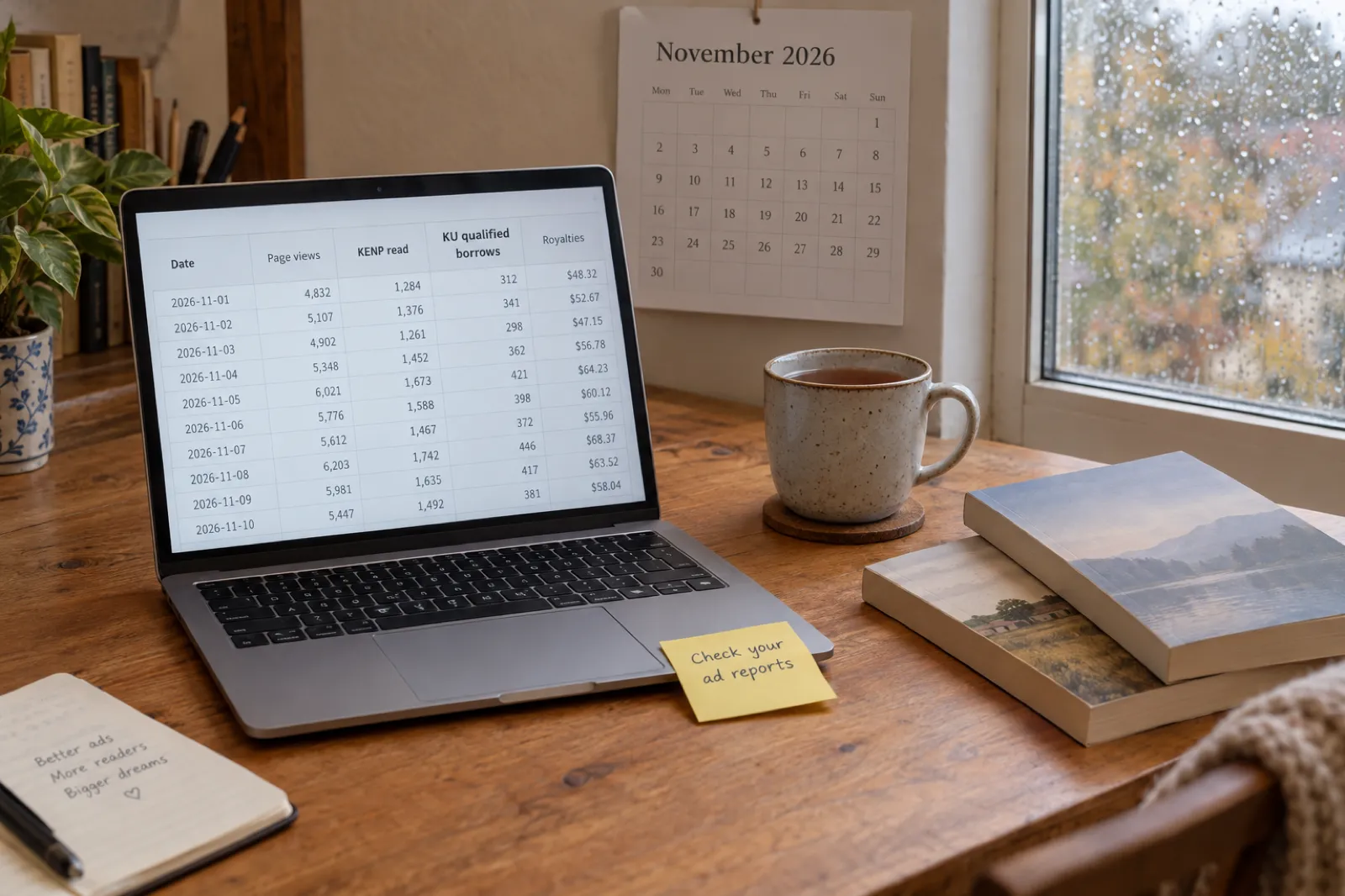
What Changed for Self-Publishers This Month (November 2026)
The self-publishing changes that matter in November 2026, each checked at its source: Amazon Ads dropped page-based KENP royalty estimates for "qualified borrows", Etsy prints your digital files and refunds the full 6.5% fee through Share & Save, Spotify audiobooks head to 180+ markets, Smashwords takes pre-orders, and new Gemini and GPT models. What each means and what to do.
 Selling
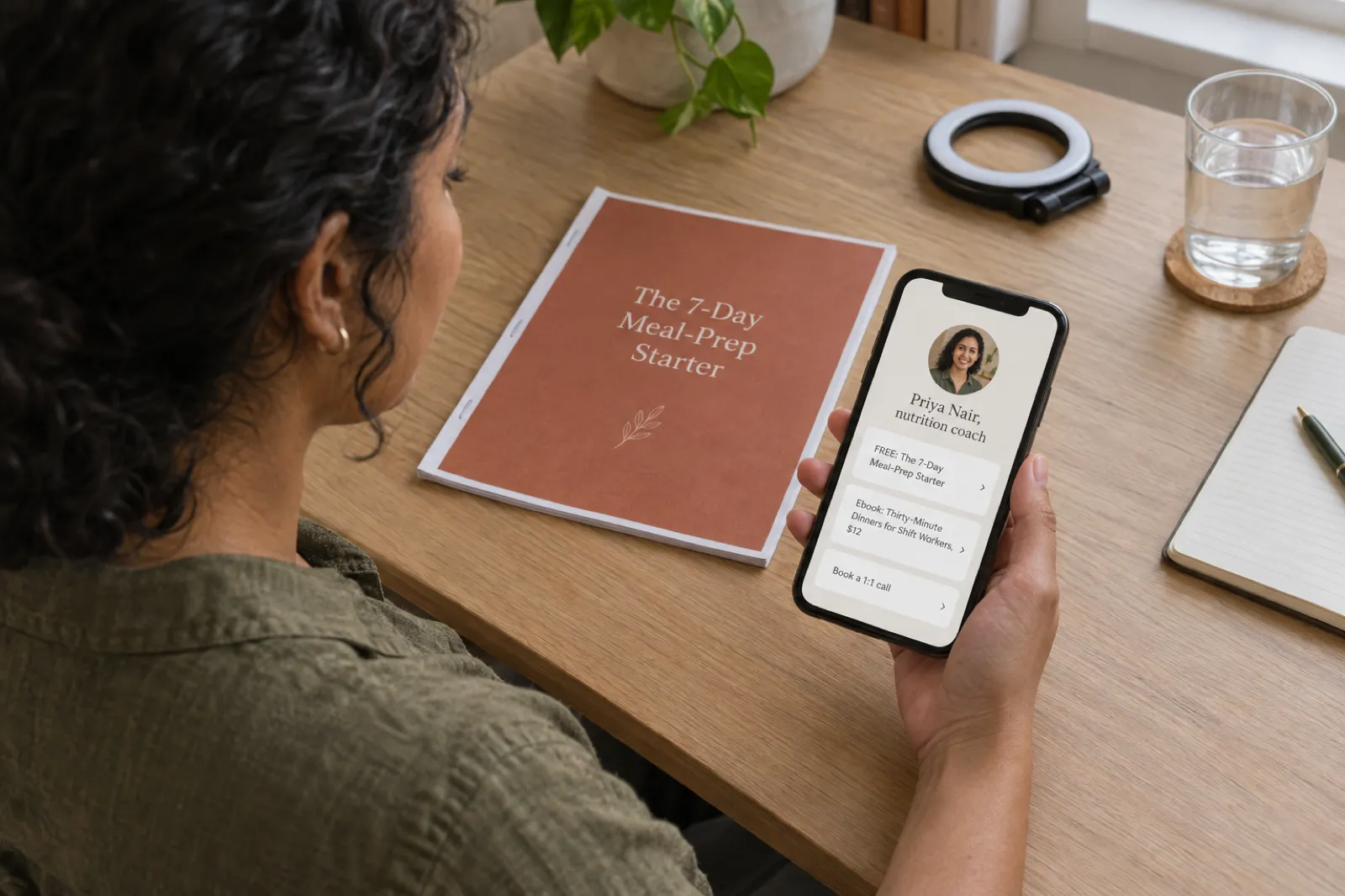
Stan Store for Authors (2026): Selling Ebooks and Lead Magnets From Your Link in Bio
Stan Store turns the link in your Instagram or TikTok bio into a small shop. It costs $29 or $99 a month, takes no cut of sales, and is built for creators with a following. Here is what it costs an author, what you can sell, how lead magnets and email work, who handles tax, a calculator to see if it beats Payhip or Gumroad for you, and a step-by-step setup.

Get ebook tips in your inbox
Join creators getting weekly strategies for writing, marketing, and selling ebooks. You also get our free PDF guide, Your First Book in a Weekend.