
Read the first chapter
The whole of chapter one, free. About 6 min. Turn the pages with the arrows, your keyboard, or a swipe.
Chapter 1
Usui Reiki Basics and Safety
Usui Reiki Basics, What It Feels Like, and What “Safe” Means
Usui Reiki is a gentle, hands-on (or hands-near) practice that supports relaxation and balance. You place your hands on yourself or someone else, using clear intention and calm attention. Reiki is not about forcing anything to happen. It’s more like creating a safe, steady space where the body and mind can settle.
When you give or receive Reiki, sessions often feel simple - maybe warm, maybe tingly, maybe pleasantly neutral. Some people notice sensations right away; others don’t notice much at all (and that’s still okay). Your job isn’t to “make” sensations happen. Your job is to offer respectful presence, clear consent, and simple technique.
Key takeaway: Reiki safety is about consent, clear boundaries, and staying within what you can responsibly do - not about chasing sensations.
To keep it grounded, use these three components of a safe Reiki interaction: 1. Consent: Clear permission before you place hands (or move closer). 2. Boundaries: You stay within your role (you’re offering Reiki support, not diagnosis or treatment). 3. Careful communication: You check in if the person feels uncomfortable, dizzy, or “off.”
Safety note (important): Reiki is not a substitute for medical care. If someone has urgent symptoms, encourage them to seek appropriate professional help. You can still offer Reiki support alongside that care, with permission and comfort.
---
Guided Practice: A Consent + Boundary “Check-In” Before Any Hands-On Reiki
Time required: 10-15 minutes Materials needed: a notebook or journal, pen, and (optional) a small timer on your phone
For this exercise, you’ll practice a short routine you can use before self-reiki or when you’re supporting another person. You’re training your nervous system to be steady and clear - because safety starts with your words.
1. Pick your setting. Sit or stand somewhere quiet. Keep your hands relaxed at your sides for now. 2. Write your consent line. In one sentence, write what you would say to ask permission. Use plain language. Example structure: “Would you like Reiki support for your [back/shoulders/hands], and is it okay if I use [hands-on/hands-near]?” 3. Write your boundary line. In one sentence, write what you will not do (for example, you won’t promise outcomes or replace medical care). Keep it simple. 4. Do a self-check (60 seconds). Ask yourself: - “Am I calm enough to be gentle?” - “Do I feel pressured or rushed?” - “Am I able to stop immediately if asked?” 5. Practice the check-in with yourself. Say your consent line out loud (even if it’s just for you). Then say your boundary line. If you’re doing self-reiki, your “consent” can be: “Yes, I want Reiki for my [area], and I’m choosing this gently.” 6. Do one placement only. Place one hand over a comfortable area on yourself (for example, your heart center over the upper chest, or your hands together). Keep it there for 2 minutes. Don’t chase sensations - just notice what’s true. 7. Complete the safety record. In your notebook, write: - Date/time - Area you placed your hand on - What you asked/confirmed (consent + boundaries) - One sentence: “I felt ___.”
Completed example (what yours can look like)
> Date/time: July 29, 2026, 7:10 pm > Area: Hands together on lap > Consent + boundaries said: “I’m choosing Reiki support for my hands. I’m not replacing medical care - this is gentle support.” > Self-check: Calm, not rushed, able to stop. > Noticing: “I felt a soft warmth and slow breathing.”
Your Turn (Safety Script Worksheet) Write your consent line and boundary line below. Keep them short enough that you could actually say them in real life.
Consent line (your words): ________________________________________________ ________________________________________________
Boundary line (your words): ________________________________________________ ________________________________________________
When you feel unsure, your “stop” plan is: ________________________________________________ ________________________________________________
---
Real-World Application: Sessions, Sensations, and Clear Boundaries in Daily Life
Reiki sessions can be surprisingly ordinary. You might feel warmth, coolness, tingling, pulsing, or nothing obvious. Sometimes the mind feels calmer before the body does. Other times your body settles first and the mind follows. All of that is normal. What matters most is that the experience stays respectful, comfortable, and safe.
Here are two everyday scenarios to practice the safety mindset (with expected outcomes). Read them, then use the prompts that follow.
Scenario A: Self-reiki after a stressful moment (10 minutes). You sit down, do your consent check for yourself, and place your hands on a chosen area (like your chest or hands). Expected outcome: you’ll likely notice slower breathing, a quieter mind, or a body sensation that feels “settled.” Even if you feel nothing special, you still completed a safe, conscious practice because you offered gentle attention on purpose.
Scenario B: Reiki for a friend who’s unsure (with consent + hands-near). You ask permission first, then offer hands-near (about a hand’s width away) instead of immediate hands-on. Expected outcome: your friend should feel more in control. If they say “too close” or “not comfortable,” you adjust distance, switch to hands-near fully, or stop - no debate.
A core safety boundary is avoiding promises. Instead of saying, “This will fix your pain,” you can say something like, “Reiki support can help you feel calmer and more grounded.” That keeps Reiki honest and keeps you out of medical territory.
Apply It (Two Quick Scenario Prompts) For each scenario, write what you would say and what you would do if the other person felt uncomfortable.
1) Scenario A (self): What area would you choose, and what would you notice in your body or breath within 10 minutes? ________________________________________________ ______________________________________________ ________________________________________________
2) Scenario B (friend): What would you ask first, and what would you do if they said “please back up”? ________________________________________________ ______________________________________________ ________________________________________________
Expected outcome check (fill in one line each): - If they’re uncomfortable, your outcome is: ______________________________ - If they’re comfortable, your outcome is: ______________________________
---
Reflection: Your Consent Practice, Your Comfort Signals, Your Next Step
You don’t need “perfect” sensations to practice safely. You do need clear boundaries and a reliable way to stop. Reflection helps you notice your personal comfort signals - what tells you, “Yes, this feels safe,” and what tells you, “Pause.”
Think about a time you’ve felt calm and a time you’ve felt tense. When you’re tense, your body may tighten, your breath may shorten, and your attention may rush. During Reiki, safety means you slow down enough to stay kind and present. (And yes, it’s okay to stop early if something doesn’t feel right.)
Your Turn (Comfort Signals Checklist) Check the boxes that match what helps you feel safe during Reiki.
• [ ] My breathing slows naturally - [ ] My shoulders drop or soften - [ ] I feel steady enough to stop instantly - [ ] I can clearly explain what I’m doing - [ ] I feel comfortable asking for consent - [ ] I feel okay offering hands-near instead of hands-on - [ ] Other: ______________________________________
Reflect (Answer with specifics) 1) When you imagine offering Reiki to another person, what exact words will you use for consent? (Write them like you’ll say them out loud.) ________________________________________________ ______________________________________________ ________________________________________________
2) What is your personal “stop signal”? (Example: “If I feel rushed,” “If they ask me to stop,” “If I feel dizzy.”) ________________________________________________ ______________________________________________ ________________________________________________
3) Choose one self-reiki boundary you will follow this week. Example: “No promises,” “No hands-on if I’m not calm,” “Hands-near only if I’m unsure.” What will you do? ________________________________________________ ______________________________________________ ________________________________________________
A good Reiki foundation feels grounded: consent first, comfort always, and no pressure to “perform” sensations. If you can hold that steady, you’re already practicing safely - and your future Reiki skills will have a solid home to grow in.
End of chapter one. 6 more chapters in the full book.
Swipe or use the arrows to turn the page


What's inside: 7 chapters
- 1. Usui Reiki Basics and Safety
- 2. Usui Reiki History in Plain Terms
- 3. Applying the Five Reiki Principles
- 4. Recognizing Subtle Energy Sensations
- 5. Mindfulness for Reiki Practice
- 6. Breathwork and Self-Reiki Routine
- 7. Daily Practice Plans and Level I Prep
About this book
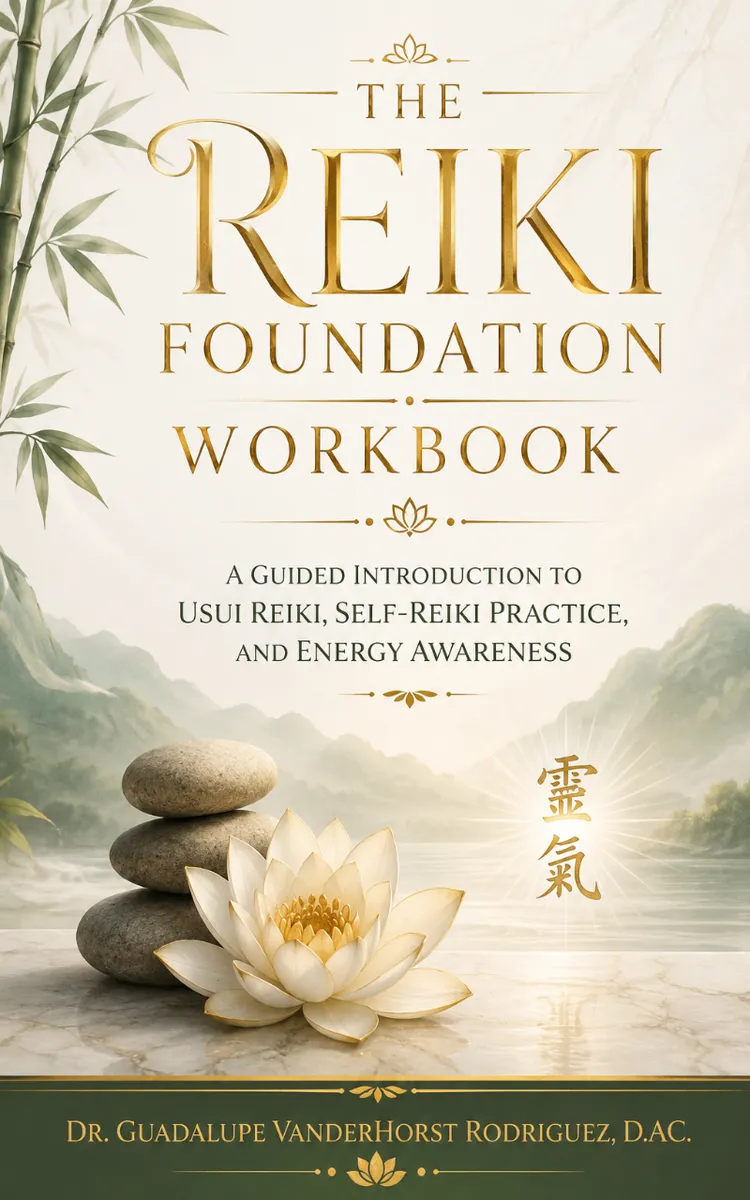
"The Reiki Foundation Workbook" is a workbook by Dr. Guadalupe Vanderhorst Rodriguez, D.Ac with 7 chapters and approximately 9,092 words. Beginner workbook for Usui Reiki foundations and self-reiki.
This book was created using Inkfluence AI, an AI-powered book generation platform that helps authors write, design, and publish complete books. It was made with the Workbook Generator.
Frequently Asked Questions
What is "The Reiki Foundation Workbook" about?
Beginner workbook for Usui Reiki foundations and self-reiki
How many chapters are in "The Reiki Foundation Workbook"?
The book contains 7 chapters and approximately 9,092 words. Topics covered include Usui Reiki Basics and Safety, Usui Reiki History in Plain Terms, Applying the Five Reiki Principles, Recognizing Subtle Energy Sensations, and more.
Who wrote "The Reiki Foundation Workbook"?
This book was written by Dr. Guadalupe Vanderhorst Rodriguez, D.Ac and created using Inkfluence AI, an AI book generation platform that helps authors write, design, and publish books.
How can I create a similar workbook?
You can create your own workbook using Inkfluence AI. Describe your idea, choose your style, and the AI writes the full book for you. It's free to start.
Write your own workbook with AI
Describe your idea and Inkfluence writes the whole thing. Free to start.
Start writingCreated with Inkfluence AI


