
Read the first chapter
The whole of chapter one, free. About 9 min. Turn the pages with the arrows, your keyboard, or a swipe.
Chapter 1
Start With Yourself, Always
Begin With the Name You Can Prove
What is the earliest family fact you can write down without guessing?
For many beginners, the answer is not a great-grandparent’s name or a dramatic story about immigration. It is your own full name, birth date, and birthplace. That small starting point matters because family research becomes confusing when you jump between distant relatives, copy unsourced online trees, or try to remember too many details at once. A clear starting record gives you a firm place to work backward.
You do not need a subscription, a large family tree, or a box of old documents to begin. You need what you already know, a simple way to record it, and a rule you can follow: start with yourself, then work backward one person and one generation at a time. By the end of this section, you will have a reliable first entry and a short list of family facts to check next.
Begin with a blank sheet of paper, a notebook, or a new spreadsheet. Write your name exactly as it appears on an official document, if you have one. Add your birth date and birthplace. If you know your parents’ full names, record them beneath your information. Do not worry about building a wide tree yet. Your first goal is accuracy, not size.
Ask yourself: Which facts do I know because I saw a record? Which facts do I know because someone told me? Both types belong in your notes, but they should not look equally certain. A memory may point you toward a useful search. A birth certificate, marriage record, or family Bible may confirm the detail. Marking that difference now will prevent confusion later.
Practical takeaway: Create one starting page with your full name, birth details, and parents’ names. Leave space beside every fact so you can add a source or a correction.
The You-to-Then Ladder
The You-to-Then Ladder is a simple way to move backward without losing your place. You begin with yourself, step to your parents, then to your grandparents, and continue only when you have enough information to identify the next person correctly. Each step represents one generation. You climb backward one person at a time rather than reaching for every relative at once.
Use these four rules when you build your starting record:
1. Write yourself first. Record your full name, birth date, and birthplace. Use the name connected to your birth record, and add other names in a notes field if your name later changed. This gives your research a fixed starting point.
2. Add your parents as separate people. Write each parent’s full name, birth date if known, birthplace if known, and relationship to you. Keep parents separate even if you know much more about one than the other. This prevents one parent’s details from accidentally blending with the other’s.
3. Mark each fact by confidence. Use simple labels such as “confirmed,” “family report,” or “unknown.” For example, write “Born in Dayton - family report” instead of presenting the location as proven. This tells you which detail needs checking first.
4. Record one next question for each person. A useful question might be, “Where did my mother live when she married?” or “What was my grandfather’s full middle name?” Specific questions lead to specific searches. A vague note such as “Find more about Grandpa” does not tell you what to do next.
A source means the place where information comes from. Your source might be a birth certificate, an obituary, a letter, a photograph with writing on the back, or a conversation with a relative. Write the source beside the fact, even when the source seems informal. For a conversation, record the person’s name, the date, and what they said. Later, you can compare that memory with a document.
For example, your record might show: “Nina’s mother: Carla Denise Morgan, born 1962, likely in Toledo, family report from Nina, March 2026.” That entry does not claim more than Nina knows. It also gives her a clear next task: check whether Carla’s birth record or another document confirms Toledo.
Do not fill empty spaces with guesses. If you do not know a birth year, write “unknown.” If you know only that a grandfather used the surname Reed but do not know his first name, record exactly that. An honest blank helps you search. A guessed name can send you into the wrong family.
You can set up your first record in a notebook or spreadsheet. A spreadsheet helps you sort names and dates later, while a notebook works well for quick notes during a family conversation. Choose the format you will actually use. The best starting record is the one you can update without creating extra work.
| Person | Full name | Birth details | Relationship | Confidence | Source or next question | |---|---|---|---|---|---| | You | Your full name | Date and place | Self | Confirmed or check | Birth record, if available | | Parent 1 | Full name | Date and place, if known | Parent | Confirmed or family report | Ask about birth record | | Parent 2 | Full name | Date and place, if known | Parent | Confirmed or family report | Ask about parents’ names |
Read your first page aloud when you finish. Does every name clearly refer to one person? Can you tell which facts you know and which facts need proof? If not, revise the wording before you search.
Practical takeaway: The You-to-Then Ladder works when each person has a separate entry, each fact has a confidence label, and each unknown has a clear question attached to it.
Nina’s First Starting Record
Nina is 34 and manages a retail store. She wants to learn where her family lived before her parents moved to their current city, but she has only scattered information: a few names, a family story about Ohio, and a photograph labeled “Grandma Rose.” She does not begin by searching for “all Morgan families in Ohio.” She starts with the facts she can check.
1. Nina creates a page titled “My Starting Record.” She writes her full legal name, her birth date, and “Cleveland, Ohio” as her birthplace. She marks those details as confirmed because she has seen her birth certificate. Expected outcome: Nina has one reliable person at the center of the record.
2. She adds her parents separately. She records “Carla Denise Morgan” as her mother and “Thomas Allen Morgan” as her father. She knows both names from family documents, but she does not know either parent’s exact birth date. Expected outcome: Nina has two clear next-generation entries without inventing dates.
3. She separates known facts from family reports. Nina writes, “Carla may have been born in Toledo, Ohio - reported by Nina’s aunt during a phone call on March 4, 2026.” She also writes, “Thomas lived in Akron as a child - reported by Nina’s father.” Expected outcome: Nina can remember where each detail came from and knows which claims still need proof.
4. She identifies one question for each parent. For Carla, Nina writes, “What was Carla’s exact birth date and county?” For Thomas, she writes, “What were Thomas’s parents’ full names?” Expected outcome: Nina has two manageable research tasks instead of a large, unclear goal.
5. She checks the photograph without treating it as proof of identity. The photograph says “Grandma Rose,” but Nina does not yet know Rose’s full name, maiden name, or relationship to which parent. She records: “Rose - possibly Carla’s mother; identity not confirmed.” Expected outcome: The photograph becomes a lead, not a mistaken fact.
6. She chooses one parent to research first. Nina starts with Carla because she has a likely birthplace and an aunt who may know more. She writes down the aunt’s name and prepares three questions before calling: “What was Carla’s full birth name?” “Where was she born?” and “What were her parents called?” Expected outcome: The conversation can fill specific gaps in Nina’s record.
Nina’s starting record does not yet reach her great-grandparents. That is a good result. She now knows exactly what she has, what she does not have, and which person deserves attention first. A small, accurate record gives her more control than a large tree filled with copied names.
Quick checklist
• Write your full name, birth date, and birthplace. - Add each parent as a separate entry. - Record unknown details as “unknown,” not as guesses. - Label facts as confirmed, family report, or needing proof. - Note the source beside each important detail. - Write one specific research question for every parent. - Treat photographs and stories as clues until another source confirms them. - Choose one parent and one question for your next step.
Practical takeaway: If your record fits on one page and shows your next two questions, you have begun correctly.
Avoiding Early Mix-Ups
Mistake: Starting with a famous or distant ancestor
A family tree search can feel exciting when you look for an unusual surname or a possible connection to a well-known person. However, distant searches often produce many people with similar names. Without a confirmed link from you to that person, you may attach the wrong family.
Do this: Start with your own birth details, then confirm each parent before moving to grandparents.
Not this: Search for a great-great-grandparent first because the name sounds familiar.
The fix is simple: return to the last person you can identify clearly and move backward one generation.
Mistake: Treating a family story as a finished fact
A relative may say, “Grandma Rose was born in Toledo,” but the story may refer to Rose’s home after marriage rather than her birthplace. The relative may also remember a nickname instead of a legal name. That does not make the story useless. It tells you what to investigate.
Do this: Record the exact wording, the speaker, and the date. Turn the story into a question such as, “Was Rose born in Toledo, or did she move there later?”
Not this: Enter “Rose was born in Toledo” as confirmed without checking.
Look for a document that names Rose and gives a place, such as a birth record, marriage record, obituary, or census record. Keep the family report in your notes even after you find a document; it explains how the clue reached you.
Mistake: Combining people who share a name
Two relatives may both appear as “Thomas Morgan,” or one person may use a middle name in one record and a nickname in another. If you combine them too early, dates and places can seem to conflict.
Do this: Keep separate entries until you can compare at least two identifying details, such as a spouse, residence, occupation, or parent.
Not this: Merge two records because the first and last names match.
When a detail conflicts, do not erase it immediately. Write both versions, mark the conflict, and note what evidence could settle it. A careful record can hold uncertainty without becoming useless.
Mistake: Recording notes without dates
A note that says “Aunt said Rose lived in Ohio” may seem clear today, but months later you may not remember which aunt spoke, when she spoke, or whether the statement referred to Rose’s birth or residence.
Do this: Add the date, speaker, exact wording when possible, and your next question.
Not this: Rely on memory to explain your notes later.
Your first record should make sense even if you set it aside for several weeks. That is the test of a useful beginning.
Practical takeaway: Keep your starting record narrow, honest, and traceable. Begin with yourself, work backward one person and one generation at a time, and let every confirmed answer open the next careful step.
End of chapter one. 7 more chapters in the full book.
Swipe or use the arrows to turn the page


What's inside: 8 chapters
- 1. Start With Yourself, Always
- 2. Build Your Family Tree Snapshot
- 3. Interview Relatives Like a Pro
- 4. Organize Notes and Documents
- 5. Find Records Using the Right Search Terms
- 6. Use Census Records to Trace Generations
- 7. Confirm Matches and Handle Conflicting Facts
- 8. Write Your Family Story With Sources
About this book
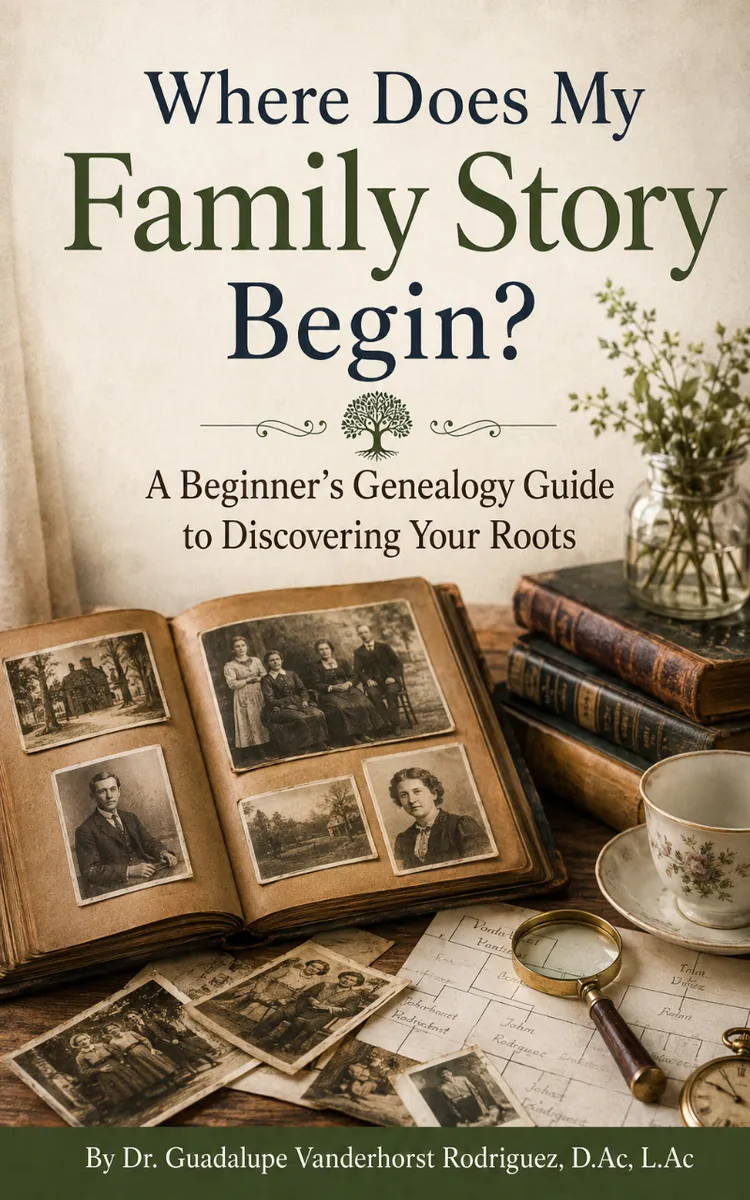
"Where Does My Family Story Begin?" is a how-to guide book by Dr. Guadalupe Vanderhorst Rodriguez, D.Ac with 8 chapters and approximately 14,892 words. Step-by-step beginner genealogy research to document family history.
This book was created using Inkfluence AI, an AI-powered book generation platform that helps authors write, design, and publish complete books. It was made with the AI Ebook Generator.
Frequently Asked Questions
What is "Where Does My Family Story Begin?" about?
Step-by-step beginner genealogy research to document family history
How many chapters are in "Where Does My Family Story Begin?"?
The book contains 8 chapters and approximately 14,892 words. Topics covered include Start With Yourself, Always, Build Your Family Tree Snapshot, Interview Relatives Like a Pro, Organize Notes and Documents, and more.
Who wrote "Where Does My Family Story Begin?"?
This book was written by Dr. Guadalupe Vanderhorst Rodriguez, D.Ac and created using Inkfluence AI, an AI book generation platform that helps authors write, design, and publish books.
How can I create a similar how-to guide book?
You can create your own how-to guide book using Inkfluence AI. Describe your idea, choose your style, and the AI writes the full book for you. It's free to start.
Write your own how-to guide book with AI
Describe your idea and Inkfluence writes the whole thing. Free to start.
Start writingCreated with Inkfluence AI


