
Read the first chapter
The whole of chapter one, free. About 10 min. Turn the pages with the arrows, your keyboard, or a swipe.
Chapter 1
Building Your Seven-Generation Family Tree
Start With the Names You Know
A useful family tree begins with a small, dependable set of facts: names, dates, and relationships. You don’t need every branch before you begin. Start with yourself, move to your parents, then to grandparents and earlier generations. That first clear chain becomes the anchor for the stories, photographs, recipes, and memories you’ll add later.
Use the same information for each person whenever possible:
• Full name, including a maiden name or former surname if known.
• Birth date and place.
• Marriage or partnership details, if relevant.
• Death date and place, if the person has died.
• Connection to you.
• Source of the information, such as a family Bible, birth certificate, obituary, photograph, or an elder’s memory.
It’s perfectly acceptable to write “unknown,” “about 1925,” or “family story - not yet confirmed.” A blank space is more useful than a confident guess. Key takeaway: Build your tree with what you can name and support today, then mark the places where future conversations or records can add detail.
For this journal, count generations consistently. You are Generation 1. Your parents are Generation 2. Your grandparents are Generation 3. Great-grandparents are Generation 4. Continue backward until you reach Generation 7. If your family uses a different way of counting, write that explanation beside the chart so descendants won’t have to guess.
Build Your Seven-Generation Family Tree
Materials needed: this journal or seven sheets of paper, a pencil, an eraser, any family records you already have, and one family member who can check names and connections.
Time required: 45-60 minutes for a first draft. Allow another 20 minutes for each follow-up conversation.
Your Turn
• Write your full name in the center or at the bottom of your family-tree page. Add your birth date and birthplace. If you prefer not to record a private detail, write “private” and keep the information in a secure family record.
• Add your parents above you. Write each person’s full name, birth date, birthplace, and relationship to you. If a parent had a previous surname, include it in parentheses.
• Add your four grandparents. Connect each grandparent to the correct parent with a line. Don’t connect people simply because their names appear close together.
• Continue backward through seven generations. Use one row or ring for each generation. Label each row clearly: Generation 1, Generation 2, and so on.
• For every person you add, place a question mark beside anything uncertain. Use “?” for an unknown date, “possibly” for an unconfirmed connection, and “about” for an estimated year.
• Add a source beside each fact. You can use short labels such as “birth certificate,” “Aunt Rose,” “obituary,” or “family Bible, page 14.”
• Circle the three facts you most want to verify. Choose facts that affect the family line, such as a grandparent’s surname, a great-grandparent’s birthplace, or the name of a parent you have only heard mentioned.
• Ask one elder or relative to review your draft. Read each connection aloud: “This is my mother, who is the daughter of…” Record corrections in pencil rather than erasing the original until you know which version is accurate.
• Make a clean copy when the relationships are clear. Keep the draft with your notes so descendants can see how the chart was built.
Here is a completed example of one small section:
Generation 1
Jordan Ellis - born March 4, 1982, Dayton, Ohio - self
Generation 2
Miriam Ellis - born July 18, 1956, Dayton, Ohio - mother
Thomas Ellis - born November 2, 1953, Springfield, Ohio - father
Generation 3
Samuel Ellis - born about 1928, place unknown - maternal grandfather
Ruth Carter Ellis - born September 9, 1931, Dayton, Ohio - maternal grandmother
Henry Ellis - born 1925, Springfield, Ohio - paternal grandfather
June Walker Ellis - birth date unknown - paternal grandmother
Source notes
Miriam’s dates: family Bible, page 3.
Samuel’s birth year: Aunt Miriam, conversation on May 12, 2026.
June’s name: 1960 wedding photograph, back inscription.
Samuel’s birthplace: unknown - ask Uncle David.
Now check your work before calling the first draft complete. You are finished when your chart includes yourself, both parents if known, all known grandparents, every person is connected to a specific child or parent, uncertain facts are marked, and at least three sources or source notes appear on the page.
Preserve This Story
Write the name of one person whose place in the chart was nearly forgotten:
Name: __________________________________________________
How is this person connected to you? _______________________
Who helped you confirm the connection? _____________________
What still needs to be checked? ____________________________
Use the Chart in Everyday Family Life
A seven-generation chart is useful beyond genealogy research. Keep a copy near family photographs, in a shared digital folder, or with important papers. When someone asks, “Who was Grandma’s mother?” you can answer from the chart instead of starting from memory each time. That small habit prevents names and connections from changing as stories are retold.
Use the chart during ordinary family moments. At a birthday dinner, ask an older relative to identify one person in a photograph and place that person on the correct generation. While sorting a box of letters, match names to the chart before deciding what to keep. When a family member sends a new document, add its source beside the fact it supports. The expected outcome is a chart that becomes more accurate without becoming overwhelming.
For example, suppose you find a 1947 wedding announcement naming “Evelyn Mae Carter.” Your chart lists your grandmother as “Evelyn Carter,” with no middle name. Add “Mae” and record the newspaper title and date. If the announcement names her parents, you may also have a new lead for Generation 4. Don’t add every detail immediately. First connect the document to the right person, then mark the next question.
If your family includes adoption, stepfamilies, guardians, donor relationships, name changes, or chosen family, use clear labels rather than forcing every relationship into one line. You might write “raised by,” “adoptive parent,” “birth parent,” “step-parent,” or “family member by marriage.” The goal is not to make every family look alike. The goal is to help descendants understand who belonged to whom and how care moved through the family.
Apply It
Choose one real family item - a photograph, letter, obituary, or certificate. Record the following:
Item examined: ____________________________________________
Person or people named: ___________________________________
Generation or generations involved: _________________________
New fact added to the chart: ________________________________
Source and date of item: ___________________________________
Next person to ask: ________________________________________
Your application is complete when the item has a written source note and at least one chart entry has been confirmed, corrected, or clearly marked for later research.
Questions for the Next Family Conversation
Which three names, dates, or connections on your chart are most important to verify, and who is the best person to ask about each one?
__________________________________________________
__________________________________________________
__________________________________________________
What does your chart show about the people who carried family names, stories, or care across the generations? Name one specific connection rather than giving a general impression.
__________________________________________________
__________________________________________________
__________________________________________________
Where might a future descendant misunderstand your chart, and what short note could you add now to make that relationship clear?
__________________________________________________
__________________________________________________
__________________________________________________
To the Generations I Will Never Meet
Use the space below for a brief letter to descendants seven generations from now. Begin with one fact from your family tree that you hope they will remember. Then add one hope, one value, and one question you wish they could answer about their own time.
Dear generations I will never meet,
__________________________________________________
__________________________________________________
__________________________________________________
__________________________________________________
__________________________________________________
One day, we will become the ancestors whose names, photographs, stories, and choices future generations seek to understand. What we preserve today becomes part of their inheritance.
Core Concept: What a Seven-Generation Starter Page Holds
Start your family record with the people closest to you: your parents. Focusing on parents first grounds the whole seven-generation tree in facts you can verify right away - names, birth dates, parents, marriages, death dates, and notes about where each fact came from. This journal organizes one person per page (or one couple per spread) so descendants can read a clear, consistent record seven generations back. Keep entries simple, repeated in the same format each time, so later readers won’t have to guess what a short label means.
There are four components to each person’s page in this journal:
• Identifying facts: full name (including maiden or former names), date and place of birth, date and place of death (if applicable).
• Family links: names of parents and spouse(s) with their birth/death years if known.
• Life events: marriage dates and places, migration notes, occupations, military service - concise, verifiable facts.
• Source and notes: where the information came from and one short line for what you still need to check.
Bold key takeaway: build each person’s page the same way so future readers can trace the line quickly and trust which facts are confirmed.
You’ve got this - use the consistent format below as your template and your notes will pay off for generations.
Guided Practice: Create a Parent Page
Materials needed: this journal, a pen, one family record (birth certificate, obituary, or a photograph with writing), and a phone for a quick call if you need to confirm one detail.
Your Turn - Step-by-step:
• At the top, write the person’s full legal name. Add any former or maiden names in parentheses.
• On the next line, write Date of Birth and Place of Birth. If unknown, write “unknown” or “about [year].”
• Add Date of Death and Place of Death if applicable, or write “living” with the last known city.
• Below that, list Parents: Father’s full name (birth-death years if known); Mother’s full name (maiden name in parentheses).
• Add Spouse(s): name, marriage date, marriage place. Note remarriages as separate lines.
• Record up to three life events (job, migration city and year, military service) in short phrases.
• Source and Notes: write where each key fact came from (e.g., “birth certificate, county records; obituary, Dayton Daily News, 1999; Aunt Rose, phone, 3/12/2026”). End with one specific follow-up: “Confirm father’s birthplace with Uncle Dan.”
Completed example:
Miriam Ellis (née Carter)
Born July 18, 1956 - Dayton, Ohio
Died - living (last known: Dayton, OH)
Parents: Samuel Carter (b. ~1928, d. 1998); Ruth Walker Carter (b. 1931)
Spouse: Thomas Ellis - married Nov 12, 1975 - Springfield, OH
Life events: Registered nurse, 1978-2005; moved to Dayton 1956; church choir leader
Sources/Notes: family Bible p.3; 1975 marriage certificate (county clerk); Aunt Rose, convo 5/12/2026. Follow up: confirm Samuel’s birthplace with Uncle David.
You’re done when the page has name, birth, parents, spouse, at least one life event, and source notes with a clear next question. It only takes 15-30 minutes per person once you have a record nearby - here’s how to make it easier: keep a small envelope with copied documents for each page.
Real-World Application: Use These Pages Every Time You Find a New Fact
Treat each completed parent page as the hub for every related item you find. If you discover a marriage certificate, add the marriage place and date to the spouse line, then write the certificate title and repository in Sources. If you digitize a photograph, write the photo filename beside the life event it illustrates (“photo: 1976 - choir, file IMG_0453.jpg”). When you scan a death notice, add the exact newspaper name and date rather than a vague memory.
Specific scenarios:
• At a family dinner, show the parent page and ask one relative to verify a birthplace - expected outcome: you get a correction or a new source to add immediately.
• While sorting attic papers, match any name to an exact page before tossing or scanning - expected outcome: fewer lost connections and clearer follow-up tasks.
• When a new document arrives in the mail, add its short citation to the Sources line and circle one action: “confirm birthplace,” “scan photo,” or “ask for full name.”
These habits keep your parent pages accurate and useful; future descendants will thank you for the precise notes.
Reflection and Next Steps
Setup: keep this journal open during conversations and add one fact per interaction.
Reflect: Which single detail about a parent did you confirm today, and what source did you attach?
__________________________________________________
__________________________________________________
__________________________________________________
Plan: Name the next person you will ask to confirm a remaining fact, and the exact question you’ll pose.
__________________________________________________
__________________________________________________
__________________________________________________
Apply It: Which document do you have that matches a parent page today, and where will you store its digital copy?
__________________________________________________
__________________________________________________
__________________________________________________
You’ve built a reliable anchor for the whole seven-generation tree by starting with parents. Keep each page consistent, add sources, and mark one clear next step - then hand this journal to the next family keeper when the time comes. You’re creating a readable, verifiable record descendants can follow with confidence.
End of chapter one. 6 more chapters in the full book.
Swipe or use the arrows to turn the page


What's inside: 7 chapters
- 1. Building Your Seven-Generation Family Tree
- 2. Starting Your Family Story Timeline
- 3. Preserving Ancestors Through Story Pages
- 4. Interviewing Elders with Ask an Elder
- 5. Capturing Wisdom to Carry Forward
- 6. Adding Photographs with Their Stories
- 7. Writing Your Seventh-Generation Letter
About this book
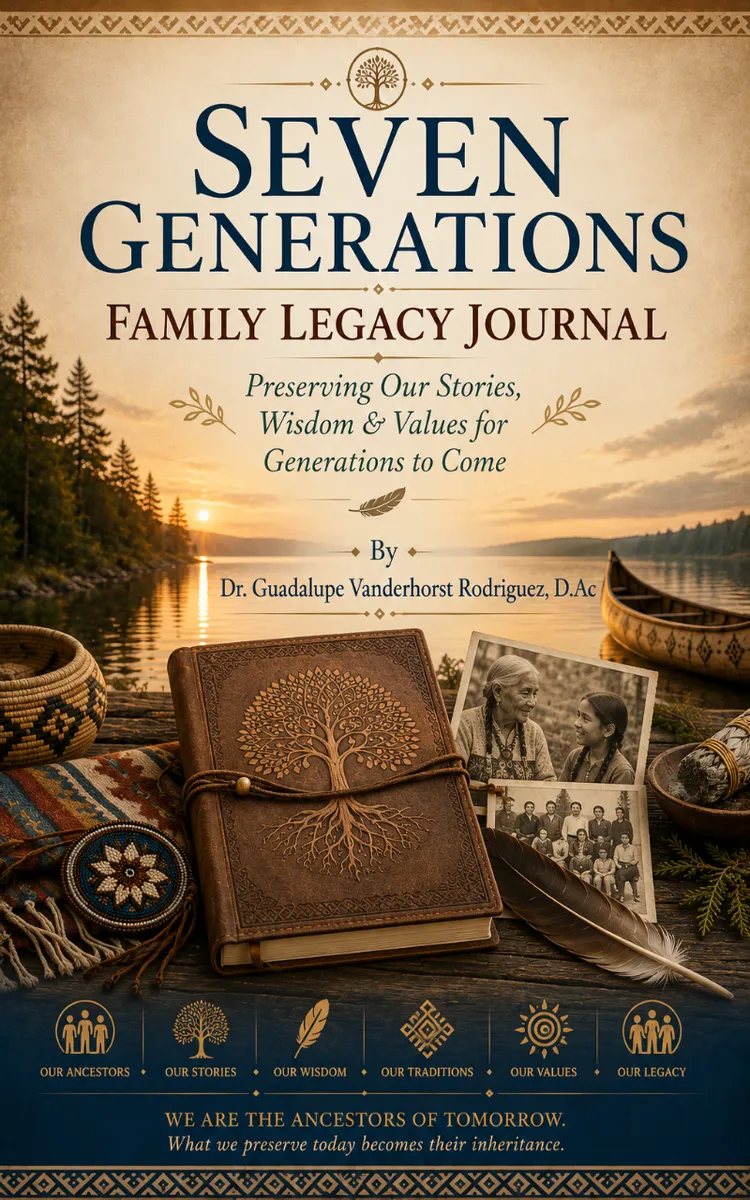
"Seven Generations Family Legacy Journal" is a workbook by Dr. Guadalupe Vanderhorst Rodriguez, D.Ac with 7 chapters and approximately 11,471 words. Family legacy journaling with prompts, charts, and keepsakes.
This book was created using Inkfluence AI, an AI-powered book generation platform that helps authors write, design, and publish complete books. It was made with the Workbook Generator.
Frequently Asked Questions
What is "Seven Generations Family Legacy Journal" about?
Family legacy journaling with prompts, charts, and keepsakes
How many chapters are in "Seven Generations Family Legacy Journal"?
The book contains 7 chapters and approximately 11,471 words. Topics covered include Building Your Seven-Generation Family Tree, Starting Your Family Story Timeline, Preserving Ancestors Through Story Pages, Interviewing Elders with Ask an Elder, and more.
Who wrote "Seven Generations Family Legacy Journal"?
This book was written by Dr. Guadalupe Vanderhorst Rodriguez, D.Ac and created using Inkfluence AI, an AI book generation platform that helps authors write, design, and publish books.
How can I create a similar workbook?
You can create your own workbook using Inkfluence AI. Describe your idea, choose your style, and the AI writes the full book for you. It's free to start.
Write your own workbook with AI
Describe your idea and Inkfluence writes the whole thing. Free to start.
Start writingCreated with Inkfluence AI


