

Read the first chapter
The whole of chapter one, free. About 2 min. Turn the pages with the arrows, your keyboard, or a swipe.
Chapter 1
When Letters Won’t Sit Still
Notice Letters That Move
Sometimes letters do not look still. They may bounce, blur, flip, or slide. A word can feel like a toy car rolling away. Reading can feel hard when letters will not stay in one place.
This does not mean you are lazy. Your brain is working hard to read. Fun fact: b, d, p, and q can look like the same letter turned in different ways!
We can notice what letters are doing. Then we can find ways to help them stay calm.
Try the Moving-Letter Game
You need: paper, a pencil, and two crayons.
Here is a quick example. Write:
b d p q
Circle the b with a red crayon. Put a blue box around the d. The letters are like little dancers. Their sticks and round bellies point in different ways.
Your Turn
1. Ask a grown-up to write b d p q in a row. 2. Point to each letter with your finger. 3. Say its name slowly. 4. Circle every b in red. 5. Circle every d in blue. 6. Draw a small arrow showing which way the stick points. 7. Tell your grown-up: “The letters stayed still,” or “The letters felt like they moved.”
You are done when you have pointed to all four letters and colored every b and d.
Great job if you used your finger, said the letters, and told how they felt.
Make It Your Own
Use different colors. Try green for p and yellow for q. Say each letter like a funny animal sound.
Try it faster, but stay careful. Point to each letter two times without skipping one.
Do it with a friend or grown-up. One person points, and the other person names the letter. Then switch.
Show What You Notice
Circle yes or no:
• Did any letter look like it moved? Yes / No - Did your finger help you follow the letters? Yes / No - Did b and d look different? Yes / No - Draw a circle around the letter that feels easiest: b d p q
Give yourself a ⭐ if you tried, even when the letters felt wiggly.
Can you draw a tiny letter dancer and show which way it moves?
End of chapter one. 6 more chapters in the full book.
Swipe or use the arrows to turn the page


What's inside: 7 chapters
- 1. When Letters Won’t Sit Still
- 2. Spotting b, d, p, and q
- 3. Tracking Words with a Finger
- 4. Trying Colored Overlays
- 5. Untangling was, saw, on, and no
- 6. Reading Through a Moving Page
- 7. Asking for Helpful Reading Support
About this book
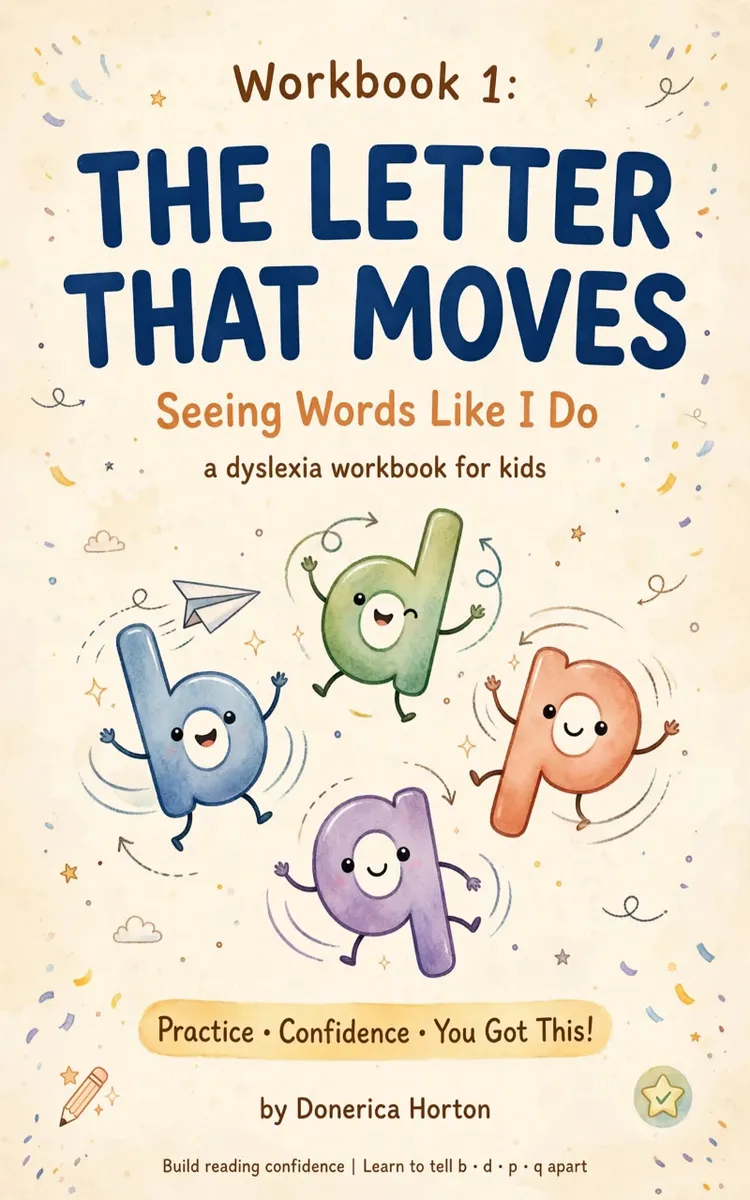
"The Letter That Moves" is a workbook by Donerica Horton with 7 chapters and approximately 2,639 words. Dyslexia, letter reversals, and empathy-building activities for children and parents.
This book was created using Inkfluence AI, an AI-powered book generation platform that helps authors write, design, and publish complete books. It was made with the Workbook Generator.
Frequently Asked Questions
What is "The Letter That Moves" about?
Dyslexia, letter reversals, and empathy-building activities for children and parents
How many chapters are in "The Letter That Moves"?
The book contains 7 chapters and approximately 2,639 words. Topics covered include When Letters Won’t Sit Still, Spotting b, d, p, and q, Tracking Words with a Finger, Trying Colored Overlays, and more.
Who wrote "The Letter That Moves"?
This book was written by Donerica Horton and created using Inkfluence AI, an AI book generation platform that helps authors write, design, and publish books.
How can I create a similar workbook?
You can create your own workbook using Inkfluence AI. Describe your idea, choose your style, and the AI writes the full book for you. It's free to start.
Write your own workbook with AI
Describe your idea and Inkfluence writes the whole thing. Free to start.
Start writingCreated with Inkfluence AI


