

Read the first chapter
The whole of chapter one, free. About 8 min. Turn the pages with the arrows, your keyboard, or a swipe.
Chapter 1
BOOM: Reading the Sawdust Cut
When BOOM Is Still Sawdust
A photograph can show a wooden word before the word exists. In the opening image of BOOM, 120 sawdust particles gather into four readable letters; when the image scatters, the neat message gives way to the disorder of a real cut.
That reversal is the point of the Sawdust-to-Shape Reveal. It begins with the finished impression - a word held briefly in dust - and then moves backward into the physical event that made such a shape possible. The particles are not decoration placed around a puzzle. They are the visible remains of material removed by a blade.
A wooden puzzle is often encountered as a quiet object: a box, a lid, a field of mahogany, a collection of pieces. Yet its identity begins in a noisier instant, when a marked board meets a saw and the maker follows a line that cannot be uncut. The reveal makes that instant visible without pretending that craft is perfectly orderly.
What does a pile of dust remember about the cut that created it?
The Word Hidden in the Waste
The 120 particles forming BOOM occupy an unusual middle ground between image and evidence. Seen together, they read as language. Seen individually, they are fragments of wood - small, irregular, and no longer attached to the board that produced them. Their arrangement gives waste a temporary structure.
That temporary structure matters because sawdust is usually treated as the least interesting part of woodworking. It collects beneath the work, settles into seams, and is swept aside. But each particle marks a tiny loss of material. The dust is a record of contact: teeth entering wood, fibers breaking, and a narrow path opening through the board.
The photograph therefore presents two kinds of accuracy at once. It is visually composed, because the particles form a legible word. It is materially truthful, because the word is made from the residue of cutting rather than a drawn imitation of it. The eye first reads BOOM; only afterward does it notice that the letters are unstable.
That instability resembles the way a puzzle withholds its meaning. A jigsaw image may appear complete until one piece is lifted. A hand-cut wooden puzzle works in the opposite direction: the maker begins with a solid surface and removes enough material for separation to become possible. The finished object carries the memory of that subtraction in every edge.
Wood makes this memory especially legible. Its fibers are not uniform like a sheet of plastic. Grain changes direction, density varies, and the surface can reveal the difference between a clean cut and a hesitant one. Even when a maker’s line is freehand, the material answers back. A curve may open smoothly in one section and show more resistance in another.
The sawdust photograph compresses all of that into a still image. It offers a controlled arrangement, then prepares the eye for its collapse.
The Moment the Image Breaks
When the BOOM image scatters, the letters do not fade. They explode into separate particles. That distinction is important. Fading suggests disappearance; scattering suggests release. The word remains present as a memory of arrangement while its components return to individual pieces.
This is the visual logic of a cut. Before the blade passes through wood, a surface appears continuous. During the cut, continuity is interrupted along a narrow route. Afterward, the separated forms may fit together again, but the original unbroken surface exists only as history.
A saw does not draw a line onto wood in the way a pencil does. It occupies space, removing a channel whose width depends on the blade and the cut. The resulting gap is not merely an outline. It is the physical distance between parts that once belonged to one board. In a handmade puzzle, that distance becomes part of the object’s character.
The decisive instant is consequently smaller than the finished puzzle and more revealing than its photograph. It is the moment when the maker’s intention meets the blade’s unavoidable thickness. A freehand cut cannot be reduced to a perfect mathematical boundary because the tool has its own body, vibration, and movement. The maker guides it, but does not erase the physical facts of sawing.
Sawdust is produced at that boundary. Some of it falls immediately; some clings to the cut, the table, or the surrounding grain. Its movement is governed by ordinary forces - gravity, air, friction, and the motion of the tool - yet the resulting trail can look almost expressive. A few particles may gather in a dense ridge. Others drift away from the main path. The disorder is not a failure of design. It is the trace of a process that happened in time.
A single sentence captures the paradox: the cleaner the finished shape, the more invisible the violence of its making can become.
The scattered reveal restores that missing history. It places the residue beside the word and asks the viewer to hold both views at once: the intentional form and the uncontrolled aftermath.
Freehand Lines and the Human Measure
The tradition behind distinctive wooden puzzles depends on this tension between control and variation. In 1987, Betsy Stuart established the E.L.M.S. tradition around boxes and puzzles made from 1/4" 5-ply mahogany. The material choice gave the work a stable, warm surface, while the freehand approach kept the cuts from acquiring the uniformity associated with machine-made or laser-cut shapes.
Freehand does not mean careless. It means that the line is carried by a person through a tool, with decisions made continuously rather than delegated entirely to a fixed digital path. The maker responds to the grain, the curve, and the developing shape. Small differences become evidence that a human hand occupied the process.
Mahogany also changes how the cut is perceived. Its color can make a narrow separation appear dark and deliberate, while the layered construction of 5-ply stock gives the edge a visible cross-section. A piece is not simply a silhouette viewed from above. It has thickness, strata, and an edge that records the route of the blade.
The distinction between freehand and laser is not only technical. It changes the object’s cultural meaning. A laser can repeat a design with remarkable consistency. A freehand cut emphasizes the maker’s encounter with a particular board on a particular day. The puzzle becomes less like a printed image transferred onto wood and more like a small artifact of judgment.
For the viewer, the difference may first appear as a slight irregularity: a curve that is not perfectly symmetrical, a notch whose two sides are subtly unlike, an edge that catches light differently along its length. Those variations are easy to mistake for imperfections until the cutting moment is understood. They are the visible remainder of choosing a path while the material is actively resisting it.
The Sawdust-to-Shape Reveal makes that remainder legible. The initial image gives the eye a stable form. The scattering interrupts the stability. What follows is not a technical demonstration but a change in scale - from the readable word to the individual particle, from the object to the event.
The Counterintuitive Shape of Precision
The surprising fact is that a freehand cut can look more precise because it is not perfectly uniform. Tiny variations in the edge tell us that the line was negotiated rather than merely reproduced.
This matters because “precision” is often confused with sameness. In a handmade puzzle, precision is better understood as the successful relationship among parts: pieces separate, edges meet, and the design remains coherent. A slightly varied curve can belong to a more exacting object than a flawless-looking line that ignores grain, thickness, or fit.
The scattered sawdust sharpens this distinction. Each particle is irregular, yet the 120 particles can form a word that the eye recognizes immediately. Order does not require identical components. It can emerge from placement, proportion, and the viewer’s ability to assemble fragments into meaning.
That reframing changes the way the cut moment is read. The blade is not simply enforcing a shape that existed in advance. It is participating in the shape’s final character. The maker’s hand, the saw’s path, and the wood’s structure meet in a narrow zone where no single element has complete control.
The result is why a handmade puzzle can feel different before it is solved. Its edges carry a quiet record of negotiation. The surface says “object,” but the cut says “event.”
Betsy Stuart’s Mahogany Line
The history of E.L.M.S. gives that event a concrete setting. In 1987, Betsy Stuart worked with 1/4" 5-ply mahogany to establish a tradition in which the puzzle’s construction remained part of its identity. The pieces were freehand cut, not laser cut, so the visual character of the finished work depended on decisions made at the saw rather than on a perfectly repeated digital template.
A box made in that tradition can seem restrained from the outside. Its significance is not announced by a large image on the lid. The mahogany carries the first impression, while the puzzle’s more personal evidence waits inside: the fit of the pieces, the warmth of the wood, and the marks left by the act of cutting.
That restraint places unusual weight on the edge. When there is no printed picture explaining the object, the viewer notices shape, grain, shadow, and separation. The cut becomes a form of language. It communicates through the narrow spaces where one piece ends and another begins.
The BOOM reveal translates that language into motion. The 120 particles first behave like a composed image, then behave like material in the world. Their scattering does not recreate Betsy Stuart’s workshop or document one particular cut; it isolates the essential transition that handmade puzzle-making depends on. A solid surface becomes divided, and the division becomes the source of the design.
The human story is therefore present without needing a dramatic scene. It resides in the choice to preserve freehand cutting, in the continued value placed on 1/4" 5-ply mahogany, and in the recognition that a puzzle’s character can be carried by marks no machine would choose in exactly the same way.
What the Dust Leaves Behind
The sawdust image reveals an overlooked truth about crafted objects: their most meaningful evidence may be what has been removed. The word BOOM exists briefly as an arrangement of residue, then breaks apart so the viewer can notice the cut beneath the composition.
A handmade puzzle is never only the shape that remains. It is also the path through which the shape became possible - the pressure, resistance, judgment, and material loss held in every narrow edge. When 120 particles scatter, they do not erase the word; they show how much disorder can gather before meaning appears.
End of chapter one. 7 more chapters in the full book.
Swipe or use the arrows to turn the page


What's inside: 8 chapters
- 1. BOOM: Reading the Sawdust Cut
- 2. Hear the Whimsy Pieces Knock
- 3. When the Mahogany Box Spills
- 4. Cut Your Own Initials in Mahogany
- 5. Rent Forever, Reveal Nothing Outside
- 6. Why Five-Ply Mahogany Matters
- 7. Betsy Stuart’s 1987 Puzzle Legacy
- 8. Chris Danner Restores the Puzzle Shop
About this book
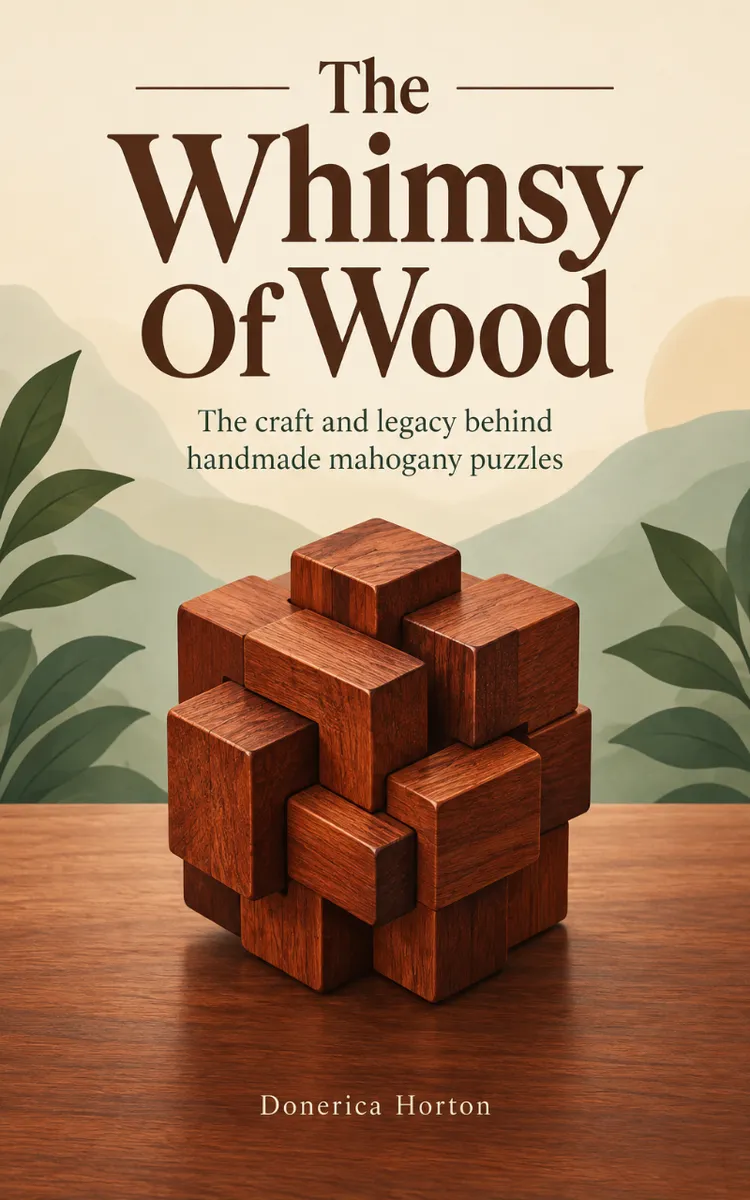
"The Whimsy Of Wood" is a curiosity book by Donerica Horton with 8 chapters and approximately 12,628 words. The history, craftsmanship, and interactive presentation of handmade mahogany puzzles.
This book was created using Inkfluence AI, an AI-powered book generation platform that helps authors write, design, and publish complete books.
Frequently Asked Questions
What is "The Whimsy Of Wood" about?
The history, craftsmanship, and interactive presentation of handmade mahogany puzzles
How many chapters are in "The Whimsy Of Wood"?
The book contains 8 chapters and approximately 12,628 words. Topics covered include BOOM: Reading the Sawdust Cut, Hear the Whimsy Pieces Knock, When the Mahogany Box Spills, Cut Your Own Initials in Mahogany, and more.
Who wrote "The Whimsy Of Wood"?
This book was written by Donerica Horton and created using Inkfluence AI, an AI book generation platform that helps authors write, design, and publish books.
Write your own curiosity book with AI
Describe your idea and Inkfluence writes the whole thing. Free to start.
Start writingCreated with Inkfluence AI


