
Read the first chapter
The whole of chapter one, free. About 9 min. Turn the pages with the arrows, your keyboard, or a swipe.
Chapter 1
Why We Copy Strangers
The First Echo
In 1950, a line of people in a laboratory was shown three vertical lines and asked which one matched the length of a separate line. The answer was obvious. Yet when several people deliberately chose the wrong line, many participants followed them. Nothing had changed about the lines. Only the company had changed.
That experiment, associated with psychologist Solomon Asch, captured a quiet force present in much less artificial settings. A café fills because people notice other customers. A queue forms around a particular checkout. A person adopts the vocabulary, posture, or order of a group without consciously deciding to copy anyone. Human beings do not merely make choices; we watch choices being made, then use them as information.
The pattern reaches beyond embarrassment or peer pressure. Other people help define what seems normal, safe, fashionable, urgent, and worth paying attention to. The influence is often so ordinary that it becomes invisible, folded into the background of daily life.
How much of what feels like personal preference begins as someone else’s example?
The Social Echo Map
A useful way to see this process is through the Social Echo Map: the path by which one person’s behaviour becomes visible, noticed, interpreted, and repeated by others. The first action may be small. Someone looks up on a train platform, pauses outside a shop, orders an unfamiliar dish, or begins clapping before anyone else. The next person does not copy the entire life of the first person. They copy a signal.
That signal may carry several meanings at once. A crowded restaurant can suggest good food, reasonable prices, or simply that the place has been discovered. A person wearing a particular style of clothing can make it seem more acceptable to others who were already considering it. A queue can communicate that waiting is worthwhile. The behaviour itself is only the visible part of the echo; beneath it sits an interpretation.
This is why social mimicry is not the same as simple imitation. A toddler copying a parent’s hand movement is reproducing an action. An adult choosing a busy supermarket, repeating a phrase heard at work, or laughing when a group laughs is responding to a mixture of action and meaning. The copied behaviour becomes evidence about the world.
The tendency has deep roots. In small human communities, watching others was a practical way to learn which plants were edible, which paths were dangerous, and which rituals belonged to the group. Individual trial and error could be costly. Observing someone else provided information without requiring the same risk. Cultural knowledge accumulated partly because people were unusually good at retaining and reproducing what others did.
Modern life has not removed that dependence on observation. It has multiplied the number of people who can serve as examples. A neighbour once influenced a household through visible local behaviour. Now a stranger’s meal, purchase, gesture, or opinion can be displayed to thousands of people within minutes. The social echo travels farther, even when the original action is detached from its setting.
Why the Crowd Feels Like Evidence
The pull of other people’s choices becomes strongest when a situation is uncertain. In a new city, travellers often choose the restaurant with customers already seated. At a conference, newcomers drift toward the room that appears busiest. On a digital platform, a product with many reviews can seem safer than an equally suitable product with none. These choices are not necessarily irrational. Other people’s behaviour supplies clues when direct knowledge is limited.
Psychologists often describe this process as social proof, but the phrase can sound more technical than the experience itself. It is the everyday assumption that if many people are doing something, they may know something we do not. The assumption can be useful, though it can also magnify errors. A crowd may gather because of accurate information, or because everyone is watching everyone else.
One of the clearest examples appears in emergencies. People do not always respond to danger by immediately running. They look at nearby faces, movements, and reactions. If others remain calm, a person may interpret the situation as harmless. If several people move quickly toward an exit, that movement can make danger seem real before anyone has identified its source. Behaviour becomes a message passed through bodies.
The same mechanism operates in quieter settings. A pause in conversation may appear uncomfortable because nobody else speaks. A meeting participant waits to see whether senior colleagues approve before expressing an opinion. A customer notices that every table has a particular condiment and assumes it belongs with the meal. Small acts of observation reduce uncertainty, but they also make the group’s first interpretation harder to question.
The crowd does not need to be large to influence a decision; sometimes two people are enough.
That matters because conformity is often pictured as a mass phenomenon, a person swallowed by a stadium or a political movement. In daily life, influence is more intimate. One colleague can establish a workplace habit. One friend can make a restaurant seem worth trying. One early customer can make a shop feel open for business. The number of people matters less than their visibility and perceived relevance.
The Body Copies Before the Mind Explains
Social mimicry also operates below deliberate thought. People tend to match one another’s posture, speaking rhythm, facial expressions, and gestures during conversation. A person leans forward; the other leans forward. One voice becomes quieter; the other follows. These adjustments are usually subtle and are not experienced as conscious decisions.
The effect is not merely decorative. Matching can make an interaction feel smoother because it reduces visible difference between people. Conversation becomes coordinated in the way a duet depends on timing. Yet the process can run in the opposite direction too. A tense room produces tight voices and restrained movements, and those physical signals can spread before anyone names the tension.
Language carries the same contagious quality. Groups develop shared phrases, shortened expressions, and preferred ways of describing events. A new employee may begin using a workplace’s vocabulary without deciding to adopt its culture. The words make participation easier, but they also teach the newcomer how the group divides the world: which problems are serious, which are jokes, and which are not discussed.
Fashion provides a more visible version of this process. A style rarely spreads because every person independently reaches the same conclusion at the same time. It spreads through exposure, recognition, and repetition. Once enough people wear a shape or colour, the unfamiliar becomes legible. What first seemed unusual can begin to look ordinary, and what looks ordinary often feels safer to choose.
There is a tension here. Mimicry helps people connect, learn, and coordinate, but it can also conceal disagreement. When everyone nods, a meeting may appear settled even if several people remain uncertain. When a group laughs, an individual may laugh along without finding anything funny. The body can join the group before the mind has reached a settled view.
The Counterintuitive Power of the First Follower
The surprising part is that influence does not always flow from the most powerful person. A visible first follower can be more important than the original leader because the follower proves that the behaviour is socially acceptable.
This changes how conformity is understood. A lone person dancing, speaking, or entering an unfamiliar space may be dismissed as unusual. Once another person joins, the act becomes a relationship rather than a spectacle. A third person sees not an isolated choice but the beginning of a pattern. The Social Echo Map has moved from one signal to a shared environment.
The idea can be seen in the spread of public behaviour, from applause in theatres to queues outside newly opened shops. The first response establishes possibility; the next response establishes permission. After that, repetition makes the behaviour appear self-explanatory. People may later remember the crowd as if it formed naturally, forgetting the fragile moment when only one or two people made the choice visible.
This is also why online popularity can feel more solid than it is. A visible count of likes, reviews, followers, or shares turns previous choices into a public backdrop for new choices. Each person is responding not only to the original item but to the evidence that others have responded. Popularity becomes both result and cause.
The connection is unexpected because conformity is often associated with weakness, while leadership is associated with independence. In practice, the boundary is less tidy. A person may lead by acting first, but another person may lead by making that action seem safe to repeat. Social behaviour is frequently built by a sequence of small permissions.
The Queue That Became a Landmark
A well-known example of social influence unfolded around The Cheesecake Factory, the American restaurant chain whose large menus and conspicuous portions became part of its identity. In busy shopping centres, visible queues outside a branch can become a form of advertising before anyone has tasted the food. Passers-by do not need a review to notice that other people have chosen to wait.
The queue performs several jobs at once. It marks the restaurant as active, signals demand, and gives waiting a social explanation: if others are standing there, the delay may be worthwhile. A person joining the line is not simply selecting a meal. They are accepting the judgement already expressed by the people ahead of them, while adding one more piece of evidence for those who arrive later.
The same pattern appears in less commercial places. At Abbey Road in London, visitors repeatedly step onto the zebra crossing made famous by the Beatles’ 1969 album cover. The action persists because the location carries a shared script: people have seen others cross, photograph the crossing, and reproduce the image. Each visitor follows a path laid down by earlier visitors, then helps preserve it for the next group.
Nothing about the crossing requires that particular performance. Its meaning is social and cumulative. The place has become a stage because people have repeatedly behaved as though it were one. A stranger’s action, once observed often enough, changes the setting itself. The road remains a road, but the crowd has added an instruction that is nowhere painted on the asphalt.
This is the quiet reach of conformity. It does not always force people against their wishes. More often, it supplies a ready-made interpretation of what a place is for, what a moment calls for, or what a reasonable person might do next. The individual choice remains real, but it is made inside an atmosphere shaped by earlier choices.
What the Echo Leaves Behind
Human beings are not isolated decision-makers who occasionally notice one another. We are observers whose choices are continually adjusted by the visible behaviour around us. The social world is built from these adjustments, layer by layer, until a habit can look like a rule and a preference can look like common sense.
Every crowd contains a history of small imitations: a gesture repeated, a queue extended, a phrase borrowed, a silence maintained. To follow others is not simply to surrender individuality; it is one of the ways societies learn and hold together. Yet the same mechanism can make a borrowed choice feel as though it came from nowhere. The most interesting question may be not who started the echo, but how long it takes before nobody remembers hearing the original sound.
End of chapter one. 4 more chapters in the full book.
Swipe or use the arrows to turn the page
What's inside: 5 chapters
- 1. Why We Copy Strangers
- 2. The Stories Memory Invents
- 3. How Small Choices Become Habits
- 4. The Hidden Language of Status
- 5. Why We Need to Belong
About this book
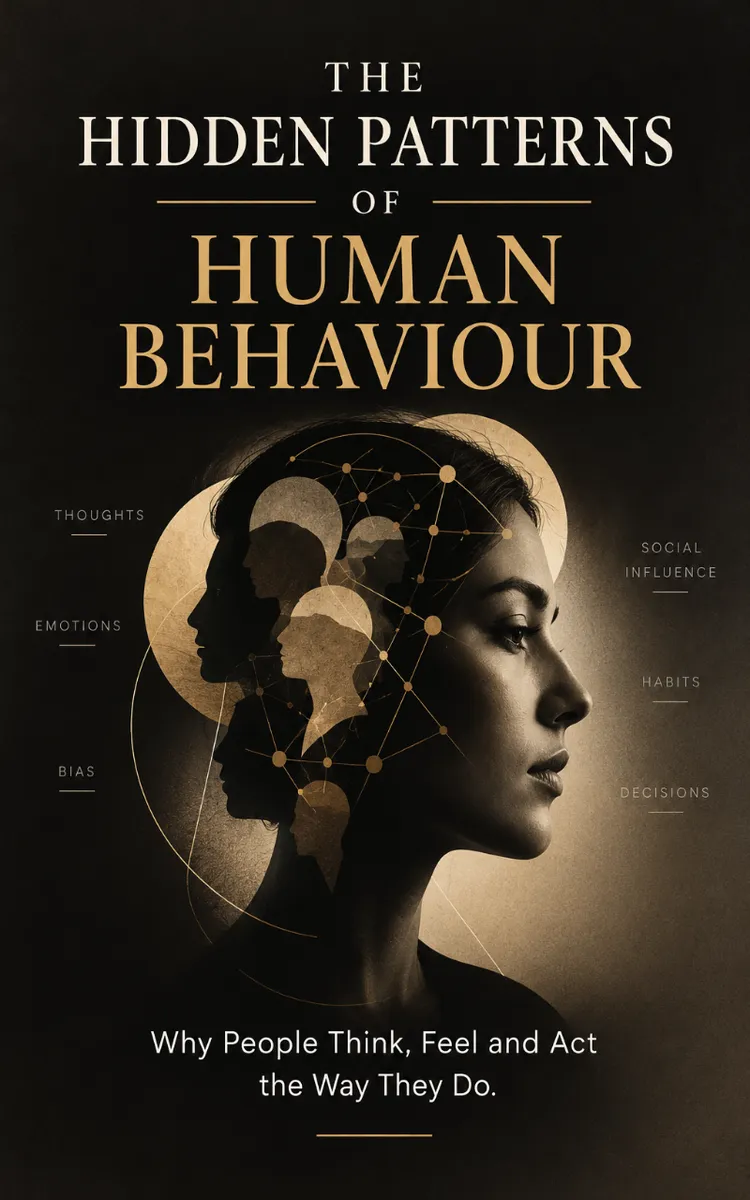
"The Hidden Patterns Of Human Behaviour" is a curiosity book by gurleen harneet with 5 chapters and approximately 7,987 words. Hidden patterns and underlying forces shaping human behaviour.
This book was created using Inkfluence AI, an AI-powered book generation platform that helps authors write, design, and publish complete books.
Frequently Asked Questions
What is "The Hidden Patterns Of Human Behaviour" about?
Hidden patterns and underlying forces shaping human behaviour
How many chapters are in "The Hidden Patterns Of Human Behaviour"?
The book contains 5 chapters and approximately 7,987 words. Topics covered include Why We Copy Strangers, The Stories Memory Invents, How Small Choices Become Habits, The Hidden Language of Status, and more.
Who wrote "The Hidden Patterns Of Human Behaviour"?
This book was written by gurleen harneet and created using Inkfluence AI, an AI book generation platform that helps authors write, design, and publish books.
Write your own curiosity book with AI
Describe your idea and Inkfluence writes the whole thing. Free to start.
Start writingCreated with Inkfluence AI


