
Read chapter 2
The whole of chapter two, free. About 9 min. Turn the pages with the arrows, your keyboard, or a swipe.
Chapter 2
Attention Markets and the Dopamine Loop
The Question Hidden in the Scroll
What if the strange emptiness people call “brain rot” is not a failure of attention, but the predictable result of an attention system working exactly as designed?
A phone does not need to force anyone to keep watching. It only needs to make the next choice easy, immediate, and slightly more rewarding than the last one. The important question is not whether digital media has made people less intelligent. It is how repeated encounters with engagement-driven design can train habits - rapid switching, constant checking, low tolerance for delay - that later feel like a change in the mind itself.
The Business of Holding Attention
The modern feed is a peculiar machine: it appears to offer endless freedom while quietly arranging the order of nearly everything a person sees. TikTok, YouTube, Instagram, Facebook, and other platforms differ in style, audience, and ownership, but they share a central economic fact. Their services are largely free to the user because the user’s attention is valuable to advertisers.
That value is not created by a single glance. It grows through time spent, return visits, reactions, comments, shares, and the small traces left behind when someone pauses over one video but swipes past another. These signals help platforms predict what might hold attention next. The prediction is then tested in real time, producing more signals. The result is a feedback system in which human behavior becomes both the product and the raw material.
The system is not simply “an algorithm” in the abstract. It is a collection of design choices: the vertical screen that lets one thumb move from video to video, the autoplay function that removes the need to decide whether to continue, the notification that interrupts a different activity, and the visible count of likes or views that turns private attention into public competition. Each choice reduces friction. Nothing needs to be searched for, selected, loaded, or deliberately finished.
That convenience is genuinely useful. A person can find a cooking technique, a local news clip, a lecture, or a song within seconds. The same structure, however, also makes trivial material unusually persistent. A clip does not need to be important to survive in the feed. It needs to produce a response: amusement, irritation, surprise, curiosity, recognition. A three-second joke and a careful explanation may occupy the same slot in the attention market if both keep the viewer moving.
This is what makes the phenomenon distinctive. Older media competed for attention, but much of it had natural stopping points: the end of a newspaper article, a television program, a chapter, or a scheduled broadcast. The infinite feed removes many of those boundaries. It converts media consumption from a series of completed encounters into a stream with no obvious shore.
Inside the Engagement-Reward Circuit
The Engagement-Reward Circuit begins with a small invitation. A notification appears, a familiar app icon catches the eye, or a person opens a platform during a pause between tasks. The first item is selected by the system, not by a clear intention formed moments earlier. The viewer watches, reads, or listens. A reaction follows - perhaps laughter, surprise, anger, or mild interest - and then the next item arrives.
The crucial feature is variability. The viewer does not know whether the next swipe will reveal something dull, amusing, useful, or astonishing. Most items may be ordinary. Occasionally one is unusually compelling. That uncertainty can make the next swipe more attractive than a predictable alternative, such as returning to a difficult email or continuing a book. The reward is not guaranteed, but it is always available.
This pattern resembles a familiar principle from behavioral psychology: actions can become persistent when rewards arrive unpredictably. A slot machine is an extreme example, but the underlying logic does not require gambling or money. A feed can deliver social recognition, novelty, humor, outrage, or information at irregular intervals. The hand learns the movement before the conscious mind has decided whether the content deserves attention.
The design also compresses time. A short video may last fifteen seconds, thirty seconds, or a minute, but the transition between videos can take less than a second. That makes stopping psychologically awkward. There is no clear moment at which the activity announces that it is complete. One piece ends, but the system has already supplied another. The decision to stop must therefore be made against the momentum of continuation.
Over time, this can shape what feels comfortable. Rapidly changing images become familiar. A person may move among a group chat, a video feed, a browser, and music without experiencing any single activity as demanding. When a slower task arrives, its early uncertainty can feel unusually unpleasant. A long article does not offer a new stimulus every few seconds. A difficult piece of work may provide no visible reward until much later. Compared with the feed, it can seem not merely harder but strangely empty.
That does not prove that a platform has permanently damaged attention. Human concentration changes with sleep, stress, age, interest, surroundings, and the demands of the task. Nor does every short video produce the same effect. The more cautious claim is that repeated design patterns can practice certain habits more often than others. The thumb becomes skilled at switching. The mind becomes accustomed to novelty. Waiting begins to feel like a problem that should be solved by checking something.
The signs are often mundane. A person opens a phone to check the time and finds a feed already moving. A video plays while breakfast cools. A notification is answered during a conversation, not because it is urgent but because its arrival has created a small pressure to respond. These moments are easy to dismiss individually. Their significance lies in repetition: a day organized around hundreds of tiny invitations can gradually make uninterrupted attention feel abnormal.
From Web Pages to Endless Feeds
The history of this system is not a simple story of technology becoming evil. Early websites competed for visits, newspapers competed for circulation, and television networks competed for viewers. What changed was the combination of mobile access, personalized recommendation, social feedback, and an advertising model capable of measuring behavior at great scale.
The smartphone placed the feed beside nearly every ordinary activity. It traveled into bedrooms, kitchens, buses, classrooms, waiting rooms, and workplaces. Earlier media required some physical arrangement: a television had to be switched on, a newspaper unfolded, a computer opened. The phone reduced those thresholds to a tap, and then the feed reduced the tap to an almost automatic gesture.
Personalization added another layer. A printed magazine presented the same sequence to everyone who bought it. A broadcast television schedule offered programs at fixed times. Digital platforms could observe what a particular user watched, skipped, replayed, searched for, or shared, then adjust the next set of recommendations. The experience became less like reading a publication and more like being continuously fitted with one.
The economics encouraged this direction. If a platform earns more when people remain active, then features that increase return visits and viewing time become commercially important. This does not require executives to want users to lose control. It requires only that the business reward attention captured and measured. Small improvements in retention can matter greatly when multiplied across millions of people and repeated every day.
Culture then gives the system its material. Users supply jokes, arguments, dance routines, commentary, tutorials, personal disclosures, and fragments of ordinary life. Some creators design deliberately for quick recognition: a striking opening image, large captions, a sudden cut, a question that promises an answer. Others adapt after noticing which posts travel furthest. The result is not merely content made by companies for consumers. It is a culture shaped by the knowledge that visibility depends on provoking measurable response.
The phrase “brain rot” enters at the end of this process as a cultural diagnosis. It is usually used loosely, sometimes humorously, to describe mental fog, compulsive scrolling, repetitive online language, or an inability to stay with material that does not provide immediate stimulation. The phrase may exaggerate what is happening, but it identifies a real tension. People are noticing that the habits rewarded by the attention market do not always transfer well to activities built around patience, memory, or sustained thought.
When Habit Looks Like Harm
The most interesting question is not whether screens are good or bad. It is why the same person can use a platform intelligently in one moment and feel controlled by it in another. The answer may lie in the difference between deliberate use and trained response.
A person who searches for a repair demonstration, watches it, and closes the app is using a tool for a defined purpose. A person who opens the same app without a clear intention and continues through whatever appears is participating in a different arrangement. Both actions may occur on the same device, under the same account, within the same minute. The difference is whether attention is leading the encounter or being repeatedly redirected by the system.
This distinction matters because “brain rot” can make a complicated process sound like a single illness. There is no single mental state hiding behind the phrase. It can refer to distraction, fatigue, compulsive checking, cultural annoyance, or the feeling that one’s thoughts have been filled with fragments. Those experiences may have different causes, including poor sleep, anxiety, isolation, or an overloaded schedule. Engagement-driven design is one influence among them, not a complete explanation.
Still, design can alter the background conditions in which attention operates. A feed that rewards speed and novelty may make those qualities easier to seek elsewhere. A notification system that interrupts often may make interruption feel normal. A recommendation engine that predicts the next preference may reduce the number of moments in which a person must choose what to pursue. These are small changes, but habits are built from small changes repeated without much reflection.
The paradox is that the system succeeds by giving users what they appear to want. It learns that a person watches sports arguments, celebrity clips, political disputes, cooking videos, or animal rescues, then supplies more of the same. The resulting feed feels personal, even intimate. Yet personalization can narrow experience while making it feel abundant. There may be thousands of items available, but the path through them is shaped by yesterday’s reactions.
What looks like a decline in attention may therefore be partly a conflict between two environments. One environment rewards immediate response, constant novelty, and visible engagement. The other - work, study, conversation, reading, craft - often rewards delayed understanding. A mind trained in one setting may not move effortlessly into the other. That is not evidence of a ruined brain. It is evidence that repeated environments teach repeated expectations.
The Engagement-Reward Circuit reveals a broader feature of modern life: influence no longer depends mainly on persuading people to choose one message. It can operate by arranging what appears next, how quickly it arrives, and how difficult it is to stop. The habits later described as “brain rot” may be the visible residue of that arrangement - attention practiced as a series of rewarded departures.
The unsettling part is how ordinary the process remains. No dramatic command is required, only a stream, a thumb, and the possibility that the next item will be better. Somewhere inside that tiny interval between one piece of content and the next, a market has learned to study human curiosity - and human curiosity has begun to learn the market’s rhythm.
End of chapter two. 6 more chapters in the full book.
Swipe or use the arrows to turn the page


What's inside: 8 chapters
- 1. The Viral Slang That Sticks
- 2. Attention Markets and the Dopamine Loop
- 3. When “Screen Time” Becomes a Diagnosis
- 4. The Attention Detox Reality Check
- 5. The “Scroll Hangover” Symptom Map
- 6. Why Algorithms Feel Like Mind Reading
- 7. The Public Health Threshold Debate
- 8. Building a Curiosity-First Default
About this book
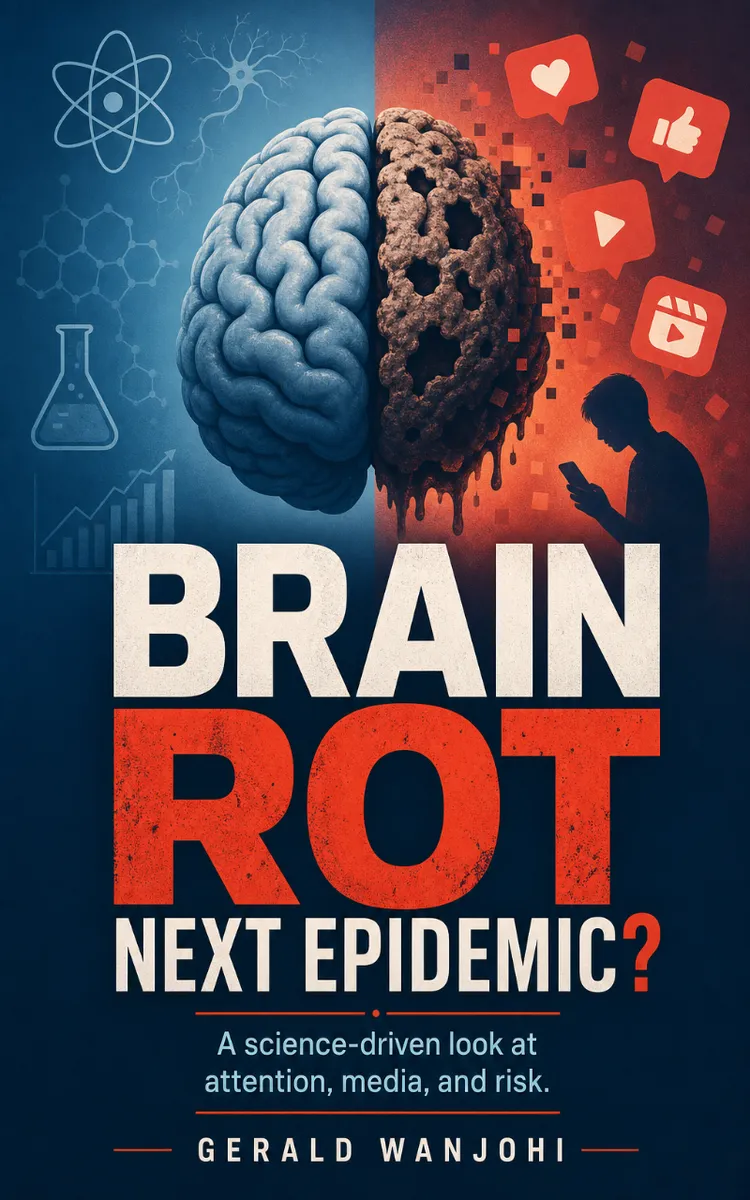
"Brain Rot Next Epidemic?" is a curiosity book by Gerald Wanjohi with 8 chapters and approximately 14,118 words. Exploring whether “brain rot” is an emerging public health risk.
This book was created using Inkfluence AI, an AI-powered book generation platform that helps authors write, design, and publish complete books.
Frequently Asked Questions
What is "Brain Rot Next Epidemic?" about?
Exploring whether “brain rot” is an emerging public health risk
How many chapters are in "Brain Rot Next Epidemic?"?
The book contains 8 chapters and approximately 14,118 words. Topics covered include The Viral Slang That Sticks, Attention Markets and the Dopamine Loop, When “Screen Time” Becomes a Diagnosis, The Attention Detox Reality Check, and more.
Who wrote "Brain Rot Next Epidemic?"?
This book was written by Gerald Wanjohi and created using Inkfluence AI, an AI book generation platform that helps authors write, design, and publish books.
Write your own curiosity book with AI
Describe your idea and Inkfluence writes the whole thing. Free to start.
Start writingCreated with Inkfluence AI


