
Read the first chapter
The whole of chapter one, free. About 9 min. Turn the pages with the arrows, your keyboard, or a swipe.
Chapter 1
The Dream Looks Different Abroad
From Postcard to Pavement
In 1956, the French writer Jean Baudrillard visited the United States and encountered a country that seemed less like a nation than an enormous public image: highways, neon, cars, supermarkets, and open space arranged at a scale difficult to reproduce in Europe. Decades later, visitors still arrive through the same bright surface. They see the postcard first - the skyline, the campus, the start-up office, the house with a garage - and only gradually meet the pavement beneath it.
That distance between image and experience is the subject here. The American Dream exported abroad is usually a story of movement: leave the old country, work hard, buy a home, choose your own life, and rise farther than your parents did. The daily version is more complicated. It includes freedom alongside exposure, abundance alongside debt, and opportunity alongside costs that are often hidden until a person has to pay them.
The Postcard-to-Pavement Lens follows that change in scale. It asks what happens when a national promise stops being a picture and becomes a rent bill, a hospital invoice, a long commute, a school district, or a decision made without family nearby.
What does the American Dream look like when the postcard has to pay for the pavement?
The Dream That Traveled Well
The American Dream became an international export long before social media made every American life visible. In the nineteenth century, newspapers, letters, immigration agents, and shipping companies carried stories of land and wages across the Atlantic. The United States appeared as a place where inherited rank mattered less, land seemed plentiful, and a person could change social position through labor.
The phrase American Dream itself is relatively modern. Historian James Truslow Adams popularized it in his 1931 book The Epic of America, describing a country where life could become better and richer for everyone according to ability or achievement. The timing mattered. Adams was writing during the Great Depression, when the promise was being tested by unemployment, bank failures, and poverty. The dream was not a description of ordinary life. It was an argument about what the country ought to make possible.
Overseas, that distinction could disappear. American films offered tidy houses, independent teenagers, large cars, and jobs connected to personal identity rather than family occupation. Advertisements compressed a complicated society into a sequence of objects: a refrigerator, a sedan, a suburban home, a college degree. The objects were not merely possessions. They represented control over one’s future.
For many newcomers, the attraction was also practical. The United States had higher wages in many industries than the places migrants left behind. Its universities, research centers, hospitals, and technology companies drew people from around the world. The country’s size created real room for reinvention. A person could move from a rural area to a city, change employers, join a new religious community, or build a business among customers with no knowledge of their family history.
Yet the exported image usually removed the conditions surrounding those possibilities. A house was shown without its property taxes. A university was shown without its tuition and loan payments. A job was shown without the cost of health insurance or the hours required to reach it. The picture was not false exactly. It was incomplete in a very particular direction: it displayed the reward and cropped out the maintenance.
Freedom With a Price Tag
Visitors often notice American freedom before they notice American insecurity. The country permits a wide range of speech, religion, dress, work, family arrangements, and personal ambition. In many places, a newcomer can make choices that would attract heavy social pressure or legal limits elsewhere. The freedom to relocate is especially visible. Americans routinely cross state lines for school, employment, marriage, or lower housing costs, carrying no internal passport and usually no formal permission from a central authority.
That mobility can feel liberating. It can also function as a substitute for public support. When housing becomes unaffordable in one city, the answer is often to move. When a job disappears, the worker is expected to search elsewhere. When a family needs specialized medical care, it may travel hundreds of miles. The ability to leave is real, but it does not mean that staying is secure.
The same pattern appears in work. The United States has long celebrated the self-made worker and the entrepreneur who operates outside old hierarchies. Small businesses can open quickly compared with many countries, and labor markets can reward specialized skills. But employment is often tied to benefits that are not guaranteed by citizenship or residence. Health insurance, retirement savings, paid leave, and predictable schedules vary widely by employer and occupation.
A visitor from a country with universal health coverage may understand American wages as generous until a medical event changes the calculation. A plumber, restaurant owner, or warehouse worker can earn enough to appear comfortably middle class and still face serious financial danger after an accident or diagnosis. The contradiction is not that Americans lack freedom. It is that many freedoms are exercised inside a system that transfers substantial risk to the individual.
A single object captures the contradiction: the American car. It represents independence, privacy, and movement. In much of the country, however, it is also a requirement for employment, groceries, school, and medical care. The vehicle that appears in the dream as a symbol of choice can become the condition for participating in ordinary life.
The Cost Hidden Behind Abundance
The United States often looks wealthy to outsiders because abundance is highly visible. Supermarkets carry enormous ranges of products. Roads stretch across a continent. Shopping districts, airports, stadiums, and homes are built on a scale that can make European or Asian visitors feel that they have entered a different geometry of daily life.
Abundance, though, is not the same as affordability. American consumption is frequently financed. Credit cards, auto loans, mortgages, and student loans allow people to obtain the visible signs of stability before they have fully paid for them. From the outside, the result can resemble prosperity. From inside, it may be a carefully balanced set of monthly obligations.
Housing offers the clearest example. The suburban home became one of the central images of postwar success, supported by mass construction, highway expansion, and policies that encouraged homeownership. But a house is not a single purchase. It carries insurance, maintenance, utilities, taxes, commuting costs, and the interest attached to the mortgage. Two homes with similar sale prices can produce very different lives depending on their distance from work and the quality of nearby schools.
Education has a similar split between image and invoice. American universities attract students from across the world because they offer strong research, broad course choices, and powerful professional networks. The campus is often presented as the entrance to opportunity. The financial obligation may continue long after graduation, shaping where a person can live, whether they can start a business, and how quickly they can support relatives.
The unexpected part is that foreigners are not simply being fooled by American advertising. Many are responding to real advantages. The country does offer unusually broad room for movement and experimentation in certain fields. The surprise is that the same system can produce both genuine opportunity and unusually personal exposure to risk.
That matters because it changes the question. The issue is not whether the American Dream is real or fake. It is real in fragments, unevenly distributed, and expensive to maintain. A visitor who asks only whether opportunity exists misses the more revealing question: who pays when opportunity fails?
The Counterintuitive Geography of Opportunity
Here is the counterintuitive finding: the American Dream is often less portable than it looks. A person may possess the education, ambition, and legal right to work, yet find that opportunity depends heavily on a particular zip code, local network, credit history, and access to transportation.
This matters because the popular image treats America as a single open field. In practice, the country is a collection of labor markets, housing markets, school systems, and local rules. A software engineer in Seattle, a nurse in rural Ohio, and a restaurant owner in Miami encounter different versions of the national promise. Even the meaning of a good wage changes with rent, insurance, childcare, and commuting time.
Visitors often learn this through geography. A city’s famous downtown may be easy to reach from an airport but difficult to afford. A university may sit beside neighborhoods where students cannot rent an apartment after graduation. A job posting may promise a salary that looks remarkable in an overseas currency, while the local cost of housing absorbs much of it.
The Postcard-to-Pavement Lens makes this mismatch visible by placing the symbol beside its operating cost. The front porch stands beside the mortgage and property tax. The open highway stands beside fuel, repairs, and the absence of public transit. The individual choice stands beside the family support that may have been left behind.
A Family Between Two Versions of America
The experience of Danyelle Khmara, a Syrian refugee and former teacher whose family settled in the United States, illustrates how quickly the dream can move from symbol to administration. Reporting on refugee resettlement has repeatedly shown the gap between arrival and stability: families may reach safety, find an apartment, enroll children in school, and still face the difficult arithmetic of rent, transportation, language access, employment, and medical care.
For a newly arrived family, the American promise is not encountered first as a mansion or a promotion. It appears as a lease that requires a deposit, a bus route that does not match a work shift, a school form written in unfamiliar English, and a job that may not recognize qualifications earned abroad. The freedom to begin again exists, but beginning again requires documents, references, credit records, and time.
This is where overseas admiration meets everyday American reality. The country can offer refuge and possibility while also demanding that newcomers navigate systems designed around assumptions they may not share. A professional may be treated as unqualified because a credential is unfamiliar. A family may be legally free to move but unable to do so because the move would mean losing childcare, work, or medical access.
Their experience does not disprove the Dream. It reveals its hidden structure. The promise depends not only on personal effort but on whether institutions recognize that effort, whether communities provide bridges, and whether a person can survive the period before the promised opportunity arrives.
The View From the Pavement
People outside the United States often see the American Dream with unusual clarity because distance turns daily life into symbols. They notice the house, the college, the car, the open road, and the language of choice. After arrival, they discover that each symbol is attached to a system of payments and permissions, many of them private rather than public.
The contradiction is not uniquely American, but its scale makes it unusually visible. A society can be rich, mobile, and inventive while leaving individuals to absorb large portions of the cost of illness, education, housing, and old age. It can offer remarkable freedom while making that freedom dependent on income and location.
Perhaps every national dream works this way: from far away, it appears as a promise; up close, it becomes a set of arrangements. The American version remains powerful because the promise is not empty. It has opened real doors, even as it has placed real weight on the people expected to walk through them. The question is not whether the door exists, but what waits on the other side - and who has been asked to hold it open.
End of chapter one. 14 more chapters in the full book.
Swipe or use the arrows to turn the page


What's inside: 15 chapters
- 1. The Dream Looks Different Abroad
- 2. A Passport Is Not a Promise
- 3. Freedom With a Price Tag
- 4. The Healthcare Shock
- 5. Why Americans Drive Everywhere
- 6. The Land of Work Without Rest
- 7. School as a Family Gamble
- 8. The Myth of Starting Over
- 9. Race Seen From the Outside
- 10. The News That Travels
- 11. Guns in the Welcome Speech
- 12. Patriotism Without the Postcard
- 13. The Generosity Nobody Sees
- 14. What America Exports-and Imports
- 15. The Dream Is a Moving Target
About this book
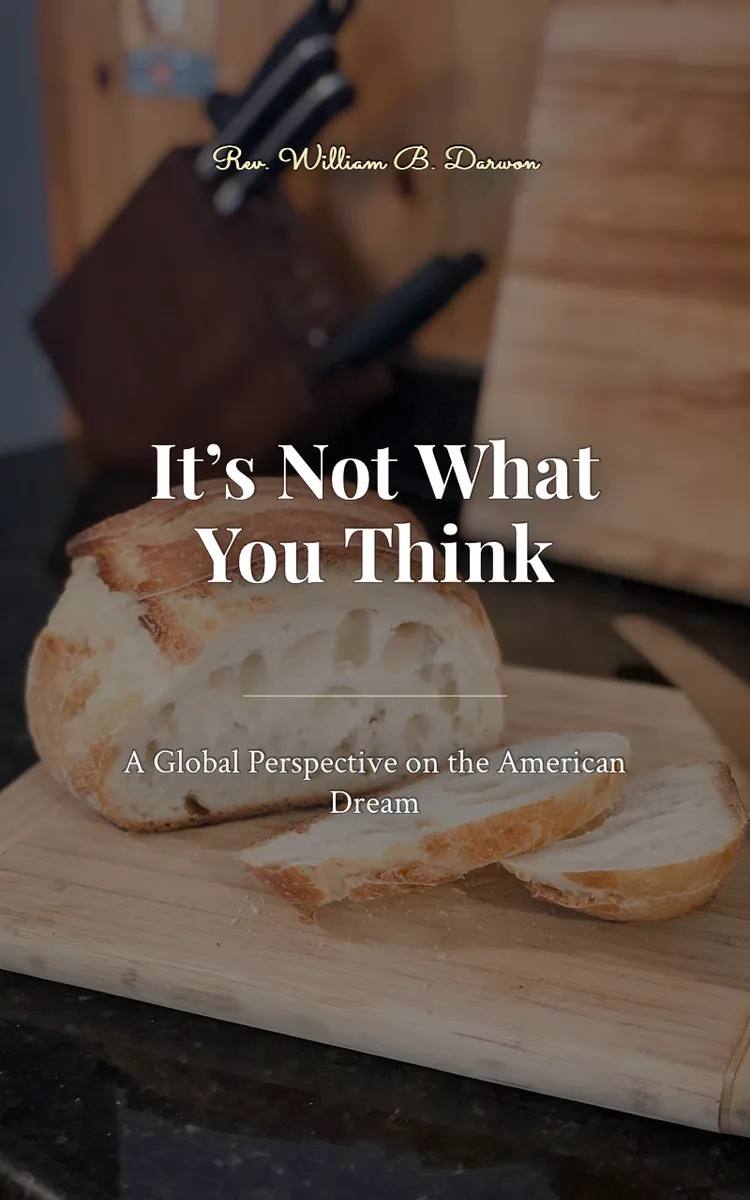
"It’s Not What You Think" is a curiosity book by Rev. William B. Darwon with 15 chapters and approximately 25,977 words. How people outside America perceive the reality of the American dream.
This book was created using Inkfluence AI, an AI-powered book generation platform that helps authors write, design, and publish complete books.
Frequently Asked Questions
What is "It’s Not What You Think" about?
How people outside America perceive the reality of the American dream
How many chapters are in "It’s Not What You Think"?
The book contains 15 chapters and approximately 25,977 words. Topics covered include The Dream Looks Different Abroad, A Passport Is Not a Promise, Freedom With a Price Tag, The Healthcare Shock, and more.
Who wrote "It’s Not What You Think"?
This book was written by Rev. William B. Darwon and created using Inkfluence AI, an AI book generation platform that helps authors write, design, and publish books.
Write your own curiosity book with AI
Describe your idea and Inkfluence writes the whole thing. Free to start.
Start writingCreated with Inkfluence AI


