
Read the first chapter
The whole of chapter one, free. About 6 min. Turn the pages with the arrows, your keyboard, or a swipe.
Chapter 1
Day 1: The Way Up Begins with Surrender
Scripture Focus
Proverbs 3:5-6 (NIV)
> Trust in the LORD with all your heart > and lean not on your own understanding; > in all your ways submit to him, > and he will make your paths straight.
God’s direction often begins where our demand for complete control ends.
A new day can carry an old pressure: the need to know how everything will turn out. You may want certainty about a decision, a relationship, your work, your finances, or a prayer that hasn’t been answered yet. You may keep checking, planning, replaying conversations, and trying to prepare for every possible outcome. Some planning is wise. But there comes a point when preparation quietly becomes control.
Proverbs does not tell us to stop thinking or ignore responsibility. It invites us to trust God more deeply than we trust our limited view. “Lean not on your own understanding” doesn’t mean understanding has no value. It means understanding isn’t strong enough to carry the full weight of your future. God sees what you can’t see. He knows what your present obedience is preparing you to receive.
Surrender, then, isn’t giving up on growth. It’s giving up the demand to manage every result. You still show up, make the phone call, complete the work, apologize, save carefully, and seek wise counsel. But you release the final outcome to God. Surrender places your future in God’s hands while keeping your next step in yours.
Reflection
The first step toward spiritual elevation is often downward in appearance. We bow our will. We admit that our plans, even sincere ones, are incomplete. That can feel uncomfortable because control gives us the illusion of safety. If you can predict every detail, you think you can prevent every disappointment. If you can work hard enough, explain yourself clearly enough, or keep watch long enough, perhaps nothing will go wrong.
Yet life with God cannot be built on constant control. Faith requires open hands. When your hands are tightly closed around a preferred outcome, there’s little room to receive God’s instruction. Surrender creates that room. It helps you hear the quiet correction, notice the unexpected opportunity to serve, or recognize that a delayed answer may be protecting and preparing you at the same time.
Consider a practical decision you’re facing. Maybe you’ve sent an application and are waiting for a response. Perhaps your business needs more customers, your family needs a difficult conversation, or you’re unsure whether to stay in a familiar role or take a new step. Surrender doesn’t tell you to sit still and do nothing. It asks you to separate obedience from outcome. Your part may be to prepare honestly, ask God for wisdom, and take the next faithful action. God’s part is what follows.
This distinction changes how we define elevation. Elevation isn’t simply getting a higher position, earning more money, receiving public recognition, or finally having life arranged according to your preferred schedule. Those things may come, but they aren’t the measure of spiritual progress. A person can gain influence and still remain inwardly restless. Another can be growing steadily in patience, integrity, courage, and trust while no one applauds. Faithful growth is elevation because it brings your life into closer agreement with God’s will.
That kind of growth may look ordinary today. You choose honesty when exaggeration would help you make a sale. You pause before sending an angry message. You accept that a closed door is not proof that God has forgotten you. You do the work in front of you without demanding immediate evidence that it will succeed. These choices may not feel dramatic, but they are acts of surrender. They train your heart to follow God rather than use God to confirm your plan.
There’s also freedom in admitting what you cannot control. You can’t control another person’s response, the timing of an opportunity, the economy, the past, or every detail of your health and future. You can control whether you bring these concerns honestly to God. You can choose whether today’s pressure makes you grasp harder or trust more deeply. A simple prayer such as, “Father, show me what obedience looks like today,” can bring the focus back to the next step.
Notice the wording of Proverbs: “In all your ways submit to him.” Not only in church or during quiet prayer, but in all your ways. Your calendar, spending, work habits, conversations, ambitions, and private thoughts all belong under God’s direction. Surrender becomes real when it reaches the places where you usually insist, “I know what’s best.” It may involve changing a plan, waiting before acting, asking for help, or obeying an instruction that seems small.
The goal isn’t to become passive or careless. It’s to become available. A surrendered heart can still be hardworking, decisive, and courageous. The difference is that it no longer treats success as proof of worth or delay as proof of failure. You obey because God is worthy of trust. You grow because He is shaping you. You move forward without requiring a complete map.
Practice for Today
1. Name the outcome you’re gripping. Set aside ten quiet minutes. Write one sentence that completes this thought: “I’m afraid that if this does not happen the way I want, then…” Be specific. You might write, “I’m afraid that if I don’t get this position, I’ll fall behind,” or “I’m afraid that if this conversation goes badly, the relationship can’t be repaired.” Don’t edit the sentence to sound spiritual. Bring the honest fear to God.
Under it, write a second sentence: “My faithful next step is…” Keep this action within your responsibility. It may be sending a truthful email, preparing for an interview, asking forgiveness, reviewing your budget, or resting instead of checking for updates every five minutes. Then pray over the outcome and release it with open hands.
2. Use a three-minute surrender prayer. For the first minute, name the situation before God without trying to solve it. For the second minute, breathe slowly and repeat, “God, I trust You with what I cannot control.” When your mind wanders, return gently to the words. For the third minute, ask, “What is the next obedient step?” Write down the first clear, wise action that agrees with Scripture and can be taken today.
This isn’t a technique for forcing an answer. It’s a way to quiet the noise long enough to distinguish faithful responsibility from anxious management. If no specific action becomes clear, your next step may be to wait, seek counsel, or continue doing the good already in front of you.
3. Practice one deliberate release. Choose one control habit for today. It could be rereading a message before sending it ten times, checking a bank balance repeatedly, trying to manage someone else’s opinion, or rehearsing a conversation you can’t control. Decide on a reasonable limit. For example, check the message twice, send it, and give the response to God. When the urge returns, say, “I have done my part; the result belongs to God,” and redirect your attention to a present responsibility.
At the end of the day, record what happened inside you. Did surrender make you careless, or did it help you act with greater peace and clarity? Thank God for one moment when you noticed His direction. Even a small change matters. A heart that releases control one decision at a time becomes more ready to recognize God’s leading.
Surrender may not change the situation immediately. It changes your position within the situation. Instead of standing over your future, trying to force it into shape, you stand before God with willingness. You can work without panic, wait without despair, and receive direction without demanding every detail first.
Closing Prayer
Father, I release the outcomes I’ve been trying to manage. Teach me to trust You beyond what I can see and to obey You in the next step before me. Give me wisdom to act, humility to wait, and peace when the results remain unknown. Shape my growth according to Your will, not my need for recognition or control. I place this day and my future in Your hands. Amen.
End of chapter one. 19 more chapters in the full book.
Swipe or use the arrows to turn the page


What's inside: 20 chapters
- 1. Day 1: The Way Up Begins with Surrender
- 2. Day 2: Hearing the Call to Obey
- 3. Day 3: Trusting God Before You See
- 4. Day 4: Letting Go of the Need to Understand
- 5. Day 5: The Courage to Take the First Step
- 6. Day 6: Obedience in the Hidden Place
- 7. Day 7: Prayer That Aligns the Heart
- 8. Day 8: Choosing Faithfulness in Small Things
- 9. Day 9: When Obedience Costs You
- 10. Day 10: Waiting Without Giving Up
- 11. Day 11: Letting God Refine Your Motives
- 12. Day 12: Receiving Correction with Humility
- 13. Day 13: Hope in the Middle of the Process
- 14. Day 14: Obeying Through Uncertainty
- 15. Day 15: Serving Before You Are Seen
- 16. Day 16: Stewarding the Open Door
- 17. Day 17: Staying Grounded as You Rise
- 18. Day 18: Elevation for the Sake of Others
- 19. Day 19: Giving God the Glory
- 20. Day 20: A Lifelong Yes
About this book
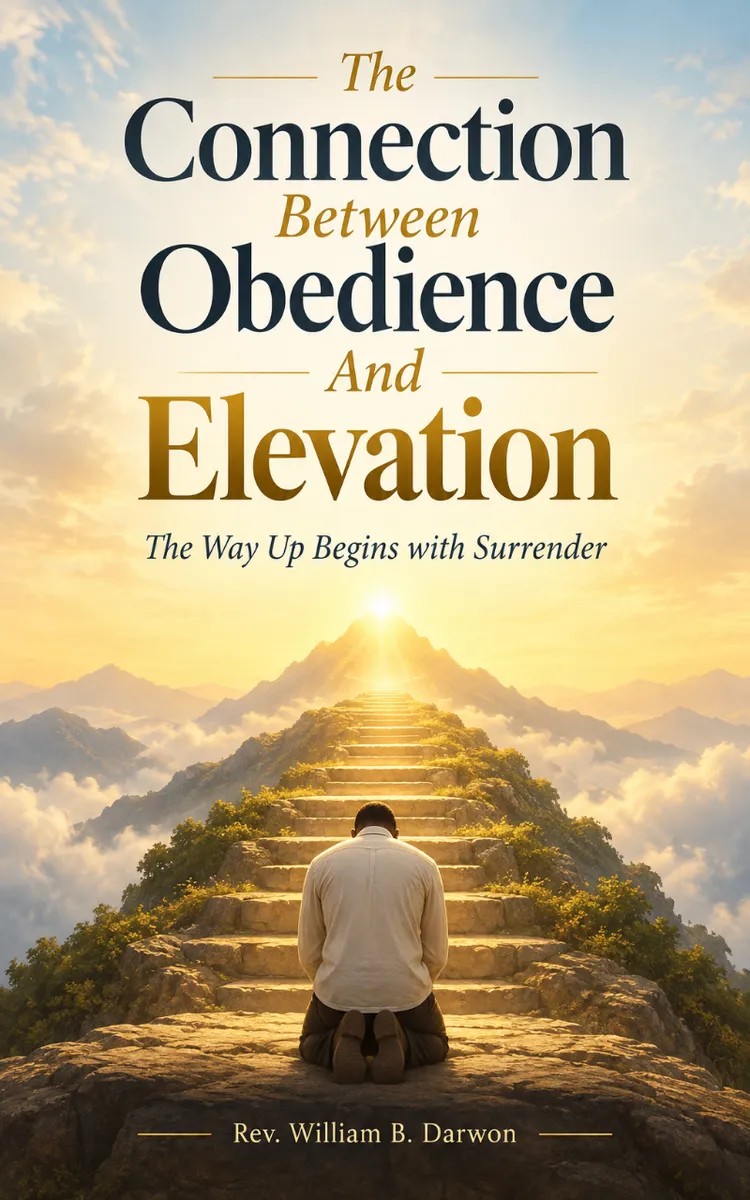
"The Connection Between Obedience And Elevation" is a religious devotional book by Rev. William B. Darwon with 20 chapters and approximately 20,263 words. The relationship between obedience, surrender, and spiritual elevation.
This book was created using Inkfluence AI, an AI-powered book generation platform that helps authors write, design, and publish complete books.
Frequently Asked Questions
What is "The Connection Between Obedience And Elevation" about?
The relationship between obedience, surrender, and spiritual elevation
How many chapters are in "The Connection Between Obedience And Elevation"?
The book contains 20 chapters and approximately 20,263 words. Topics covered include Day 1: The Way Up Begins with Surrender, Day 2: Hearing the Call to Obey, Day 3: Trusting God Before You See, Day 4: Letting Go of the Need to Understand, and more.
Who wrote "The Connection Between Obedience And Elevation"?
This book was written by Rev. William B. Darwon and created using Inkfluence AI, an AI book generation platform that helps authors write, design, and publish books.
Write your own religious devotional book with AI
Describe your idea and Inkfluence writes the whole thing. Free to start.
Start writingCreated with Inkfluence AI


