

Read the first chapter
The whole of chapter one, free. About 6 min. Turn the pages with the arrows, your keyboard, or a swipe.
Chapter 1
Spotting the Chemistry of Chaos
When the Spark Makes You Abandon Your Common Sense
You meet someone on a dating app, and within three messages, your body is awake. They’re charming, inconsistent, slightly hard to read. They disappear for a day, return with a flirty voice note, and suddenly your mood depends on a phone screen. You call it chemistry. You reread their messages. You explain the gaps. You tell a friend, “There’s just something about them.”
Then the first date feels electric because you’re working for every scrap of attention. You leave buzzing, not because you felt known, but because you felt chosen - temporarily. A calm person who replies clearly and keeps plans may seem pleasant, yet somehow flat. The unpredictable person feels alive. Your stomach flips. Your brain starts writing a love story before you know their last name.
In a long-term relationship, the same pattern can wear a wedding ring. Your partner comes home quiet, and you read rejection into it. They ask for space, and you chase reassurance. They finally soften, and the relief feels like intimacy. You may even miss the drama when things settle, then poke at the quiet until somebody reacts. Do you recognize yourself in this pattern?
The Question That Changes What “Chemistry” Means
What if the spark isn’t telling you who belongs in your life - but what your nervous system already knows how to survive?
Your brain doesn’t crave happiness first. It craves what is familiar. If love once came with uncertainty, emotional distance, criticism, or sudden warmth, your system may mistake those conditions for attraction. Not because you secretly want pain. Because your body learned to pay close attention when connection wasn’t guaranteed.
That’s why activating intensity can feel more convincing than steady compatibility. You’re not simply attracted to the person. You’re reacting to the chase, the guessing, the relief, and the next emotional payoff. The “high” comes from unpredictability. It can feel like desire, but underneath it may be your threat response scanning for the next change in temperature.
Before the shift, you might say, “I can’t stop thinking about them. It must mean this is special.” After the shift, you ask, “Do I like who they are, or am I trying to earn safety from them?” Before, a partner’s silence sends you into a three-hour investigation. After, you notice the alarm, check the facts, and judge the relationship by its pattern - not by the rush when tension finally breaks.
This doesn’t mean calm is always healthy or intensity is always harmful. Some people are genuinely exciting, passionate, and compatible. The point is to separate excitement from activation. The Spark-or-Flare Test helps you do that. A spark expands your life. A flare demands that you stare at it.
Follow the Chain Before You Call It Love
Here’s how familiar chaos can turn into a romance story:
1. When they become warm, then suddenly distant, your system registers uncertainty. 2. You feel anxious, alert, and unusually focused on them. 3. So you check your phone, overanalyze every word, and work harder to regain closeness. 4. Which leads to a rush when they respond, followed by deeper attachment to the cycle.
The same pattern can happen inside a committed relationship. Your partner raises a concern, and instead of hearing the issue, you hear danger. You defend yourself, withdraw, threaten to leave, or demand immediate reassurance. When the argument ends, the relief feels powerful. You mistake the end of distress for proof that the bond is strong.
Now try the alternative chain:
1. When someone is inconsistent or a conflict suddenly spikes, you name the activation instead of calling it chemistry. 2. You feel the pull to chase, punish, perform, or shut down. 3. So you pause long enough to ask what is actually happening and what you actually know. 4. Which leads to a clearer choice: ask for consistency, repair the conflict, or step away from a relationship that keeps your body on guard.
Use the Spark-or-Flare Test with three questions: Is there warmth without a chase? Is there attraction without confusion? Do I feel more like myself after contact, or less?
If the connection needs chaos to feel alive, it isn’t intimacy - it’s activation wearing perfume.
Rate the Pattern, Not the Fantasy
Take a notebook and answer these without defending the person or prosecuting yourself. You’re collecting information, not building a case.
1. From 1 to 10, how peaceful do you feel during the spaces between contact? A low number suggests the connection is being powered by uncertainty. A higher number doesn’t prove compatibility, but it shows your body isn’t constantly waiting for impact.
2. From 1 to 10, how much do you know about this person’s actual character compared with how much you imagine about their potential? A low number means fantasy may be carrying the relationship. A higher number means your attraction has room to rest on observed behavior.
3. Yes or no: Do you feel more attracted after they disappoint, withdraw, or make you prove yourself? If yes, emotional distance may be intensifying the pull. If no, attraction may be growing from genuine contact rather than repair-seeking.
4. From 1 to 10, how safe is it to bring up a small concern? A low number matters, even if the chemistry is spectacular. A higher number suggests the relationship can hold reality instead of requiring you to stay agreeable, silent, or hypervigilant.
Here’s a simple interpretation guide. If your answers show high intensity, low peace, little real knowledge, and fear around honest conversation, treat the connection as a flare until its behavior proves otherwise. If attraction and steadiness are both present, keep observing. Don’t rush to label it safe, either. Compatibility is revealed through repeated choices, especially after disappointment.
The Seven-Day Spark-or-Flare Challenge
Track the feeling after the contact
1. Day 1: Record the body signal. After your next date, call, text exchange, or disagreement, write three words describing your body: open, tight, restless, grounded, heavy, energized. Add one sentence about what happened. Timing: within ten minutes. Difficulty: Easy.
2. Days 2-4: Compare the rush with the reality. Each time you feel a strong pull, write two columns: “What I know” and “What I’m hoping.” Include concrete behavior, such as “They canceled twice,” “They listened when I raised a concern,” or “I’m assuming they’ll become consistent.” Timing: five minutes after each activating moment. Difficulty: Medium.
3. Days 5-7: Make one clean request or boundary. Say something direct: “I enjoy seeing you, and I’m looking for plans that are followed through,” or “I want to discuss this without insults. I’m going to pause and return to it tonight.” Then watch what happens. Timing: within the next week, not during the peak of an argument. Difficulty: Hard.
You’ll know it’s working when...
• You stop treating anxiety as proof of attraction. - You can describe the person’s behavior without filling in the blanks with fantasy. - You feel clearer after setting a boundary, even if the answer disappoints you.
The goal isn’t to make every relationship quiet or every date sensible. The goal is to stop handing the word “chemistry” to every connection that activates old alarms. A genuine spark can survive clarity. A flare usually needs confusion, pursuit, and emotional smoke.
Choose the Connection That Leaves You More Yourself
The most important truth is this: familiar intensity can feel like desire while genuine compatibility feels like room to breathe.
• Your first rush may reflect recognition, not destiny. - Uncertainty can create obsession because your system is waiting for relief. - The Spark-or-Flare Test separates attraction from the need to earn safety. - Consistency, honest conversation, and your sense of self reveal more than a dramatic beginning.
If you’re single, this gives you a way to slow down before turning a stranger’s inconsistency into a love story. If you’re partnered, it gives you a way to notice when conflict has become the relationship’s main source of closeness. You don’t need to shame yourself for being drawn to what feels familiar. You do need to become honest about the price.
The next time someone makes your heart race, don’t ask only, “How badly do I want them?” Ask, “What is my body preparing me for - and what happens when this connection stops feeling exciting?” That answer may show you the defensive pattern waiting underneath the spark.
End of chapter one. 7 more chapters in the full book.
Swipe or use the arrows to turn the page


What's inside: 8 chapters
- 1. Spotting the Chemistry of Chaos
- 2. Recognizing Your Defense Shield
- 3. Tracing Old Threats in Present Love
- 4. Interrupting the Escalation Loop
- 5. Setting Boundaries Without Disappearing
- 6. Building Safety Beyond Your Partner
- 7. Repairing Trust Through Small Returns
- 8. Choosing Sovereign Connection
About this book
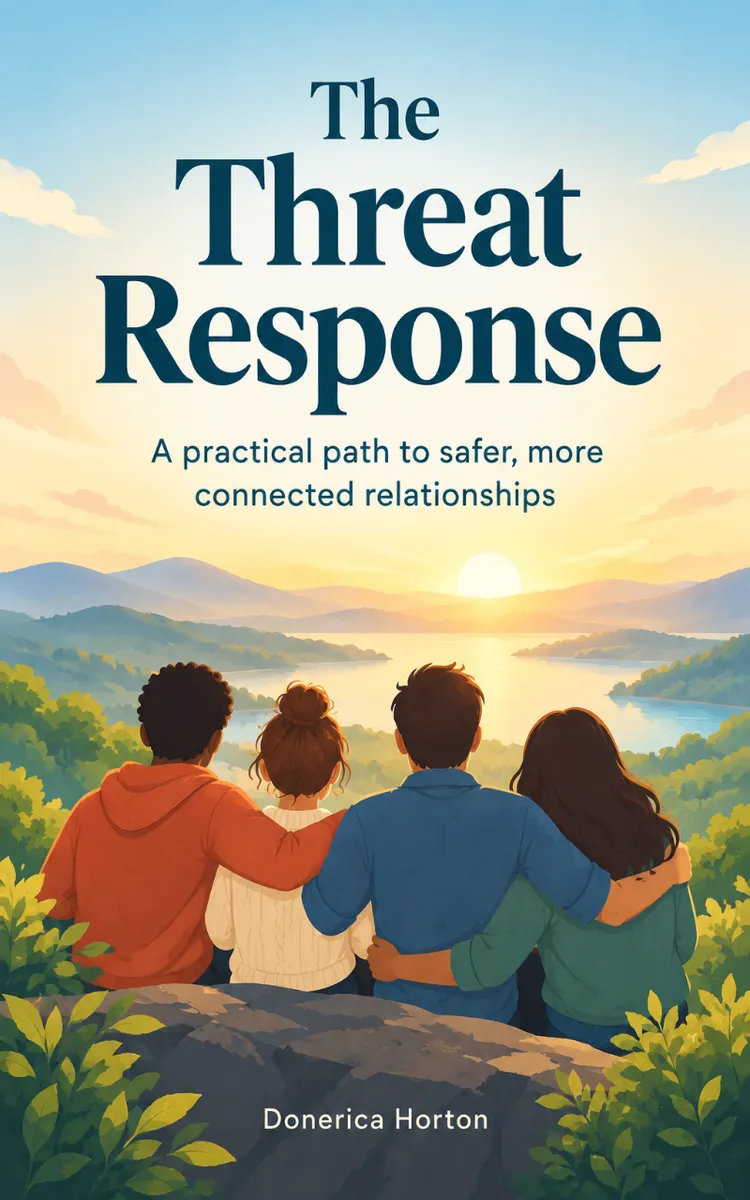
"The Threat Response" is a self-help book by Donerica Horton with 8 chapters and approximately 11,717 words. How nervous-system threat responses shape dating, conflict, and intimacy.
This book was created using Inkfluence AI, an AI-powered book generation platform that helps authors write, design, and publish complete books. It was made with the AI Self-Help Book Writer.
Frequently Asked Questions
What is "The Threat Response" about?
How nervous-system threat responses shape dating, conflict, and intimacy
How many chapters are in "The Threat Response"?
The book contains 8 chapters and approximately 11,717 words. Topics covered include Spotting the Chemistry of Chaos, Recognizing Your Defense Shield, Tracing Old Threats in Present Love, Interrupting the Escalation Loop, and more.
Who wrote "The Threat Response"?
This book was written by Donerica Horton and created using Inkfluence AI, an AI book generation platform that helps authors write, design, and publish books.
How can I create a similar self-help book?
You can create your own self-help book using Inkfluence AI. Describe your idea, choose your style, and the AI writes the full book for you. It's free to start.
Write your own self-help book with AI
Describe your idea and Inkfluence writes the whole thing. Free to start.
Start writingCreated with Inkfluence AI


