
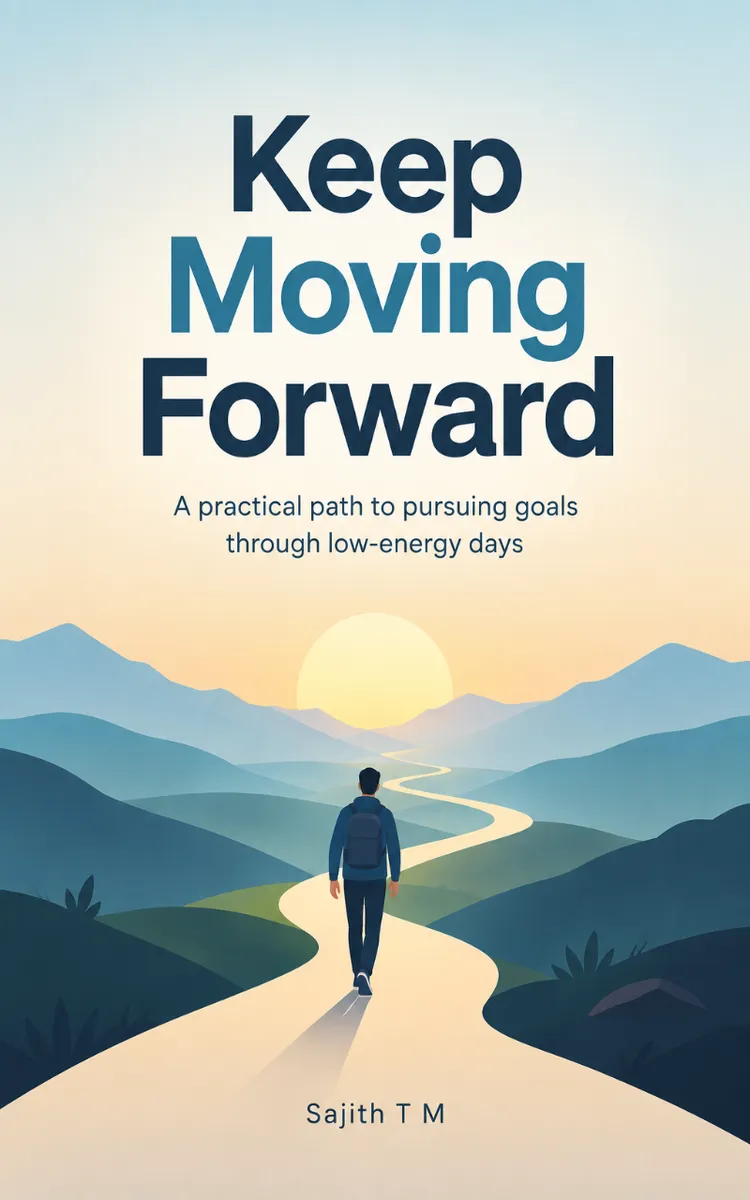
Read the first chapter
The whole of chapter one, free. About 6 min. Turn the pages with the arrows, your keyboard, or a swipe.
Chapter 1
Acting Before You Feel Ready
The Moment Motivation Disappears
The alarm rings, and your first thought is already a negotiation: “I’ll do it after coffee.” Then after coffee becomes after breakfast. By lunchtime, the workout, business task, writing session, or difficult phone call has moved to tomorrow. You haven’t said no. You’ve simply kept waiting for the version of you who feels ready.
Later, you open the notebook, stare at the blank page, and feel the familiar weight in your chest. The task looks bigger because you haven’t touched it. You check your phone for “just five minutes,” then look up forty minutes later with less energy than before. Nothing dramatic happened. That’s what makes the pattern so slippery. You’re not quitting; you’re postponing the first move until confidence or enthusiasm arrives. Do you recognise this in yourself?
The problem isn’t that you don’t care. You probably care a lot. That’s often why the task feels so heavy. When something matters, your mind notices every way it could go badly. Starting then feels like making a promise you might not keep. Waiting feels safer.
But waiting has a hidden cost. Each delay teaches your brain that action requires a special mood. The longer you wait, the more convincing that story becomes.
What If Readiness Is Not the Starting Line?
What if you don’t need to feel ready before you act - you feel more ready because you act?
Readiness is often treated like a green light. You expect confidence to rise, energy to appear, and doubt to quiet down before you begin. In real life, those feelings often show up after a small action. Your mind gets evidence: “I can do one part of this.” That evidence is more useful than another hour of thinking about it.
This is the First-Move Principle: separate the first action from the emotional state you wish you had. The first move doesn’t need to solve the whole problem. It only needs to make the next move easier. Open the document. Put on your shoes. Write the first rough sentence. Place the call on your screen. Small actions reduce the fog because they turn a vague threat into something your hands can handle.
Take a business owner who needs to contact three overdue customers. On a low-energy morning, the old approach is to promise a call when confidence returns. The new approach is to set a five-minute timer and write one plain message: “Hi, I’m checking in about the outstanding invoice. Could you let me know when payment is expected?” The message may still feel uncomfortable. But after writing it, the next message takes less effort. The before state was waiting for courage. The after state is moving with some discomfort still present.
That’s the shift. You’re not trying to manufacture enthusiasm. You’re proving that enthusiasm isn’t required for the first move.
How Waiting Strengthens the Wrong Habit
Here’s the usual chain:
1. When you notice a task that feels important or uncomfortable, your mind predicts effort, failure, or embarrassment. 2. You feel tension, doubt, and low energy. The task seems even larger than it did five minutes earlier. 3. So you wait for motivation or confidence to appear. You check messages, tidy something unnecessary, or choose an easier task. 4. Which leads to temporary relief, followed by more pressure. The task remains, your available time shrinks, and starting feels even harder.
The alternative chain begins with the same trigger:
1. When you notice the uncomfortable task, you name the smallest visible first move. 2. You still feel some resistance, but you stop treating that feeling as a command. 3. So you act for five minutes or complete one defined piece. You gather evidence that action is possible before motivation arrives. 4. Which leads to less uncertainty and a better chance of continuing. Even if you stop after five minutes, you’ve weakened the habit of waiting.
Notice what changed. The task didn’t become easy. You changed the order. Action came before confidence instead of confidence being asked to approve action.
Try this today with one task you’ve been avoiding. Don’t write “work on finances” on your list. Write “open the banking app and find last month’s statement.” Don’t write “exercise.” Write “put on training shoes and walk outside for three minutes.” A first move should be so clear that tired-you can understand it without a meeting.
You don’t have to feel ready; you have to make the next move small enough to begin.
A Honest Check-In With Yourself
Use these questions to notice what happens before you delay. Rate yourself honestly, not impressively.
1. On a scale of 1-10, how often do you wait for motivation before starting an important task? A low score suggests you already separate feelings from action fairly well. A high score shows that motivation has become a permission slip.
2. On a scale of 1-10, how clearly can you name the first physical action for a goal? A high score means your next move is visible. A low score may mean the goal is still too broad, such as “get healthier” or “grow the business.”
3. Yes or no: When you feel tired, do you assume the whole task must wait? “Yes” reveals an all-or-nothing rule. “No” suggests you already allow a smaller version of progress.
4. On a scale of 1-10, how willing are you to act while feeling uncertain or unenthusiastic? A high score reflects willingness, not constant bravery. A low score points to the exact place where the First-Move Principle can help.
For a simple interpretation, look for your highest number or your “yes.” That’s your current bottleneck. If your first-move clarity is low, shrink the task. If your willingness is low, lower the time commitment. If you keep waiting for motivation, practise starting before you feel different. You don’t need to fix everything at once. You need to identify what blocks the first move.
The Five-Minute First-Move Challenge
Choose one avoided task and begin before your mood gets a vote.
1. Name the first move - Easy. Within the next ten minutes, choose one task you’ve delayed. Write the smallest physical action on paper or in your phone. Make it measurable: “open the proposal and write the heading,” not “finish the proposal.” - You’ll know it’s working when... - the action takes one sentence to describe; - you can begin without extra research; - your body knows what to do next.
2. Set a five-minute timer - Medium. Start at a fixed time today, preferably within the next three hours. Put your phone out of reach, begin the first move, and continue only until the timer ends. You may keep going, but you’re not required to. The point is to practise beginning without waiting for enthusiasm. - You’ll know it’s working when... - you start while still feeling some resistance; - you stay with the task until the timer ends; - the task feels less mysterious than it did before.
3. Record the evidence - Medium. When the timer ends, write three short notes: what you did, how you felt before, and how you felt after. Do this immediately. Your brain needs a clear record that action was possible without perfect energy or confidence. - You’ll know it’s working when... - your “before” feeling is no longer treated as a prediction; - you can point to a completed piece of work; - starting tomorrow feels slightly less dramatic.
If five minutes feels too hard, use two. If it feels easy, repeat it once later today. The challenge isn’t to create a heroic burst of effort. It’s to build trust in your ability to move while your feelings are mixed.
The First Move Changes What Comes Next
Motivation is helpful, but it is not the boss of your next action.
• Action and motivation can arrive in either order; waiting is not the only option. - The First-Move Principle turns a large, emotional task into one visible physical action. - Discomfort after starting does not mean you chose the wrong goal; it may simply mean you began honestly. - Every small start gives your mind evidence that progress is possible on an ordinary, tired day.
You may still have mornings when confidence is missing and your energy is low. That doesn’t disqualify you from moving forward. It only means the move may need to be smaller, gentler, and more specific.
Once you can begin without waiting to feel ready, a new question appears: how do you keep going when the first burst of effort fades?
End of chapter one. 9 more chapters in the full book.
Swipe or use the arrows to turn the page


What's inside: 10 chapters
- 1. Acting Before You Feel Ready
- 2. Redefining Yourself as Consistent
- 3. Choosing Goals That Matter
- 4. Making Progress Smaller
- 5. Designing Habits That Stick
- 6. Protecting Energy for What Matters
- 7. Removing Friction from Action
- 8. Recovering Quickly After Setbacks
- 9. Staying Accountable Without Shame
- 10. Adapting Your Practice for the Long Run
About this book
"Keep Moving Forward" is a self-help book by Sajith T M with 10 chapters and approximately 14,857 words. Build consistency that survives low motivation, tired days, and missed sessions. Keep Moving Forward helps you stop waiting for the right mood and start with a manageable action, even when you don’t feel ready.
This book was created using Inkfluence AI, an AI-powered book generation platform that helps authors write, design, and publish complete books. It was made with the AI Self-Help Book Writer.
Frequently Asked Questions
What is "Keep Moving Forward" about?
Build consistency that survives low motivation, tired days, and missed sessions. Keep Moving Forward helps you stop waiting for the right mood and start with a manageable action, even when you don’t feel ready. You’ll learn to return to a goal without treating one missed day as proof that you’ve failed. You’ll also learn to connect today’s effort to what the outcome means to you, so slow progress doesn’t make the work feel pointless. A twenty-minute run, for example, can matter because it brings you closer to keeping up with your daughter and trusting yourself again. Across ten chapters, this book offers a steadier definition of consistency: not doing everything perfectly, but coming back. Start with five minutes, one paragraph, or the shoes by the door.
How many chapters are in "Keep Moving Forward"?
The book contains 10 chapters and approximately 14,857 words. Topics covered include Acting Before You Feel Ready, Redefining Yourself as Consistent, Choosing Goals That Matter, Making Progress Smaller, and more.
Who wrote "Keep Moving Forward"?
This book was written by Sajith T M and created using Inkfluence AI, an AI book generation platform that helps authors write, design, and publish books.
How can I create a similar self-help book?
You can create your own self-help book using Inkfluence AI. Describe your idea, choose your style, and the AI writes the full book for you. It's free to start.
Write your own self-help book with AI
Describe your idea and Inkfluence writes the whole thing. Free to start.
Start writingCreated with Inkfluence AI


