
Read the first chapter
The whole of chapter one, free. About 7 min. Turn the pages with the arrows, your keyboard, or a swipe.
Chapter 1
Minimum Viable Discipline Wins
You Keep Starting Big, Then Paying With Your Energy
You’re not lazy. You’re not “off track” in some dramatic, movie-scene way. You’re doing that familiar mid-career dance where you decide you’ll get disciplined again on a Monday… and then reality shows up by Thursday.
Rohit, 46, operations director, had a whole plan. He’d been telling himself for weeks that he needed to get back to the basics: gym time, a professional course, and a few outreach calls to keep his network warm. On paper, it looked solid. In real life, he would start with a burst of effort, then hit a wall when the day ran long or his inbox got loud. He’d still “try” to do everything, but the attempts felt heavier each time, like dragging a suitcase with a broken wheel. Eventually, the effort didn’t feel like progress anymore. It felt like proof he’d lost something he used to have.
So he’d recover for a bit, promise himself he’d be more realistic, and then restart again with a slightly smaller plan… until it wasn’t small enough. The pattern repeated quietly: a push, a crash, a resolve, a restart. You can probably feel where this goes before I even spell it out. Do you recognize this in yourself?
The Question Nobody Asks: How Small Would Still Count?
What if your discipline problem isn’t that you can’t stick to habits, but that you’re choosing habits that are too big for your current energy?
Most advice tells you to “be consistent” like it’s a character trait you can summon. But when you’re burned out, the bottleneck isn’t your intention. It’s the cost. Every habit has a hidden price tag: attention, emotional friction, and the mental load of deciding, starting, and recovering. When you stack multiple habits together at full size, you’re not just training behavior. You’re draining the fuel that lets you show up in the first place.
Here’s the before-and-after Rohit didn’t expect. Before: he aimed for 45-60 minutes at the gym, plus a full course session on weekdays. When work got intense, he’d skip one thing, then feel behind, then “catch up” by doing more the next day. That catch-up move was the trap. It created a bigger bill. After: he switched to Minimum Viable Discipline (MVD) Ladder thinking. Instead of asking, “What should I do?” he asked, “What’s the smallest version that still counts as me being disciplined?” His MVD wasn’t a new workout philosophy. It was a smaller contract. On tough days, he committed to 10 minutes of movement only, no performance goals. For learning, he did 15 minutes of course time or even less if the day was brutal, as long as he showed up to the same place with the same next action.
The surprising part wasn’t that the smaller habits felt easier. It was that they protected his identity. He stopped treating skipped days as evidence he’d failed, because his “counts” criteria were realistic. He didn’t need to win every day at full effort. He needed to win enough days to keep his self-image intact.
So ask yourself the uncomfortable question: are you demanding a level of output that your life, right now, can’t consistently pay for?
The Minimum Viable Discipline (MVD) Ladder Cause-and-Effect Chain
1. When you commit to a habit at a size that matches “old you” instead of “current you,” you feel pressure to perform, even when you’re tired. 2. You feel stress and mental resistance at the start, because the habit asks for too much willpower to initiate. 3. So you try to power through, or you skip and decide you’ll “make up for it later.” 4. Which leads to a bigger gap next time, and that gap becomes proof in your mind that you’re slipping.
Here’s the alternative chain when you use the Minimum Viable Discipline (MVD) Ladder.
1. When you shrink the habit to the smallest version that still counts, you feel permission to show up imperfectly. 2. You feel less resistance at the start because the start doesn’t require a big emotional lift. 3. So you do the MVD even on a rough day, and you protect momentum instead of chasing recovery. 4. Which leads to consistency returning, not because you magically got tougher, but because your discipline system stopped demanding more fuel than you have.
Rohit’s ladder had a bottom rung he could reach on the worst days. For gym: 10 minutes of movement. For learning: 15 minutes at the same time each weekday. Those numbers weren’t about fitness or productivity. They were about reducing the “start cost.” When his days got heavy, he still got to say, honestly, “I kept my word.” That sentence mattered more than the workout length.
The goal isn’t to live small. The goal is to rebuild your consistency without draining your willpower until you can climb again. You don’t lose discipline because you’re broken; you lose it because your habits cost too much.
Rate Yourself: Is Your Discipline Too Expensive Right Now?
Be honest with yourself. This isn’t a guilt exercise. It’s a cost check. Use the prompts below and rate them 1-10, where 1 means “not at all” and 10 means “a lot.”
1. Starting effort: On a typical day you want to work out or learn, how much effort does it take just to begin? (1-10) If you’re consistently high here, your habit size is probably too big for your current energy, so the habit keeps losing before it even starts.
2. Backlog guilt: When you skip, how quickly do you feel the urge to “catch up” with extra effort? (1-10) High scores usually reveal a compulsion to pay the bill immediately, which spikes fatigue and makes the next start even harder.
3. Identity hit: How much does a missed day shake your self-image as a disciplined person? (1-10) If the hit is big, you’re using “full performance” as your definition of discipline, instead of a minimum win that keeps your identity steady.
4. Recovery imbalance: Do you swing between over-functioning and then disappearing for a while? (Yes/No) If yes, you’re likely treating rest as a consequence instead of part of the discipline system, which makes consistency unstable.
Quick interpretation guide - Mostly 1-3: your habits may already be priced close to what you can pay. - Mostly 4-6: you’re probably okay, but your “default size” might still be draining you on rough days. - Mostly 7-10: you’re choosing habits that are too expensive, and you’ll keep burning willpower to keep the streak alive.
The point is simple: if your discipline feels like a negotiation every day, it’s too costly.
The MVD Ladder Challenge: Shrink One Habit This Week
You don’t need a total life overhaul. You need one experiment that proves you can keep a win alive without draining yourself.
MVD Ladder Micro-Start Challenge
1. Pick one habit you’ve been failing at (or forcing). Choose the smallest version you did before it became “serious.” Set a timer for 5 minutes and do only that on one weekday this week. Expected difficulty: Easy. You’ll know it’s working when you feel relief at starting, not dread.
2. Create your MVD Ladder rungs. Write three rungs for the same habit: - Bottom rung: the smallest “still counts” version (example Rohit used: 10 minutes of movement) - Middle rung: your normal version on decent days - Top rung: the version you used to aim for when you were fresh Expected difficulty: Easy to Medium. You’ll know it’s working when you can clearly picture what you’ll do on your worst day.
3. Lock a “counts” rule for skipped days. Decide now what counts if your day goes sideways. Example rule: “If I can’t do the middle rung, I do the bottom rung anyway.” Do this on two more days, even if it feels too small. Expected difficulty: Medium. You’ll know it’s working when you keep the identity win even without full effort.
Checklist for success by the end of the week: - You completed the bottom rung at least once. - You skipped without spiraling into catch-up behavior. - You felt more like yourself after the day, not less.
This isn’t about doing less forever. It’s about getting your discipline back by lowering the start cost.
Minimum Viable Discipline Wins When You Stop Confusing “More” With “Better”
Discipline isn’t failing you. Your habits are just too large for the energy you have on real workdays.
Here’s what this chapter is really about, stripped down:
• When your habit size matches “old you,” you pay with willpower, not progress. - Minimum Viable Discipline (MVD) Ladder is how you keep wins small enough that you can repeat them. - Your identity stabilizes when “counts” is realistic, even on messy days. - Recovery-based discipline works better when rest and boundaries protect your ability to start.
Rohit didn’t become disciplined overnight. He stopped treating discipline like a performance test. He treated it like a contract with a bottom rung. And once the contract was believable, consistency came back without him having to bully himself into motion.
If you can shrink the habit and still keep your self-respect, what else in your system might be costing you more energy than you realize?
End of chapter one. 7 more chapters in the full book.
Swipe or use the arrows to turn the page


What's inside: 8 chapters
- 1. Minimum Viable Discipline Wins
- 2. Stop Scheduling Hours You Don’t Have
- 3. Stack Habits Onto What’s Automatic
- 4. Reverse Identity Drift Before It Locks In
- 5. Build Boundaries Without Guilt
- 6. Recovery-Based Discipline, Not Rest as Escape
- 7. Use Friction to Protect Your Focus
- 8. Rebuild Drive With True North Commitments
About this book
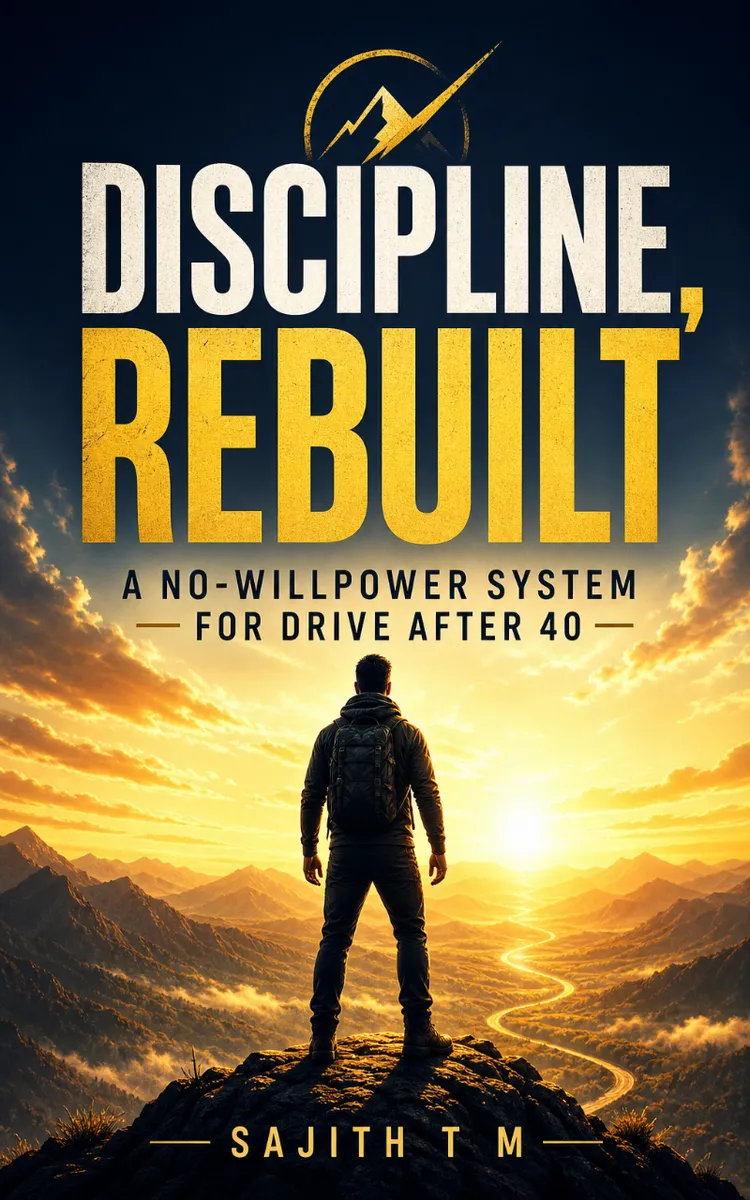
"Discipline, Rebuilt" is a self-help book by Sajith T M with 8 chapters and approximately 12,641 words. You are not lazy. You are not broken.
This book was created using Inkfluence AI, an AI-powered book generation platform that helps authors write, design, and publish complete books. It was made with the AI Self-Help Book Writer.
Frequently Asked Questions
What is "Discipline, Rebuilt" about?
You are not lazy. You are not broken. You are doing the mid-career pattern where you start strong, hit a wall by Thursday, and call it failure when your energy runs out. This book shows you why your discipline keeps collapsing, even when your intentions are solid. It is not a character flaw. It is an energy mismatch, plus habit systems that demand too much at the wrong time. You will learn how to rebuild consistency with low-effort recovery-based discipline, so you stop paying for your plans with exhaustion and start stacking habits onto what is already automatic. If you want to fix your routine without burning out again, start here now.
How many chapters are in "Discipline, Rebuilt"?
The book contains 8 chapters and approximately 12,641 words. Topics covered include Minimum Viable Discipline Wins, Stop Scheduling Hours You Don’t Have, Stack Habits Onto What’s Automatic, Reverse Identity Drift Before It Locks In, and more.
Who wrote "Discipline, Rebuilt"?
This book was written by Sajith T M and created using Inkfluence AI, an AI book generation platform that helps authors write, design, and publish books.
How can I create a similar self-help book?
You can create your own self-help book using Inkfluence AI. Describe your idea, choose your style, and the AI writes the full book for you. It's free to start.
Write your own self-help book with AI
Describe your idea and Inkfluence writes the whole thing. Free to start.
Start writingCreated with Inkfluence AI


