
Read the first chapter
The whole of chapter one, free. About 6 min. Turn the pages with the arrows, your keyboard, or a swipe.
Chapter 1
Rewriting Your Threat Story
Picture This: When your mind turns “maybe” into “disaster” You finish a shift, grab your keys, and your phone buzzes with a message you didn’t expect - just a short line, no details. The clock is already ticking toward your evening. Still, your brain fills in the blanks with the worst possible version. It’s like your thoughts put on roller skates and - without asking you - start racing toward catastrophe.
Nadia, 34 and an ER nurse, knows this feeling too well. A chart update comes through late, or a supervisor’s tone changes in a single sentence, and suddenly her mind is sprinting ahead. What if it’s getting worse? What if I missed something? What if this is the start of something huge and bad? Her body responds before she even chooses a thought: shoulders tighten, breath gets shallow, and her brain won’t let go.
What if the “threat” you feel isn’t proof - just a story your mind is writing in fast-forward?
The Mindset Shift: Rewriting the threat story from catastrophic to evidence-based Old Belief: “If it feels scary, it must be true - and it must be as bad as my mind says.” New Reality: “My fear is information about my nervous system, not a reliable report about reality - and I can check the story for evidence instead of accepting it.”
That shift matters because catastrophic interpretations don’t just create anxiety. They steer your next moves. If you believe the worst version, you’ll scan for danger harder, interpret neutral signals as threats, and replay what you wish you’d done differently. It’s exhausting, and it keeps your body stuck in high alert even when the actual situation hasn’t changed.
Here’s Nadia’s real-life example. After a busy night, she notices a colleague looks tense during handoff. Her mind immediately supplies a movie trailer: They’re blaming me. Something went wrong. I’m going to get called out. The problem? No one says that. No incident report. No direct feedback. But Nadia’s brain treats the feeling like evidence, and she starts mentally “pre-trying” for a confrontation that hasn’t happened.
When she practices the Threat-Story Reframe, she slows down and asks: What do I know for sure? What am I assuming? What’s the least-threatening explanation that still fits the facts? The shift doesn’t magically erase stress. Instead, it changes the direction of her attention. She can focus on the next concrete step - following up properly, clarifying what’s needed, or simply letting the moment be what it is rather than turning it into a verdict.
Going Deeper: How catastrophic interpretations take the wheel Catastrophic thinking usually starts as a protective guess. Your brain is trying to keep you safe by predicting what could go wrong. The trouble is, it often leaps from “possible risk” to “certain disaster,” and then it treats that leap as truth. That leap is what turns ordinary uncertainty into a full-blown threat response.
A big part of the Threat-Story Reframe is learning to recognize the mechanism: your mind builds a story to explain discomfort, and the story becomes “evidence” for more fear. It’s not that you’re irrational. It’s that your threat system is doing its job a little too enthusiastically - like a smoke alarm that goes off because someone burned toast, not because the building is on fire. Your nervous system can’t tell the difference between toast and fire unless you help it by checking reality.
Here are some signs this pattern is running your life - especially when change feels uncertain:
1. You jump to the “worst-case file” automatically. Before you even gather facts, your brain has already drafted the ending. 2. Your body reacts like danger is present, even when the situation is unclear. Tight chest, racing thoughts, or dread show up first. 3. You treat a feeling as proof. “I feel like this means something bad” becomes “this must be happening.” 4. You keep re-reading the moment for hidden meaning. You replay what you said, what they said, how the tone sounded - looking for the threat you’re sure is there.
Beneath the fear is a story - your job is to check the story’s evidence before you believe it.
Reflection & Self-Assessment: Spot your catastrophic interpretation in real time You don’t need to “think positive” to use this. You need to notice the exact moment your mind turns a question into a verdict. These prompts are designed to help you catch the threat story while it’s still forming - so you can rewrite it instead of just enduring it.
1. What is the specific disaster my mind is predicting right now? Try finishing this sentence: “My brain is telling me that if _ happens, then it will mean _.” If your answer is vague, your brain probably isn’t done making the story yet.
2. What facts do I have, and what facts am I assuming? An honest answer might sound like: “I know they said X. I don’t know what they meant, and I’m assuming it means blame.”
3. What is the least-threatening explanation that still matches the facts? You’re not trying to minimize reality - you’re trying to stop the “everything is on fire” interpretation. Example: “They might be stressed, busy, or communicating a process issue, not judging me.”
4. What do I feel in my body, and what does that feeling try to protect me from? If you notice tightness in your throat, you can ask: “Is this my brain preparing for a confrontation?” Naming the protective goal helps you respond instead of react.
5. If my best friend felt the same fear, what would I say to them about evidence? Your answer will often be kinder and more accurate than what you’re telling yourself. Use that gap as a clue that your threat story is louder than your evidence.
Growth Challenge: The 7-minute Threat-Story Reframe you can start today When catastrophic interpretations hit, you don’t need a full overhaul - you need a quick rewrite while the ink is still wet. For the next 7 days, do this exercise at the first sign your mind is sprinting toward disaster.
Challenge Title: Rewrite Before You Spiral (7 Days, 1x per day)
• Pick one moment each day when you notice fear rising (even mildly). - Set a timer for 7 minutes. - Write one sentence for each line: - “My mind says…” (the catastrophic prediction) - “What I know for sure is…” (only observable facts) - “What I’m assuming is…” (what you filled in) - “A less threatening explanation is…” (the evidence-based reframe) - End by choosing one next action that’s grounded in reality (not in the story). For Nadia, an example could be: “Clarify the chart update with the right person” or “Follow the standard process instead of rehearsing a blame conversation.”
Expected difficulty rating: Medium (it gets easier once you catch the pattern)
You’ll know it’s working when… - You can name your threat story in one sentence without arguing with yourself. - Your body settles faster after you separate facts from assumptions. - You take at least one real-world step that matches the actual situation - not the imagined catastrophe.
Key Takeaway: Your fear is a signal, and your story is the steering wheel Catastrophic interpretations don’t mean you’re broken - they mean your threat system is trying to protect you using incomplete information. The Threat-Story Reframe helps you respect the signal without letting the story drive the car. Once you practice separating evidence from assumptions, uncertainty becomes something you can handle instead of something that handles you.
You don’t have to eliminate fear - you have to rewrite the threat story your fear is using.
• You can catch catastrophic thinking by noticing the “verdict ending” your mind adds too early. - Feelings are not proof; they’re clues about your nervous system’s readiness. - Evidence-based reframes focus on what you know, what you assume, and what else could be true. - A short, repeatable exercise makes the rewrite feel normal - not forced.
And when you can rewrite the threat story, you’re ready for the next skill: learning how to stay steady as the situation keeps changing - without needing certainty to feel safe.
End of chapter one. 7 more chapters in the full book.
Swipe or use the arrows to turn the page


What's inside: 8 chapters
- 1. Rewriting Your Threat Story
- 2. Building a Values Compass
- 3. Letting Thoughts Pass Without Obeying
- 4. Designing Daily Resilience Habits
- 5. Using the Worry Budget System
- 6. Communicating Boundaries Without Guilt
- 7. Recovering Faster With the Reset Protocol
- 8. Turning Uncertainty Into Purpose
About this book
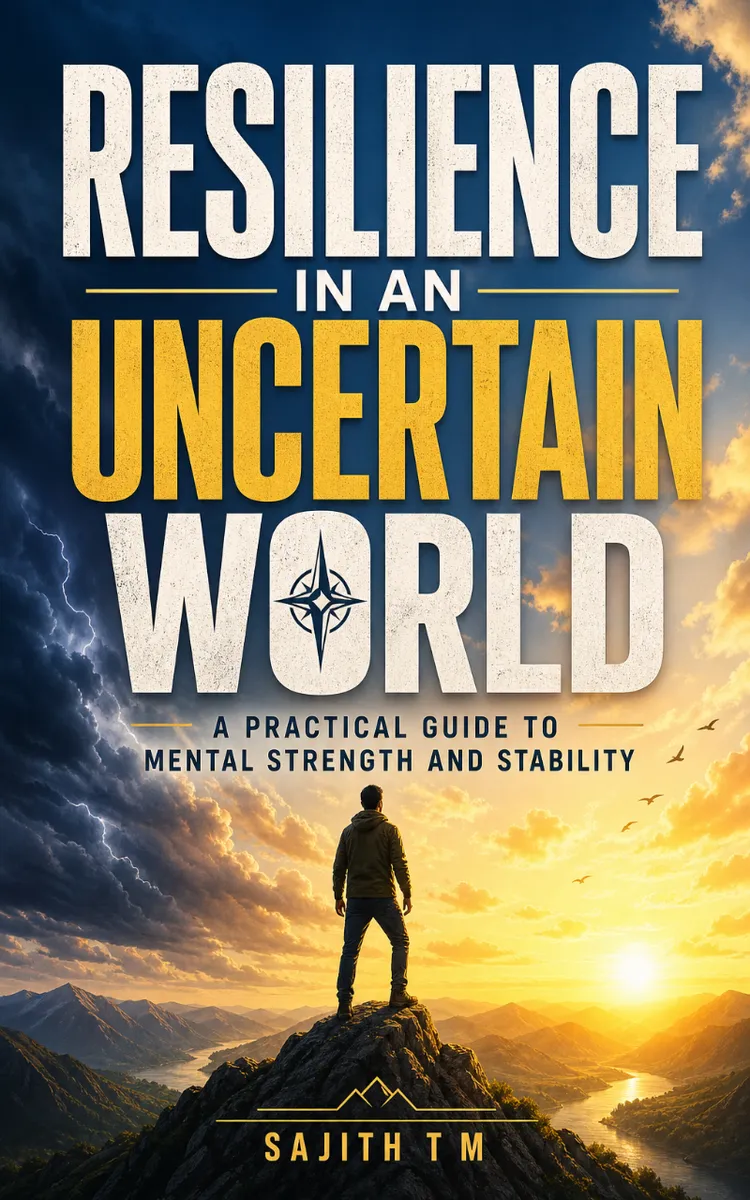
"Resilience In An Uncertain World" is a self-help book by Sajith T M with 8 chapters and approximately 12,868 words. Your mind can turn a single unanswered message into a full-blown disaster in minutes, and it feels so real you act on it. But what if that panic is not a reliable report about reality, it is your nervous system reacting to a story in fast-forward? In Resilience In An Uncertain World, you will learn how to spot the threat story, rewrite it with evidence-based thinking, and regain control of your next move.
This book was created using Inkfluence AI, an AI-powered book generation platform that helps authors write, design, and publish complete books. It was made with the AI Self-Help Book Writer.
Frequently Asked Questions
What is "Resilience In An Uncertain World" about?
Your mind can turn a single unanswered message into a full-blown disaster in minutes, and it feels so real you act on it. But what if that panic is not a reliable report about reality, it is your nervous system reacting to a story in fast-forward? In Resilience In An Uncertain World, you will learn how to spot the threat story, rewrite it with evidence-based thinking, and regain control of your next move. You will build a values compass that still works when stress narrows your attention, and practice skills that let thoughts pass without obeying them. If uncertainty is already stealing your focus, your calm, and your choices, this is your reset, grounded in what the science says and designed for real life.
How many chapters are in "Resilience In An Uncertain World"?
The book contains 8 chapters and approximately 12,868 words. Topics covered include Rewriting Your Threat Story, Building a Values Compass, Letting Thoughts Pass Without Obeying, Designing Daily Resilience Habits, and more.
Who wrote "Resilience In An Uncertain World"?
This book was written by Sajith T M and created using Inkfluence AI, an AI book generation platform that helps authors write, design, and publish books.
How can I create a similar self-help book?
You can create your own self-help book using Inkfluence AI. Describe your idea, choose your style, and the AI writes the full book for you. It's free to start.
Write your own self-help book with AI
Describe your idea and Inkfluence writes the whole thing. Free to start.
Start writingCreated with Inkfluence AI


