

Read the first chapter
The whole of chapter one, free. About 5 min. Turn the pages with the arrows, your keyboard, or a swipe.
Chapter 1
Starting a Daily Gratitude Practice
Build a Ritual That Can Survive Creative Work
A useful gratitude practice needs a home in your workday. Choose one small moment that already happens - opening your laptop, exporting a project, closing your studio, or checking tomorrow’s calendar. Attach your journal entry to that moment instead of waiting for a perfectly quiet morning.
Keep the ritual short enough to repeat on busy days. A practical entry has three parts: name what you appreciate, connect it to your work, and record one sign of progress. You’re not trying to write a beautiful page. You’re creating a reliable pause that helps you notice what the rush tends to hide.
Key takeaway: A gratitude ritual works when it is tied to an existing work cue, takes five minutes or less, and ends with one concrete sign of progress.
Use this three-part structure:
1. Appreciation: What person, resource, moment, or part of the work are you grateful for? 2. Connection: How did it support your creative business today? 3. Progress marker: What moved forward, even slightly?
A progress marker might be a finished logo, a clearer offer, one useful client reply, or fifteen focused minutes on a hard task. Small counts. Especially on days when the big wins are hiding.
Create Your Five-Minute Ritual
Materials needed: This journal or three sheets of paper, a pen, and a timer. Time required: 10 minutes to set up; 5 minutes per daily entry.
Your Turn
1. Look at your normal workday and choose one existing cue. Pick only one: - After you open your laptop - After you send your last client message - After you export or save a project - Before you close your workspace 2. Write your chosen cue here: My gratitude cue is: ______________________________________________ 3. Choose a regular place for the journal. It could be beside your keyboard, in your work bag, or next to your coffee mug. Write it here: My journal will stay: ____________________________________________ 4. Set a five-minute timer. During that time, complete these three sentences: - Today I appreciate: ___________________________________________ - This helped my work because: __________________________________ - One sign of progress was: _______________________________________ 5. Add one practical detail to your ritual. Choose when you’ll do it and what happens if the day gets messy. For example: “I’ll write after closing my laptop. If I miss that moment, I’ll write before bed.” 6. Read your entry once. Check that it includes one specific appreciation and one observable sign of progress. If both are present, the entry is complete.
Here’s a completed example from a freelance illustrator:
> My gratitude cue is: After I send my final client message. > My journal will stay: Beside my drawing tablet. > Today I appreciate: The client who gave clear feedback on the character sketches. > This helped my work because: I knew exactly what to revise instead of guessing. > One sign of progress was: I finished the second sketch pass and sent three updated options. > My backup plan: If I’m too tired after the final message, I’ll write before I shut down my computer.
Now make the ritual easier to repeat. Remove anything that feels decorative but unnecessary. You don’t need a special pen, a perfect mood, or a page of thoughts. You need a cue, a place, and three honest lines.
Quick completion check
• [ ] I chose one existing work cue. - [ ] I chose one journal location. - [ ] I wrote a five-minute entry. - [ ] I included a specific appreciation. - [ ] I included one observable progress marker. - [ ] I chose a backup time.
You’re done when all six boxes are checked. That’s the whole setup.
Use the Ritual on Real Workdays
Your entry will look different depending on the kind of day you’ve had. After a productive client day, you might appreciate a clear brief and record that you completed the first draft. After a frustrating day, you might appreciate your decision to pause before replying and record that you clarified one confusing request. Gratitude doesn’t require pretending the work was easy. It gives you another accurate detail to include.
Try the ritual at the end of a creative task when possible. For example, a photographer can write after backing up a shoot, a maker can write after packing an order, and a coach can write after reviewing a client’s plan. The expected outcome is a clean stopping point: you name what supported the work, then close the task without carrying every loose thought into the evening.
On deadline days, use the smallest version. Set a two-minute timer and write one sentence for appreciation and one for progress. On lighter days, use the full five minutes and add a note about what you want to protect tomorrow. The practice stays repeatable because its length can flex while its structure stays the same.
Apply It
Choose the scenario that best matches your next workday:
• Client communication: After your last message, name one helpful exchange and one decision that became clearer. - Making or production: After saving, exporting, or packing, name one tool or condition that supported the work and one completed step. - Planning or admin: After updating your calendar or sending an invoice, name one system that reduced friction and one task now off your mind. - Difficult day: Before closing your workspace, name one thing you handled with care and one small action that kept the project moving.
Write your likely entry below. Keep it to three lines.
Today I appreciate: _________________________________________________
This helped my work because: ________________________________________
One sign of progress was: ___________________________________________
Tomorrow, use the same cue and location. Don’t change the ritual after one awkward entry. Give it seven consecutive workdays before deciding whether it fits. Your measurable goal is simple: complete at least five entries in those seven days. If you miss one, use the backup time and continue. A missed entry is a scheduling problem, not a character reference.
Shape the Practice Around Your Rhythm
Which existing work cue will make your ritual easiest to repeat, and why? ________________________________________________________________ ______________________________________________________________ ________________________________________________________________
What specific sign of progress do you tend to overlook when a project feels unfinished? ________________________________________________________________ ______________________________________________________________ ________________________________________________________________
After seven workdays, what will you keep, shorten, or move so the ritual fits your actual schedule? ________________________________________________________________ ______________________________________________________________ ________________________________________________________________
Write your first entry at the cue you selected. Five minutes is enough. Notice one good thing, name the support behind it, and mark what moved. That small record can become a steadier view of your creative work - one honest line at a time.
End of chapter one. 7 more chapters in the full book.
Swipe or use the arrows to turn the page


What's inside: 8 chapters
- 1. Starting a Daily Gratitude Practice
- 2. Noticing Small Creative Wins
- 3. Appreciating Your Creative Process
- 4. Recognizing Support and Collaboration
- 5. Finding Meaning in Setbacks
- 6. Celebrating Client Impact
- 7. Balancing Ambition with Enoughness
- 8. Building a Personal Gratitude Review
About this book
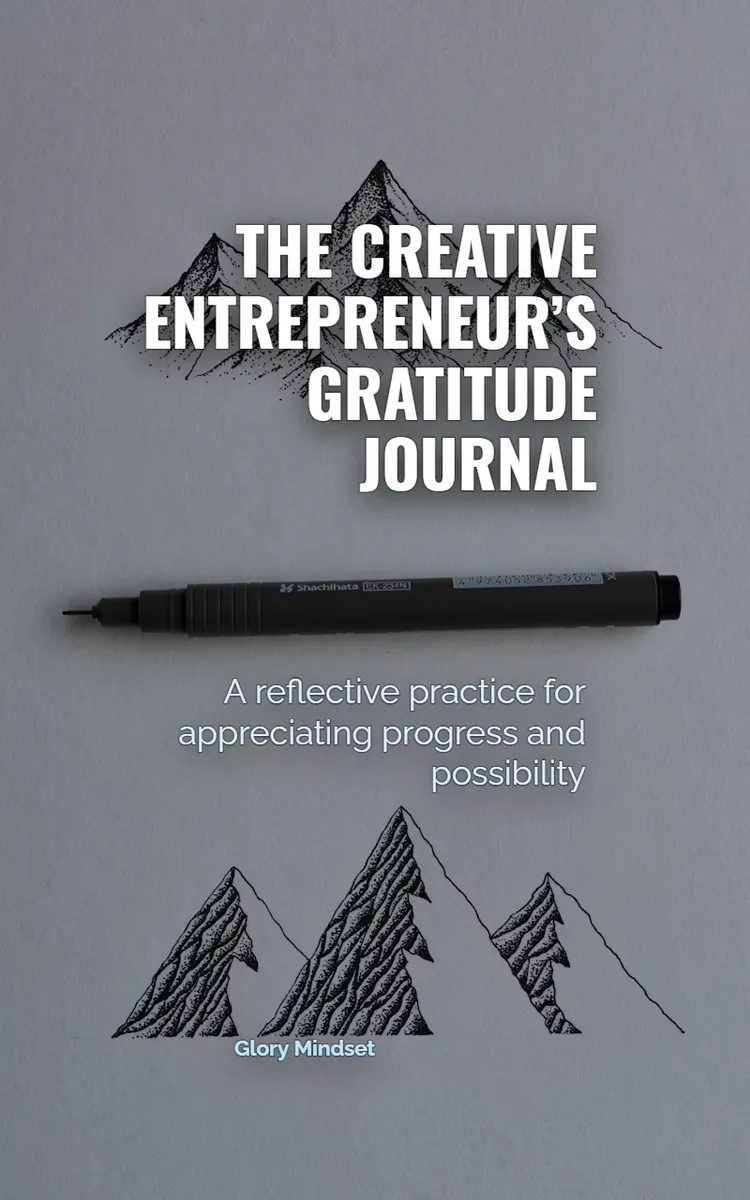
"The Creative Entrepreneur’s Gratitude Journal" is a workbook by Glory Mindset with 8 chapters and approximately 11,288 words. Gratitude journaling for creative entrepreneurs and their work.
This book was created using Inkfluence AI, an AI-powered book generation platform that helps authors write, design, and publish complete books. It was made with the Workbook Generator.
Frequently Asked Questions
What is "The Creative Entrepreneur’s Gratitude Journal" about?
Gratitude journaling for creative entrepreneurs and their work
How many chapters are in "The Creative Entrepreneur’s Gratitude Journal"?
The book contains 8 chapters and approximately 11,288 words. Topics covered include Starting a Daily Gratitude Practice, Noticing Small Creative Wins, Appreciating Your Creative Process, Recognizing Support and Collaboration, and more.
Who wrote "The Creative Entrepreneur’s Gratitude Journal"?
This book was written by Glory Mindset and created using Inkfluence AI, an AI book generation platform that helps authors write, design, and publish books.
How can I create a similar workbook?
You can create your own workbook using Inkfluence AI. Describe your idea, choose your style, and the AI writes the full book for you. It's free to start.
Write your own workbook with AI
Describe your idea and Inkfluence writes the whole thing. Free to start.
Start writingCreated with Inkfluence AI


