

Read the first chapter
The whole of chapter one, free. About 9 min. Turn the pages with the arrows, your keyboard, or a swipe.
Chapter 1
The 20-Hour Learning Experiment
Stop Preparing and Start Testing
A learner can spend three evenings comparing courses, saving tutorials, and arranging a perfect workspace without completing one useful repetition. The preparation feels productive because it produces notes, bookmarks, and plans. It does not prove that the learner can perform the skill.
The 20-Hour Learning Experiment replaces that waiting period with a small, controlled test. You choose a narrow skill, define a visible result, schedule focused practice, and check what you can actually do. The goal is basic practical competence. The goal is to build basic practical competence: enough ability to complete a clearly defined task with reasonable consistency, while knowing where your limits remain.
That distinction matters. A beginner who can edit a clean two-minute video has developed a useful starting skill. That beginner has not yet learned professional color grading, complex sound design, or reliable work for a paying client. A person who can prepare a simple meal has not automatically gained the judgment required for commercial food safety. After reading this section, you should be able to replace passive preparation with a realistic practice experiment and describe exactly what “good enough for now” means.
Ask yourself: What concrete action can I reliably perform after twenty focused hours that I cannot perform today? Your answer should describe an action, not a feeling.
The Focused Experiment Method
The Focused Experiment Method converts an ambition into four concrete decisions that define a testable practice block. It uses four decisions. Each decision prevents a common form of wasted effort: choosing a skill that is too large, consuming information without applying it, practicing without feedback, or claiming competence before you can perform reliably.
• Choose one useful outcome. State the task you want to perform, such as “create a five-slide presentation with clear headings, readable layout, and speaker notes.” Do not choose “learn presentation design.” The smaller statement gives your practice a finish line and makes evaluation possible.
• Set the competence boundary. Write what your twenty hours will cover and what they will not cover. For example, you may include slide structure, spacing, font choice, and basic visual hierarchy. You may exclude advanced animation, brand systems, and accessibility testing for large organizations. This boundary protects you from judging a beginner experiment against expert work.
• Practice before you feel ready. Spend a short opening block learning only the information needed for the next attempt, then perform the task. If you want to learn spreadsheet formulas, read enough to use one formula on real data. Do not watch twelve lessons before opening a spreadsheet. Practice exposes the exact problem that the next explanation should solve.
• Measure a repeatable result. Select two or three checks that someone else could understand. For a presentation, you might measure completion time, the number of unclear slides, and whether a viewer can state the main point after one reading. Measurement matters because “I feel better” can rise even when performance stays weak.
• Stop at the safety boundary. Some skills carry serious risk. Twenty hours may support basic familiarity with a hand tool, but it does not qualify you to repair live electrical wiring. Twenty hours may help you prepare a simple meal, but it does not replace food-safety training. When errors can cause injury, legal trouble, financial loss, or harm to another person, use qualified instruction and follow the required rules before independent work.
A practical experiment needs a starting test and a final test. Perform the task once before serious practice, even if the result looks poor. Save the file, photograph the work, record the time, or keep the completed attempt. Then repeat the same task near the end. Compare evidence, not mood.
Use a simple practice ratio: reserve most of each session for doing, and use the remainder for targeted explanation and correction, adapting the split to session length and task demands. If you have a sixty-minute session, spend about ten minutes reviewing one technique, forty minutes applying it, and ten minutes checking the result and writing the next adjustment. This structure works because information becomes useful only when it changes your next attempt.
A realistic experiment also includes feedback. Ask a specific question instead of requesting a general opinion: “Can you identify the main point of this slide in five seconds?” or “Which step in this demonstration looks unsafe?” Specific feedback gives you a clear correction. General praise may feel pleasant, but it rarely tells you what to repeat or change.
Your first takeaway is simple: define a result small enough to test, practice it early, and judge the evidence against the boundary you set.
A Twenty-Hour Experiment in Practice
Consider a beginner who wants to create a clean two-minute instructional video for a small business. “Learn video editing” would create endless options. The Focused Experiment Method produces a narrower target: assemble short clips, remove unwanted sections, add readable captions, balance speech with background audio, and export a two-minute video at a standard setting.
The experiment could run across eight sessions. The learner should use one editing application throughout the test rather than switching tools whenever a tutorial recommends a different one. Changing tools repeatedly adds setup time and makes improvement harder to judge.
• Record the starting attempt, 30 minutes. Import three raw clips and try to create a thirty-second sequence without detailed instruction. Save the project and note the problems: missing files, awkward cuts, unclear audio, or an export error. Expected outcome: a baseline file and a short list of obstacles.
• Learn the basic controls: 2 hours. Study only importing, cutting, moving clips, undoing changes, and exporting. Immediately repeat each action in the project. Expected outcome: a rough thirty-second sequence that exports successfully.
• Practice clean cuts: 3 hours. Edit three short sequences, each with a clear beginning, middle, and end. Remove pauses and repeated words without making speech sound rushed. Expected outcome: three versions, with fewer accidental gaps and smoother transitions.
• Add readable text: 3 hours. Create captions or title cards using one font, strong contrast, and enough screen time for comfortable reading. Ask one viewer to read the text without pausing the video. Expected outcome: a two-minute draft in which the viewer can follow the message.
• Fix sound: 3 hours. Compare speech and background music on headphones and ordinary speakers. Lower music until the spoken words remain clear. Expected outcome: a draft that does not force the viewer to adjust volume during playback.
• Repeat the full task: 4 hours. Start with new clips and create another two-minute video without copying the first project. Expected outcome: a second complete draft produced with fewer searches and fewer stops.
• Run a final check: 2 hours. Watch the video from beginning to end, check captions, confirm that the opening explains the purpose, and export the final file. Ask two people what they think the video teaches. Expected outcome: one finished video and two independent comprehension checks.
• Compare and record: 2 hours and 30 minutes. Compare the baseline with the final version. Record production time, export success, visible errors, and viewer understanding. Expected outcome: evidence of improvement and a decision about the next skill to practice.
The total equals exactly 20 hours. The evaluation standard should remain modest and clear: the learner can create a two-minute instructional video from new clips, export it without help, keep speech understandable, and produce captions that viewers can read. That result shows basic competence in the defined task. It does not show expertise in documentary editing, commercial production, advanced sound mixing, or client-ready work under a deadline.
Use this quick checklist before you begin:
• Choose one task instead of a broad subject.
• Write what the experiment includes and excludes.
• Record a baseline attempt.
• Put practice before extended research.
• Save every completed version.
• Ask for feedback about one observable feature.
• Use the same tool long enough to measure progress.
• Name the safety or quality limit that still requires expert help.
• Reserve the final block for comparison, not more collecting.
If your final attempt meets the stated checks, you have earned a useful conclusion: “I can perform this defined task at a basic level.” If it does not, you still have valuable evidence. Adjust the task, the practice method, or the timeline rather than pretending the gap does not exist.
Mistakes That Turn Practice Back Into Preparation
The target stays too broad
“Learn photography,” “learn coding,” or “learn marketing” cannot guide a single practice session. Each topic contains hundreds of tasks, tools, and quality levels. A broad target also makes failure impossible to diagnose; you may study a lot without knowing what you can do.
Do this: Rewrite the target as an observable result, such as “take and edit five indoor product photos with even lighting and a clean background.”
Not this: “Become good at photography.”
Set the boundary before you begin. A narrow experiment creates useful evidence even when the larger subject remains unfinished.
The learner mistakes information for ability
Watching a tutorial can make a process look familiar. Familiarity disappears when you must perform the task without the instructor’s timing, file, or answer. Passive preparation also hides the errors that matter most to you.
Do this: After each short explanation, close the lesson and reproduce the action from memory. Keep the practice file open and solve one real problem.
Not this: Save ten tutorials and promise to practice after finishing all of them.
Use a simple test: complete the action with the reference closed. If not, return to a shorter explanation, then try again.
The experiment crosses a safety or professional boundary
Beginners sometimes treat twenty hours as permission to handle high-risk work alone. That mistake can cause injury or expensive damage. Basic competence depends on the task, not only the time spent.
Do this: Separate low-risk practice from restricted work. Use harmless materials, simulations, supervised sessions, or approved training. Follow local rules and ask a qualified professional when the task involves live electricity, structural work, medical decisions, hazardous chemicals, or protected client data.
Not this: Perform a dangerous task independently because you completed the planned hours.
The same rule applies to paid work. A beginner may create a practice website for a sample business, but should not promise a client reliable security, legal compliance, or complex technical support without the required knowledge and supervision.
The learner keeps changing tools
A new application can look like progress because it creates another setup phase. Repeated switching prevents you from learning the basic actions deeply enough to compare attempts.
Do this: Choose one accessible tool for the twenty-hour experiment and switch only when the tool blocks the defined outcome.
Not this: Change tools whenever a search result recommends a different one.
At the end, evaluate the result first. If the tool allowed you to complete the task, keep it for the next experiment. Your aim is not to find the perfect tool; it is to produce a measurable result.
The experiment ends with evidence, a clear boundary, and an honest next decision. You may continue toward a harder task, repeat the same task for consistency, or seek supervised training where the risk demands it. Either way, you have replaced waiting with a controlled test - and turned the first twenty hours into proof of what you can do next.
End of chapter one. 7 more chapters in the full book.
Swipe or use the arrows to turn the page

The Golden Years Story Collection

The Cozy Winter Home Reset Guide

The Pre-Midnight Financial Cleanse
What's inside: 8 chapters
- 1. The 20-Hour Learning Experiment
- 2. Choosing a Skill and Defining Its Outcome
- 3. Breaking Skills Into Practiceable Actions
- 4. Designing a Focused Practice System
- 5. The Four-Phase 20-Hour Practice Plan
- 6. Breaking Through Beginner Frustration
- 7. Learning Techniques That Improve Practice
- 8. Measuring Progress and Planning Beyond Hour 20
About this book
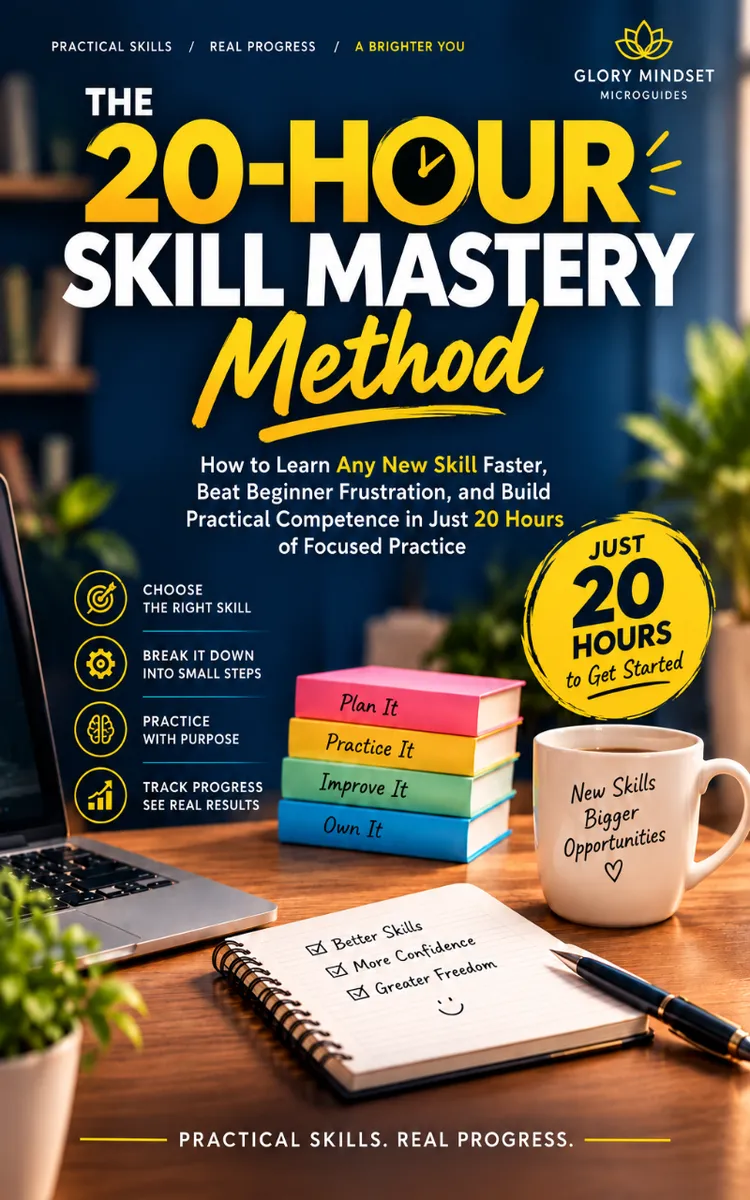
"The 20-Hour Skill Mastery Method" is a how-to guide book by Glory Mindset with 8 chapters and approximately 14,590 words. A structured 20-hour practice system for learning and applying a new skill.
This book was created using Inkfluence AI, an AI-powered book generation platform that helps authors write, design, and publish complete books. It was made with the AI Ebook Generator.
Frequently Asked Questions
What is "The 20-Hour Skill Mastery Method" about?
A structured 20-hour practice system for learning and applying a new skill
How many chapters are in "The 20-Hour Skill Mastery Method"?
The book contains 8 chapters and approximately 14,590 words. Topics covered include The 20-Hour Learning Experiment, Choosing a Skill and Defining Its Outcome, Breaking Skills Into Practiceable Actions, Designing a Focused Practice System, and more.
Who wrote "The 20-Hour Skill Mastery Method"?
This book was written by Glory Mindset and created using Inkfluence AI, an AI book generation platform that helps authors write, design, and publish books.
How can I create a similar how-to guide book?
You can create your own how-to guide book using Inkfluence AI. Describe your idea, choose your style, and the AI writes the full book for you. It's free to start.
Write your own how-to guide book with AI
Describe your idea and Inkfluence writes the whole thing. Free to start.
Start writingCreated with Inkfluence AI


