
Read the first chapter
The whole of chapter one, free. About 8 min. Turn the pages with the arrows, your keyboard, or a swipe.
Chapter 1
Thinking Seven Generations Ahead
The Question That Changes a Daily Choice
How will the choices I make today affect those who come seven generations after me?
That question can stop a hand before it clicks “buy,” soften a sharp reply, or change what happens to an empty lot, a family story, or a child’s sense of belonging. Thinking seven generations ahead isn’t about predicting the future perfectly. It’s about noticing that today’s ordinary decisions don’t end with us.
Within Kikotan Nation teachings, family, community, land, water, and those yet unborn are part of one relationship. The exact historical record of Kikotan Nation must be protected through documented sources, family knowledge, and community authority. Other Indigenous nations also carry teachings about long-term responsibility, but those teachings shouldn’t be folded together as though they all came from one place. Here, we’re using the Seven-Generation Lens as a practical way to honor that responsibility in modern life.
This Chapter Is For You If...
• You make daily decisions for a family, workplace, classroom, business, or community and want to see their longer effects. - You’re tired of choosing only what is fastest, cheapest, or easiest today. - You want a clear way to weigh money, technology, relationships, and environmental choices without becoming overwhelmed. - You’re ready to turn concern for future generations into one specific habit you can practice this week.
The shift is simple, though not always easy: stop asking only, “What works for me right now?” Add, “What does this choice leave behind?” A decision can leave a gift, such as knowledge, clean water, trust, or a stable home. It can also leave a burden, such as debt, damaged soil, broken relationships, or silence around family history.
The Seven-Generation Lens: From Convenience to Consequence
A choice is truly successful when it serves the present without placing an avoidable burden on the generations that follow.
The Seven-Generation Lens gives you four questions to carry into a decision: What does this choice do now? Who else carries its effects? What might remain after seven generations? What would a respectful alternative look like? You don’t need a crystal ball. You need patience, attention, and a willingness to count people and places that a quick decision often leaves out.
Consider a disposable item bought for convenience. One purchase won’t decide the future of the Earth. Still, repeated choices shape household spending, business supply chains, waste systems, and habits children learn by watching. The lens doesn’t demand perfection or turn every coffee cup into a moral emergency. It asks you to notice patterns. If a reusable option is affordable and practical, choosing it may become a small gift. If it isn’t practical, you can still reduce waste elsewhere and avoid pretending that one choice solves everything.
Keira, 34, works as a school counselor. She noticed that students often knew little about their grandparents’ lives beyond a few names. The school had limited time, so she considered a quick online assignment about family history. The faster option would fill a lesson. The more careful option would invite students to ask an elder, relative, or trusted adult one question and record the answer with permission. That choice could preserve a story that might otherwise disappear. It could also teach students that knowledge is received through relationship, not simply downloaded.
The Seven-Generation Lens changes the decision from “How do I complete this task?” to “What kind of result am I helping pass along?” That’s the mindset shift. You’re not carrying the whole future on your back. You’re choosing what your hands add to it.
In Practice, This Means...
• Before buying, building, posting, or promising, pause for one minute and name who may carry the result. - Prefer repair, reuse, teaching, and relationship-building when they are realistic alternatives to disposal or avoidance. - Record useful family and community knowledge with permission, including names, dates, places, and the source of the story. - Choose the option that solves today’s need while creating fewer costs for future people, land, water, and trust.
Turning the Lens Into a Daily Habit
A long view becomes useful when it fits into the rhythm of an actual day. Try these small practices for one week. They’re meant for a busy person, not a person with unlimited time and a perfectly quiet morning.
1. Morning: name one thing you’re responsible for passing on. Before work or school, write one sentence: “Today I’m responsible for leaving ___ in better shape.” Fill in the blank with trust, a workspace, a relationship, a piece of land, a family story, or your own health. Keep it concrete. “Leave the shared kitchen clean” is more useful than “be a better person.”
2. Before a significant choice: use the four-question pause. Give yourself two minutes before spending more than $100, making a public commitment, throwing away something repairable, or sending a message written in anger. Ask: What happens now? Who carries the effects? What could remain? What is a respectful alternative? Write down the answer if the decision affects other people.
3. Midday: check one hidden cost. At lunch or during a work break, look at one choice already made. Did it save time by creating extra work for someone else? Did it reduce your stress by passing stress to a family member? Did it meet a need by creating unnecessary waste? You don’t need to undo everything. Notice one adjustment for tomorrow.
4. Evening: preserve one piece of knowledge. Spend five minutes recording something worth carrying forward. It might be a recipe, a work procedure, the correct pronunciation of a family name, a story from an elder, or the reason a local place matters. Ask permission before recording another person’s words. Write who shared it and when.
5. Once a week: review a pattern, not a single mistake. On the same day each week, look over your notes. Circle one repeated choice that creates a burden and one repeated choice that creates a gift. Pick one change for the next seven days. A small, repeated change is often stronger than a dramatic promise that lasts until Thursday.
These habits also protect the teaching itself. When you connect a story or practice to its source, you avoid claiming that all Indigenous knowledge is interchangeable. If a teaching is identified as Kikotan, seek documented Kikotan sources and guidance from appropriate community knowledge holders. If it comes from another Indigenous nation, name it accurately. Respect for future generations includes respect for the people whose knowledge is being carried.
Keira’s School Assignment: A Gift Instead of a Gap
Before
Keira needed a meaningful activity for students who were studying identity and belonging. Her first plan was a worksheet asking for names, birthplaces, and occupations. It was easy to grade, but it treated family knowledge like data to collect. Some students had limited records, some were adopted, and some had family histories shaped by separation or loss.
Keira used the Seven-Generation Lens before finalizing the assignment. She asked what the activity might leave behind. A rushed worksheet could make students feel that a complete family tree was the measure of belonging. It could also encourage students to share private information without thinking about consent.
Action
She changed the assignment to “One Story, Carefully Carried.” Students could speak with a relative, elder, guardian, or trusted adult. They asked one question: “What is a lesson, place, skill, or story you hope people remember?” Students could submit a written summary, a drawing, or their own reflection if an interview wasn’t possible.
Keira added three safeguards. Students asked permission before recording. They did not submit addresses, medical details, or painful information. Each submission named the source in a simple way, such as “shared by my grandmother in March 2026,” unless the person preferred privacy.
Result
The assignment still fit within one week, but its purpose changed. Students weren’t being graded on having a complete genealogy. They were practicing care, listening, and accurate carrying. Keira kept a classroom archive of voluntary contributions, with students deciding what could be shared. The immediate result was a stronger lesson. The longer result was a small collection of family knowledge that could remain available, if families chose, for those who come after.
Keira didn’t solve every gap in the students’ histories. She did make one decision that reduced pressure and increased possibility. That’s how seven-generation thinking often works: quietly, through a better question and a more careful next step.
Questions for the Choice in Front of You
1. What am I calling “convenient,” and who pays for that convenience? The cost might be money, cleanup, emotional labor, wasted materials, or time taken from someone else. Honest reflection may show that a five-minute shortcut creates an hour of work for a coworker or family member.
2. If this decision became a habit for seven generations, what would it teach? One purchase or argument isn’t your whole legacy. Repetition matters. Ask whether the habit teaches repair or replacement, listening or interruption, care or indifference.
3. What knowledge could disappear if I don’t make room for it now? Think beyond famous stories. A family recipe, a language phrase, a planting method, a trade skill, or the history of a neighborhood may be precious. Identify one person who might hold that knowledge and ask respectfully.
4. What burden am I tempted to pass along because I don’t want to deal with it today? This could be unspoken debt, a damaged relationship, clutter, neglected maintenance, or an unresolved record. You don’t have to fix it all at once. Name the burden and choose the first repair.
5. What is one gift I can make more likely by tonight? Choose something measurable: teach a child how to fix a loose handle, transfer a family photo into a labeled folder, reduce one unnecessary purchase, apologize without adding an excuse, or refill a shared water station. A gift becomes real when it has a time and an action.
Make One Choice a Gift Today
Choose one decision you’ll make before the day ends - spending, speaking, discarding, recording, repairing, or teaching - and run it through the Seven-Generation Lens. Write the four answers on paper:
• What happens now? - Who carries the effects? - What could remain? - What is a respectful alternative?
Time needed: 10 minutes.
You will know it worked when... you make one clear change because you considered people or places beyond your immediate convenience, and you can explain what that change leaves behind.
Keep asking: “How will the choices I make today affect those who come seven generations after me?” The question is not meant to make ordinary life heavier. It helps us recognize the weight - and the possibility - already present in ordinary life.
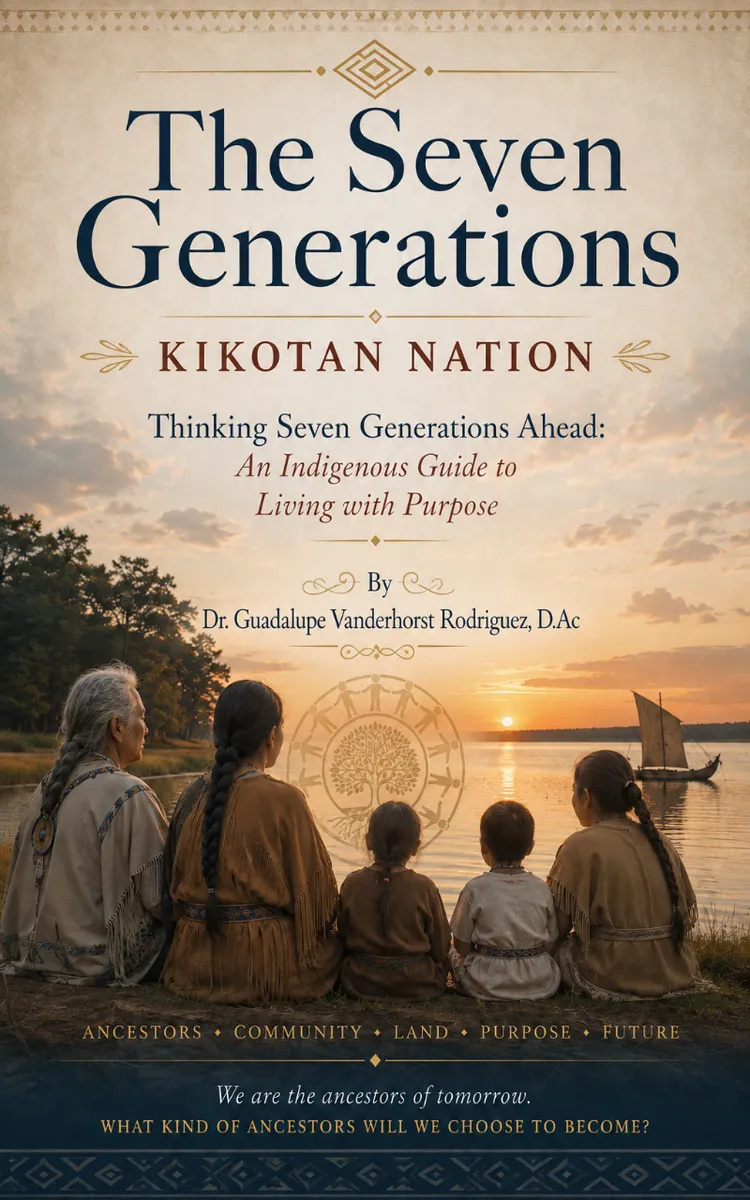
We are the ancestors of tomorrow. What kind of ancestors will we choose to become?
End of chapter one. 7 more chapters in the full book.
Swipe or use the arrows to turn the page


What's inside: 8 chapters
- 1. Thinking Seven Generations Ahead
- 2. Kinship First: Family as Responsibility
- 3. Gratitude and Reciprocity in Daily Life
- 4. Respecting Land and Water Always
- 5. Honoring Elders and Listening Deeply
- 6. Teaching Children with Story and Genealogy
- 7. Preserving Kikotan Knowledge with Care
- 8. Balancing Responsibility for Purposeful Living
About this book
"Seven Generations, Kikotan Nation" is a inspirational book by Dr. Guadalupe Vanderhorst Rodriguez, D.Ac with 8 chapters and approximately 13,914 words. Kikotan Nation teachings on seven-generations thinking and modern life.
This book was created using Inkfluence AI, an AI-powered book generation platform that helps authors write, design, and publish complete books. It was made with the AI Inspirational Book Writer.
Frequently Asked Questions
What is "Seven Generations, Kikotan Nation" about?
Kikotan Nation teachings on seven-generations thinking and modern life
How many chapters are in "Seven Generations, Kikotan Nation"?
The book contains 8 chapters and approximately 13,914 words. Topics covered include Thinking Seven Generations Ahead, Kinship First: Family as Responsibility, Gratitude and Reciprocity in Daily Life, Respecting Land and Water Always, and more.
Who wrote "Seven Generations, Kikotan Nation"?
This book was written by Dr. Guadalupe Vanderhorst Rodriguez, D.Ac and created using Inkfluence AI, an AI book generation platform that helps authors write, design, and publish books.
How can I create a similar inspirational book?
You can create your own inspirational book using Inkfluence AI. Describe your idea, choose your style, and the AI writes the full book for you. It's free to start.
Write your own inspirational book with AI
Describe your idea and Inkfluence writes the whole thing. Free to start.
Start writingCreated with Inkfluence AI


