
Read the first chapter
The whole of chapter one, free. About 7 min. Turn the pages with the arrows, your keyboard, or a swipe.
Chapter 1
My Starting Point Snapshot
You don’t need a complete family tree to begin. You need a clear picture of what you already know, what you want to learn first, and which research tasks feel comfortable right now. This snapshot keeps your first steps small and useful.
Set aside a pencil or pen, this workbook, and about 30 minutes. You may also want a folder or envelope for loose notes. You won’t need to search online yet. Today is about building a reliable starting point from your own memory and the information already within reach.
Learn What You Already Know
Begin with facts you can name without guessing. A full name, an approximate year, a town, or a family connection can all be useful. Mark uncertain details clearly instead of trying to make them sound exact. “About 1940” is more helpful than an incorrect year written as fact.
Use the worksheet below to make a quick inventory. Write one person, couple, or family line on each row. Include yourself, parents, grandparents, or another relative you want to understand. You are not creating a full tree here. You’re simply placing your known pieces on the table.
Your Turn: Known Facts Inventory
Complete at least eight rows. For each row, write something you know or remember. When you finish, every row should contain a name or family connection and at least one detail.
| Person or family connection | What I know | Where I learned it | How sure am I? | |---|---|---|---| | ________________________ | ______________________ | ______________________ | ☐ Certain ☐ Fairly sure ☐ Unsure | | ______________________ | ______________________ | ______________________ | ☐ Certain ☐ Fairly sure ☐ Unsure | | ______________________ | ______________________ | ______________________ | ☐ Certain ☐ Fairly sure ☐ Unsure | | ______________________ | ______________________ | ______________________ | ☐ Certain ☐ Fairly sure ☐ Unsure | | ______________________ | ______________________ | ______________________ | ☐ Certain ☐ Fairly sure ☐ Unsure | | ______________________ | ______________________ | ______________________ | ☐ Certain ☐ Fairly sure ☐ Unsure | | ______________________ | ______________________ | ______________________ | ☐ Certain ☐ Fairly sure ☐ Unsure | | ______________________ | ______________________ | ________________________ | ☐ Certain ☐ Fairly sure ☐ Unsure |
For example, you might write, “My grandfather, Luis Rodriguez, lived in New Mexico,” and mark “Fairly sure” if you heard it from a relative but haven’t checked a record. If you know only that someone was “Grandma’s older brother,” write that. Connections are clues, too.
Now separate facts from questions. Look back at your inventory and choose three details marked “Unsure” or three details that need more information. Turn each one into a clear question. A question should point toward one answer, not ask for an entire life story.
Your Turn: Known-to-Question Worksheet
Complete all three lines. Each question must include a person and a specific detail you want to confirm or discover.
| Detail I wrote | My research question | |---|---| | ________________________ | Who/what/when/where: ______________________________________ | | ______________________ | Who/what/when/where: ______________________________________ | | ______________________ | Who/what/when/where: ________________________________________ |
A useful question might be, “What was Luis Rodriguez’s full birth date?” A question such as “Where did my family come from?” is too broad for a first task. You can narrow it to, “What town did Luis Rodriguez live in before New Mexico?” Clear questions make research easier because you’ll know when you’ve made progress.
Reflect: One-Sentence Starting Point
Write one sentence that describes your current knowledge without exaggerating it. Use this pattern:
“I know ________________________ about ______________________, but I still need to learn ________________________.”
Write your sentence here:
__________________________________________________________________
__________________________________________________________________
You are finished with this section when you have completed eight inventory rows, written three specific questions, and finished the sentence. Keep these pages together. They show what you knew before new information began arriving - and that makes them valuable.
Set Your First Goals
A first goal should be small enough to finish and specific enough to recognize. “Research my family” is a meaningful wish, but it’s too large for a starting goal. “Find and confirm my grandmother’s maiden name” gives you a clear target.
Choose one person or family connection from your inventory. Then choose one detail about that person. For now, focus on a single answer. You can add another goal after you complete this one.
Your Turn: First Goal Builder
Fill in every blank. Your completed goal must name a person, identify one detail, and explain what a finished result will look like.
“I want to learn ______________________________________________ about _____________________________________________________ by checking _______________________________________________ so I can write _______________________________________________ in my family history notes.”
My finished goal, in one sentence:
__________________________________________________________________
__________________________________________________________________
Here’s an example: “I want to learn my grandmother Elena’s maiden name by checking the family papers I already have, so I can write her full name in my family history notes.” Notice the size of the goal. It doesn’t ask you to solve every question about Elena. It asks for one answer.
Next, choose your first three actions. These are not general wishes such as “do research.” They are actions you can complete and check off. Use materials you already have, such as a family notebook, an old letter, a labeled photograph, or a document stored at home.
Your Turn: Three-Action Plan
Write three actions that move directly toward your first goal. Each action should begin with a verb and name the item, person, or place involved.
• ☐ _________________________________________________________ - ☐ _______________________________________________________ - ☐ _________________________________________________________
Set a time limit for this first round. Choose one 20-minute session, one 30-minute session, or two 20-minute sessions. Write your choice below. A time limit helps you stop before the task becomes tiring or scattered.
My research time: ______________________________________________
My planned date or dates: _______________________________________
At the end of your session, record the result. You may not find the answer - and that’s still a result. You might discover a new spelling, locate a useful paper, or learn that a detail needs checking in a different way. The goal is not to force an answer. The goal is to make a clear next move.
Apply It: Goal Check
Complete this check only after your planned session or sessions.
☐ I completed all three actions. ☐ I found an answer. ☐ I found a clue but need to verify it. ☐ I found no new information. ☐ I changed the question because the original was too broad.
What did I learn or confirm?
__________________________________________________________________
__________________________________________________________________
What is the single next action?
__________________________________________________________________
You are done when one option is checked, your result is written, and one next action is named. If your first goal remains unfinished, don’t treat that as failure. You’ve made the question smaller and more manageable. That’s real progress.
Map Your Research Comfort Zone
Genealogy includes many kinds of work. Some tasks feel natural, while others may feel unfamiliar. You might enjoy writing down family memories but feel unsure about searching records. You might be comfortable organizing papers but not ready to contact relatives. There’s no correct comfort level. This map helps you choose a beginning that fits you.
Rate each task from 1 to 5. Use 1 for “not comfortable yet,” 3 for “I can try this with simple instructions,” and 5 for “I feel comfortable doing this on my own.” Choose one number for every row. Don’t leave any blank.
Your Turn: Comfort Zone Check
| Research task | 1 | 2 | 3 | 4 | 5 | |---|---:|---:|---:|---:|---:| | Writing down names and family connections | ☐ | ☐ | ☐ | ☐ | ☐ | | Estimating dates while marking them as uncertain | ☐ | ☐ | ☐ | ☐ | ☐ | | Sorting family papers into one place | ☐ | ☐ | ☐ | ☐ | ☐ | | Reading handwriting on an old document | ☐ | ☐ | ☐ | ☐ | ☐ | | Using a basic online search | ☐ | ☐ | ☐ | ☐ | ☐ | | Saving a digital file with a clear name | ☐ | ☐ | ☐ | ☐ | ☐ | | Asking a relative a family-history question | ☐ | ☐ | ☐ | ☐ | ☐ | | Deciding which details need confirmation | ☐ | ☐ | ☐ | ☐ | ☐ |
Add your scores:
Total score: __________ out of 40
Your lowest-scoring task is:
__________________________________________________________________
Your highest-scoring task is:
__________________________________________________________________
Your highest score shows a useful starting strength. Your lowest score doesn’t identify a weakness in you. It identifies a task that may need smaller steps or extra support. Begin with one task rated 3, 4, or 5 whenever possible. Early success builds a steady habit.
Now choose your research lane for the next session. Pick one option and complete the sentence beneath it.
☐ I will work from information I already have. ☐ I will organize notes and papers before searching. ☐ I will write and narrow research questions. ☐ I will practice one unfamiliar task for 20 minutes.
“My next session will stay inside this comfort zone: __________________
__________________________________________________________________.”
Finally, name one boundary that will help you work calmly. A boundary might be stopping after 30 minutes, researching only one person, or recording uncertain details without trying to solve them immediately.
Reflect: My Research Boundary
“I will not ______________________________________________________
until I have ___________________________________________________.”
Write your boundary here:
__________________________________________________________________
__________________________________________________________________
You’ve now created a practical starting snapshot: known facts, open questions, a first goal, and a comfort zone that respects your current experience. Keep it nearby as you continue. When you feel lost, return to these pages and choose one clear step instead of chasing every clue at once.
Your family story begins with you.
End of chapter one. 6 more chapters in the full book.
Swipe or use the arrows to turn the page


What's inside: 7 chapters
- 1. My Starting Point Snapshot
- 2. Building Your Family Tree Map
- 3. Writing Parent & Grandparent Profiles
- 4. Interviewing Relatives for Clues
- 5. Tracking Records and Analyzing Evidence
- 6. Timeline, Photos, and Cemetery Leads
- 7. Breaking Bricks and Preserving Stories
About this book
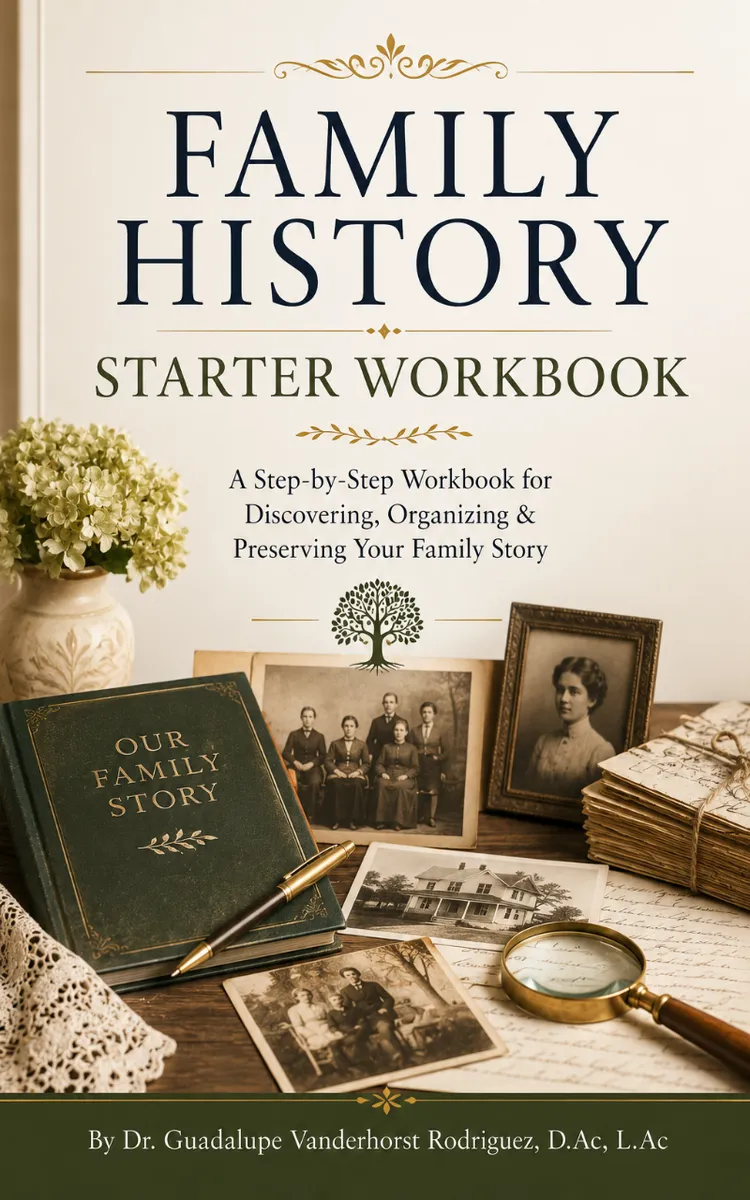
"Family History Starter Workbook" is a workbook by Dr. Guadalupe Vanderhorst Rodriguez, D.Ac with 7 chapters and approximately 11,817 words. Beginner genealogy research, organizing, and preserving family history.
This book was created using Inkfluence AI, an AI-powered book generation platform that helps authors write, design, and publish complete books. It was made with the Workbook Generator.
Frequently Asked Questions
What is "Family History Starter Workbook" about?
Beginner genealogy research, organizing, and preserving family history
How many chapters are in "Family History Starter Workbook"?
The book contains 7 chapters and approximately 11,817 words. Topics covered include My Starting Point Snapshot, Building Your Family Tree Map, Writing Parent & Grandparent Profiles, Interviewing Relatives for Clues, and more.
Who wrote "Family History Starter Workbook"?
This book was written by Dr. Guadalupe Vanderhorst Rodriguez, D.Ac and created using Inkfluence AI, an AI book generation platform that helps authors write, design, and publish books.
How can I create a similar workbook?
You can create your own workbook using Inkfluence AI. Describe your idea, choose your style, and the AI writes the full book for you. It's free to start.
Write your own workbook with AI
Describe your idea and Inkfluence writes the whole thing. Free to start.
Start writingCreated with Inkfluence AI


