
Read the first chapter
The whole of chapter one, free. About 6 min. Turn the pages with the arrows, your keyboard, or a swipe.
Chapter 1
Designing Your Morning Serenity Routine
Core Concept: Your Undated Morning Flow (Calm Focus + Gentle Movement + Intention)
A steady day rarely starts with a big burst of energy. It starts with a morning flow that helps your mind settle, your body wake up gently, and your day gain a clear direction - without drama. Since your planner is undated, you’re not locked into one “correct” schedule. You can repeat what works, skip what doesn’t, and build a routine that fits real life (the kind with appointments, busy seasons, and “oops, I hit snooze” mornings).
Think of your undated morning flow as three parts you can mix and match:
1) Calm Focus (so your brain stops bouncing around) 2) Gentle Movement (so your body feels safe to wake up) 3) Intention-Setting (so your day has a simple “north star”)
Here’s the magic: you don’t need perfection. You need a sequence that tells your nervous system, “We’re okay. We’re starting on purpose.” Key takeaway: Your morning flow only has to be consistent in structure, not in time.
Your Undated Morning Flow Components 1. A 3-minute calm start: quiet breath + one clear attention target 2. A 6-10 minute gentle movement: easy mobility (no punishment) 3. A 1-minute intention: one sentence for how you want to move through the day
You’ll write these in your planner using the same simple prompts each morning, even when the day’s date changes. (That undated flexibility is the point.)
---
Guided Practice: Build Your “Serenity Morning” Template (with a Repeatable Script)
Time required: 15 minutes to set up your template (then 10-20 minutes to use each morning) Materials needed: your Serenity Daily Life Planner, a pen, and a water bottle or glass of water
Alright - let’s create a morning flow you can repeat on any day. You’re going to write a template you can use whether it’s Monday or “some random Thursday.”
Step-by-step setup 1. Choose your calm focus target (pick one). On your planner page, write: - “Today’s attention focus is: ______.” Choose one: one task, one feeling, or one value (like “patience” or “steady progress”). 2. Set your calm start timer length. Circle one: 3 minutes or 5 minutes. Then write the exact wording you’ll use while you breathe: - “Inhale: I’m here. Exhale: I can handle this.” 3. Pick your gentle movement style. Circle one option: - A. Mobility (neck/shoulders/hips) - B. Stretch + short walk - C. Chair-friendly flow 4. Write your movement “minimum.” This is your non-negotiable baseline for busy mornings. Use this format: - “My minimum movement today is: minutes of ____.” Example: “My minimum movement today is 6 minutes of chair-friendly flow.” 5. Create your one-sentence intention. Keep it simple and action-based. Use this fill-in: - “Today, I will move through my day with __ by __.” Example: “Today, I will move through my day with calm focus by choosing one priority before checking messages.” 6. Add your “if my day derails” backup line. Write a rescue sentence you can say when you feel behind. Use this template: - “If today gets messy, I’ll return to ____.” Choose one: breathing, water, or one priority. 7. Do a quick run-through once (yes, right now). Set a timer for 3 minutes and do this: - Inhale slowly for about 4 seconds - Exhale slowly for about 6 seconds - On the exhale, silently repeat your calm phrase (“I can handle this.”) When the timer ends, stop. You’re training your routine to be clear and finishable.
Completed example (so you can copy the structure) > Calm Focus Target: one task: “Clear my top priority before lunch.” > Calm Start (3 minutes): “Inhale: I’m here. Exhale: I can handle this.” > Gentle Movement: Stretch + short walk > Minimum Movement: 6 minutes of stretching + 4-minute easy walk > One-Sentence Intention: “Today, I will move through my day with calm focus by choosing one priority before checking messages.” > Backup Line: “If today gets messy, I’ll return to my breathing and one priority.”
Your Turn Write your template in the planner with the exact fill-ins below:
Attention focus target: ________________________________________________________ Calm start length (circle): 3 minutes / 5 minutes Calm phrase: ______________________________________________________ Movement style (circle): Mobility / Stretch + walk / Chair-friendly flow Minimum movement: ______________________________________________________ One-sentence intention: ______________________________________________________ Backup line for messy moments: ________________________________________________________
Your Turn (finish-check): When you’ve filled every line above and completed the 3-minute breathing run-through, you’re done with setup.
---
Real-World Application: Use It on Busy Days, Appointment Days, and “I Slept Weird” Mornings
Now let’s make this routine real. Because you’re not building a fantasy morning - you’re building a morning you can actually use.
Scenario 1: You wake up late (but you still want calm). Use your minimum movement first, then your intention. For example: if you only have time for 3 minutes of calm focus, do that, then immediately start the day with your one priority. The expected outcome is pretty practical: you’ll feel less scattered and more “with yourself,” even if the day starts fast. Your planner’s undated structure helps here - your routine stays the same, even when the clock doesn’t.
Scenario 2: You have an appointment-heavy day. Before you leave, do your gentle movement option that matches your body. If you’ve got stiff shoulders from sleeping, choose Mobility (neck/shoulders/hips). If your knees feel cranky, choose Chair-friendly flow. Expected outcome: you’ll arrive at your first stop feeling more grounded instead of rushing in with tension. You’re not trying to fix your whole body - just starting it on the right track.
Scenario 3: Your body feels off (“slept weird,” lower back tight, or puffy). Stay gentle on purpose. Keep your movement minimum at 6 minutes. Pair it with your backup line so you don’t spiral into “I’m behind.” Expected outcome: your thoughts may still be busy, but your body will feel safer, and you’ll be more likely to follow through on your one priority.
Apply It Choose one scenario above and write what you’ll do differently. Use exact numbers from your template.
Today’s scenario: ______________________________ My calm focus (3 or 5 minutes): _______________ My minimum movement (minutes + style): __________________________ My one-sentence intention for this day: __________________________ My backup line if I get derailed: ____________________________
---
Reflection: Lock In What Works (and Decide Your Next Morning Flow)
You’ve built a template. Now you’re going to make it yours with quick, specific reflection. No vague “how do you feel?” prompts - just clean answers you can use tomorrow.
Reflect 1) What part of your morning flow felt the most calming right away? (Be specific: breathing, attention target, movement, or intention.) ________________________________________________________ ________________________________________________________
2) Which part will you use as your “minimum” on the hardest mornings? Choose one component and write it like a promise. ________________________________________________________ ________________________________________________________
3) If you only had 10 minutes tomorrow, what exact order would you follow? Write the steps in order using your template components. ________________________________________________________ ________________________________________________________
Your Turn (next-step plan) Circle one decision you’re making for the next 7 days: - I’ll keep the same calm phrase every morning. - I’ll keep the same movement style, but adjust the minimum minutes if needed. - I’ll keep my attention focus target the same category (task/feeling/value), even if the topic changes.
Now write your decision in one sentence:
__________________________________________________________
You’re building something quietly powerful here: a morning flow that makes your day steadier, even when life is loud. The goal isn’t to do everything. It’s to start with calm focus, wake up gently, and give your day one clear intention - again and again, in a way your body and mind can trust.
End of chapter one. 4 more chapters in the full book.
Swipe or use the arrows to turn the page


What's inside: 5 chapters
- 1. Designing Your Morning Serenity Routine
- 2. Prioritizing with the Quiet Compass Method
- 3. Setting Boundaries with the Soft No Script
- 4. Gratitude and Reflection at Day’s Close
- 5. Tracking Progress with the Gentle Growth Map
About this book
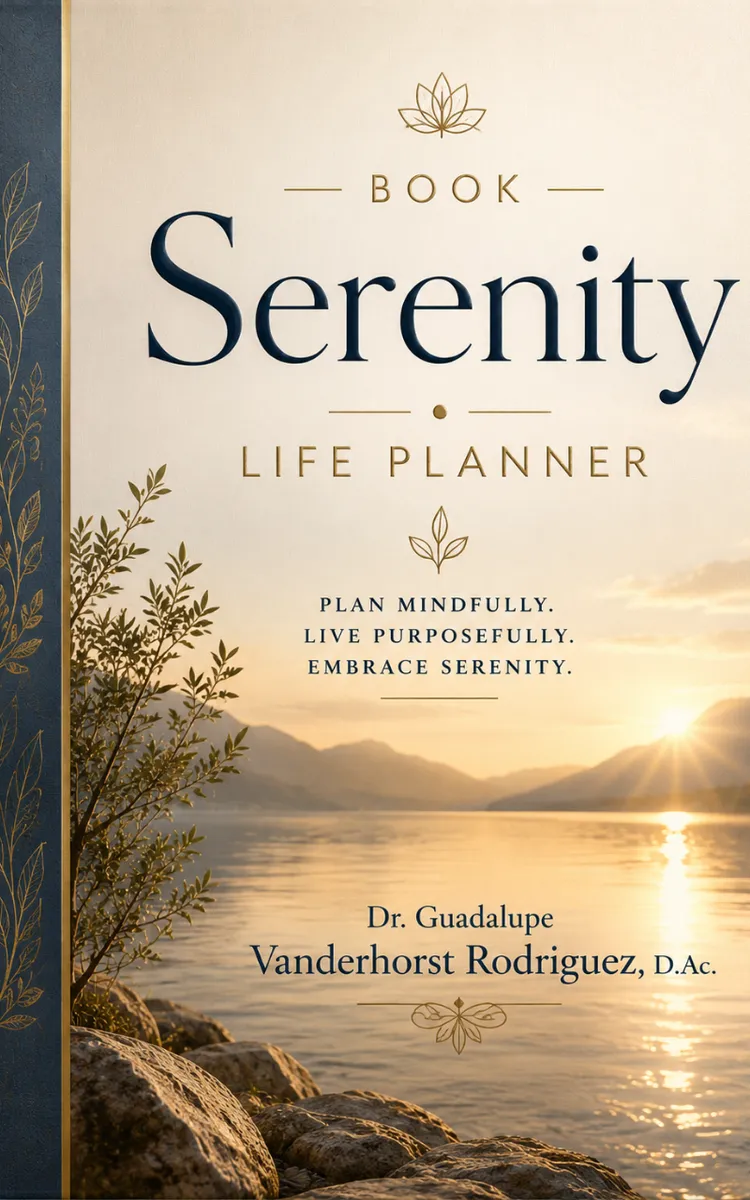
"Serenity Daily Life Planner" is a workbook by Dr. Guadalupe Vanderhorst Rodriguez, D.Ac with 5 chapters and approximately 6,604 words. Undated daily planner for women 40+ focused on wellness and organization.
This book was created using Inkfluence AI, an AI-powered book generation platform that helps authors write, design, and publish complete books. It was made with the Workbook Generator.
Frequently Asked Questions
What is "Serenity Daily Life Planner" about?
Undated daily planner for women 40+ focused on wellness and organization
How many chapters are in "Serenity Daily Life Planner"?
The book contains 5 chapters and approximately 6,604 words. Topics covered include Designing Your Morning Serenity Routine, Prioritizing with the Quiet Compass Method, Setting Boundaries with the Soft No Script, Gratitude and Reflection at Day’s Close, and more.
Who wrote "Serenity Daily Life Planner"?
This book was written by Dr. Guadalupe Vanderhorst Rodriguez, D.Ac and created using Inkfluence AI, an AI book generation platform that helps authors write, design, and publish books.
How can I create a similar workbook?
You can create your own workbook using Inkfluence AI. Describe your idea, choose your style, and the AI writes the full book for you. It's free to start.
Write your own workbook with AI
Describe your idea and Inkfluence writes the whole thing. Free to start.
Start writingCreated with Inkfluence AI


