

Read the first chapter
The whole of chapter one, free. About 20 min. Turn the pages with the arrows, your keyboard, or a swipe.
Chapter 1
Space, Stars, and Cosmic Surprises
Overview
A teaspoon of neutron-star material would weigh about a billion tons, while a day on Venus lasts longer than its year. Facts #1 - #50 travel from nearby planets and moons to exploding stars, black holes, galaxies, and the strange rules of spaceflight. Each entry includes a clear explanation and, where safe, a simple way to observe or test the idea on Earth.
The Breakdown
#1: The Sun Is a Star
Problem: The Sun can look special because it is much brighter than every other star in our sky. Its closeness makes it seem larger, but it is one star among hundreds of billions in the Milky Way.
Solution: Compare the Sun with stars you can see at night, but never stare at the Sun or use binoculars to view it. Use a planetarium app to identify bright stars and learn that they are distant suns.
Result: You can understand that Earth belongs to a huge star system, not a small, separate neighborhood.
#2: Sunlight Takes Eight Minutes to Reach Earth
Problem: Light travels incredibly fast, yet the Sun is about 150 million kilometers away. Because light needs time to cross that distance, sunlight reaching your face shows the Sun as it was about 8 minutes and 20 seconds earlier.
Solution: Use the speed of light, about 300,000 kilometers per second, to estimate the travel time: distance divided by speed. A safe demonstration is to flash a lamp across a long room and discuss how the real distance is vastly greater.
Result: Looking into space is also looking into the past, even when you are viewing the nearby Sun.
#3: Venus Has a Longer Day Than Year
Problem: Venus takes about 225 Earth days to orbit the Sun, but it rotates once every 243 Earth days. Its “day” measured from one sunrise to the next lasts about 117 Earth days.
Solution: Draw a circle for Venus’s orbit and use a ball to show slow rotation. Remember that rotation means spinning, while revolution means traveling around another object.
Result: A planet’s day and year do not have to match the pattern we know from Earth.
#4: Venus Is Hotter Than Mercury
Problem: Mercury is closer to the Sun, so it seems like it should be the hottest planet. Venus is hotter because its thick carbon dioxide atmosphere traps heat through a powerful greenhouse effect.
Solution: Place two thermometers, one inside a covered clear container and one outside, in sunlight with adult supervision. The covered thermometer can become warmer because heat escapes less easily.
Result: Distance from the Sun is only one part of a planet’s temperature story; its atmosphere matters greatly.
#5: Mercury Has Wild Temperature Changes
Problem: Mercury has almost no atmosphere to spread heat around. Daytime temperatures can reach about 430°C, while nighttime temperatures can fall near −180°C.
Solution: Compare a dark rock and a cup of water in sunlight, then check which changes temperature faster with an adult’s help. Water stores heat well, while bare rock can heat and cool quickly.
Result: An atmosphere acts like a blanket and a heat-moving system, helping prevent extreme swings.
#6: Earth Is Not a Perfect Sphere
Problem: Earth spins, and that spin makes the planet bulge slightly around its middle. Earth’s equatorial diameter is about 43 kilometers wider than its pole-to-pole diameter.
Solution: Spin a soft ball or an orange gently while watching its shape. Do not throw it; the goal is simply to notice how rotation can affect a flexible object.
Result: Earth is an “oblate spheroid,” meaning a nearly round shape that is slightly flattened at the poles.
#7: Earth’s Atmosphere Is Very Thin
Problem: The air around Earth looks huge from the ground, but compared with the planet, it is a thin layer. Most weather and nearly all life-supporting air are found in the lowest part, called the troposphere.
Solution: Look at a globe and wrap a thin layer of clear plastic around it to represent the atmosphere. This is not to scale, but it shows why protecting air quality matters.
Result: The atmosphere is both valuable and surprisingly delicate when compared with Earth’s size.
#8: Gravity Gets Weaker With Distance
Problem: Gravity does not suddenly stop at the edge of Earth. It becomes weaker as distance increases, but Earth’s gravity reaches the Moon and keeps it in orbit.
Solution: Stretch a rubber band gently between your hands and move one hand farther away to model a weakening pull. The band is only an analogy, so do not use it to calculate real gravity.
Result: Astronauts in orbit still feel Earth’s gravity; they appear weightless because they are constantly falling around Earth.
#9: The Moon Is Moving Away
Problem: The Moon is drifting away from Earth by about 3.8 centimeters each year. This happens because ocean tides transfer some of Earth’s spinning energy to the Moon’s orbit.
Solution: Mark the Moon’s average distance on a long strip of paper, then add 3.8 centimeters to represent one year of change. Remember that the Moon will not suddenly leave Earth.
Result: Earth and the Moon form a changing system, with energy slowly moving between rotation and orbit.
#10: The Moon Has Quakes
Problem: Earth is not the only world with shaking ground. Moonquakes can be caused by tides, temperature changes, impacts, or the Moon adjusting as it cools.
Solution: Make a simple “moon surface” from flour in a tray and drop a small marble from a low height with adult permission. Observe the crater and the vibration in the powder.
Result: The Moon is not completely still; its surface records impacts and responds to forces inside and around it.
#11: The Moon Has Almost No Atmosphere
Problem: The Moon’s gravity is too weak to hold a thick atmosphere for long. Without much air, sound cannot travel across its surface, and temperatures change sharply.
Solution: Place a ringing phone inside a sealed container and compare the sound with the container opened; never attempt to create a vacuum at home. Use videos from space agencies to hear how astronauts communicate through radios.
Result: On the Moon, astronauts need spacesuits and radios because there is no breathable air or ordinary sound-filled environment.
#12: Footprints Can Last for Millions of Years
Problem: Wind and rain erase footprints on Earth, but the Moon has no weather like ours. Apollo astronaut footprints may remain for a very long time unless struck by a meteorite.
Solution: Press a shoe into damp sand, then compare it with a dry tray of flour protected from movement. Keep the demonstration indoors and avoid breathing flour dust.
Result: A footprint’s lifetime depends on erosion, and the Moon has very little erosion to erase marks.
#13: Mars Has the Solar System’s Largest Volcano
Problem: Olympus Mons on Mars rises about 22 kilometers above its surroundings, nearly three times the height of Mount Everest above sea level. Mars could build such a giant volcano because its lower gravity and lack of moving crustal plates let lava pile up in one place.
Solution: Stack modeling clay around a small central opening to make a broad shield volcano. Use clay only, and do not heat or melt anything.
Result: Planet size, gravity, and crust movement help determine how large mountains and volcanoes can become.
#14: Mars Has Blue Sunsets
Problem: Earth’s sunsets often look red or orange because air scatters blue light. On Mars, fine dust scatters light differently, making the area near the setting Sun appear bluish.
Solution: Shine a flashlight through a clear container of water with a tiny amount of milk mixed in by an adult. Observe how the beam’s color changes from different angles.
Result: The color of a sunset depends on the atmosphere and dust, not only on the Sun itself.
#15: Mars Has Dust Devils
Problem: Mars has thin air, but its surface can still produce spinning columns of dust called dust devils. Some stretch for kilometers and leave dark tracks behind.
Solution: Swirl dry sand gently in a clear container or watch a space-agency video. Do not blow dust into the air, since particles can irritate eyes and lungs.
Result: Even a thin atmosphere can move material when sunlight warms the ground and rising air begins to spin.
#16: Jupiter Is Mostly Hydrogen and Helium
Problem: Jupiter has no solid surface where a spacecraft could simply land. Its upper layers are gas, but pressure increases so much deeper down that hydrogen behaves in unusual liquid and metallic forms.
Solution: Use a clear bottle filled with colored water to represent layers becoming denser with depth. This model is not a real pressure experiment, so never seal a bottle containing gas or heat it.
Result: A gas giant is not an empty balloon; its material changes under enormous pressure.
#17: Jupiter Has a Giant Storm
Problem: Jupiter’s Great Red Spot is a storm larger than Earth that has lasted for centuries. It is shrinking slowly, but it remains a powerful example of weather on another planet.
Solution: Place a drop of food coloring into water and stir it slowly to model swirling fluid. Use a tray to catch spills and never drink the colored water.
Result: Storms can behave differently when a planet has fast winds, deep layers, and no solid ground to interrupt them.
#18: Jupiter Has a Tiny Day
Problem: Jupiter is the largest planet, yet it rotates once in about 10 hours. Its rapid spin creates strong winds and makes the planet bulge at the equator.
Solution: Spin a ball slowly, then faster, while keeping it safely in your hands. Notice that the faster motion is harder to control, just as rapid rotation affects a planet’s shape.
Result: Size does not decide how long a day lasts; rotation speed does.
#19: Saturn Would Float in Water
Problem: Saturn’s average density is about 0.69 grams per cubic centimeter, less than water’s 1 gram per cubic centimeter. A bathtub large enough to hold Saturn would let it float, although no such bathtub exists.
Solution: Test density with a sealed plastic bottle, water, and a small cork under adult supervision. Never place electronics or loose objects in water.
Result: A planet’s average density includes all its layers, and Saturn is unusually light for its enormous size.
#20: Saturn’s Rings Are Mostly Ice
Problem: Saturn’s rings look like solid disks from far away, but they are made of countless pieces of water ice and rock. Some pieces are smaller than dust, while others are several meters wide.
Solution: Sprinkle salt or crushed ice onto a dark tray and view it from different angles. Do not throw particles, and wash hands afterward.
Result: The rings are more like a huge orbiting swarm than a single smooth object.
#21: Uranus Rolls Sideways
Problem: Uranus is tilted about 98 degrees, so it rotates almost on its side. Each pole can face the Sun for about 42 Earth years, followed by a long winter-like darkness.
Solution: Tilt a ball while moving it around a lamp, keeping the lamp cool and stable. Never touch a hot bulb.
Result: A planet’s tilt can control its seasons in ways far stranger than Earth’s familiar pattern.
#22: Neptune Has the Fastest Winds
Problem: Neptune’s winds can reach more than 2,000 kilometers per hour, faster than many jet aircraft. The planet receives weak sunlight, so scientists are still studying what powers such intense weather.
Solution: Blow across the top of a cup of water to see how moving air creates ripples, without inhaling water. Compare the tiny ripples with Neptune’s enormous atmospheric motion.
Result: Wind speed depends on atmospheric conditions and energy flow, not simply on how much sunlight a planet receives.
#23: Pluto Has Mountains of Water Ice
Problem: Pluto is extremely cold, so water ice can become hard as rock. Its mountains can rise several kilometers, and some are made from frozen water rather than ordinary liquid snow.
Solution: Freeze a small cup of water and compare the ice with a rock of similar size. Ask yourself why water behaves differently on Earth and Pluto.
Result: The same substance can act like a liquid, a soft solid, or a strong rock depending on temperature and pressure.
#24: A Year on Pluto Lasts 248 Earth Years
Problem: Pluto is so far from the Sun that one orbit takes about 248 Earth years. A person could live an entire lifetime without seeing Pluto complete even half of one trip.
Solution: Draw a timeline from your birth year to 248 years later. Add historical events to see how long a Pluto year is compared with human time.
Result: A planet’s year depends mainly on its distance from the Sun and its orbital speed.
#25: Asteroids Are Leftover Building Blocks
Problem: Asteroids are rocky or metallic objects left from the Solar System’s formation about 4.6 billion years ago. They are not all alike: some are piles of rubble, while others are dense metal-rich bodies.
Solution: Build a model with pebbles and clay, using gentle pressure to hold pieces together. Do not launch or throw the model.
Result: Studying asteroids helps scientists learn what materials helped build planets.
#26: Comets Grow Tails Near the Sun
Problem: A comet’s ice can change directly into gas when sunlight warms it. Dust and gas stream away, forming a glowing coma and tail that point generally away from the Sun because of sunlight and the solar wind.
Solution: Place an ice cube in a bowl and observe it melting in a safe location. Do not use dry ice without trained adult supervision, because it can cause cold burns and release carbon dioxide gas.
Result: A comet’s tail is not a permanent trail behind it; it forms and changes as the comet approaches the Sun.
#27: A Meteorite Is a Space Rock That Reaches the Ground
Problem: A meteoroid is a rock in space, and a meteor is the bright streak made when one enters an atmosphere. If a piece survives and lands, it is called a meteorite.
Solution: Use three labels on paper - meteoroid, meteor, meteorite - and arrange them in order. Watch meteor showers only outdoors with an adult and away from bright lights.
Result: Three similar words describe three different stages of a space rock’s journey.
#28: Earth’s Atmosphere Burns Up Many Space Rocks
Problem: Small meteoroids often heat and glow when they collide with air molecules at high speed. The friction-like interaction and compression of air can destroy them before they reach the ground.
Solution: Rub your hands together briefly to feel heat from motion, then remember that atmospheric entry involves far greater speed and energy. Never test this with real rocks or fire.
Result: Earth’s atmosphere acts as a protective shield against many small objects from space.
#29: Some Asteroids Have Moons
Problem: An asteroid does not have to travel alone. More than one hundred asteroids are known to have smaller companions, and some systems contain two or more bodies orbiting each other.
Solution: Use a large ball and a small ball connected by an invisible idea rather than string; walk the small ball around the large one carefully. This models an orbit without pretending gravity is a physical rope.
Result: Even small objects can form miniature systems held together by gravity.
#30: The Milky Way Is a Galaxy
Problem: The Milky Way is not a cloudy stripe painted across the sky. It is a barred spiral galaxy containing hundreds of billions of stars, including the Sun.
Solution: In a dark location with adult permission, look for the Milky Way during a moonless night. A star map or astronomy app can help, but protect your eyes from bright screens.
Result: The night sky reveals our location inside a vast, rotating collection of stars, gas, and dust.
#31: We Cannot See the Milky Way’s Full Shape
Problem: Earth lies inside the Milky Way’s disk, so dust and nearby stars block a complete outside view. Astronomers combine observations of stars, gas, and other wavelengths to map the galaxy.
Solution: Place a small bead inside a jar of colored water and try to view the whole pattern from inside; the comparison is imperfect but useful. Use diagrams from a trusted observatory to see the galaxy’s estimated shape.
Result: Sometimes science learns about a whole structure by measuring its parts from within.
#32: The Milky Way Is Colliding With Andromeda
Problem: The Andromeda Galaxy is moving toward the Milky Way, and the two may merge in about 4.5 billion years. Individual stars are unlikely to crash because the spaces between them are enormous.
Solution: Scatter a few dozen beads across a large table and slide two groups together. Notice how rarely beads touch, even when the groups overlap.
Result: A galaxy collision is mostly a slow gravitational reshaping, not a sky filled with constant star explosions.
#33: Galaxies Come in Different Shapes
Problem: Galaxies may be spiral, elliptical, or irregular. Their shapes reflect how stars move, how gas is arranged, and whether galaxies have interacted.
Solution: Sort pictures from a space-agency gallery into three shape groups. Look for arms, smooth ovals, or messy uneven forms.
Result: Classifying galaxy shapes gives astronomers clues about a galaxy’s history.
#34: Nebulas Are Stellar Nurseries
Problem: A nebula is a cloud of gas and dust in space. Some nebulas contain regions where gravity pulls material together until new stars begin to form.
Solution: Put a little water and glitter in a clear jar, swirl it, and watch clumps move; this is only a visual model. Keep the jar sealed and do not shake it near electronics.
Result: Space can be both nearly empty and full of dense clouds where stars are born.
#35: Stars Have Different Colors
Problem: Star color reveals surface temperature. Blue-white stars are hotter than yellow stars like the Sun, while red stars have cooler surfaces.
Solution: Compare the colors of stars in a sky app, never by staring at the Sun. A candle flame can show that flame color changes with temperature, but do not touch or modify the flame.
Result: Color becomes a useful temperature clue even across enormous distances.
#36: Stars Are Not All the Same Age
Problem: Some stars formed recently from gas clouds, while others are more than 10 billion years old. A star’s color, brightness, and chemical makeup help scientists estimate its age.
Solution: Arrange pictures of a baby, adult, and older person to model stages, then compare this with a star-life diagram. Remember that stars do not age in exactly the same way because their masses differ.
Result: A star-filled sky is a mixture of objects from different moments in cosmic history.
#37: The Sun Will Become a Red Giant
Problem: In about 5 billion years, the Sun will use up much of the hydrogen in its core and expand into a red giant. Its outer layers may reach beyond the current orbit of Mercury and possibly affect Earth.
Solution: Stretch a balloon gently to model expansion, but do not overinflate it. Use an astronomy diagram to compare the Sun’s present size with its future estimated size.
Result: Stars change over time, and even a steady-looking star has a life story.
#38: Massive Stars Die in Supernovas
Problem: A very massive star can end in a supernova, an enormous explosion that throws newly formed elements into space. This event can briefly shine brighter than an entire galaxy.
Solution: Sprinkle colored sand into a tray and spread it outward with a gentle push to model material leaving an explosion. Do not use fireworks or homemade explosives.
Result: Supernovas help create and spread elements that later become part of planets, rocks, and living things.
#39: A Neutron Star Is Incredibly Dense
Problem: After some massive stars explode, their cores can collapse into neutron stars. A neutron star may pack more mass than the Sun into a sphere only about 20 kilometers wide.
Solution: Compare a small steel ball with a large pillow to discuss how the same amount of material can be packed into different volumes. Never attempt to compress objects with heavy equipment.
Result: Density can become so extreme that a city-sized object contains star-sized mass.
#40: Pulsars Act Like Cosmic Lighthouses
Problem: Some neutron stars spin rapidly and send beams of radiation from their magnetic poles. When a beam sweeps past Earth, telescopes detect regular pulses, so these objects are called pulsars.
Solution: Rotate a flashlight slowly in a dark room while an adult supervises, keeping the beam away from eyes. A brief flash across a wall models how a rotating beam can appear periodic.
Result: Regular pulses allow astronomers to measure time, motion, and the behavior of extreme matter.
#41: Black Holes Do Not Suck Everything Nearby
Problem: A black hole has gravity, but it does not pull objects from unlimited distances like a cosmic vacuum cleaner. At the same distance, a black hole with the Sun’s mass would pull Earth with nearly the same strength as the Sun.
Solution: Use a magnet and paper clips only as a simple comparison of force weakening with distance; magnets are not black holes. Keep magnets away from electronics and small children.
Result: The danger comes from getting very close, especially inside the event horizon, not from black holes roaming through space and grabbing everything.
#42: The Event Horizon Is a One-Way Boundary
Problem: The event horizon is the boundary around a black hole beyond which light cannot escape. It is not a solid surface or a wall.
Solution: Draw a circle on paper and label the outside “signals can escape” and the inside “signals cannot return.” Do not treat the drawing as a picture of the black hole’s entire interior.
Result: The event horizon marks a limit on what information can reach distant observers.
#43: Black Holes Can Bend Light
Problem: Gravity curves space and time, and extremely strong gravity near a black hole can bend passing light. This effect is called gravitational lensing.
Solution: Hold a clear glass marble over printed words and move it slowly to see how the letters distort. The marble bends light through glass, while a black hole bends light through gravity.
Result: Distorted images of distant objects can reveal an unseen black hole.
#44: Time Runs Differently Near Strong Gravity
Problem: Einstein’s theory of relativity predicts that clocks closer to strong gravity tick more slowly compared with clocks farther away. The difference is tiny on Earth but important for precise systems.
Solution: Compare two clocks placed at different heights only as a thought experiment; ordinary home clocks will not show a noticeable change. Use a GPS explanation to learn that satellite timing includes relativity corrections.
Result: Gravity affects time as well as motion, and modern navigation depends on understanding this effect.
#45: GPS Needs Relativity
Problem: Global Positioning System (GPS) satellites carry clocks that experience different speeds of time because they move quickly and orbit in weaker gravity than Earth’s surface. Without corrections, location errors would grow to kilometers each day.
Solution: Find GPS on a phone or map and remember that its accuracy depends on satellite clocks, ground stations, and relativity calculations. Do not share your location publicly without adult guidance.
Result: A theory developed from space and time becomes a tool used in everyday navigation.
#46: Astronauts Lose Bone Strength
Problem: In microgravity, astronauts’ bones do not carry normal body weight, so bone density can decrease during long missions. Muscles also weaken without regular exercise.
Solution: Astronauts use resistance machines and other exercise equipment for about two hours each day. On Earth, use safe body-weight exercises with an adult or coach and stop if anything hurts.
Result: Space travel requires planned exercise because the human body evolved under Earth’s gravity.
#47: Water Forms Floating Spheres in Space
Problem: In microgravity, surface tension pulls water into rounded blobs instead of making it settle at the bottom of a cup. Air bubbles can remain inside the blob.
Solution: At home, place one drop of water on wax paper and observe how surface tension makes it round; keep water away from electronics and clean spills immediately. Do not attempt a zero-gravity experiment.
Result: Without strong downward settling, surface tension becomes the main force shaping small amounts of liquid.
#48: Fire Behaves Differently in Microgravity
Problem: On Earth, hot gases rise and fresh air flows in, making a candle flame teardrop-shaped. In microgravity, there is little buoyant flow, so flames can become rounder and may burn more slowly.
Solution: Observe a candle only with an adult present, on a clear heat-safe surface, and never leave it unattended. Do not try to recreate microgravity with fire.
Result: Gravity changes how heat and gases move, so even familiar flames look different in orbit.
#49: Space Is Not Completely Empty
Problem: Space contains thin gas, dust, radiation, magnetic fields, and tiny particles. Most regions are extremely empty, but a small amount of material can still affect spacecraft over long distances.
Solution: Sprinkle a pinch of glitter into a sealed clear bag and observe how particles spread; keep glitter away from eyes and drains. Use satellite images and space-weather reports to learn about invisible solar particles.
Result: “Empty space” means very low density, not absolute nothingness.
#50: Voyager 1 Is in Interstellar Space
Problem: Voyager 1, launched in 1977, traveled beyond the region dominated by the Sun’s solar wind and entered interstellar space in 2012. It still sends extremely faint signals that take many hours to cross the distance to Earth.
Solution: Visit a space-agency mission page with an adult and check its distance and signal-delay information. Use a long strip of paper to mark the journey, remembering that even a classroom scale cannot capture the true distances.
Result: A human-made machine can travel beyond the Sun’s protective bubble and continue sending news from the space between stars.
What Comes Next
The next chapter moves from the vastness of space to surprising forces closer to home, including motion, pressure, energy, and experiments you can test safely on Earth. Keep asking one useful question: what invisible force is making this happen?
End of chapter one. 9 more chapters and about 39,350 words in the full book.
Swipe or use the arrows to turn the page

The Next Generations

Why Generations Misunderstand Each Other

Generation Beta: Childhood Beyond The Smartphone
What's inside: 10 chapters
- 1. Space, Stars, and Cosmic Surprises
- 2. Earth’s Wild Weather and Restless Planet
- 3. Amazing Animals and the Science of Survival
- 4. The Human Body: Tiny Machines and Big Mysteries
- 5. Plants, Fungi, and the Hidden Life of Nature
- 6. Weird Physics: Motion, Forces, and Gravity
- 7. Light, Sound, Electricity, and Magnetism
- 8. Incredible Chemistry in the Kitchen and Beyond
- 9. Everyday Science: Food, Materials, and Machines
- 10. Shocking Experiments, Science Records, and Future Ideas
About this book
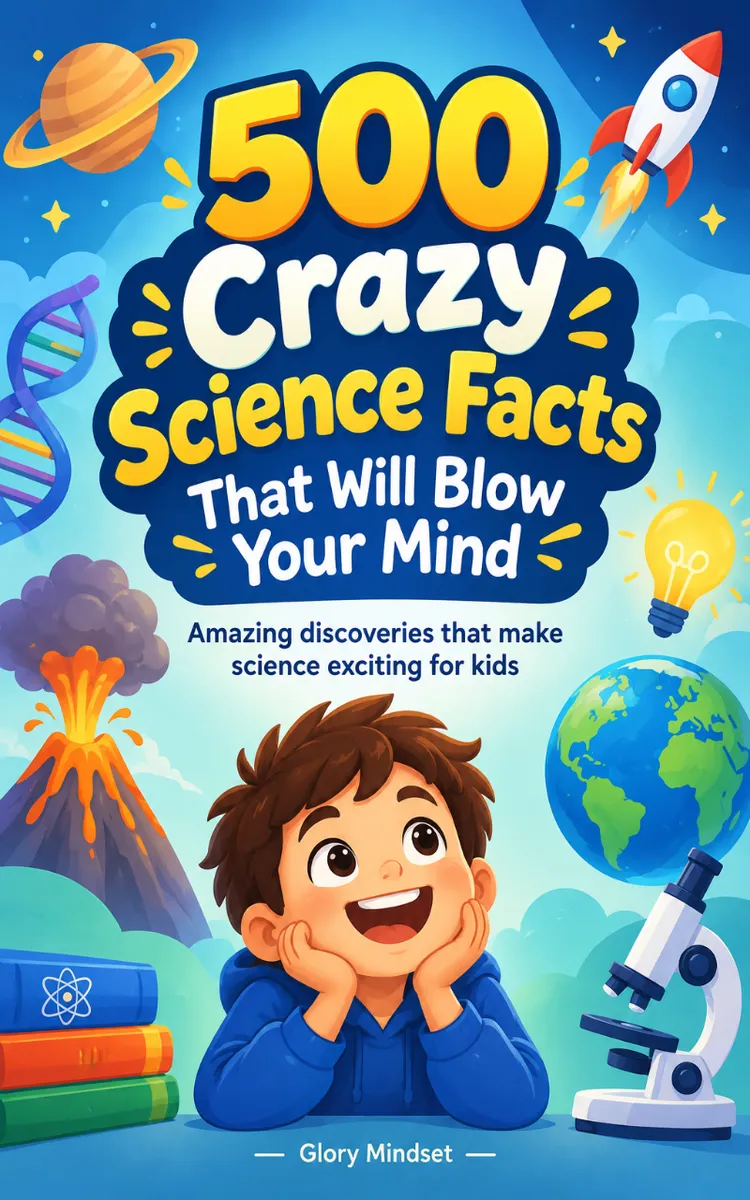
"500 Crazy Science Facts That Will Blow Your Mind" is a list book by Glory Mindset with 10 chapters and approximately 39,350 words. Surprising facts about physics, chemistry, experiments, forces, and everyday science.
This book was created using Inkfluence AI, an AI-powered book generation platform that helps authors write, design, and publish complete books.
Frequently Asked Questions
What is "500 Crazy Science Facts That Will Blow Your Mind" about?
Surprising facts about physics, chemistry, experiments, forces, and everyday science
How many chapters are in "500 Crazy Science Facts That Will Blow Your Mind"?
The book contains 10 chapters and approximately 39,350 words. Topics covered include Space, Stars, and Cosmic Surprises, Earth’s Wild Weather and Restless Planet, Amazing Animals and the Science of Survival, The Human Body: Tiny Machines and Big Mysteries, and more.
Who wrote "500 Crazy Science Facts That Will Blow Your Mind"?
This book was written by Glory Mindset and created using Inkfluence AI, an AI book generation platform that helps authors write, design, and publish books.
Write your own list book with AI
Describe your idea and Inkfluence writes the whole thing. Free to start.
Start writingCreated with Inkfluence AI


