

Read the first chapter
The whole of chapter one, free. About 18 min. Turn the pages with the arrows, your keyboard, or a swipe.
Chapter 1
Our Solar System: The Sun, Planets, and Their Moons
Overview
A blazing star holds nearly all the mass in our solar system, while eight planets, dwarf planets, moons, asteroids, and comets travel through the space around it. Facts #1 - #50 map this neighborhood, explain how its worlds differ, and show how gravity keeps them moving in dependable paths.
The Breakdown
#1: The Sun Is Our Solar System’s Star
Problem: Without the Sun, Earth would be a frozen, dark world. It is easy to think of the Sun as a planet because it appears as a round disk in the sky, but planets shine mainly by reflecting light.
Solution: Classify the Sun correctly: it is a star, a huge ball of hot plasma, or electrically charged gas. It produces its own light and heat through nuclear fusion, a process that joins hydrogen atoms to make helium.
Result: The Sun supplies the energy that powers Earth’s weather, oceans, plants, and nearly every food chain.
#2: The Sun Contains Almost All Solar-System Mass
Problem: The planets look large in pictures, yet they contain only a tiny share of the solar system’s total mass. Pictures also place planets close together, making the Sun’s dominance hard to see.
Solution: Remember the key comparison: the Sun holds about 99.8 percent of the solar system’s mass. The planets, moons, asteroids, comets, and dust share the remaining fraction.
Result: This enormous mass gives the Sun powerful gravity, allowing it to control the paths of nearly every major object nearby.
#3: The Sun’s Energy Begins in Its Core
Problem: Sunlight does not come from a burning fire like wood or coal. Ordinary burning could not keep the Sun shining for billions of years.
Solution: Look to the core, where pressure and temperature are extreme. Hydrogen nuclei fuse into helium, releasing energy that slowly travels outward before escaping as sunlight.
Result: The Sun has produced energy for about 4.6 billion years and still has a large supply of hydrogen fuel.
#4: Sunlight Takes About Eight Minutes to Reach Earth
Problem: The Sun is close compared with other stars, but it is still about 150 million kilometers away. Light does not arrive instantly.
Solution: Use the travel time as a space-distance clue: sunlight takes about 8 minutes and 20 seconds to reach Earth. When you observe the Sun, you see it as it was more than eight minutes earlier.
Result: Looking into space always means looking into the past, even when the target is our own star.
#5: The Solar System Has a Flat Main Disk
Problem: The solar system is not arranged randomly in every direction. A simple picture of planets scattered like marbles can hide its real shape.
Solution: Picture a broad, thin region called the planetary disk. Most planets orbit in nearly the same flat plane because they formed from a spinning disk of gas and dust around the young Sun.
Result: This shared layout makes the planets’ paths easier to compare and helps explain why spacecraft often travel near this plane.
#6: The Solar System Is Much Larger Than the Planetary Orbits
Problem: A drawing that ends at Neptune can make the solar system seem finished. Farther out, however, icy objects and comets continue into enormous regions.
Solution: Separate the solar system into zones. The inner planets orbit near the Sun, the outer planets lie much farther away, and distant regions such as the Kuiper Belt contain icy bodies beyond Neptune.
Result: The solar system is not a small ring of eight worlds; it is a vast system with a crowded center and a very deep outer frontier.
#7: The Four Inner Planets Are Rocky
Problem: Mercury, Venus, Earth, and Mars are sometimes grouped with the giant planets, even though their surfaces and sizes are very different.
Solution: Call them terrestrial planets, meaning Earth-like rocky worlds. They have solid surfaces made mainly of rock and metal and are much smaller than Jupiter, Saturn, Uranus, and Neptune.
Result: The inner planets provide four different examples of how rocky worlds can develop: scorched, cloud-covered, life-bearing, or cold and dusty.
#8: The Four Outer Planets Are Giant Worlds
Problem: The outer planets are often treated as oversized versions of Earth. They are not; their compositions and atmospheres are very different.
Solution: Group Jupiter and Saturn as gas giants, made mostly of hydrogen and helium. Group Uranus and Neptune as ice giants, containing more water, ammonia, and methane-rich materials deep inside.
Result: Comparing these four planets shows that “planet” includes several very different kinds of worlds.
#9: Mercury Is the Smallest Planet
Problem: Mercury is often confused with a moon because it is small and heavily cratered. It is actually the smallest of the eight planets.
Solution: Measure it against Earth: Mercury’s diameter is about 4,879 kilometers, a little more than one-third of Earth’s diameter. It is also the planet closest to the Sun.
Result: Mercury demonstrates that a planet can be small, rocky, and still have its own orbit around a star.
#10: Mercury Has the Shortest Year
Problem: A year does not last the same amount of time on every planet. Using Earth’s 365-day year as the only model causes confusion.
Solution: Mercury travels around the Sun in just 88 Earth days. Its close orbit means it moves quickly, covering a shorter path than the more distant planets.
Result: Mercury completes more than four trips around the Sun during one Earth year.
#11: Mercury Has Huge Temperature Changes
Problem: Mercury has almost no thick atmosphere to spread heat from its sunny side to its dark side. As a result, the surface experiences extreme conditions.
Solution: Compare its temperatures: daytime areas can reach about 430°C, while nighttime areas can fall near −180°C. Its long solar day gives the surface plenty of time to heat and cool.
Result: Mercury is a world of sharp temperature contrasts, not a planet that is simply hot everywhere.
#12: Mercury Has Water Ice in Deep Craters
Problem: Sunlight reaches most of Mercury’s surface, so frozen water seems impossible there. Yet some places never receive sunlight.
Solution: Examine the bottoms of deep polar craters. Their steep walls block the Sun permanently, allowing water ice to remain in darkness despite Mercury’s hot surroundings.
Result: A planet near the Sun can still preserve ice when its landscape creates a permanent shadow.
#13: Venus Is Earth’s Neighbor
Problem: Venus is often called Earth’s twin because it is similar in size, but that nickname can hide its dangerous differences.
Solution: Compare both worlds carefully. Venus has a diameter close to Earth’s, yet its thick carbon-dioxide atmosphere and clouds of sulfuric acid create a surface pressure about 90 times Earth’s.
Result: Similar size does not guarantee similar conditions; Venus is far hotter and harsher than Earth.
#14: Venus Has the Hottest Planetary Surface
Problem: Mercury is closer to the Sun, so many people expect it to be the hottest planet. Mercury loses heat quickly, while Venus traps it.
Solution: Focus on Venus’s runaway greenhouse effect. Its dense carbon-dioxide atmosphere allows sunlight in but prevents much heat from escaping, keeping surface temperatures near 465°C.
Result: Venus is the hottest planet in the solar system, even though Mercury orbits closer to the Sun.
#15: Venus Rotates Backward
Problem: Most planets spin in the same general direction as they orbit, but Venus turns the opposite way. This makes sunrise and sunset behave differently there.
Solution: Define retrograde rotation as spinning opposite to the usual direction. On Venus, one rotation takes about 243 Earth days, and the Sun would appear to rise in the west and set in the east.
Result: Venus shows that a planet’s spin can differ greatly from its journey around the Sun.
#16: Venus Has the Longest Planetary Day
Problem: “Day” can mean either one spin or the time from one sunrise to the next. Mixing these meanings creates wrong comparisons.
Solution: Venus rotates once in about 243 Earth days, longer than its 225-Earth-day trip around the Sun. Because of its backward spin, its solar day - the time between noons - is about 117 Earth days.
Result: Venus has a very slow rotation, giving it one of the strangest day-and-year combinations in the solar system.
#17: Earth Has Liquid Surface Water
Problem: Water exists elsewhere as ice or vapor, but stable liquid water covering a planet’s surface is uncommon. Earth’s oceans are not a minor detail; they shape the entire planet.
Solution: Notice Earth’s position in the Sun’s habitable zone, the region where temperatures can allow liquid water on the surface. Earth’s atmosphere and oceans also help balance heat.
Result: Liquid water supports Earth’s climate system and provides the main environment for known life.
#18: Earth’s Atmosphere Protects the Surface
Problem: Without an atmosphere, Earth would face much greater temperature swings and more harmful space radiation. The atmosphere is not merely empty air above our heads.
Solution: Identify its useful parts. Nitrogen makes up most of the air, oxygen supports many living things, and the ozone layer absorbs much ultraviolet radiation from the Sun.
Result: Earth’s atmosphere helps keep the surface warm enough for liquid water and shields life from several dangers.
#19: Earth’s Magnetic Field Acts Like a Shield
Problem: The solar wind is a stream of charged particles flowing from the Sun. Without protection, these particles could gradually strip away parts of an atmosphere.
Solution: Earth’s moving, molten-metal outer core generates a magnetic field. This field guides many charged particles around the planet and helps create auroras near the poles.
Result: Earth’s magnetic field reduces the solar wind’s direct impact and adds another layer of protection for the atmosphere.
#20: Earth Has One Natural Moon
Problem: A moon is not just a bright object in the night sky. It can affect a planet’s motion, oceans, and long-term stability.
Solution: Study Earth’s Moon as a natural satellite, meaning an object held in orbit by a planet’s gravity. It is about one-quarter of Earth’s diameter, unusually large compared with its planet.
Result: The Moon helps produce tides and steadies much of Earth’s wobble as Earth spins.
#21: Mars Is Known as the Red Planet
Problem: Mars looks red because its surface contains rusty iron minerals, not because the planet is glowing hot.
Solution: Connect the color to chemistry. Iron in Martian rocks reacted with oxygen long ago, forming iron oxides, the same general family of compounds that makes rust on Earth.
Result: A planet-wide layer of dusty, iron-rich material gives Mars its famous red appearance.
#22: Mars Has the Largest Volcano
Problem: Earth’s volcanoes are impressive, but comparing them only with familiar mountains hides the scale of Mars’s surface features.
Solution: Locate Olympus Mons, a shield volcano about 22 kilometers high. Its broad slopes formed from many flows of runny lava over a long period.
Result: Olympus Mons rises nearly three times higher than Mount Everest measured from sea level, making it the tallest known volcano in the solar system.
#23: Mars Has Deep Canyons
Problem: Mars is often pictured as a flat desert, yet its surface includes enormous cliffs and valleys.
Solution: Examine Valles Marineris, a canyon system stretching about 4,000 kilometers. Tectonic cracking and later erosion helped shape this vast scar near the planet’s equator.
Result: Mars contains a canyon system roughly ten times longer than Earth’s Grand Canyon.
#24: Mars Has Two Small Moons
Problem: Mars’s moons can be mistaken for round worlds like Earth’s Moon. They are much smaller and shaped more like lumpy rocks.
Solution: Name them Phobos and Deimos. Phobos is the larger and closer moon, while Deimos is smaller and farther away; both may be captured asteroids or remnants from ancient impacts.
Result: Mars’s moon system is tiny and irregular compared with Earth’s single, large Moon.
#25: Jupiter Is the Largest Planet
Problem: Jupiter’s size is difficult to judge from a photograph because no spacecraft image can show its full scale beside every other planet.
Solution: Use a direct comparison: Jupiter’s diameter is about 11 times Earth’s, and more than 1,300 Earths could fit inside it by volume, although the real packing would leave gaps.
Result: Jupiter dominates the planetary family by size and strongly influences the motion of many smaller objects.
#26: Jupiter Has a Powerful Magnetic Field
Problem: A magnetic field is invisible, so Jupiter’s strength is easy to overlook. Its field affects a huge region around the planet.
Solution: Compare it with Earth’s: Jupiter’s magnetic field is about 14 times stronger at its cloud tops. It traps charged particles in intense radiation belts.
Result: Jupiter’s magnetosphere, or magnetic region around a planet, is the largest planetary structure in the solar system.
#27: Jupiter’s Great Red Spot Is a Giant Storm
Problem: The Great Red Spot is not a solid island or a permanent mark painted on Jupiter. It is a moving storm in the planet’s atmosphere.
Solution: Observe its position in Jupiter’s southern hemisphere. The storm is larger than Earth and has lasted for centuries, though its size and color change over time.
Result: The Great Red Spot reveals that giant planets can host weather systems far larger and longer-lived than those on Earth.
#28: Jupiter Rotates Very Quickly
Problem: A planet’s size does not tell you how fast it spins. Jupiter is enormous but completes a rotation in less time than Earth.
Solution: Record its rotation period: about 10 hours. This rapid spin stretches Jupiter slightly at its equator and helps form its wide bands of clouds.
Result: Jupiter has the shortest day of the eight planets, despite being the largest.
#29: Jupiter Has Many Moons
Problem: Counting moons can change as astronomers discover small objects around giant planets. A single old number may soon become outdated.
Solution: Recognize Jupiter as a moon-rich planet with more than 90 confirmed moons as observations continue. Its four largest - Io, Europa, Ganymede, and Callisto - are called the Galilean moons.
Result: Jupiter’s system resembles a small planetary system, with worlds of different sizes and surfaces circling one giant planet.
#30: Ganymede Is the Largest Moon
Problem: Some moons are larger than planets such as Mercury, so size alone does not decide whether an object is called a planet.
Solution: Compare Ganymede with Mercury. Ganymede, Jupiter’s moon, is slightly larger in diameter, but it orbits Jupiter rather than the Sun directly.
Result: Ganymede is the largest moon in the solar system and has its own magnetic field.
#31: Io Is the Most Volcanically Active World
Problem: Io’s surface is not calm or ancient-looking. Jupiter’s gravity repeatedly squeezes the moon, producing enormous internal heat.
Solution: Track the cause: Io’s slightly changing orbit, influenced by nearby moons, flexes its interior. That tidal heating powers hundreds of volcanoes that erupt sulfur and molten rock.
Result: Io is the most volcanically active world known, with a surface constantly renewed by eruptions.
#32: Europa May Hide an Ocean
Problem: Europa’s bright surface is covered with ice, so its possible liquid water cannot be seen directly. The ocean lies beneath the frozen shell.
Solution: Study the clues: cracked ice patterns, surface movement, and magnetic measurements suggest a salty ocean under the ice. Tidal heating from Jupiter may keep some of that water liquid.
Result: Europa is one of the best places to investigate whether environments suitable for life exist beyond Earth.
#33: Callisto Is Heavily Cratered
Problem: A cratered surface records impacts, but weather and geology can erase those marks. Callisto has preserved many of them.
Solution: Inspect its ancient, icy crust. Callisto has fewer signs of internal activity than Io or Europa, so impact scars have remained for billions of years.
Result: Callisto acts like a historical record of collisions in the outer solar system.
#34: Saturn Is Famous for Its Rings
Problem: Saturn’s rings can look like one solid disk in small images. They are actually a broad, thin collection of countless pieces.
Solution: Describe the rings as particles of water ice and rock, ranging from tiny grains to large chunks. Gravity keeps these particles orbiting Saturn while small moons help shape gaps and edges.
Result: Saturn has the brightest and most extensive ring system visible from Earth with a telescope.
#35: Saturn Is Less Dense Than Water
Problem: Saturn is huge, but size does not equal density. Density means how much mass is packed into a given volume.
Solution: Compare average densities: Saturn’s is about 0.69 grams per cubic centimeter, while water’s is about 1 gram per cubic centimeter. Saturn would float in a fictional ocean large enough to hold it.
Result: Saturn’s low density comes from its enormous amount of light hydrogen and helium.
#36: Saturn Has a Six-Sided Jet Stream
Problem: Saturn’s north pole contains a strange shape that could be mistaken for a solid mark on the planet.
Solution: Identify the feature as a hexagon, a six-sided jet stream about 30,000 kilometers wide. It is made of moving atmosphere, not land, and has persisted for decades of observation.
Result: Saturn’s polar hexagon is one of the solar system’s most unusual weather patterns.
#37: Uranus Spins on Its Side
Problem: Uranus’s tilt is so large that its poles can point toward the Sun during parts of its orbit. Ordinary planet diagrams often fail to show this.
Solution: Measure the tilt at about 98 degrees. Scientists think a massive collision early in Uranus’s history may have knocked it into this unusual orientation.
Result: Uranus experiences extreme seasons, with each pole receiving about 42 Earth years of sunlight followed by about 42 years of darkness.
#38: Uranus Has Faint Rings
Problem: Saturn receives most ring-system attention, so it is easy to forget that other planets also have rings.
Solution: Look for Uranus’s narrow, dark rings. Astronomers discovered them in 1977 when the rings briefly blocked starlight as Uranus passed in front of a star.
Result: Ring systems are not unique to Saturn; Uranus, Jupiter, and Neptune also have them.
#39: Uranus Appears Blue-Green
Problem: Uranus’s color does not come from oceans covering its visible surface. Its upper atmosphere controls the color seen from far away.
Solution: Focus on methane gas, which absorbs much of the red light in sunlight. The remaining blue and green light scatters back toward observers.
Result: Methane gives Uranus its calm blue-green appearance, even though its atmosphere is cold and turbulent.
#40: Neptune Has the Fastest Winds
Problem: Neptune receives weak sunlight because it is far from the Sun, but weak sunlight does not mean still air.
Solution: Measure its winds, which can reach about 2,000 kilometers per hour. Heat escaping from Neptune’s interior helps drive powerful atmospheric motion.
Result: Neptune has the fastest winds measured on any planet in the solar system.
#41: Neptune Was Predicted Before It Was Seen
Problem: Uranus did not follow its predicted orbit exactly, and the mismatch could have been dismissed as a measurement error.
Solution: Use gravity as a detective tool. Mathematicians calculated that an unseen planet might be tugging on Uranus, and astronomers observed Neptune in 1846 near the predicted location.
Result: Neptune became a powerful example of discovering a world through its gravitational influence before seeing it directly.
#42: Neptune Has a Great Dark Spot
Problem: Neptune’s atmosphere can change, so its dark spots are not permanent surface features.
Solution: Identify the Great Dark Spot as a large storm system observed by Voyager 2 in 1989. Unlike Jupiter’s Great Red Spot, it later disappeared, showing that Neptune’s weather shifts over time.
Result: Neptune proves that even distant planets can have enormous, changing storms.
#43: A Planet Must Orbit the Sun
Problem: Many objects are round, but roundness alone does not make an object a planet. Some moons and dwarf planets are nearly spherical too.
Solution: Use the first part of the planet definition: the object must orbit the Sun. It must also be massive enough for gravity to make it nearly round and must have cleared most similar-sized objects from its orbital neighborhood.
Result: This definition separates the eight planets from moons, asteroids, and dwarf planets.
#44: Dwarf Planets Are Different from Planets
Problem: Pluto is round and travels around the Sun, so its classification can seem unfair or confusing.
Solution: Apply the full definition. A dwarf planet orbits the Sun and is nearly round but has not cleared its neighborhood of other objects; Pluto shares its region with many icy bodies.
Result: Pluto remains an important dwarf planet, while the eight planets occupy more dominant orbital paths.
#45: Pluto Is a Dwarf Planet
Problem: Pluto was called the ninth planet after its discovery, then reclassified in 2006. The change was about scientific categories, not Pluto suddenly changing.
Solution: Place Pluto in the Kuiper Belt, a distant zone beyond Neptune filled with icy objects. Pluto has mountains, glaciers of nitrogen ice, and five known moons.
Result: Pluto is still a fascinating world; its label tells us about its orbital neighborhood.
#46: Ceres Is the Largest Object in the Asteroid Belt
Problem: The asteroid belt is often pictured as a packed wall of rocks. In reality, its objects are spread across a huge region.
Solution: Locate Ceres between Mars and Jupiter. It is a dwarf planet and the largest body in the asteroid belt, with a diameter of about 940 kilometers.
Result: Ceres shows that dwarf planets can exist far from the icy outer solar system, even among rocky asteroids.
#47: Eris Helped Change Pluto’s Classification
Problem: Eris is nearly Pluto’s size and orbits in the distant outer solar system. Its discovery raised a difficult question: how many “planets” should be counted?
Solution: Compare Eris with Pluto and apply one consistent definition. Eris is a dwarf planet in the scattered disk, a region of icy bodies with stretched, tilted orbits.
Result: Eris helped astronomers recognize that the solar system contains many round worlds beyond Neptune, not just one unusual Pluto.
#48: Moons Orbit Planets and Dwarf Planets
Problem: A moon can look like a small planet, but its motion tells us what it is. The key difference is which object it orbits.
Solution: Check the path: Earth’s Moon orbits Earth, while Earth orbits the Sun. Moons can orbit planets, dwarf planets, or even asteroids, and they come in many sizes and shapes.
Result: Orbital relationships provide a reliable way to sort the solar system’s many worlds.
#49: Gravity Keeps Worlds in Orbit
Problem: Planets do not need invisible ropes to stay near the Sun. They are constantly moving forward, while the Sun’s gravity continually bends their paths.
Solution: Combine two ideas: inertia, an object’s tendency to keep moving, and gravity, the attraction between masses. Earth’s forward motion would carry it straight ahead, but solar gravity curves that motion into an orbit.
Result: An orbit is a continuous fall around the Sun rather than a motionless track in space.
#50: Orbital Speed Depends on Distance
Problem: The planets do not all travel at the same speed. A distant planet has a longer path and feels a weaker gravitational pull than a nearby planet.
Solution: Compare Mercury and Neptune. Mercury moves around the Sun at about 47 kilometers per second, while Neptune travels at about 5.4 kilometers per second; closer worlds generally move faster.
Result: Distance from the Sun helps explain the different lengths of planetary years and the varied speeds of their journeys.
What Comes Next
The solar system is only one neighborhood in a much larger universe. Next, we will travel beyond its planets to examine stars, galaxies, and the immense structures that fill deep space.
End of chapter one. 9 more chapters and about 39,849 words in the full book.
Swipe or use the arrows to turn the page

The Amazing Human Body For Curious Kids

500 Amazing Animal Facts Kids Will Love

1,001 Amazing Facts About The World
What's inside: 10 chapters
- 1. Our Solar System: The Sun, Planets, and Their Moons
- 2. Planet Worlds: Rocky Planets, Gas Giants, and Dwarf Planets
- 3. Moons, Rings, Comets, and Asteroids
- 4. The Sun, Stars, and the Life of a Star
- 5. Galaxies, Nebulae, and the Milky Way
- 6. Black Holes, Neutron Stars, and Cosmic Extremes
- 7. Exoplanets and the Search for Life
- 8. Astronaut Adventures and Life in Space
- 9. Rockets, Spacecraft, Telescopes, and Space Missions
- 10. The Universe: Big Bang, Cosmic Mysteries, and the Future
About this book
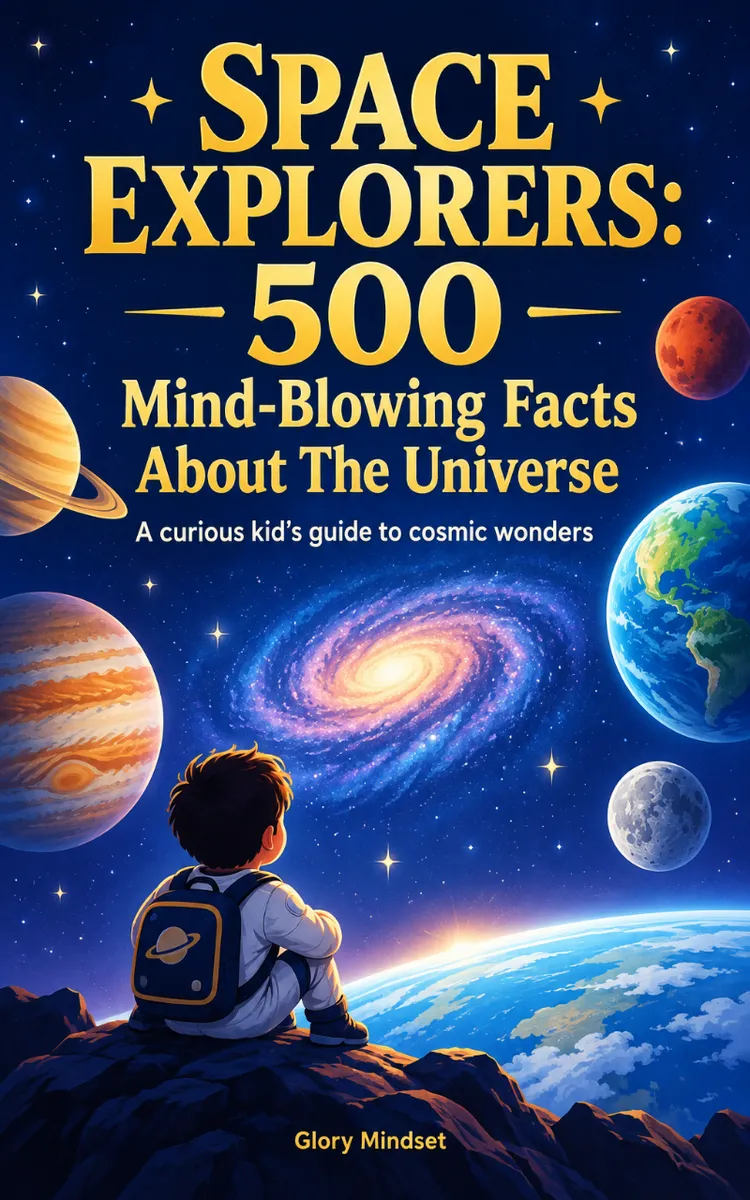
"Space Explorers: 500 Mind-Blowing Facts About The Universe" is a list book by Glory Mindset with 10 chapters and approximately 39,849 words. Space and astronomy facts about planets, black holes, galaxies, astronauts, and cosmic mysteries.
This book was created using Inkfluence AI, an AI-powered book generation platform that helps authors write, design, and publish complete books.
Frequently Asked Questions
What is "Space Explorers: 500 Mind-Blowing Facts About The Universe" about?
Space and astronomy facts about planets, black holes, galaxies, astronauts, and cosmic mysteries
How many chapters are in "Space Explorers: 500 Mind-Blowing Facts About The Universe"?
The book contains 10 chapters and approximately 39,849 words. Topics covered include Our Solar System: The Sun, Planets, and Their Moons, Planet Worlds: Rocky Planets, Gas Giants, and Dwarf Planets, Moons, Rings, Comets, and Asteroids, The Sun, Stars, and the Life of a Star, and more.
Who wrote "Space Explorers: 500 Mind-Blowing Facts About The Universe"?
This book was written by Glory Mindset and created using Inkfluence AI, an AI book generation platform that helps authors write, design, and publish books.
Write your own list book with AI
Describe your idea and Inkfluence writes the whole thing. Free to start.
Start writingCreated with Inkfluence AI


