

Read the first chapter
The whole of chapter one, free. About 17 min. Turn the pages with the arrows, your keyboard, or a swipe.
Chapter 1
Your Brain: The Body’s Busy Control Center
Overview
Your brain weighs about 1.3 kilograms, yet it helps you read a word, catch a ball, remember a joke, and feel excitement - all while controlling breathing and heartbeat. Facts #1 - #50 trace its main parts, the nerve cells that carry messages, and the ways the brain helps you learn, remember, move, think, and feel.
The Breakdown
#1: The Brain Is the Control Center
Problem: Every body system needs information and instructions. Without a control center, your muscles could not move together, your eyes could not report what they see, and your organs could not respond quickly to changes.
Solution: Think of the brain as a busy control center connected to the body by nerves. It receives messages, makes decisions, and sends commands. It also runs many jobs automatically, including breathing and adjusting body temperature.
Result: The brain links your thoughts, actions, senses, and body functions into one working team.
#2: The Brain Uses a Lot of Energy
Problem: The brain makes up only about 2 percent of an adult’s body weight, but it uses roughly 20 percent of the body’s resting energy. Brain cells need a steady supply of oxygen and glucose, a type of sugar used as fuel.
Solution: Eat regular, nourishing meals, drink water, and breathe normally during activity. Sleep also helps the brain manage its energy and repair its working systems.
Result: A well-fueled brain can keep sending messages and solving problems more reliably.
#3: The Cerebrum Handles Many Big Jobs
Problem: Reading, planning, speaking, remembering, and noticing sounds all require complicated work. If these jobs were handled by one tiny spot, the brain would quickly become overloaded.
Solution: The largest brain region, the cerebrum, handles many thinking and sensing tasks. Its wrinkled outer layer is called the cerebral cortex. The folds give it more working surface inside the skull.
Result: The cerebrum gives you room for language, learning, choices, imagination, and conscious movement.
#4: The Left and Right Hemispheres Work Together
Problem: The cerebrum has two halves, called hemispheres. It is tempting to say that one side does everything logical and the other does everything creative, but real brain work is not that simple.
Solution: Let both hemispheres share information through a thick bundle of nerve fibers called the corpus callosum. Some tasks show stronger activity on one side, but reading, drawing, talking, and playing sports usually use networks on both sides.
Result: The two hemispheres cooperate instead of acting like separate brains.
#5: The Frontal Lobe Helps You Plan
Problem: Starting a task is easy when you feel excited, but finishing it may require attention, choices, and self-control. These skills can fail when you are tired or distracted.
Solution: The frontal lobe, near your forehead, helps with planning, decision-making, speech, attention, and voluntary movement. Break a large job into small steps and pause before making a quick choice.
Result: You are more likely to organize actions, control impulses, and reach a goal.
#6: The Parietal Lobe Maps Body Sensations
Problem: Your brain must know whether a touch is on your finger, elbow, or cheek. It also needs to judge space so you can reach for a cup without knocking it over.
Solution: The parietal lobe processes touch, pressure, temperature, and body position. It also helps with spatial awareness - the ability to understand where things are around you.
Result: You can locate sensations and guide your body through spaces more accurately.
#7: The Temporal Lobe Helps With Sound and Memory
Problem: Hearing a sound is not enough; the brain must identify whether it is a voice, a song, or a warning. It must also connect sounds with memories and meaning.
Solution: The temporal lobe, near your ears, helps process sound, understand language, and form or retrieve certain memories. When listening, focus on the speaker instead of splitting your attention between several noises.
Result: Sounds become meaningful information rather than just vibrations.
#8: The Occipital Lobe Processes Vision
Problem: Your eyes collect light, but they do not create the complete picture you experience. The brain must sort edges, colors, shapes, and movement.
Solution: The occipital lobe at the back of the brain processes visual information from the eyes. Give your eyes regular breaks during close-up work, and use good lighting so the visual system does not work harder than necessary.
Result: The brain turns signals from light-sensitive cells into useful pictures of the world.
#9: The Cerebellum Fine-Tunes Movement
Problem: Walking, balancing, typing, and catching require carefully timed muscle actions. A command that is slightly too strong or too late can make movement wobbly.
Solution: The cerebellum, a smaller region at the back of the brain, helps coordinate balance, timing, and precision. Practice gives it repeated information about what a movement should feel like.
Result: Movements become smoother and more accurate with practice.
#10: The Brainstem Keeps Basic Functions Going
Problem: You cannot consciously remind yourself to breathe every few seconds while reading or sleeping. Important automatic jobs need constant supervision.
Solution: The brainstem connects the brain with the spinal cord and helps control breathing, heartbeat, swallowing, and alertness. Protect your head and neck during activities such as cycling by using properly fitted safety equipment.
Result: Essential body functions continue even when your attention is busy elsewhere.
#11: The Spinal Cord Is a Message Highway
Problem: The brain is not directly connected to every muscle and skin cell. Messages need a fast route between the brain and the rest of the body.
Solution: The spinal cord, a long bundle of nerve tissue inside the backbone, carries signals up to the brain and commands down to the body. The bones of the spine help protect it, so safe movement and injury prevention matter.
Result: The brain can communicate with distant parts of the body in fractions of a second.
#12: Neurons Are Message-Carrying Cells
Problem: Ordinary body cells cannot quickly send a signal across a long distance. The nervous system needs specialized cells for rapid communication.
Solution: A neuron, or nerve cell, receives information, processes it, and passes a message onward. Most neurons have branching dendrites that receive signals and a long axon that sends signals.
Result: Trillions of connections allow the brain and body to share information constantly.
#13: Dendrites Receive Signals
Problem: A neuron must collect messages from nearby cells, sense organs, or other parts of the nervous system. Without receiving branches, it would have little information to use.
Solution: Dendrites are branch-like parts of neurons that receive signals. Their many branches allow one neuron to collect information from several sources.
Result: Neurons can compare incoming signals before deciding whether to pass a message along.
#14: Axons Send Signals Away
Problem: A message may need to travel from the brain to a toe or from the spinal cord to a hand. A short cell body alone could not bridge those distances.
Solution: An axon carries an electrical signal away from a neuron’s cell body. Some axons are very short, while others stretch for about a meter in a tall person.
Result: Signals can travel between distant parts of the nervous system.
#15: Myelin Speeds Up Messages
Problem: Electrical signals moving along an axon can be slow if they travel across every bit of its surface. The body needs a faster way to send urgent instructions.
Solution: Myelin is a fatty insulating covering around some axons. It is arranged in sections, allowing the signal to jump between small gaps called nodes.
Result: Myelinated nerve signals can move much faster than signals along an uninsulated axon.
#16: Synapses Are Tiny Communication Gaps
Problem: Most neurons do not physically touch the next cell. A message must cross a microscopic space between them.
Solution: This meeting point is called a synapse. When an electrical signal reaches the end of an axon, it can cause chemicals to cross the gap and affect the next cell.
Result: Synapses let neurons pass, strengthen, weaken, or block information.
#17: Neurotransmitters Carry Chemical Messages
Problem: An electrical signal cannot simply leap across every synapse. The nervous system needs chemical messengers to deliver the message across the gap.
Solution: Neurotransmitters are chemicals released by one neuron and detected by another cell. Different neurotransmitters can encourage a cell to become active or help calm its activity.
Result: Chemical messages give the brain fine control over movement, mood, attention, and many other functions.
#18: Nerve Signals Are Electrical and Chemical
Problem: Calling the nervous system “electrical” gives only half the story. Signals travel electrically inside a neuron but often use chemicals between neurons.
Solution: Learn the sequence: an electrical signal moves along an axon, chemicals cross the synapse, and the next cell changes its activity. This pattern repeats across connected networks.
Result: The brain combines speed inside cells with flexible communication between cells.
#19: Reflexes Can Act Before Thought
Problem: Touching something hot can injure skin if the response waits for a long thinking process. A fast protective reaction is useful.
Solution: In a reflex, sensory information can travel to the spinal cord and trigger a muscle response before the brain fully recognizes the pain. The brain still receives the information and becomes aware of what happened.
Result: Reflexes help pull the body away from danger quickly.
#20: Sensory Neurons Report the World
Problem: The brain cannot directly feel light, sound, pressure, or heat. It needs special cells to translate these forms of energy into nerve signals.
Solution: Sensory neurons carry information from receptors in the eyes, ears, skin, nose, and other tissues. Notice how touching a rough surface produces a different pattern of signals than touching smooth glass.
Result: The brain receives a changing report about the outside world and the body’s inside condition.
#21: Motor Neurons Command Muscles
Problem: Knowing that you want to move is not enough. The instruction must reach the correct muscle fibers in the right order.
Solution: Motor neurons carry commands from the brain or spinal cord to muscles. When you reach for a pencil, many motor neurons help control the shoulder, arm, wrist, and fingers.
Result: Nerve signals become physical movement.
#22: Glial Cells Support Neurons
Problem: Neurons need food, protection, cleanup, and insulation. They could not handle all these jobs while also sending messages.
Solution: Glial cells are support cells in the nervous system. They help nourish neurons, maintain their surroundings, make some myelin, and remove damaged material.
Result: Neurons have the support system needed to stay healthy and communicate.
#23: The Brain Uses Networks, Not Isolated Spots
Problem: A single brain area rarely performs a complicated skill alone. Reading a sentence, for example, involves seeing letters, recognizing words, understanding language, and holding meaning in mind.
Solution: Brain regions work in networks, which are groups of connected areas. Think of a network as a team in which each member contributes a different job.
Result: Cooperation between regions creates abilities that no single small spot could produce by itself.
#24: The Thalamus Sorts Many Incoming Signals
Problem: The brain receives enormous amounts of information from the senses. Sending every signal everywhere would create confusion.
Solution: The thalamus, a small structure deep inside the brain, acts like a relay station for much sensory information. It helps direct signals to the proper areas for processing.
Result: Sensory messages arrive at useful destinations instead of flooding the whole brain equally.
#25: The Hypothalamus Helps Keep Conditions Steady
Problem: Your body works best within certain ranges of temperature, water balance, and energy. Too much change can make cells work poorly.
Solution: The hypothalamus monitors and helps control body temperature, hunger, thirst, and other internal conditions. Sweating when hot and feeling thirsty after activity are examples of this regulation.
Result: The brain helps maintain a stable internal environment, called homeostasis.
#26: The Limbic System Links Feelings and Memory
Problem: Events connected with strong feelings are often remembered clearly, while ordinary details may fade. Emotions can change what you notice and remember.
Solution: Several connected brain structures, often grouped as the limbic system, help process emotion, motivation, and memory. When something important happens, notice both the event and the feeling attached to it.
Result: Experiences gain personal meaning and can guide future choices.
#27: The Amygdala Helps Detect Threats
Problem: A sudden crash or movement may require attention before you have time to study every detail. The brain needs an alarm system for possible danger.
Solution: The amygdala helps detect emotionally important signals, especially possible threats. If you feel startled, pause, look for the actual cause, and use slow breathing once you are safe.
Result: The alarm response can protect you, while careful checking prevents every startling event from seeming dangerous.
#28: The Hippocampus Helps Form Memories
Problem: New experiences do not automatically become lasting memories. The brain must organize details such as place, time, and events.
Solution: The hippocampus, a seahorse-shaped structure deep in the brain, helps form many new memories. To help it, connect new information with a clear place, image, example, or earlier fact.
Result: Connected information is easier to store and retrieve later.
#29: Attention Chooses What Gets Priority
Problem: You cannot fully process every sight, sound, thought, and sensation at once. Dividing attention between a lesson and a noisy device can make both harder.
Solution: Attention acts like a spotlight, giving extra processing power to selected information. Put distracting devices aside, choose one task, and work in a short, focused block.
Result: You notice more details and make fewer mistakes.
#30: Working Memory Holds Small Amounts Briefly
Problem: Working memory keeps information available while you use it, such as remembering a number while typing it. It is limited, so long instructions can disappear quickly.
Solution: Break instructions into small groups and repeat or write down important details. For example, remember a phone number in chunks instead of one long string.
Result: Smaller pieces are easier for the brain to hold and use.
#31: Learning Changes Connections
Problem: Knowing something once does not guarantee that you will remember it next week. Brain connections become more useful through repeated, meaningful activity.
Solution: Learning can strengthen or adjust connections between neurons. Practice a skill, explain it in your own words, and use it in a new example rather than only rereading it.
Result: The brain builds a stronger path for finding and using the information.
#32: Practice Can Make Skills Automatic
Problem: A new skill demands attention because each step is unfamiliar. This can make playing an instrument, tying a knot, or solving a problem feel slow.
Solution: Practice accurately in short sessions. Repeating mistakes can strengthen the wrong pattern, so slow down, correct the movement, and then gradually increase speed.
Result: The skill requires less conscious effort, leaving attention available for other details.
#33: Sleep Helps Learning
Problem: Staying awake all night may add study time, but tired brains have trouble focusing and remembering. New information needs time to be organized.
Solution: Sleep supports memory processing after learning. Review important material earlier, then protect a regular sleep period instead of relying on a last-minute cram session.
Result: Rest can help new knowledge become easier to recall.
#34: Memories Are Rebuilt During Recall
Problem: Remembering is not like replaying a perfect video. Each recall can include missing details or changes caused by later information.
Solution: Check important memories against notes, photographs, or reliable records. When telling a story, separate what you clearly remember from what you are guessing.
Result: You become less likely to treat a confident memory as automatically exact.
#35: Retrieval Strengthens Recall
Problem: Rereading can feel familiar without proving that you can produce the answer yourself. Familiarity and recall are different abilities.
Solution: Close the book and answer questions from memory. Use flash cards, explain a process aloud, or write the main points without looking.
Result: Practice pulling information out makes future recall faster and more dependable.
#36: Mistakes Provide Useful Feedback
Problem: An incorrect answer can feel like failure, but avoiding mistakes prevents the brain from discovering what needs changing. Repeating an error without checking it makes the error stronger.
Solution: Find the exact step where the mistake happened, correct it, and try a similar example. Ask, “What clue did I miss?” rather than only looking at the final answer.
Result: The brain uses errors as information for building a more accurate skill.
#37: Language Uses Several Brain Systems
Problem: Understanding a sentence requires more than hearing its sounds. The brain must identify words, grammar, meaning, and the speaker’s purpose.
Solution: Language networks across the brain help you understand and produce speech, reading, and writing. Read aloud, listen carefully, and use new words in complete sentences to connect sound, meaning, and memory.
Result: Practice strengthens the links needed to communicate clearly.
#38: The Brain Predicts What Comes Next
Problem: The brain would be slow if it had to analyze every familiar event from the beginning. It uses past experience to prepare for likely sights, sounds, and movements.
Solution: Predictions help you catch a ball, finish a familiar sentence, or follow a rhythm. Stay ready to update the prediction when new evidence disagrees with it.
Result: Prediction makes everyday actions faster while flexible updating keeps them accurate.
#39: Emotions Change Body Activity
Problem: Feelings are not only thoughts. Fear, excitement, anger, and joy can change heart rate, breathing, muscle tension, and attention.
Solution: Notice the feeling and the body signal together. Name the emotion, pause, and take several comfortable slow breaths before choosing what to do.
Result: You gain a little space between an emotional signal and an impulsive action.
#40: The Prefrontal Cortex Supports Self-Control
Problem: A tempting action can feel urgent even when it causes trouble later. Choosing a better response requires holding a goal in mind.
Solution: The prefrontal cortex, part of the frontal lobe, helps with planning, judgment, and self-control. Use a simple pause: stop, name the choice, consider one consequence, and then act.
Result: A brief pause can help long-term goals guide behavior.
#41: Movement Begins With a Plan
Problem: Reaching for a cup involves more than turning on one muscle. The brain must choose the target, set force, and coordinate many joints.
Solution: Movement-planning areas prepare commands, and motor areas send them toward the spinal cord and muscles. Watch the object, begin smoothly, and adjust as your hand receives feedback.
Result: Planned movement becomes directed rather than random.
#42: The Brain Uses Feedback While You Move
Problem: A movement can go off course because an object shifts or a muscle uses too much force. A first command is not always enough.
Solution: Vision, touch, balance signals, and sensors in muscles report what is happening. The brain compares the result with the goal and changes the next command.
Result: Feedback lets you correct a wobbly step or adjust a catch while the action is still happening.
#43: Balance Depends on Several Senses
Problem: Standing upright requires information about head position, body position, and the ground. If one source is confusing, balance becomes harder.
Solution: The inner ear senses head movement, the eyes report the surroundings, and body sensors report joint and muscle position. Use a handrail and good lighting when balance is uncertain.
Result: The brain combines several reports to keep the body upright.
#44: Pain Is a Protective Signal
Problem: Pain can be unpleasant, but it warns that tissue may be damaged or under threat. Ignoring severe or worsening pain can allow an injury to become worse.
Solution: Pain signals are processed by the nervous system and influenced by attention, emotions, and past experience. Stop a harmful activity, tell a trusted adult about serious pain, and seek medical help when needed.
Result: Treating pain as useful information helps protect the body instead of simply trying to silence it.
#45: The Brain Can Change After Experience
Problem: It is easy to think that the brain is fixed after early childhood. That idea would make learning seem impossible whenever something feels difficult.
Solution: Neuroplasticity is the brain’s ability to change its connections and activity with experience. Practice, recovery, new challenges, and helpful surroundings can all shape those changes.
Result: The brain remains adaptable, although different skills may require different amounts of time and practice.
#46: Stress Can Redirect Attention
Problem: During stress, the brain may focus strongly on a possible problem. This can help in an emergency but make schoolwork or careful listening harder.
Solution: First check whether there is immediate danger. If you are safe, slow your breathing, identify the next small action, and talk with a trusted adult when stress keeps interfering.
Result: The brain can shift from alarm toward problem-solving.
#47: The Brain Notices Patterns
Problem: Separate details are harder to remember than a meaningful pattern. A list of unrelated facts can feel confusing.
Solution: Group information by shape, sound, cause, order, or category. For example, organize brain regions by their main jobs instead of memorizing a random list.
Result: Patterns reduce mental effort and make information easier to retrieve.
#48: Curiosity Directs Attention
Problem: Information that seems meaningless is easy to ignore. A question gives the brain a reason to search for connections.
Solution: Turn a fact into a specific question, such as “Why does the cerebellum help balance?” Then look for evidence and explain the answer in your own words.
Result: Curiosity guides attention and helps new information connect with what you already know.
#49: Brain Health Depends on Daily Care
Problem: The brain cannot work at its best when it is repeatedly deprived of sleep, oxygen, water, or nutritious food. Injuries can also damage delicate brain tissue.
Solution: Sleep regularly, eat varied foods, drink when thirsty, stay physically active, and protect your head during activities with fall or collision risks. Never treat a head injury as something to hide; tell a trusted adult.
Result: Daily care supports attention, learning, movement, and safe brain function.
#50: The Brain Is a Team of Constantly Talking Parts
Problem: Thinking, feeling, sensing, and moving are often described separately, but real actions combine them. Catching a ball may involve vision, attention, prediction, memory, movement planning, balance, and emotion at once.
Solution: When studying the brain, ask three questions: Which information arrives? Which brain systems process it? Which command or feeling follows? This approach shows how regions and nerve cells cooperate rather than working alone.
Result: The brain becomes easier to understand as a living communication network - busy every second, even while you sleep.
What Comes Next
The next chapter moves from the brain’s control center to the heart and blood vessels, following how blood carries oxygen and supplies the body’s working cells. Keep the brain’s message network in mind: the heart gives that network the fuel it needs.
End of chapter one. 9 more chapters and about 34,769 words in the full book.
Swipe or use the arrows to turn the page

History’s Biggest Secrets: 500 Amazing Facts Kids Should Know

500 Incredible Facts About The Deep Blue Sea

Space Explorers: 500 Mind-Blowing Facts About The Universe
What's inside: 10 chapters
- 1. Your Brain: The Body’s Busy Control Center
- 2. The Senses: How You Discover the World
- 3. The Heart and Blood: Your Inner Delivery Service
- 4. Bones and Joints: Your Living Framework
- 5. Muscles and Movement: How Your Body Gets Going
- 6. Breathing and Digestion: Fueling Every Cell
- 7. Sleep, Dreams, and the Body Clock
- 8. Skin, Hair, and Nails: Your Protective Covering
- 9. Immunity and Healing: Your Body’s Defenses
- 10. The Hidden Helpers: Hormones, Cells, and Body Systems
About this book
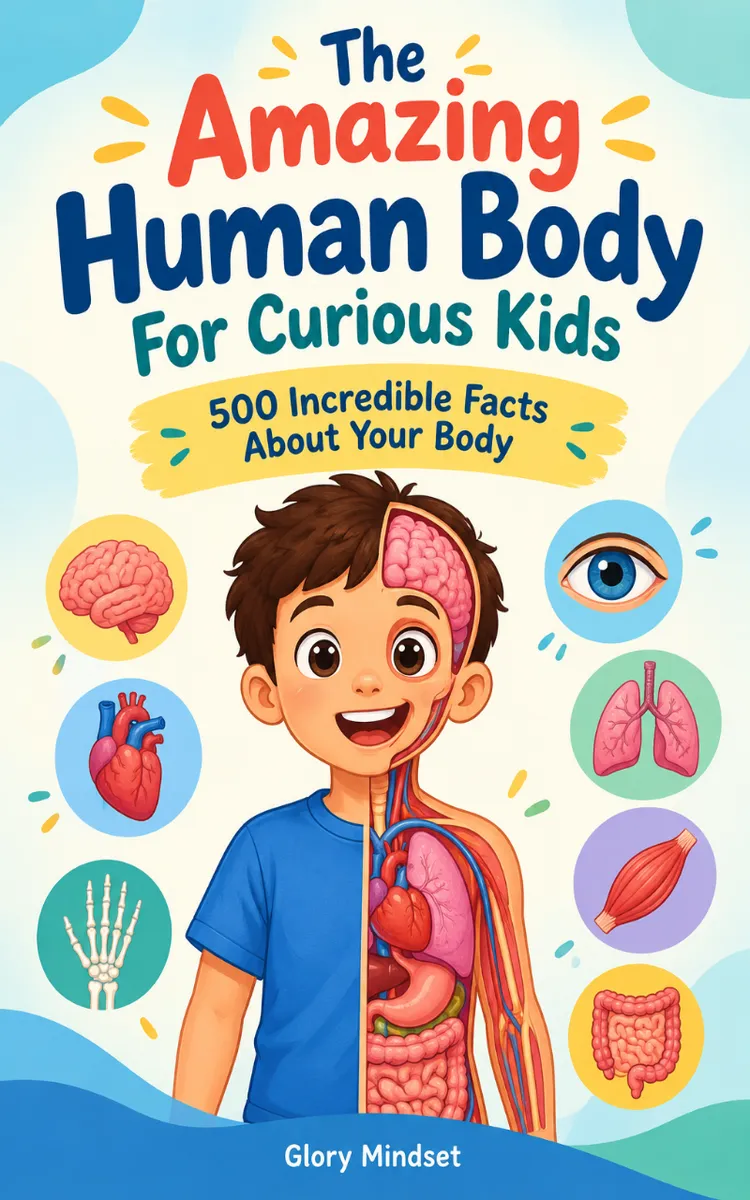
"The Amazing Human Body For Curious Kids" is a list book by Glory Mindset with 10 chapters and approximately 34,769 words. Child-friendly facts about human biology, organs, senses, sleep, and health.
This book was created using Inkfluence AI, an AI-powered book generation platform that helps authors write, design, and publish complete books.
Frequently Asked Questions
What is "The Amazing Human Body For Curious Kids" about?
Child-friendly facts about human biology, organs, senses, sleep, and health
How many chapters are in "The Amazing Human Body For Curious Kids"?
The book contains 10 chapters and approximately 34,769 words. Topics covered include Your Brain: The Body’s Busy Control Center, The Senses: How You Discover the World, The Heart and Blood: Your Inner Delivery Service, Bones and Joints: Your Living Framework, and more.
Who wrote "The Amazing Human Body For Curious Kids"?
This book was written by Glory Mindset and created using Inkfluence AI, an AI book generation platform that helps authors write, design, and publish books.
Write your own list book with AI
Describe your idea and Inkfluence writes the whole thing. Free to start.
Start writingCreated with Inkfluence AI


