

Read the first chapter
The whole of chapter one, free. About 18 min. Turn the pages with the arrows, your keyboard, or a swipe.
Chapter 1
The Ocean’s Blue Beginnings
Overview
Earth’s ocean began with water delivered by a young, cooling planet, volcanic gases, and icy bodies from space. Its salt, blue color, moving seafloor, tides, currents, and waves all come from understandable physical forces - gravity, sunlight, heat, wind, and plate motion. The 50 facts below trace those forces from the ocean’s earliest beginnings to the restless surface and deep seafloor beneath us.
The Breakdown
#1: Earth’s First Oceans Formed as the Planet Cooled
Problem: Early Earth was far too hot for stable oceans. Much of its water existed as vapor in a thick atmosphere, while molten rock covered large areas of the young planet.
Solution: As Earth cooled, water vapor condensed into rain. Volcanic gases supplied additional water vapor, and rainfall collected in low basins over millions of years.
Result: Permanent oceans formed roughly 4 billion years ago, creating the long-lived habitat where marine life could develop.
#2: Volcanoes Helped Supply the Ocean’s Water
Problem: Volcanoes are often viewed only as destructive features, but the early atmosphere needed a steady source of gases. Without enough water vapor, rainfall and ocean formation would have been much slower.
Solution: Volcanic eruptions released water vapor, carbon dioxide, nitrogen, and other gases from Earth’s interior. Scientists compare volcanic gases with the chemistry of ancient rocks to study how the atmosphere and oceans changed.
Result: Volcanism helped build the atmosphere that allowed liquid water to remain on the surface.
#3: Some Ocean Water Arrived from Space
Problem: Earth’s original water source is not explained by one process alone. The young planet was struck repeatedly by asteroids and other bodies, some of which contained water-bearing minerals and ice.
Solution: Researchers compare the ratios of hydrogen isotopes - different forms of hydrogen - in ocean water with those found in meteorites. These comparisons suggest that water-rich space rocks contributed to Earth’s supply.
Result: The ocean is partly a planetary inheritance, carrying a chemical connection to the early solar system.
#4: Earth’s Oceans Are About 4 Billion Years Old
Problem: The exact age of the first ocean is difficult to pin down because Earth’s active crust destroys and recycles many ancient rocks. Direct evidence from the earliest period is rare.
Solution: Scientists study tiny zircon crystals from ancient rocks. Some zircons more than 4 billion years old show chemical signs that they formed in contact with liquid water.
Result: Oceans probably existed surprisingly early, not long after Earth formed 4.54 billion years ago.
#5: Ocean Basins Are Earth’s Great Low Places
Problem: Water does not spread evenly across a planet. Gravity pulls it toward lower regions, while continents and mountain ranges interrupt its path.
Solution: Compare a globe’s raised continents with its broad, depressed ocean basins. Today, oceans cover about 71 percent of Earth’s surface and hold roughly 1.3 billion cubic kilometers of water.
Result: The ocean’s enormous area comes from the shape of Earth’s crust, not from water simply coating every surface equally.
#6: Most Ocean Water Is Saltier Than Freshwater
Problem: Freshwater from rivers, lakes, and rain contains relatively few dissolved minerals. Seawater carries far more dissolved material, making it unsuitable for drinking and difficult for many land plants to use.
Solution: Measure salinity, the amount of dissolved salt in water. Average open-ocean salinity is about 35 parts per thousand, meaning roughly 35 grams of dissolved salts occur in each kilogram of seawater.
Result: Salinity affects buoyancy, freezing, currents, and the kinds of organisms that can live in a region.
#7: Rivers Deliver Minerals to the Sea
Problem: Rainwater and groundwater slowly wear down rocks. The dissolved material does not vanish when a river reaches the coast; much of it enters the ocean.
Solution: Follow a river from its mountain source to its estuary, where fresh and salt water meet. Weathering releases ions such as sodium, calcium, and bicarbonate, which are carried downstream.
Result: Rivers help maintain the ocean’s supply of dissolved minerals, even though each individual stream contributes only a small share.
#8: Hydrothermal Vents Add Chemicals from Below
Problem: Seawater does not receive minerals only from the land. At mid-ocean ridges, seawater sinks into cracks, heats near magma, and reacts with hot rock.
Solution: Study hydrothermal vents, where mineral-rich water returns to the seafloor at temperatures that can exceed 300 degrees Celsius. The water carries substances including iron, sulfur, and manganese.
Result: The seafloor acts as a chemical factory, adding and removing materials from the ocean without sunlight.
#9: Salt Leaves the Ocean in Several Ways
Problem: If rivers continually add dissolved minerals, the ocean would become steadily saltier unless salt also left the water. Salt can be removed when minerals form, settle, or become trapped in sediments.
Solution: Look for salt deposits, mineral crusts, and seafloor sediments. Evaporation can leave thick layers of halite, or rock salt, while organisms use calcium and carbonate to build shells and skeletons.
Result: Ocean salinity reflects a long-term balance between chemical inputs and removals.
#10: Sodium and Chloride Dominate Seawater
Problem: Seawater contains many dissolved elements, but not all occur in large amounts. Treating every trace element as equally important makes ocean chemistry harder to understand.
Solution: Focus first on sodium and chloride, the two major ions. Together they account for most of the salt in seawater; magnesium, sulfate, calcium, and potassium make up much of the remainder.
Result: The familiar taste of seawater comes mainly from a simple chemical partnership, not from one mysterious substance called “sea salt.”
#11: Seawater Freezes Below Freshwater’s Freezing Point
Problem: Pure water freezes at 0 degrees Celsius, but ocean water remains liquid at lower temperatures. This difference matters in polar regions where ice forms every winter.
Solution: Dissolved salts interfere with the orderly crystal structure needed for freezing. Average seawater begins freezing near −1.9 degrees Celsius, although the exact point changes with salinity.
Result: The ocean can stay liquid under conditions that would freeze a freshwater lake.
#12: Sea Ice Rejects Much of Its Salt
Problem: When seawater freezes, the growing ice crystals mostly exclude salt. If the salt stayed evenly inside the ice, polar water would behave very differently.
Solution: Watch brine, concentrated salty water, drain through channels in newly formed sea ice. This process can increase the salinity and density of nearby seawater.
Result: Freezing at the poles helps produce dense water that can sink and contribute to global ocean circulation.
#13: The Ocean Looks Blue Because of Light Absorption
Problem: Seawater does not simply reflect a blue sky like a mirror. Even under a cloudy sky, clear deep water can appear blue or blue-green.
Solution: Sunlight contains many colors. Water absorbs longer red, orange, and yellow wavelengths more efficiently, while blue light travels farther and returns to an observer from scattered light.
Result: The ocean’s blue color comes mainly from water’s interaction with light, not from dye or paint dissolved in the sea.
#14: Red Light Disappears Near the Surface
Problem: Different colors of sunlight do not travel equally far underwater. A red object can look dark or gray only a few meters below the surface because red wavelengths are absorbed quickly.
Solution: Divers use lights and color-correction filters to restore lost colors. At greater depth, blue and blue-green wavelengths dominate the available daylight.
Result: Depth changes the appearance of animals, coral, equipment, and even blood, which looks dark underwater because red light is missing.
#15: Clear Water Can Still Look Deep Blue
Problem: Suspended mud, plankton, and bubbles can make water green, brown, or milky. A blue ocean does not always mean the water is chemically pure or free of life.
Solution: Separate color from clarity. In tropical open water with few particles, blue wavelengths can travel through many meters of water; in productive coastal water, microscopic organisms may shift the color toward green.
Result: Ocean color provides clues about light, particles, depth, and biological activity, but it must be interpreted carefully.
#16: Phytoplankton Can Turn Water Green
Problem: Tiny drifting organisms contain pigments that absorb sunlight. When phytoplankton become abundant, their color can overpower the deep blue produced by clear water.
Solution: Use satellite instruments and water samples to track chlorophyll, a green pigment found in many photosynthetic organisms. High chlorophyll often signals productive waters, though different species and sediments can alter the color.
Result: A green patch seen from space may reveal a major food-producing zone near the ocean surface.
#17: The Seafloor Is Not Flat
Problem: A world map can make the ocean look like a smooth, empty surface. Beneath it lie mountains, valleys, plains, trenches, volcanoes, and fracture zones.
Solution: Use multibeam sonar, which sends sound pulses across a wide strip of seafloor and measures their return time. Repeated passes build detailed three-dimensional maps.
Result: Modern mapping shows that the hidden seafloor rivals the continents in variety and relief.
#18: Mid-Ocean Ridges Form a Global Mountain Chain
Problem: New crust is created in places that cannot be seen from the surface. Without mapping, the scale of this underwater mountain system remained unknown.
Solution: Trace the mid-ocean ridge system, a connected chain of volcanic mountains stretching about 65,000 kilometers around the planet. It marks many boundaries where tectonic plates move apart.
Result: The largest mountain chain on Earth lies beneath the waves, mostly hidden from ordinary view.
#19: Seafloor Spreading Creates New Crust
Problem: If continents move apart, the gap must be filled with new rock. Otherwise, Earth’s crust would develop enormous permanent cracks.
Solution: At a spreading ridge, hot mantle rises, partially melts, and produces magma. The magma cools into basalt, pushing older seafloor outward on both sides.
Result: The ocean floor is continually renewed, with the youngest crust found near active ridges.
#20: Magnetic Stripes Record Seafloor Motion
Problem: New basalt contains magnetic minerals that respond to Earth’s magnetic field as the rock cools. The field occasionally reverses, creating a time-stamped pattern in the seafloor.
Solution: Measure magnetic anomalies across a mid-ocean ridge. Matching stripes on opposite sides show that crust formed at the ridge and moved outward.
Result: Magnetic stripes became one of the clearest proofs of seafloor spreading and plate tectonics.
#21: Oceanic Crust Is Younger Than Most Continental Crust
Problem: Continental rocks can survive for billions of years, but oceanic crust is repeatedly recycled. Comparing the two without considering this cycle gives a distorted picture of Earth’s history.
Solution: Date basalt and sediments from different parts of the ocean floor. Most oceanic crust is less than about 200 million years old, while some continental rocks exceed 4 billion years.
Result: The seafloor is geologically young because old oceanic crust sinks back into Earth at subduction zones.
#22: Subduction Recycles Oceanic Crust
Problem: New seafloor cannot form forever without an equal process removing older crust. If it did, Earth would grow larger every time a ridge erupted.
Solution: At a subduction zone, a dense oceanic plate bends and sinks beneath another plate. Water and sediments travel downward, while parts of the slab eventually return to the mantle.
Result: Subduction balances seafloor spreading and helps drive the long-term recycling of Earth’s crust.
#23: Ocean Trenches Mark Deep Plate Boundaries
Problem: The deepest parts of the ocean are not random holes. They form where one tectonic plate bends downward into the mantle.
Solution: Study trenches with sonar and remotely operated vehicles. The Mariana Trench reaches about 11 kilometers below sea level at Challenger Deep.
Result: Trenches reveal powerful plate movements and create some of the most extreme habitats on Earth.
#24: Earthquakes Can Displace the Seafloor
Problem: A sudden shift along a fault can lift or drop a large section of seabed. The water above it responds immediately, sometimes producing a tsunami.
Solution: Monitor seafloor pressure and earthquake activity near subduction zones. Deep-ocean sensors can detect the passing pressure change of a tsunami before it reaches shore.
Result: Understanding seafloor motion improves tsunami warnings and shows how solid Earth can move the ocean itself.
#25: Underwater Volcanoes Build Islands
Problem: Most volcanic eruptions occur beneath the ocean, where water hides the growing mountain. A volcano may erupt repeatedly before its summit reaches the surface.
Solution: Track volcanic cones with sonar, temperature sensors, and satellite measurements of surface discoloration. Repeated eruptions can build seamounts, islands, or temporary volcanic land.
Result: Some islands are simply the visible tops of enormous mountains that began on the seafloor.
#26: Seamounts Redirect Ocean Water
Problem: A seamount may rise thousands of meters from the seabed, yet its influence is easy to miss from the surface. The obstacle changes water flow and can disturb layers with different temperatures and nutrients.
Solution: Map the seamount and measure currents around it with drifting instruments. Upwelling near its slopes can bring deep nutrients toward sunlit water.
Result: Submerged mountains can create biological hotspots where fish, corals, and plankton gather.
#27: Tides Come Mainly from the Moon’s Gravity
Problem: Ocean water does not rise and fall at the same time everywhere. The pattern can seem irregular unless the main gravitational forces are separated.
Solution: Track the Moon’s position relative to Earth. Its gravity pulls ocean water into a broad bulge, while Earth’s rotation and the ocean basins shape the second high-water region on the opposite side.
Result: Most coastal tides follow a repeating lunar rhythm, although local geography changes their timing and height.
#28: The Sun Also Affects Tides
Problem: The Moon is closer, but the Sun is vastly more massive. Ignoring the Sun leaves part of the tidal pattern unexplained.
Solution: Compare the positions of the Sun, Moon, and Earth. When the three line up at new moon or full moon, their gravitational effects combine to produce spring tides.
Result: Spring tides have a larger range between high and low water; they are not named for the season.
#29: Neap Tides Have a Smaller Range
Problem: Tides become weaker when the Sun and Moon pull from different directions. People who expect the largest tides every week may misread shoreline conditions.
Solution: Look for the first- and third-quarter Moon, when the Sun and Moon are roughly at right angles from Earth. Their tidal effects partly oppose each other.
Result: Neap tides produce a smaller difference between high and low water, often about halfway between spring-tide periods.
#30: Coastlines Can Amplify Tides
Problem: The same astronomical tide can create a small range in one place and a dramatic range in another. The shape and depth of a bay strongly affect the result.
Solution: Examine narrow, funnel-shaped bays and shallow coastal shelves. Water can be pushed into a smaller space, increasing tidal height; resonance can amplify the effect further.
Result: The Bay of Fundy in Canada experiences some of the world’s largest tidal ranges, locally exceeding 15 meters.
#31: Tidal Timing Is Not Exactly Twelve Hours
Problem: A simple clock model suggests two high tides every day, six hours apart from low tide. Real coastlines often show delays and unequal heights.
Solution: Remember that the Moon moves eastward as Earth rotates, so the tidal day averages about 24 hours and 50 minutes. Basin shape, friction, and local depth then alter the schedule.
Result: Tide tables are location-specific tools, not interchangeable predictions for every beach.
#32: Wind Transfers Energy into Waves
Problem: Waves are often mistaken for water traveling all the way from the horizon to shore. In most surface waves, the water particles move in looping paths while energy travels forward.
Solution: Compare wave height, wavelength, and period, the time between crests. Stronger wind, a longer distance of open water, and more time allow larger waves to develop.
Result: Wind determines much of a wave’s size and energy before the wave reaches land.
#33: Fetch Controls Wave Growth
Problem: A short stretch of open water limits wave development even during strong winds. A storm over a broad ocean area can build much larger seas.
Solution: Measure fetch, the uninterrupted distance over which wind blows across water. Forecasting services combine wind speed, duration, and fetch to estimate wave conditions.
Result: Large fetch helps explain why ocean swells generated far offshore can reach distant coastlines.
#34: Swell Can Travel Far from Its Storm
Problem: Waves near a storm are mixed, steep, and chaotic. Far from the storm, the longest waves separate and travel efficiently across the ocean.
Solution: Distinguish local wind waves from swell. Long-period swell can cross thousands of kilometers while losing relatively little energy compared with shorter, rougher waves.
Result: A calm beach may receive powerful waves generated by a storm far beyond the horizon.
#35: Waves Slow in Shallow Water
Problem: A deep-water wave can move quickly offshore but change sharply near a coast. Its lower part begins interacting with the seabed as depth decreases.
Solution: Watch wave speed and wavelength decline as the wave enters shallow water. Because the wave energy is compressed into a smaller depth, wave height often increases.
Result: Shoaling explains why waves steepen near shore and why coastal navigation becomes more difficult.
#36: Breaking Waves Release Energy
Problem: A wave becomes unstable when its crest outruns its base. The crest topples forward, converting organized wave energy into turbulence, spray, and sound.
Solution: Observe the ratio of wave height to water depth. Waves commonly break when their height approaches roughly 78 percent of the local water depth, though seabed shape changes the exact value.
Result: Breaking waves reshape beaches, stir sediments, and deliver energy to the coastline.
#37: Tsunamis Have Very Long Wavelengths
Problem: A tsunami may be barely noticeable in deep water, where its height can be less than a meter. Its danger becomes clear only when the wave reaches shallow coastal water.
Solution: Measure wavelength and period rather than judging danger by offshore height. Tsunamis can have wavelengths of hundreds of kilometers and periods ranging from minutes to more than an hour.
Result: As the wave slows and rises near shore, it can flood far inland and produce several surges.
#38: Rogue Waves Can Rise Above Nearby Seas
Problem: A single wave much larger than surrounding waves can strike ships with little warning. It may form through wave interference, currents, wind, or a combination of these forces.
Solution: Use radar, satellites, and wave buoys to record unusual wave groups. Avoid relying only on an average wave height, which can hide rare extremes.
Result: Better measurements show that exceptionally large waves are real physical events, not merely sailor stories.
#39: Ocean Currents Move Heat
Problem: Sunlight heats tropical water more strongly than polar water. Without large-scale movement, heat would remain concentrated near the equator.
Solution: Track currents with drifting buoys, satellite measurements, and temperature profiles. Currents such as the Gulf Stream carry warm water toward higher latitudes.
Result: Ocean circulation moderates regional climates and helps move energy around the planet.
#40: Surface Currents Follow Wind and Earth’s Rotation
Problem: Wind does not push every layer of water in the same direction. Earth’s rotation bends moving water, producing patterns that differ between hemispheres.
Solution: Study the Coriolis effect, the apparent deflection caused by Earth’s rotation. Surface water tends to move right of its motion in the Northern Hemisphere and left in the Southern Hemisphere.
Result: Wind-driven currents form broad gyres, or circular ocean systems, rather than straight rivers across the sea.
#41: Ocean Gyres Collect Floating Debris
Problem: Rotating currents can trap floating material in the center of large ocean basins. Plastics and fishing gear may remain in circulation for years or longer.
Solution: Map the five major subtropical gyres and track debris with surface drifters. Reducing plastic loss at rivers, ports, and fishing grounds prevents new material from entering these systems.
Result: Gyres reveal how circulation concentrates floating objects, while also showing why cleanup alone cannot solve the source of pollution.
#42: Upwelling Brings Deep Nutrients Upward
Problem: Sunlit surface water can become nutrient-poor after plankton consume available nitrogen and phosphorus. Deep water often holds nutrients released as sinking organic matter decomposes.
Solution: Look for winds that push surface water away from a coast. Deeper water then rises to replace it, a process called upwelling.
Result: Coastal upwelling zones support major fisheries, including productive regions off Peru, Chile, California, and northwest Africa.
#43: Downwelling Carries Surface Water Deeper
Problem: The ocean also needs a way to move surface water downward. Without sinking regions, oxygen and heat would be distributed differently through the deep ocean.
Solution: Find places where surface water becomes colder or saltier and therefore denser. Convergence of surface currents can also force water downward.
Result: Downwelling helps transport oxygen into deeper layers and links surface conditions with the ocean interior.
#44: Density Depends on Temperature and Salinity
Problem: Warm water is generally less dense than cold water, while salty water is generally denser than fresh water. These effects can oppose each other and make layering difficult to predict by temperature alone.
Solution: Measure both temperature and salinity with a conductivity-temperature-depth instrument, commonly called a CTD. Use the combined values to calculate density and identify water masses.
Result: Density differences help organize the ocean into layers and drive deep circulation.
#45: The Thermocline Separates Warm and Cold Water
Problem: Sunlight warms the upper ocean, while deeper water remains colder. The transition is not always gradual; temperature can drop quickly through a distinct layer.
Solution: Lower a temperature sensor through the water column and plot the readings. The thermocline is the zone where temperature changes rapidly with depth.
Result: The thermocline limits mixing between surface and deep water and affects where many marine animals feed.
#46: The Ocean Has a Permanent Deep Cold Layer
Problem: Below the upper mixed layer and thermocline, sunlight has little direct effect. Deep water therefore changes temperature far more slowly than surface water.
Solution: Compare profiles from tropical and polar oceans. The deep ocean is commonly near 0-4 degrees Celsius, even beneath warm regions.
Result: The cold deep layer stores vast amounts of heat and helps stabilize Earth’s climate over long periods.
#47: Waves and Tides Mix Coastal Water
Problem: Freshwater, sediment, nutrients, and pollutants can form separate layers near shore. If they never mixed, local chemistry and oxygen levels could become sharply uneven.
Solution: Observe how breaking waves, tidal currents, and turbulent channels stir the water. Estuaries often mix fresh river water with seawater in complex, shifting patterns.
Result: Coastal turbulence distributes heat, salt, oxygen, and nutrients, creating changing conditions for marine life.
#48: Internal Waves Move Along Density Boundaries
Problem: Not all waves appear at the surface. A disturbance can travel along the boundary between warm, lighter water and cold, denser water deep below.
Solution: Use sonar, temperature sensors, or satellite measurements of surface roughness to detect internal waves. These waves may be tens of meters high vertically while remaining nearly invisible from a boat.
Result: Internal waves transport energy and nutrients and can strongly affect submarines and deep-diving animals.
#49: Pressure Rises Rapidly with Depth
Problem: Water weighs much more than air, so pressure increases with every meter of descent. At 10 meters, pressure is roughly twice the surface pressure; at 1,000 meters, it is about 100 times greater.
Solution: Use pressure-rated equipment and descend or ascend gradually when required. Deep-sea vehicles rely on thick pressure spheres, careful engineering, and repeated testing.
Result: Pressure explains why deep-ocean exploration is difficult and why many deep-sea animals have bodies adapted to extreme conditions.
#50: The Ocean Is a Connected Physical System
Problem: Salt, heat, tides, winds, waves, plate motion, and gravity are often taught as separate subjects. In reality, a change in one part of the system can influence many others.
Solution: Trace a complete chain: sunlight warms surface water, wind moves it, evaporation raises salinity, density changes cause sinking, and deep currents carry the water elsewhere. Add seafloor ridges, trenches, tides, and coastal shape to understand the full pattern.
Result: The ocean is not a still blue covering but a moving engine powered by Earth’s heat, gravity, rotation, and geology.
What Comes Next
The ocean’s physical forces create the setting for an extraordinary cast of living organisms. Next comes a closer look at marine life - from tiny plankton and reef builders to animals equipped for darkness, pressure, and the coldest depths.
End of chapter one. 9 more chapters and about 43,419 words in the full book.
Swipe or use the arrows to turn the page


What's inside: 10 chapters
- 1. The Ocean’s Blue Beginnings
- 2. Life in the Sunlit Reef
- 3. Giants, Hunters, and Ocean Travelers
- 4. Strange Creatures of the Deep
- 5. The Hidden World of the Seafloor
- 6. Shipwrecks, Sunken Treasures, and Lost Cities
- 7. How Humans Explore the Ocean
- 8. Ocean Mysteries and Unanswered Questions
- 9. The Ocean in Motion: Climate and Connections
- 10. Protecting the Deep Blue Sea
About this book
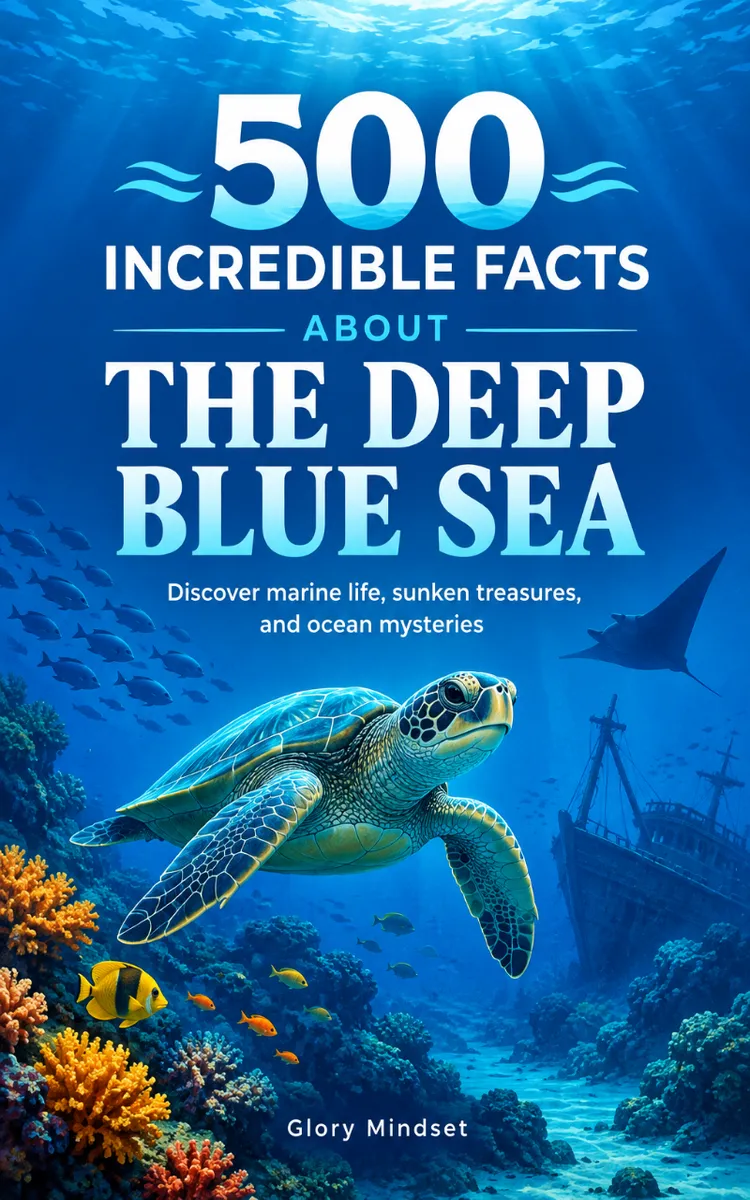
"500 Incredible Facts About The Deep Blue Sea" is a list book by Glory Mindset with 10 chapters and approximately 43,419 words. Facts about marine life, sunken treasures, and underwater ocean mysteries.
This book was created using Inkfluence AI, an AI-powered book generation platform that helps authors write, design, and publish complete books.
Frequently Asked Questions
What is "500 Incredible Facts About The Deep Blue Sea" about?
Facts about marine life, sunken treasures, and underwater ocean mysteries
How many chapters are in "500 Incredible Facts About The Deep Blue Sea"?
The book contains 10 chapters and approximately 43,419 words. Topics covered include The Ocean’s Blue Beginnings, Life in the Sunlit Reef, Giants, Hunters, and Ocean Travelers, Strange Creatures of the Deep, and more.
Who wrote "500 Incredible Facts About The Deep Blue Sea"?
This book was written by Glory Mindset and created using Inkfluence AI, an AI book generation platform that helps authors write, design, and publish books.
Write your own list book with AI
Describe your idea and Inkfluence writes the whole thing. Free to start.
Start writingCreated with Inkfluence AI


