

Read the first chapter
The whole of chapter one, free. About 8 min. Turn the pages with the arrows, your keyboard, or a swipe.
Chapter 1
Why the Tablet Holds Their Attention
The Screen That Answers Back
A child watching a cartoon may sit still for twenty minutes, yet a tablet game can hold the same child through hundreds of tiny decisions: tap, drag, choose, miss, try again. The difference is not simply that one screen is brighter or more entertaining. It is that the tablet responds.
That response changes the experience from viewing to participation. A child is not only receiving images and sounds but testing possibilities inside a small, immediate world. The device offers information, feedback, novelty, and control in a sequence that can feel almost perfectly fitted to the next moment of attention.
The attraction matters because children growing up connected encounter interactive media early and often. But attraction is not the same as addiction, and long attention is not automatically harmful or useful. Research can describe patterns across groups; it cannot predict precisely why one child becomes absorbed in a puzzle while another abandons it, or why the same child may focus intensely on a digital drawing but struggle with a worksheet.
The central question is therefore narrower and more revealing than “How much screen time is too much?” It is this: What is the screen doing that makes attention feel worth giving?
From Television’s Window to the Tablet’s Door
Television introduced children to moving images without requiring much physical participation. Its basic relationship was one-way: the program continued whether the viewer watched closely, looked away, or left the room. Children could become absorbed, but the medium did not need their decisions to keep moving.
Digital media changed that arrangement. Early computer games asked children to direct characters, solve problems, and respond to rules. Later devices combined the visual language of television with the responsiveness of a toy, the search capacity of a library, and the social reach of a communication tool. The tablet placed these functions behind one smooth surface. A finger could open a story, alter a picture, launch a game, or summon an answer.
That history helps explain why interactive media can feel unusually compelling. The child is not waiting for the next scene; the child is helping produce it. Even a simple matching game creates a loop: the device presents a task, the child acts, and the system responds. When the response is immediate and understandable, the child receives a clear signal that attention has had an effect.
This loop resembles ordinary play. Blocks fall, wheels turn, dolls answer in imagined conversations, and board games change according to a player’s move. Digital media compresses these relations into milliseconds and can repeat them without the practical limits of physical materials. A tablet does not run out of puzzle pieces, grow bored of repeating a song, or need a second player to continue.
One surprising feature of the medium is how little it needs to offer at any one moment. A sound, animation, colour change, or new choice may be enough to renew interest. The attraction often lies not in a grand story but in the steady arrival of small consequences.
The Attention Window Map
Attention is often discussed as though it were a single supply that screens either consume or preserve. Children’s actual experiences are more varied. They may sustain attention while searching for information, shift rapidly between game elements, return repeatedly to a familiar video, or concentrate on creating something that matters to them. These are different forms of attention, even when they occur on the same device.
The Attention Window Map provides a way to see those differences without treating every pause, glance, or change of activity as a failure. Its central idea is that attention has a shape. A child may enter an activity quickly because the first challenge is clear. Attention may widen when the child is given choices, narrow when a task becomes difficult, or close when the goal feels pointless. The duration matters, but so do the conditions around it.
Consider a child using an educational drawing application. The child may spend several minutes selecting colours, abandon the picture when a tool behaves unexpectedly, and then return after discovering a new brush. From a distance, this can look like restless switching. Viewed more closely, it may be exploration followed by problem-solving. A different child might remain on the same screen while copying a picture carefully, showing a longer and quieter window of concentration.
Research on attention can identify broad relationships between media use and outcomes, but it has limits. A study may compare groups of children, ask families to report habits, or examine performance on a particular task. Such evidence can reveal patterns, yet it cannot capture every difference in content, context, temperament, sleep, family routine, or purpose. “Screen use” is not one activity. Watching a slow nature program, sending messages, playing a fast-paced game, and creating music place different demands on the mind.
The same caution applies to claims that interactive media either strengthens or damages attention in general. A game may train persistence within its own rules without automatically improving concentration during reading. A child may learn to track several changing objects on a screen while finding it difficult to follow a long verbal explanation. Skills can transfer, but transfer is not guaranteed merely because two activities both require focus.
The map becomes clearer when adults notice what surrounds the attention: the child’s goal, the pace of feedback, the level of challenge, and the point at which interest changes. These observations do not produce a neat score. They reveal a pattern.
The Counterintuitive Pull of Difficulty
The most counterintuitive feature of many digital experiences is that children are not always drawn to ease. A task that is too simple can lose its grip; a task that is difficult but understandable can hold attention longer because it creates a problem worth solving.
This matters because the tablet’s appeal is often blamed on instant gratification. Immediate feedback is certainly important, but feedback alone does not explain sustained engagement. Children also respond to uncertainty, mastery, and the feeling that the next attempt might succeed. A well-designed challenge makes failure informative rather than final: the child sees what happened and can try a slightly different response.
Physical play has always contained this pattern. A child learning to balance on a bicycle does not repeat the identical movement forever. Each attempt supplies information about speed, posture, and control. Digital games can make the same process more visible, delivering a response after every move and adjusting the difficulty with unusual precision.
That precision is also part of the concern. A digital system can keep presenting a new challenge at the moment interest begins to fade. It may offer rewards, sounds, or progress markers that encourage continuation. The child’s attention is not merely being invited; it is being managed by a sequence designed to reduce stopping points.
Yet design does not determine experience completely. One child may be absorbed by collecting virtual objects, while another cares only about building a world. One may feel encouraged by a countdown; another may find it stressful. Individual differences are not a minor complication added after the main explanation. They are part of the explanation.
Temperament, prior knowledge, language, motor skills, and emotional state all alter the attention window. A child who has spent the morning moving between lessons may seek the predictability of a familiar video. Another may need movement before any screen activity becomes tolerable. A child who seems unable to focus on a digital story may be following its images closely but lacking the language to explain what was understood.
A Classroom with Many Kinds of Focus
The question becomes concrete in classrooms where children use the same device for different purposes. In one primary classroom, a teacher may see one group recording spoken explanations, another researching images, and another working through an interactive mathematics task. The room is quiet in places and restless in others, but noise and movement do not provide a reliable measure of concentration.
A child recording an explanation may pause repeatedly, delete words, and begin again. The visible activity looks interrupted, yet the child may be planning language, listening critically, and revising. Nearby, a classmate may complete a game level quickly but struggle to describe the strategy used. Both children have been engaged, though their attention has taken different forms.
Teachers often notice these distinctions because classroom attention has consequences beyond the screen. The important question is not simply whether children remain seated or keep their eyes on a display. It is whether they understand the task, can explain their choices, tolerate difficulty, and reconnect with other forms of learning when the device is removed.
A tablet can make a child’s thinking unusually visible. It records choices, displays revisions, and sometimes shows where errors occurred. It can also conceal thought behind rapid movement. Tapping quickly may signal confidence, guessing, excitement, or an attempt to escape a confusing task. The same behaviour can carry different meanings in different children.
This is why broad conclusions about “children today” can mislead. Generation Alpha shares early exposure to digital devices and visual, interactive media, but shared access does not produce identical habits. A child’s digital childhood is shaped by the device’s design and by the surrounding environment: family technology habits, opportunities for movement and play, sleep, relationships, and the expectations of adults.
The tablet is therefore less like a single influence than a room with many doors. One door opens onto entertainment, another onto communication, another onto information, and another onto creation. Attention changes according to which door the child enters and what is waiting on the other side.
What the Screen Reveals About Us
Interactive media attracts children because it gives attention an immediate consequence. A gesture changes something; a question receives an answer; a failed attempt leaves information behind. These features are technological, but the underlying desires are older: curiosity, control, competence, surprise, and the pleasure of making something happen.
The deeper puzzle is that a child’s attention is not a fixed possession that screens simply capture. It is a relationship between a person, an activity, and a moment. The tablet makes that relationship unusually easy to observe because every touch produces a visible trace, yet much of the most important activity remains hidden in the child’s interpretation of what the response means.
Screens do not reveal a single new kind of childhood. They reveal, in accelerated form, how human attention has always followed meaningful feedback. The mystery is not why children look back at the glowing surface, but what they are discovering there - and what kind of attention the next response will ask them to give.
End of chapter one. 7 more chapters and about 13,581 words in the full book.
Swipe or use the arrows to turn the page

The Next Generations

Why Generations Misunderstand Each Other

Generation Beta: Childhood Beyond The Smartphone
What's inside: 8 chapters
- 1. Why the Tablet Holds Their Attention
- 2. Learning by Tapping, Watching, and Making
- 3. Screens, Sleep, and the Daily Rhythm
- 4. Teaching Children to Stay Safe Online
- 5. Friendship Beyond the Group Chat
- 6. Creativity in a World of Templates
- 7. Growing Up Through Disrupted School Years
- 8. Raising Humans, Not Screen Habits
About this book
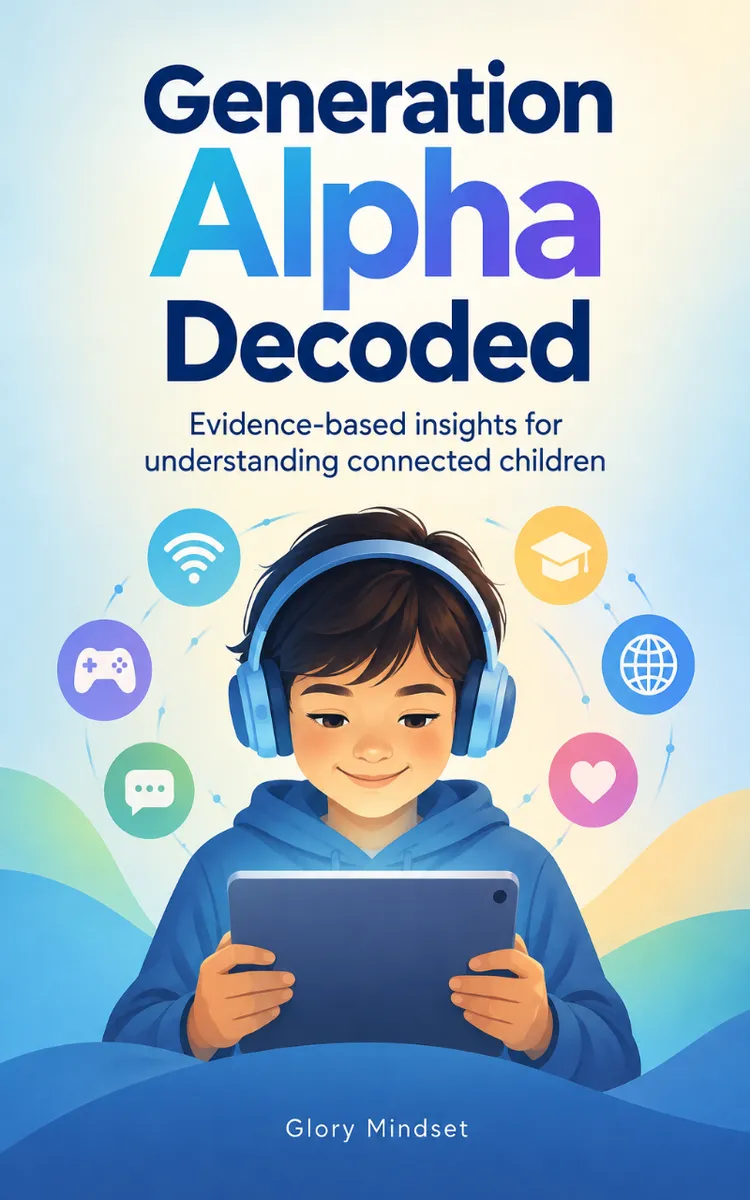
"Generation Alpha Decoded" is a curiosity book by Glory Mindset with 8 chapters and approximately 13,581 words. Generation Alpha’s digital childhood, learning, relationships, and screen habits.
This book was created using Inkfluence AI, an AI-powered book generation platform that helps authors write, design, and publish complete books.
Frequently Asked Questions
What is "Generation Alpha Decoded" about?
Generation Alpha’s digital childhood, learning, relationships, and screen habits
How many chapters are in "Generation Alpha Decoded"?
The book contains 8 chapters and approximately 13,581 words. Topics covered include Why the Tablet Holds Their Attention, Learning by Tapping, Watching, and Making, Screens, Sleep, and the Daily Rhythm, Teaching Children to Stay Safe Online, and more.
Who wrote "Generation Alpha Decoded"?
This book was written by Glory Mindset and created using Inkfluence AI, an AI book generation platform that helps authors write, design, and publish books.
Write your own curiosity book with AI
Describe your idea and Inkfluence writes the whole thing. Free to start.
Start writingCreated with Inkfluence AI


