

Read the first chapter
The whole of chapter one, free. About 8 min. Turn the pages with the arrows, your keyboard, or a swipe.
Chapter 1
A Childhood Without a Phone
The Child Who Speaks Before Swiping
A child can now ask a machine to play a song, dim a lamp, answer a question, or call a parent without ever holding a phone. The first digital interface many children encounter may not be a screen at all, but a voice floating from a speaker in the kitchen.
That changes the shape of early technology use. The familiar story begins with a child receiving a smartphone, yet connected devices can enter family life years earlier: a voice assistant answering from a counter, a television displaying photographs, a night-light responding to movement, or a toy sending information through a wireless connection. These objects do not always look like computers. Their quiet presence makes digital interaction part of ordinary childhood routines before children understand it as “technology.”
The Ambient Childhood Map follows that less visible path: from spoken commands and background screens to toys that listen, respond, and connect. It asks where childhood ends and the digital environment begins when the device is built into the room rather than carried in a pocket.
If a child never owns a phone, can childhood still become deeply digital?
From the Computer on the Desk to the Computer in the Room
For much of the personal-computer era, digital activity had a recognizable location. A child sat at a desk, opened a laptop, or approached a television and game console. The boundary was physical and visible. Someone could see when the computer was being used because the child was facing it.
Voice assistants loosened that boundary. Amazon introduced Echo, with its Alexa voice assistant, in 2014; Google Home followed in 2016. These products placed microphones in ordinary household spaces and made conversation a method of control. A person did not need to locate a keyboard or learn a menu. A spoken request could produce music, a timer, weather information, or an answer.
For young children, this matters because speech is available before reading. A preschooler may not be able to type a search phrase, but can ask a question in the same language used with parents. The machine’s reply arrives with little visible effort. Digital interaction becomes less like operating a tool and more like addressing a household presence.
That presence is not human, although its design often borrows human cues. Voice assistants use names, turn-taking, polite phrases, and familiar voices. They can appear patient because they repeat an answer without showing irritation. For a child, the difference between a person and a responsive system may not be obvious at first. A machine that answers every question can seem less like an appliance than a new category of companion.
The change is also architectural. A phone is usually associated with one owner, one hand, and one screen. A smart speaker belongs to a room. Parents, visitors, older siblings, and children may all speak to it, sometimes without knowing exactly what it records, stores, or sends for processing. The device is shared, but its consequences are not necessarily shared equally.
When Screens Become Part of the Background
Screens have also moved away from the desk and the television set. A smart display can sit beside a kitchen sink, show a recipe, display family photographs, play music videos, or provide a visual answer to a spoken question. Connected televisions can recommend programs and remember viewing patterns. Doorbells, thermostats, baby monitors, and household dashboards may contain small screens or connect to larger ones.
This is a different kind of screen exposure from settling down for a cartoon. An ambient screen may be glanced at rather than watched continuously. It can appear during breakfast, while a parent cooks, or as a clock in a bedroom. Its role is often practical, but its content can shift quickly from information to entertainment, from a family photograph to an advertisement, from a timer to an autoplaying video.
The distinction between “using a screen” and “being around screens” becomes difficult to maintain. A child may not be holding a device, yet may still be surrounded by digital prompts, notifications, animated images, and algorithmic suggestions. The room itself begins to offer responses.
A connected home also changes the rhythm of family attention. A speaker interrupts with a reminder. A television wakes to display a recommendation. A toy announces that its battery is low. These are small events, but they teach children that objects can call for attention without a person first choosing to speak. The household becomes a place where information arrives on its own schedule.
One surprising feature of ambient screens is that they can feel less intrusive precisely because they are small or familiar. A large television announces itself. A display built into a refrigerator or lamp can fade into the background. Yet background devices may observe more of daily life because they remain present across many ordinary moments.
Toys That Listen, Respond, and Connect
The history of connected toys began before today’s voice assistants became common. In the late 1990s, Furby became famous for appearing to learn words and respond to interaction. It did not connect to the internet, but it helped establish the idea that a toy could behave as though it had a developing relationship with its owner.
Later products combined sensors, wireless connections, microphones, cameras, and software. Hello Barbie, released by Mattel in 2015, used speech recognition and an internet connection to respond to children’s questions. Other toys have connected to mobile applications, allowing children to unlock features, record play, or receive changing content. A stuffed animal, doll, or robot could now be updated after it left the shop.
The physical form remains important. A child may hug a toy, carry it to bed, or place it beside other treasured objects. The digital system behind it may be remote, operated through company servers and software updates. The toy’s body is in the child’s room; parts of its memory and decision-making may be elsewhere.
That arrangement creates a new kind of intimacy. Traditional toys can be watched, listened to, and repaired by families. Connected toys may also collect voice recordings, usage information, account details, or identifiers linked to a household. The question is not only what the toy does for the child, but what the toy learns about the child while appearing to play.
A connected toy can also alter the meaning of repetition. Children often ask the same question, tell the same story, or repeat the same game because repetition is part of learning and pleasure. Software may treat those exchanges as data, a service improvement, or an opportunity to offer another feature. What feels like play from one side can be measurement from the other.
The Ambient Childhood Map
The Ambient Childhood Map is a way to trace digital contact by location and function rather than by ownership. It begins with the room: what devices are listening, displaying, sensing, or responding there? It then follows the routine: when does a child encounter them, and what kind of interaction do they invite? Finally, it follows the connection: where does the information go, and who controls the system that receives it?
This map reveals why the smartphone is a misleading starting point. A child may be years away from owning a personal phone while already living among networked objects. The first digital habits may involve asking a speaker for a song, watching a display during breakfast, or expecting a toy to remember a name.
The map also shows that dependence does not begin only when a child spends hours scrolling. It can begin with a smaller expectation: that every question should receive an immediate answer, every room should respond, and every object should perform a task on request. These expectations are not necessarily harmful, but they shape what children come to regard as normal.
A brief comparison helps clarify the shift. A book waits until someone opens it. A connected device may wait for a voice, a movement, a schedule, or a remote instruction. The difference is not simply that one object is digital. It is that the digital object can participate in the timing of family life.
The Strange Result: Less Screen Ownership, More Digital Presence
The counterintuitive finding is this: a child can have less personal screen ownership while experiencing more digital mediation in daily life. Removing a smartphone does not remove the network; it may simply move the network into speakers, toys, televisions, cars, and household systems.
This matters because attention is only one part of the question. Privacy, trust, independence, and expectations about machines are shaped by repeated contact, including contact that feels brief or harmless. A child who rarely holds a screen may still learn that rooms listen, toys answer, and services remember.
The reframing changes the central question from “How much screen time does this child have?” to “How many parts of this child’s life are being interpreted or managed by connected systems?” Time remains relevant, but it is no longer the whole picture. The digital childhood may be quiet, distributed, and woven into routines that families do not describe as screen use.
A Doll, a Cloud, and a Household’s Trust
The Hello Barbie controversy made this distributed digital life unusually visible. The doll, introduced in 2015, used a microphone and internet connection to hold conversations with children. Its design reflected a powerful idea: a traditional play object could become more responsive when connected to remote software.
Privacy advocates and security researchers questioned how recordings were handled and whether a toy in a child’s bedroom should transmit conversations beyond the home. The concerns were not limited to the doll’s words or appearance. They centered on the invisible path between the child’s voice, the toy’s microphone, the internet connection, and the company’s systems.
The episode also exposed a mismatch between physical appearance and technical function. A doll looks like a toy, and children approach it through play. Yet a connected doll can resemble a voice assistant concealed inside a familiar object. The child experiences a conversation; the household must also contend with data practices, account settings, updates, and security.
That tension remains relevant as connected devices become ordinary. The most influential digital object in a child’s life may not look advanced. It may be a speaker beside the family calendar, a display on a kitchen counter, or a toy carried from room to room. Its power comes from being accepted as part of home life.
The Room That Answers Back
Human beings have always taught children that objects have roles: a bed is for sleeping, a table is for eating, and a toy is for play. Connected technology complicates those categories because one object can also listen, record, calculate, recommend, and respond. The child learns not only what an object is, but what kind of relationship the object offers.
That relationship may begin before a child can name it. Childhood can become digital without a first phone, a first account, or a deliberate decision to enter an online world. Sometimes the network arrives as a voice from the kitchen, waiting for a question. Sometimes it glows quietly in the corner, already part of the room.
End of chapter one. 7 more chapters and about 13,180 words in the full book.
Swipe or use the arrows to turn the page


What's inside: 8 chapters
- 1. A Childhood Without a Phone
- 2. When a Tutor Knows the Next Question
- 3. The Home That Watches Back
- 4. Who Owns a Child’s Digital Shadow?
- 5. Can a Robot Comfort a Child?
- 6. Health Data Before the First Symptom
- 7. Raising Children Who Can Disconnect
- 8. The Future Will Not Be One Future
About this book
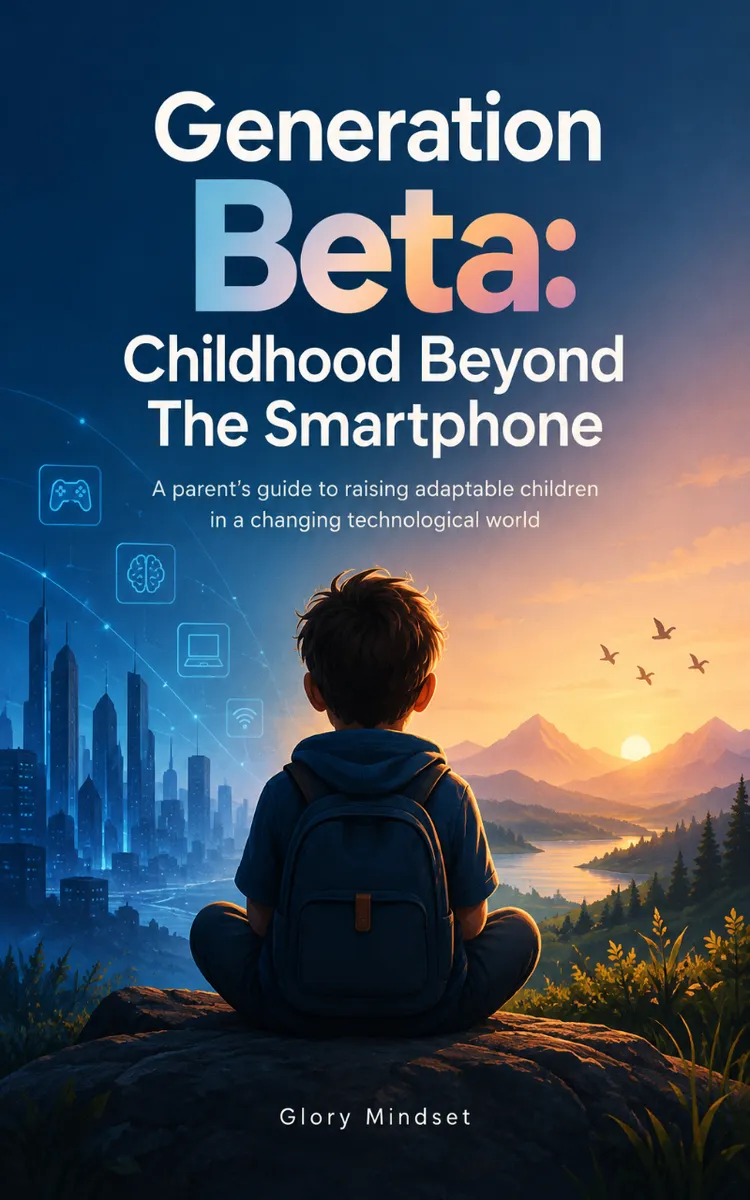
"Generation Beta: Childhood Beyond The Smartphone" is a curiosity book by Glory Mindset with 8 chapters and approximately 13,180 words. Emerging technologies and possible childhood experiences of Generation Beta.
This book was created using Inkfluence AI, an AI-powered book generation platform that helps authors write, design, and publish complete books.
Frequently Asked Questions
What is "Generation Beta: Childhood Beyond The Smartphone" about?
Emerging technologies and possible childhood experiences of Generation Beta
How many chapters are in "Generation Beta: Childhood Beyond The Smartphone"?
The book contains 8 chapters and approximately 13,180 words. Topics covered include A Childhood Without a Phone, When a Tutor Knows the Next Question, The Home That Watches Back, Who Owns a Child’s Digital Shadow?, and more.
Who wrote "Generation Beta: Childhood Beyond The Smartphone"?
This book was written by Glory Mindset and created using Inkfluence AI, an AI book generation platform that helps authors write, design, and publish books.
Write your own curiosity book with AI
Describe your idea and Inkfluence writes the whole thing. Free to start.
Start writingCreated with Inkfluence AI


