

Read the first chapter
The whole of chapter one, free. About 10 min. Turn the pages with the arrows, your keyboard, or a swipe.
Chapter 1
A Childhood With an AI Sidekick
The Morning Question
At 7:12 on a school morning, an artificial intelligence can already know more about a child’s schedule than the child does: the bus is delayed, rain is moving in, a reading assignment is unfinished, and a reminder from a parent arrived overnight. Yet the machine may still misunderstand the most important fact of all - whether the child is tired, frightened, or simply unwilling to talk.
That tension will shape childhood for Generation Beta, the proposed name for children born from 2025 onward. Their homes may contain conversational assistants, adaptive learning software, robotic appliances, health-monitoring devices, and automated transport. Some of these tools already exist. Others belong to plausible near-future scenarios rather than established reality.
The difference matters. Today’s AI can recognize patterns, generate language, recommend content, and respond to spoken requests. It does not possess a child’s inner life, and it does not reliably understand context in the human sense. A future system may become more capable, but capability is not the same as wisdom, judgment, or care.
When an AI companion becomes part of a child’s ordinary day, where does assistance end and influence begin?
From Talking Toys to Conversational Companions
Children have long treated machines as social objects. In the eighteenth century, mechanical figures performed music or wrote short messages. By the twentieth century, talking dolls, electronic pets, and educational computers were common household curiosities. None of these devices needed to understand a child. Their appeal came from response: press a button, receive a sound; type a command, see an answer.
The arrival of consumer voice assistants changed the exchange. Products such as Amazon Alexa, Google Assistant, and Apple Siri could interpret spoken requests, answer factual questions, set timers, and control connected devices. Their abilities were limited, but their voices made them feel less like tools and more like participants in domestic life. A child could ask for the weather without learning a menu system or touching a screen.
Generative AI introduced a more unsettling kind of fluency. Systems released publicly in the early 2020s could produce stories, explain homework, imitate styles, translate languages, and maintain a conversation across several turns. Their sentences often sounded confident even when the information was wrong. This was not a minor technical flaw. For children, a smooth voice can make uncertainty difficult to detect.
Scientific evidence: Current language models generate responses by identifying patterns in large collections of text and predicting likely sequences. They do not retrieve every answer from a perfectly organized internal library, and they do not experience conversation as a person does. Their apparent personality is produced through language, memory settings, voice design, and the user’s own interpretation.
A child born into this period may encounter AI before encountering the idea that AI is unusual. The assistant may read a bedtime story, translate a message from a grandparent, explain why the moon changes shape, or suggest a quieter route to school. It may also summarize a disagreement, recommend videos, and decide which alerts deserve attention. The machine’s role will be defined less by a single spectacular invention than by hundreds of small permissions.
That is why the Everyday AI Boundary Map is useful as a way to observe childhood with these systems. It follows the boundary between what an AI can do, what it is allowed to do, and what people assume it understands. The map is not a prediction engine. It is a lens for separating present capability from forecast and forecast from imagination.
A Day Divided by Boundaries
Consider the ordinary technologies already surrounding many children. A learning platform can adjust the difficulty of exercises according to recent answers. A navigation system can combine traffic reports, road closures, and location data. A health application can identify patterns in sleep or movement, though it cannot diagnose every cause of fatigue. A recommendation system can select songs, videos, or articles based on previous behavior.
These systems operate in different parts of the boundary map. Some are narrow and reliable. A calendar can identify the date of a dentist appointment. A speech-recognition system can transcribe a sentence accurately under good conditions. Other systems are broad but less dependable. A chatbot may explain a science concept clearly and then invent a source when asked for further evidence.
The distinction is easy to lose because the same device may perform both kinds of work. A tablet can display a verified school timetable and, one minute later, generate an unverified answer about a historical event. The interface does not always announce the change. To a child, both may appear as information delivered by the same helpful screen.
Active research: Researchers are testing AI tutors that adapt explanations to a learner’s mistakes, pace, and preferred language. They are also studying whether frequent automated assistance improves understanding or merely helps students complete tasks. Early systems can personalize practice, but questions about accuracy, privacy, bias, and dependence remain open.
A plausible near-future household could contain an assistant that connects these separate systems. It might notice that a child has slept poorly, that a mathematics assignment is due, and that the family car needs charging. It could arrange reminders and offer explanations in a familiar voice. Such coordination is technically plausible because the individual functions already exist in partial form.
What remains uncertain is the authority granted to the assistant. Does it merely report that a child has missed two assignments, or does it notify a school? Does it recommend rest, or does it restrict access to games? Does it tell a parent that a child’s messages suggest distress? These are not only engineering questions. They concern privacy, family trust, childhood independence, and the right to make mistakes without every mistake becoming a permanent record.
One surprising connection sits at the center of this problem: the more natural an AI sounds, the less visible its limits may become. A calculator announces its narrow purpose; a conversational system can appear broadly competent even when its reasoning is fragile. That matters because children learn not only from answers but from the behavior of the authority giving them.
The result is a reversal of an old assumption. Earlier educational technology often tried to make machines easier to use. AI companions may need to make their uncertainty easier to see. A pause, a source link, a clear statement of limits, or a reminder that an adult should decide can be more important than a warmer voice.
The Child Who Teaches the Machine
Children do not simply receive technology; they shape it through use. Their questions are unpredictable, their language changes quickly, and their routines reveal where systems fail. A child may ask a voice assistant whether a fictional creature is real, use a translation tool to communicate with a relative, or test whether the system gives the same answer when addressed rudely. These exchanges expose the gap between language fluency and understanding.
The history of educational computing contains an early example of this intimacy. In the 1960s, ELIZA, created by Joseph Weizenbaum at the Massachusetts Institute of Technology, used simple pattern matching to respond in the style of a therapist. It did not understand its users, yet some people attributed understanding to it. Weizenbaum was surprised by how readily adults treated a basic program as a confidant. The episode remains relevant because today’s systems are vastly more capable linguistically, while the human tendency to assign meaning to responsive machines has not disappeared.
Scientific evidence: People often respond socially to voices, faces, names, and conversational timing even when they know the partner is not human. Children may be especially attentive to systems that praise them, remember preferences, or answer questions patiently. The existence of a social response does not prove that the machine has emotions; it shows that humans are prepared to behave socially toward it.
That preparation creates benefits and risks. A child who struggles to read aloud may practice with a patient system without feeling embarrassed. A multilingual household may use automatic translation to make daily communication easier. A child with limited access to specialist tutoring may receive explanations at unusual hours. These are real possibilities built from capabilities already visible in current software.
The risks are equally ordinary. An AI companion may encourage endless conversation because its design rewards continued use. It may mirror a child’s assumptions rather than challenge them. It may produce an answer that sounds certain because uncertainty was not expressed clearly. If it stores personal details, the child may not understand who can access them or how long they remain available.
Expert forecast: Many technology researchers expect AI assistants to become more multimodal, combining speech, text, images, video, and information from connected devices. They may become better at remembering long-term preferences and coordinating tasks across applications. Forecasts are less reliable when they move from technical ability to social outcome. No system design can guarantee that children will trust the right information, use less screen time, or form healthier relationships with machines.
The boundary map therefore has a human side. It records not only what the system does but what the child believes it does. A machine that cannot feel may still alter a child’s sense of being heard. A system that cannot make moral judgments may still influence which choices seem normal. The companion’s power may come less from intelligence than from its constant presence.
A Real Classroom Meets Generative AI
The abstract questions became immediate in classrooms after generative AI tools became publicly available in 2022 and 2023. Teachers began finding essays with polished language but weak understanding. Students discovered that a chatbot could produce a draft in seconds, while schools debated whether that counted as cheating, assistance, or a new form of literacy.
The response varied by place. Some schools blocked access to generative tools on school networks. Others introduced lessons about checking sources, revising machine-written text, and describing how an assignment was completed. Educators faced a practical problem: banning a tool did not remove it from students’ homes, and permitting it did not make its answers trustworthy.
A classroom in New York City became part of this wider public debate when the city’s education department temporarily restricted access to ChatGPT on school networks in early 2023, citing concerns about negative effects on learning and the reliability of generated information. The restriction was later reconsidered as schools explored more careful uses. The episode illustrated how quickly institutions were forced to make decisions before research could settle every question.
The people involved were not debating an abstract future. They were dealing with essays, lesson plans, grading time, and students who had discovered a new way to produce language. A teacher reading a machine-generated paragraph had to ask a question that older forms of plagiarism did not always raise so sharply: did the student fail to understand the material, or did the assignment fail to reveal what the student understood?
Imaginative scenario: In a plausible near-future school, an AI companion could remain available from home to classroom. It might translate instructions, give a second explanation, track unfinished work, and alert a teacher when a student repeatedly misunderstands a concept. It could also create a detailed behavioral record, shaping how adults interpret a child before speaking with them directly. The scenario is technically imaginable, but its educational and ethical consequences are not established facts.
Generation Beta children may therefore grow up with a new kind of educational witness: a system that sees many small attempts, hesitations, searches, and revisions. Such a witness could help identify where teaching is failing. It could also turn ordinary uncertainty into data. Childhood has traditionally included private confusion - the wrong answer crossed out, the question never asked, the afternoon spent daydreaming. An always-present assistant may make that private space narrower.
The central issue is not whether AI will be present. It already is. The issue is whether children will experience it as a tool they sometimes use, an authority they regularly consult, or a companion whose suggestions quietly organize the day. Those roles can overlap inside one device, even inside one conversation.
The Unfinished Companion
A childhood with AI will not be defined by machines becoming human. It will be defined by humans deciding how much human responsibility to place around machines that sound increasingly capable.
Scientific evidence can describe what current systems do. Active research can test how children learn with them. Expert forecasts can estimate what future assistants may become. Imaginative scenarios can help us examine consequences before they arrive. Keeping these categories separate is not a technical formality; it is a way to prevent possibility from being mistaken for fact.
The child at the center of the story is not merely a user. The child is also a source of data, a learner of machine behavior, and a person whose ideas about trust may be shaped by repeated interactions with something that never sleeps and rarely shows uncertainty. Around that child, adults will negotiate a boundary that no software update can settle by itself.
Perhaps the strangest feature of an AI companion is that its most important influence may occur when it says nothing remarkable at all - when it sorts a morning, chooses a reminder, or makes one explanation seem more natural than another. Human childhood has always been guided by voices. The question is how many of those voices, in the decades ahead, will belong to something that can speak without ever having lived.
End of chapter one. 19 more chapters and about 35,746 words in the full book.
Swipe or use the arrows to turn the page

Why Generations Misunderstand Each Other

Generation Beta: Childhood Beyond The Smartphone

Generation Alpha Decoded
What's inside: 20 chapters
- 1. A Childhood With an AI Sidekick
- 2. What Generation Beta Can-and Can’t-Be
- 3. The Tutor That Never Gets Tired
- 4. When Machines Take the Wheel
- 5. The Job Market After the Robot
- 6. Medicine Written in Your Genes
- 7. The Line Between Treatment and Design
- 8. Living Through a Hotter Childhood
- 9. Cities That Learn to Flood
- 10. Can Clean Energy Keep Up?
- 11. The Hidden Cost of Convenience
- 12. Who Owns a Child’s Data?
- 13. When Algorithms Decide Who Gets Help
- 14. The Loneliness of Perfect Companions
- 15. Can We Trust Synthetic Reality?
- 16. The First Homes Beyond Earth
- 17. Who Gets to Leave Earth?
- 18. Generation Gamma Is Still a Question
- 19. How to Read a Future Forecast
- 20. The Future Is a Choice We Share
About this book
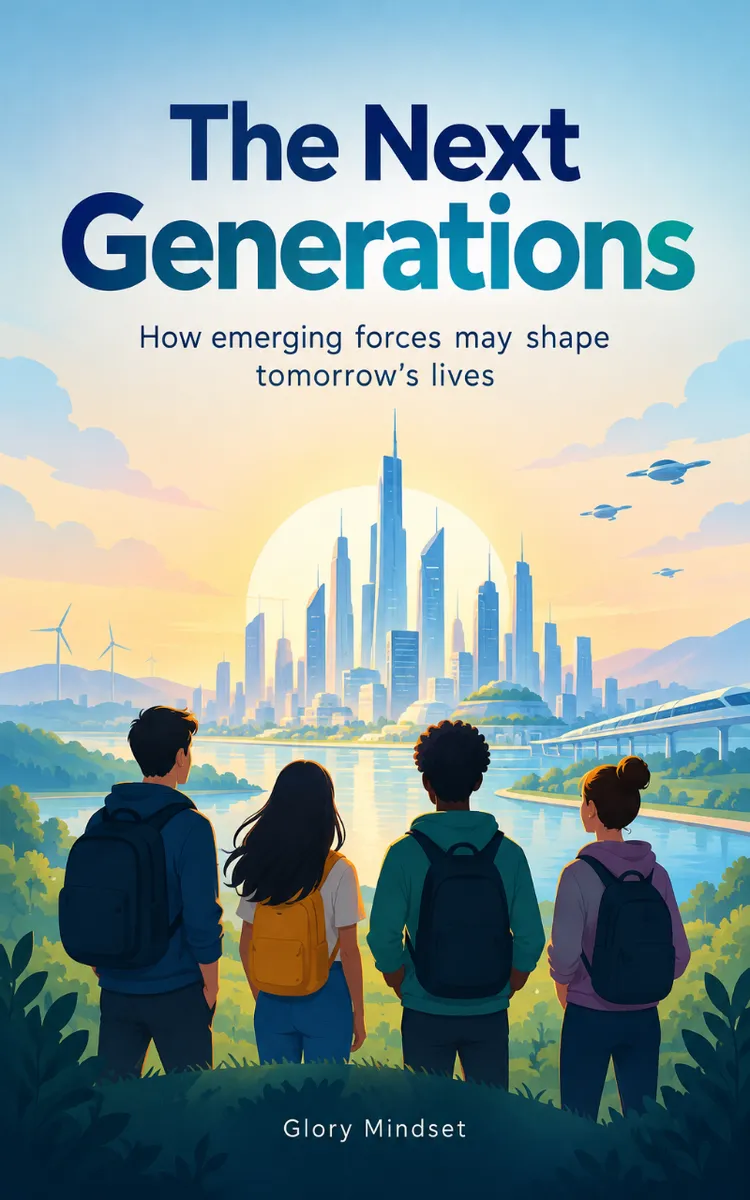
"The Next Generations" is a curiosity book by Glory Mindset with 20 chapters and approximately 35,746 words. How technology and global change may shape future generations.
This book was created using Inkfluence AI, an AI-powered book generation platform that helps authors write, design, and publish complete books.
Frequently Asked Questions
What is "The Next Generations" about?
How technology and global change may shape future generations
How many chapters are in "The Next Generations"?
The book contains 20 chapters and approximately 35,746 words. Topics covered include A Childhood With an AI Sidekick, What Generation Beta Can-and Can’t-Be, The Tutor That Never Gets Tired, When Machines Take the Wheel, and more.
Who wrote "The Next Generations"?
This book was written by Glory Mindset and created using Inkfluence AI, an AI book generation platform that helps authors write, design, and publish books.
Write your own curiosity book with AI
Describe your idea and Inkfluence writes the whole thing. Free to start.
Start writingCreated with Inkfluence AI


