

Read the first chapter
The whole of chapter one, free. About 10 min. Turn the pages with the arrows, your keyboard, or a swipe.
Chapter 1
The Castle's Unmarked Door
The delivery wagon stopped beneath the unfinished hotel’s raw brick face, and Emery Ward smelled lime mortar, wet timber, and the bitter medicinal powder sealed inside his case.
He had been told the building was an ordinary construction site. The upper floors were still open to the weather; boards crossed the windows, and scaffolding creaked against the wall. Yet the place had already begun to resemble something less like a hotel than a structure assembled around a secret. Its windows did not align. Some doors opened onto darkness where rooms should have been. A narrow tower rose above the roofline, blind and unfinished.
Emery carried the case through the entrance, intending to deliver the medicine, collect his receipt, and be back at his pharmacy before nightfall. That was the whole errand. The hotel was growing quickly, and its proprietor had promised regular business. Nothing about the delivery seemed unusual until C.B. Howard appeared at the end of a corridor and smiled as though Emery had arrived at precisely the right moment.
The case concerns C.B. Howard’s murder castle in Chicago, where deception, concealed architecture, and murder converged during the late nineteenth century.
What makes the place significant is not that it was unfinished. Chicago was full of unfinished buildings, especially as the city expanded toward the World’s Columbian Exposition. The significance lay in the way Howard used ordinary commercial language to conceal extraordinary intentions. He called the structure a hotel. He presented himself as a businessman, a pharmacist, and a man attentive to the needs of others. Behind that reassuring surface, the building’s corridors, rooms, doors, and passages became instruments of control.
The historical record surrounding Howard contains disputed stories, inflated newspaper claims, and murders he confessed to only after his arrest. What is certain is that he deceived people for profit, that he was convicted of murder, and that the building associated with him became inseparable from the public image of America’s first known serial killer. In this account, Emery Ward’s delivery becomes the first moment when the architecture itself reveals what Howard’s manners conceal.
• Date: Late nineteenth century, during the construction of Howard’s Chicago hotel
• Location: Chicago, Illinois
• Victims: The full number remains disputed; Howard was convicted in the murder of Benjamin Pitezel
• Status: Solved in part; Howard was captured, tried, convicted, and executed, though many suspected murders remain unresolved
Emery Ward, Chicago pharmacist - Emery knew medicines by their weight, texture, and smell. He was accustomed to counting bottles beneath the bright, practical light of his shop, not carrying them through corridors that shifted around him. His purpose was commercial and simple: deliver the order and leave. The hotel changed that purpose before he understood it had done so.
C.B. Howard, proprietor and con artist - Howard cultivated trust as carefully as he planned deception. He could speak with apparent concern, ask after a person’s health, and make a business arrangement feel like a personal favor. His manner was not the theatrical menace of a villain announcing himself. It was quieter: patience, courtesy, and the confidence of a man who expected others to accept his directions.
The hotel workers - Their labor raised walls, fitted doors, and carried materials through a building whose design was not always clear even to those constructing it. Some rooms were altered after being framed. Some corridors led nowhere. The workers’ presence gave the property a legitimate appearance while the incomplete structure allowed Howard to change it beyond ordinary scrutiny.
Christina Vigo, lodger - Clara’s name appears in the unresolved thread that draws Emery back toward the hotel. Her disappearance is not treated as proof of murder by itself, but the interruption in the guest ledger gives the building a human absence that cannot be explained by warped floors or missing fixtures.
Investigators - Later investigators would have to separate fact from the sensational accounts printed after Howard’s arrest. Their work exposed fraud, concealment, and murder, but it could not restore every missing person whose name had passed through Howard’s orbit.
The morning of the delivery - Emery arrived at the hotel with the medicine packed in a wooden case. The street was noisy with wagons and hammering, but inside the entrance the sound changed. It narrowed into hollow knocks and the scrape of boards underfoot.
A few minutes later - Howard met him before Emery could find the office. He apologized for the confusion, explaining that the interior was still being arranged. His voice was mild, almost solicitous.
“Leave the case with me,” Howard said. “You should not be wandering through unfinished rooms.”
“I was told to obtain a receipt.”
“And you shall. Come this way.”
Howard took the case without strain and moved deeper into the building. Emery followed because the request sounded reasonable, and because Howard spoke as though concern - not control - had prompted it.
Shortly afterward - The corridor divided where no division appeared on the exterior wall. Howard turned left. Emery noticed that the passage narrowed, then widened again, with doors set at uneven intervals. One door had a brass knob but no visible hinges. Another opened onto a shallow recess containing only plaster dust.
“Is the office beyond here?” Emery asked.
“Temporarily,” Howard replied. “The workmen have made a nuisance of the layout. It will be corrected.”
Before noon - Howard led Emery through a room with no finished ceiling. Cold air moved through the beams overhead. The medicine case was placed on a table, but Howard did not produce a receipt. Instead, he asked whether Emery could supply more medicines as the hotel filled.
He spoke of guests who might need powders, tonics, and sleeping draughts. He spoke of discretion. He spoke of regular payment.
“You have a careful reputation,” Howard said. “That is why I prefer dealing with you.”
The compliment settled over Emery like a hand laid gently on his shoulder. It was difficult to object to a man who appeared to be trusting him.
Near midday - Emery attempted to return by the route he had taken in. The door he remembered was closed. He tried the knob. It turned, but the door opened onto a blank wall of fresh boards.
He looked back at Howard.
“That is not the entrance.”
“No,” Howard said. “The workmen have altered the passage.”
“Then show me the way out.”
Howard’s expression did not change. “There is no reason to be alarmed.”
The reassurance made the corridor feel narrower.
Moments later - Howard opened a different door and revealed a passage so tight Emery had to turn his shoulders to enter. The air smelled of glue and damp plaster. Somewhere beyond the wall, a pipe struck at irregular intervals, each metallic knock seeming to come from a different direction.
Emery placed his palm against the boards. They were cold.
“How many passages are in this building?”
Howard smiled faintly. “A hotel must provide privacy.”
Early afternoon - They reached a stairwell that descended only one flight before ending at a locked door. Howard produced a key, but instead of opening it, he examined the lock as though checking the work of someone else.
“This is the private side,” he said. “You need not concern yourself with it.”
“Then why bring me here?”
Howard looked at him with practiced patience. “Because you were in a hurry. Haste makes people careless.”
The words sounded like advice. They also sounded like a warning.
[TURNING POINT] Later that afternoon - Emery found the guest ledger while Howard was called away by a worker. It lay open in a temporary office beneath a film of dust. Names and room numbers filled the pages. Near the bottom, an entry for Christina Vigo ended abruptly. There was no departure notation, no forwarding address, and no mark indicating that the room had been cleared.
Emery heard Howard returning and closed the ledger.
A short time later - Howard resumed his gentle manner and offered to walk Emery out. He did not ask what Emery had seen. That omission frightened Emery more than an accusation might have done.
At a junction, Howard pressed a panel in the wall. A section of wood shifted inward, revealing a hidden passage.
“You see?” Howard said. “The building is confusing only until one knows it.”
Emery stepped through because the open passage was the first clear route he had been given. Behind him, the panel moved back into place with a soft wooden click.
Before nightfall - The passage ended at a rear exit opening into an alley. Emery emerged into colder air, carrying no receipt and no certainty that he had been free to leave at any point. Howard followed him outside, still holding the medicine case.
“You will return tomorrow,” Howard said.
“I have no reason to.”
Howard handed back the case. “You have every reason. I have a growing hotel, and you have a business worth expanding.”
Emery looked toward the concealed entrance. Howard inserted a key and locked it.
The sound was small. It carried farther than the street noise.
Physical evidence:
• Medicine case: Emery’s delivery, carried through the hotel and retained by Howard until the exit. Its ordinary purpose contrasted with the extraordinary route Howard imposed on the delivery.
• Altered doors and false openings: Doors opened onto blank walls, recesses, or restricted areas, demonstrating that the interior could not be understood from the exterior.
• Locked passage: The private route was secured and controlled by Howard, making movement through the building dependent on his permission.
• Guest ledger: The entry for Christina Vigo stopped without a departure notation, creating a documented gap rather than proof, by itself, of what happened to her.
• Rear exit: The concealed passage led to an alley, confirming that the architecture provided a route unknown to an ordinary visitor.
Witness accounts:
• Emery’s account: Howard gave reassuring directions, led him through confusing corridors, and locked the concealed entrance after Emery emerged.
• Workers’ observations: The hotel’s construction involved changing interior arrangements and incomplete spaces, conditions that allowed unusual passages and doors to appear without immediate public explanation.
• Lodger records: The ledger preserved names and room assignments, including the interrupted entry associated with Christina Vigo.
Investigative leads:
• The building’s design - Later examination focused on concealed rooms, passages, and doors as evidence of deliberate control rather than accidental construction.
• Howard’s business dealings - Investigators followed his pattern of fraud, false identities, and financial schemes, which revealed deception operating alongside the hotel.
• Missing persons and lodgers - Names connected to Howard were compared against departures, payments, and known movements, though the surviving record could not resolve every disappearance.
• The murder of Benjamin Pitezel - This became the central prosecutable case that led to Howard’s conviction.
• Howard’s confessions - After capture, Howard offered accounts of multiple killings, but his statements varied and were treated cautiously because he was a proven liar seeking advantage.
What Changed: Emery entered the hotel believing he was making a routine delivery. He left having seen a passage that did not appear on any ordinary plan, a ledger entry that ended without explanation, and Howard locking the concealed entrance behind him. The building was no longer merely unfinished. Its confusion had function.
Why It Mattered: Until that moment, Howard’s reassurance had worked. He had converted delay into courtesy and disorientation into a problem caused by construction. The locked door broke that spell. Emery understood that Howard had not simply guided him through the hotel; he had controlled where Emery could go, what he could see, and when he could leave.
What Followed:
• Emery returned to his pharmacy shaken, carrying the memory of Christina Vigo’s unfinished entry.
• Howard’s offer of regular business remained open, binding commercial opportunity to unease.
• Emery now had a reason to return to the hotel, not as a supplier, but as a witness seeking an explanation.
Legal Outcome: The events surrounding the hotel would later be folded into the larger case against C.B. Howard. Howard was ultimately arrested after his frauds and the Pitezel murder brought sustained attention from investigators. He was tried, convicted of Benjamin Pitezel’s murder, sentenced to death, and executed by hanging in 1896. His later claims about additional victims helped create the enduring image of the murder castle, but the exact number of his victims remains uncertain.
Impact:
• The hotel became a lasting symbol of how commercial respectability could conceal predatory violence.
• Newspapers magnified Howard’s crimes, sometimes blending verified evidence with claims that could not be proved.
• The case left Chicago with a grim lesson about the danger of trusting appearances, especially when a man’s concern seemed more convincing than his records.
Unresolved Questions:
• What happened to every person whose name passed through Howard’s businesses and hotels?
• Which features of the building were intended for murder, and which were later exaggerated by newspapers?
• How many deaths could be attributed to Howard with evidence strong enough to withstand the distortions of his own confessions?
That evening, Emery placed the pharmacy key on the counter and listened to the bottles settling in their wooden racks. The sound should have been familiar. Instead, each small clink recalled the hidden passage and the lock turning behind him.
Outside, Chicago continued to build itself upward.
Somewhere within the unfinished hotel, Howard was still deciding which doors should open.
End of chapter one. 39 more chapters and about 95,007 words in the full book.
Swipe or use the arrows to turn the page


What's inside: 40 chapters
- 1. The Castle's Unmarked Door
- 2. The Pharmacist's Trust
- 3. The Missing Lodger, Clara Voss
- 4. The Corridor Behind Room 27
- 5. A Kindness with a Price
- 6. The Fire in the Supply Room
- 7. The Ledger's Altered Names
- 8. The Basement That Has No Plan
- 9. The Face of a Benefactor
- 10. The Vanishing of Benjamin Pitezel
- 11. The Insurance Policy Trail
- 12. The Hotel's False Fire Escape
- 13. The Cost of Speaking
- 14. The Inspector's Failed Visit
- 15. The Pitezel Family's Journey
- 16. The Locked Guest Chamber
- 17. The Pharmacist's False Confession
- 18. The Newspaper's Missing Proof
- 19. The Castle's Empty Rooms
- 20. The Pitezel Claim Unravels
- 21. The Witness Who Looked Away
- 22. The Search for the Pitezel Children
- 23. The Hotel's Hidden Blueprint
- 24. Returning to the Murder Castle
- 25. The Burden of the Castle
- 26. Howard's Arrest in Boston
- 27. The Alias Behind the Arrest
- 28. The Cellblock's Closed Doors
- 29. The Children Found in Toronto
- 30. Elias's Lowest Night
- 31. The Insurance Man's Testimony
- 32. The Transfer Through the Night
- 33. The Witness Who Stays
- 34. The Trial's Missing Link
- 35. Howard Takes the Stand
- 36. The Verdict Against Holmes
- 37. The Castle's Last Inspection
- 38. Howard's Final Confession
- 39. The Execution at Moyamensing
- 40. The Names the Castle Kept
About this book
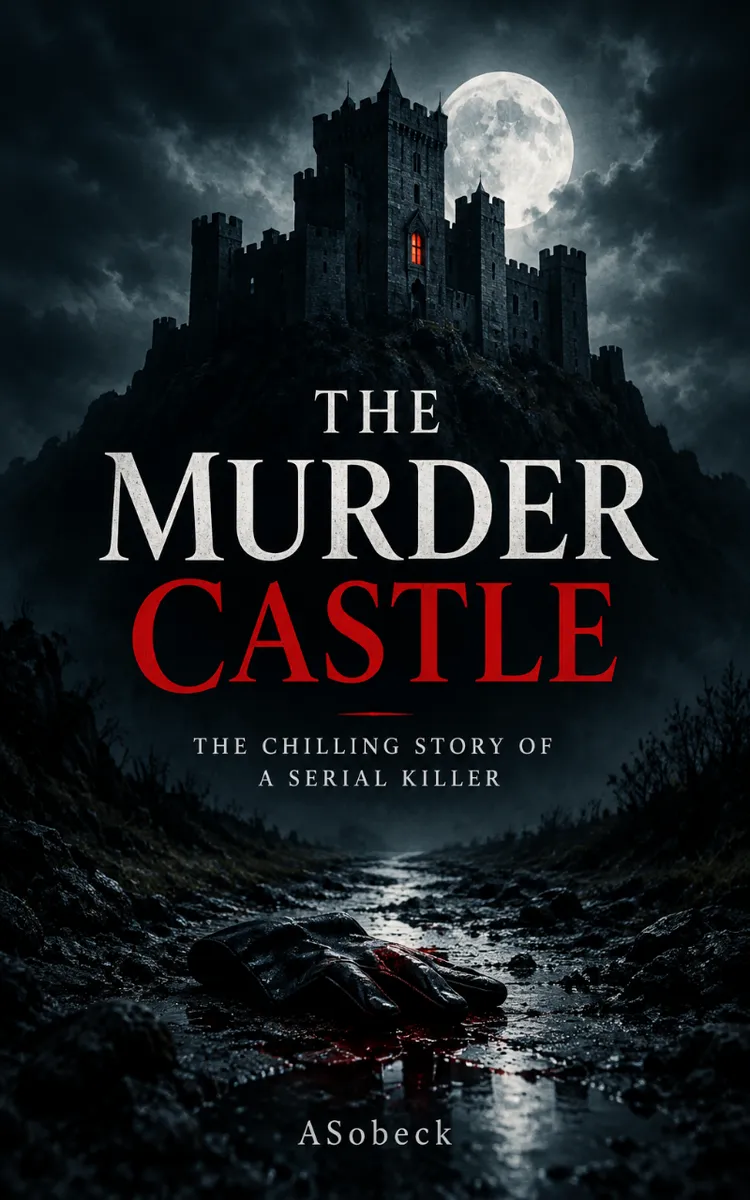
"The Murder Castle" is a true crime book by ASobeck with 40 chapters and approximately 95,007 words. The hotel’s doors do not lead where they should, and C. B.
This book was created using Inkfluence AI, an AI-powered book generation platform that helps authors write, design, and publish complete books. It was made with the AI True Crime Book Writer.
Frequently Asked Questions
What is "The Murder Castle" about?
The hotel’s doors do not lead where they should, and C. B. Howard has a key for every one of them. In late nineteenth-century Chicago, pharmacist Emery Ward carries medicine through an unmarked entrance into Howard’s unfinished hotel. The laudanum orders are too large for a building with so few lodgers. A narrow passage ends at a hidden panel. Then a missing woman’s unfinished name draws Ward back inside. The Murder Castle traces Howard’s deceptions and murders through the architecture built to conceal them, then follows the evidence toward his capture, trial, and execution. The corridors are unsettling, but the deeper question is how a respectable proprietor made a place of secrets seem like an ordinary hotel. Follow the doors he controlled to the evidence that brought his crimes into view.
How many chapters are in "The Murder Castle"?
The book contains 40 chapters and approximately 95,007 words. Topics covered include The Castle's Unmarked Door, The Pharmacist's Trust, The Missing Lodger, Clara Voss, The Corridor Behind Room 27, and more.
Who wrote "The Murder Castle"?
This book was written by ASobeck and created using Inkfluence AI, an AI book generation platform that helps authors write, design, and publish books.
How can I create a similar true crime book?
You can create your own true crime book using Inkfluence AI. Describe your idea, choose your style, and the AI writes the full book for you. It's free to start.
Write your own true crime book with AI
Describe your idea and Inkfluence writes the whole thing. Free to start.
Start writingCreated with Inkfluence AI


