
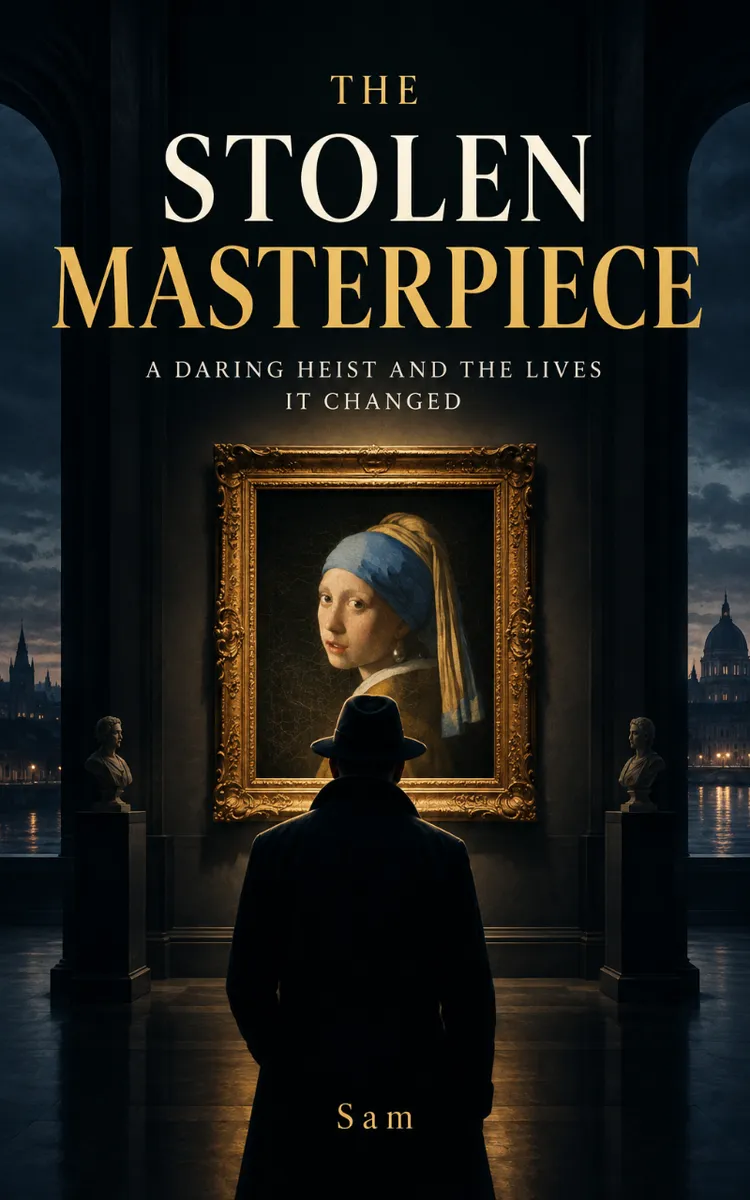

Read the first chapter
The whole of chapter one, free. About 9 min. Turn the pages with the arrows, your keyboard, or a swipe.
Chapter 1
The Louvre's Unlocked Door
The Louvre’s clocks had not yet struck seven when Vincenzo Peruggia slipped through the service entrance with a folded workman’s blouse under his arm.
Rain ticked against the high windows of the Salle des États. Beyond the glass, Paris was still gray and half-asleep, its streets shining beneath the first weak light. Inside, the museum belonged to echoes: the scrape of a broom somewhere below, the hollow knock of pipes, the faint complaint of a door settling into its frame.
Vincenzo paused with one hand on the corridor wall.
He knew this place by its sounds.
The guards changed shifts near the eastern stair. The cleaners began in the galleries facing the river. A door on the second floor dragged against the stone because its hinge had swollen. He had carried frames through these passages, patched glass, lifted crates, and slept through lectures from supervisors who never remembered his name.
Today, he needed the museum to forget him.
He straightened his jacket. Beneath it, his shirt was damp with sweat despite the cold.
“The picture,” he whispered.
The words sounded foolish in the empty corridor. He said them again, more firmly.
“The picture, then out.”
He moved.
His shoes made too much noise on the polished floor. He slowed, placing each foot along the dark seams between the tiles. In his pocket, a small screwdriver pressed against his thigh. He had wrapped its handle in cloth so it would not rattle. A narrow blade lay beside it, borrowed from the workshop and sharpened the night before.
He had imagined this moment for weeks. In his room, he had imagined the frame coming loose with a quiet click. He had imagined himself walking out beneath the pale morning sky with the portrait hidden beneath his blouse, another worker among hundreds.
The Louvre, in his imagining, had always been still.
It was not still now.
A cart squealed around the far corner.
Vincenzo flattened himself against a pillar. The cart emerged, piled with folded cloths and brass buckets. An old cleaner pushed it with both hands, her slippers whispering over the floor. She glanced toward him.
“You’re early,” she said.
“So are you.”
She shrugged. “The dust does not sleep.”
He gave her a smile that felt stiff on his face. “I have work in the gallery.”
“Everyone has work in the gallery.”
The cart rolled past. Its wheels squeaked until the sound thinned into silence.
Vincenzo waited another ten seconds, then crossed toward the staircase.
The portrait hung in the Salle des États beneath a dull wash of electric light. Even from the doorway, he could see the dark wood of its frame and the small crowd of paintings arranged around it. She was not yet famous enough to command a wall alone. Visitors passed her each day, pausing only when a guide pointed her out.
That was part of what made the plan possible.
The other part was that Vincenzo had handled the protective glass himself.
He reached the gallery and stood listening. Somewhere beyond the partition, a guard coughed. The sound carried through the open space, then vanished.
Vincenzo stepped inside.
The portrait waited behind its glass, smaller than he remembered. Her face was calm, almost amused, while the room around her held its breath in strips of shadow and reflected light. The famous smile seemed less like a welcome than a secret she had kept from everyone who came to stare.
He approached the frame.
“Forgive me,” he murmured.
He set the folded blouse on the floor and drew out the screwdriver. His fingers were clumsy. The first screw resisted. Metal whispered against metal.
He stopped.
Footsteps.
Vincenzo turned toward the entrance. A guard passed across the distant corridor, his keys chiming softly at his belt. The man did not look in. Vincenzo remained bent over the frame, one hand resting against the glass, until the footsteps faded.
His fingers had begun to tremble.
He wiped them on his trousers and tried again.
The screw loosened.
Then another.
The protective glass shifted by a fraction, and a thin line of cold air touched the painting. Vincenzo eased the panel forward. It was heavier than he had expected. The glass caught the light and threw it across the floor like a blade.
He lowered it against the wall.
The frame remained.
He worked at the catches, careful not to scratch the wood. The portrait was mounted more securely than the other paintings he had repaired. A pair of metal brackets held it in place, each tightened with a stubborn screw.
“Come on,” he breathed.
His wrist cramped. He changed the angle of the tool and pressed harder.
The screw turned.
A soft click sounded behind him.
Vincenzo froze.
At the gallery entrance stood a young attendant, one hand on the doorframe. He wore the museum’s dark vest and carried a ledger beneath his arm.
“What are you doing?”
Vincenzo looked at the portrait, then at the man.
“Glass,” he said. “It is loose.”
The attendant frowned. “There is no repair scheduled.”
“It became loose.”
“That is not an answer.”
Vincenzo lifted the screwdriver. “Would you prefer it fall?”
The attendant glanced toward the painting. His uncertainty lasted only a moment, but it was enough. Vincenzo seized it.
“Go and find Monsieur Poncet,” he said. “Tell him the bracket has failed.”
The young man shifted his weight. “You tell him.”
“I am holding it.”
The attendant looked again at the frame. Vincenzo placed his palm against the upper edge and leaned into it, making the danger visible.
“Go.”
The man hesitated, then disappeared through the doorway.
Vincenzo waited until the footsteps moved away. He did not breathe properly until the latch clicked in the corridor.
Then he attacked the final bracket.
The metal snapped loose.
The portrait sagged forward into his hands.
It was not large. That was what he had told himself. A wooden panel, a little over two feet high, light enough for one man to carry. But when he pulled it free, its weight dropped suddenly against his wrists, and the force drove him back a step.
The smile tilted.
For one terrible second, Vincenzo nearly dropped her.
He caught the lower edge against his hip and clutched the panel to his chest. The wood dug into his ribs. His sleeve snagged on a corner of the frame, tearing with a dry rip.
“Quiet,” he whispered, though he was speaking to himself.
He laid the portrait faceup on the floor and studied the empty frame. The wall behind it appeared startlingly pale, a clean rectangle where she had watched the museum’s visitors pass.
The absence seemed louder than any alarm.
Vincenzo wrapped the blouse around the panel. He had planned to carry the painting beneath his coat, but the blouse was too small and the portrait too rigid. One corner remained exposed.
He tried folding it diagonally.
The fabric slipped.
He tried again, tightening the sleeves around the wood. The portrait’s edge pressed into his stomach, and the bundle became an awkward, hard-sided shape that could not be hidden against his body.
He had imagined a man leaving with a package.
He had not imagined carrying a woman’s face like a door.
A noise rose from the corridor.
“Peruggia?”
The voice belonged to the young attendant.
Vincenzo seized the bundled portrait and hurried toward the service passage. He did not run. Running would draw attention. He walked quickly, head lowered, as if irritation alone had driven him from the gallery.
Behind him, the attendant called again.
“Peruggia, wait.”
Vincenzo turned the corner.
The service corridor narrowed between storage rooms. Its walls were painted a tired cream, scuffed where carts had struck them. He reached the first exit and pulled at the handle.
Locked.
He tried the key ring he had taken from the workshop hook that morning. The first key did not fit. Neither did the second.
Footsteps approached from behind.
“Come on,” Vincenzo muttered.
The third key entered halfway and stopped.
He twisted it anyway. The lock gave a hard metallic click, but the door did not open. Something pressed against the other side.
Vincenzo leaned into it.
A cleaning cart stood wedged in the passage beyond.
He pushed harder. The cart’s wheels squealed, but the door moved only an inch before striking a bucket. Through the gap came the smell of soap and wet stone.
Behind him, the footsteps grew louder.
He pulled the door shut and turned toward the stairwell.
The bundle dragged at his arms. The blouse had loosened, exposing one corner of the panel. He tightened his grip and descended.
At the first landing, a guard appeared below.
Vincenzo stopped so suddenly that the portrait struck his chest.
The guard looked up. “You there.”
“Yes?”
“Why are you carrying that?”
Vincenzo glanced down at the bundle. “A damaged panel.”
“Where is the work order?”
“In the gallery.”
“Then take it back.”
The guard started up the stairs.
Vincenzo’s mind emptied. He saw the man’s hand moving toward the rail, the shine of his buttons, the small ring of keys at his belt. He saw the narrow stair behind him and the locked door above.
Then he stepped down.
“I was told to bring it to the workshop.”
“By whom?”
Vincenzo stopped one stair above him. “Monsieur Poncet.”
The guard’s expression tightened. “Poncet is not here.”
“He will be.”
“That is not - ”
A bell rang somewhere in the museum.
One clear stroke, then another.
The guard turned his head toward the sound.
Vincenzo moved.
He shoved the bundle forward with both hands. The portrait struck the guard’s shoulder, knocking him sideways against the wall. The man cursed and grabbed for the cloth. Vincenzo twisted, tore the bundle free, and climbed past him.
“Stop!”
The shout followed him up the stairs.
Vincenzo reached the landing and ran.
His shoes slipped on the stone. The portrait slammed against the banister. He caught it before it fell, but the impact sent a sharp crack through the wood.
Not the painting.
Please, not the painting.
He reached the upper corridor and plunged through a door marked for staff. The passage beyond was darker, crowded with crates and rolled carpets. He staggered between them, clutching the panel beneath his arm.
A second door waited at the far end.
He jammed the first key into the lock.
Behind him, voices echoed through the stairwell.
“Check the corridor!”
“He went this way!”
The key turned.
The door opened onto a small storage room.
Vincenzo slipped inside and pulled it closed. He stood in darkness among stacked frames, listening to the guards pass outside. Dust coated his tongue. A draft moved beneath the door, cold against his ankles.
The portrait rested against his knees.
He lowered it carefully to the floor.
For several moments he could do nothing but stare at the bundle. His hands had gone numb. His left sleeve hung torn at the cuff. Somewhere beyond the wall, the museum continued waking: footsteps, bells, the rumble of carts, the murmured arrival of the first visitors.
He had it.
The thought came without triumph.
He had it, and he was still inside.
Vincenzo unwrapped the blouse. The portrait emerged in the dimness, its colors muted, her eyes fixed on him as though she understood the insult of the room.
He touched the edge of the panel.
“I will get you out,” he whispered.
From the corridor came the scrape of a key entering a lock.
Vincenzo looked toward the only other door, a narrow exit at the rear of the storage room. He lunged for it, seized the handle, and pulled.
Nothing.
He tried again, harder.
The door held fast.
Beyond it, through a wired pane of glass, he could see the museum’s outer passage and the iron gate that led toward the courtyard. The gate was closed. A thick chain crossed it, bright beneath the electric lamp.
The key ring shook in his hand.
Behind him, the storage-room lock began to turn.
Vincenzo dragged the blouse over the portrait, lifted her against his chest, and backed into the darkness between the frames.
The door opened.
Light spilled across the floor, stopping just short of his shoes.
And the Louvre, which had seemed to offer a hundred exits, gave him none.
End of chapter one. 9 more chapters and about 21,807 words in the full book.
Swipe or use the arrows to turn the page

What's inside: 10 chapters
- 1. The Louvre's Unlocked Door
- 2. A Portrait Beneath His Coat
- 3. The Empty Wall's Question
- 4. The Room Under Watch
- 5. The Florentine Offer
- 6. The Motive He Cannot Defend
- 7. The Portrait Returns to View
- 8. The Cell and the Story
- 9. The Mona Lisa Comes Home
- 10. A Thief's Last Claim
About this book
"The Stolen Masterpiece" is a true crime book by Sam Adams with 10 chapters and approximately 21,807 words. A retelling of a famous art theft and its perpetrators.
This book was created using Inkfluence AI, an AI-powered book generation platform that helps authors write, design, and publish complete books. It was made with the AI True Crime Book Writer.
Frequently Asked Questions
What is "The Stolen Masterpiece" about?
A retelling of a famous art theft and its perpetrators
How many chapters are in "The Stolen Masterpiece"?
The book contains 10 chapters and approximately 21,807 words. Topics covered include The Louvre's Unlocked Door, A Portrait Beneath His Coat, The Empty Wall's Question, The Room Under Watch, and more.
Who wrote "The Stolen Masterpiece"?
This book was written by Sam Adams and created using Inkfluence AI, an AI book generation platform that helps authors write, design, and publish books.
How can I create a similar true crime book?
You can create your own true crime book using Inkfluence AI. Describe your idea, choose your style, and the AI writes the full book for you. It's free to start.
Write your own true crime book with AI
Describe your idea and Inkfluence writes the whole thing. Free to start.
Start writingCreated with Inkfluence AI


