
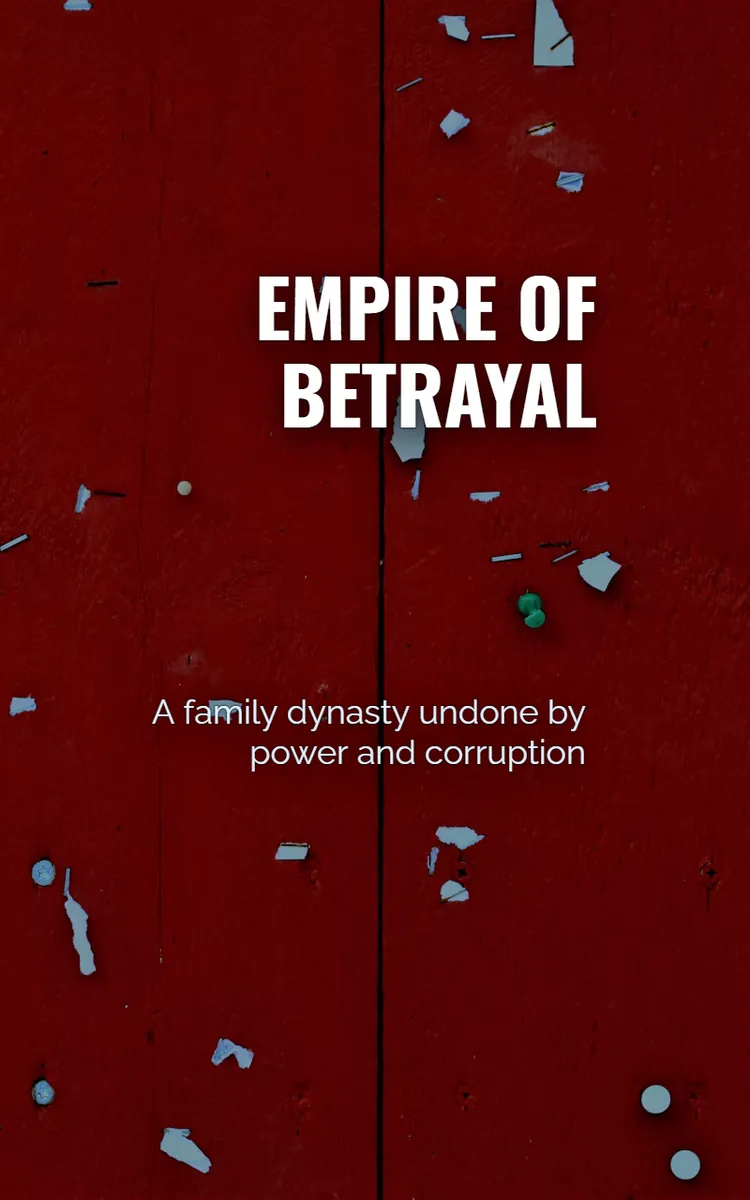
Read the first chapter
The whole of chapter one, free. About 10 min. Turn the pages with the arrows, your keyboard, or a swipe.
Chapter 1
The Port Ledger Raid
The first siren reached Mateo Rojas before the smell of diesel did.
He had just stepped from the port road into the wet maze of Buenaventura’s cargo yards, where rainwater ran beneath stacked containers and the pavement shone with oil. At thirty-eight, Mateo had learned to treat surprise as a form of information. A siren meant a gate had closed, a name had been spoken, or someone had decided that a routine errand was no longer routine.
He checked the folded paper in his shirt pocket. The instruction was brief: recover the ledger before the authorities found it. No explanation, no signature. The Arbeláez family did not need to explain itself to a man who had spent twelve years moving messages, payments, permits, and apologies between their business and the officials who protected it.
He had expected to leave Buenaventura within the hour.
The port made that expectation foolish.
Mateo moved past a row of refrigerated containers, keeping his shoulders relaxed. Salt hung in the air with the sharper odor of rotting fruit from a damaged shipment nearby. Cranes groaned above the yard, their metal arms disappearing into low cloud. Men in yellow vests watched the gates, some employed by the port, others by companies whose names changed whenever the police began asking questions.
At the first checkpoint, a guard raised one hand.
“Documents.”
Mateo gave him his identification and a delivery authorization bearing the seal of a company that officially transported agricultural equipment. The guard studied the papers, then studied Mateo.
“Where is the equipment?”
“Delayed at the customs shed.”
“Then why are you leaving?”
“I am not leaving. I am going there.”
The guard looked toward the shed. A second man stood beside the barrier, his hand resting near the radio clipped to his belt. Neither seemed convinced. Mateo recognized the hesitation. It was not the uncertainty of men doing their jobs. It was the calculation of men waiting to see who would claim him.
He took back his papers.
“Call your supervisor,” Mateo said.
The older guard’s mouth tightened. “You call him.”
Mateo did not argue. Arguments created witnesses. He stepped aside and waited while rain ticked against the metal roof of the booth. The delay cost him three minutes, then five. On the other side of the barrier, a police truck rolled past without slowing.
He had entered the port through a service gate using a name that no longer appeared on any official roster. The ledger was supposed to be inside a customs office near Pier Four, hidden among seized manifests. A clerk loyal to the Arbeláez family had sent word that it had survived the morning raid. The clerk had not said how long he expected it to survive.
Mateo’s phone vibrated once.
Do not use Pier Four.
The message came from an unknown number. He deleted it and looked toward the cranes. A black sedan stood beyond the fence, its windows dark despite the daylight. He could not see the driver, but he knew the posture of surveillance: stillness in a place built for movement.
The guard returned his papers.
“Go through,” he said.
Mateo stepped beneath the raised barrier. The permission felt less like freedom than an invitation.
The customs shed was farther away than he remembered. He crossed between trucks, breathing through the diesel fumes, and entered a narrow corridor formed by containers stacked three levels high. The rain had made the metal slick. Water dripped from the corners in steady lines, striking the concrete like a clock.
A man in a blue port jacket appeared at the far end.
“Rojas.”
Mateo stopped.
The man was not a customs officer. He was younger, perhaps twenty-five, with a narrow face and a pistol concealed beneath his jacket. Behind him, another figure stepped into view.
“This way,” the younger man said.
“Who sent you?”
“You know who.”
That answer belonged to the Arbeláez family, but the port had more than one faction using the family’s name. Mateo had learned that loyalty became unreliable when a dynasty began to fracture. The older Arbeláez brothers controlled the routes. Their cousins controlled the warehouses. Politicians controlled the permits. Men like Mateo carried the messages between them and were praised for discretion until discretion became evidence.
“I have instructions,” Mateo said.
“So do we.”
The second man moved forward. Mateo saw the scar beneath his left eye. He had seen him once in Cali, standing behind Esteban Arbeláez during a meeting with a provincial official. That memory settled the matter. These men were not there to help him. They were there to make sure the ledger reached a particular hand.
Mateo turned before either man could block the corridor. He walked back at an ordinary pace, hearing their footsteps follow. At the corner, he slipped between two parked trucks and crossed into a loading lane crowded with workers. A forklift reversed with a warning beep. A chain scraped over steel. Someone shouted for a driver to move.
He kept moving until the footsteps disappeared.
The customs shed had two entrances. The front was watched by police, so Mateo circled behind it and found the service door propped open. Inside, the air smelled of wet cardboard, ink, and mold. Files stood in leaning stacks along the walls. A ceiling fan turned slowly above a room where three clerks sat with their hands visible on their desks.
The clerk Mateo was looking for had gone.
A woman with silver hair glanced up from a registry book.
“You are late,” she said.
“Where is Salcedo?”
“Taken for questioning.”
“By whom?”
She closed the book. “Does it matter?”
Mateo placed a folded note on the desk. “I was told the material was here.”
Her eyes moved to the note but did not touch it. “Material disappears when men ask for it too loudly.”
“I am not asking loudly.”
“No. You are asking with the name of the Arbeláez family behind you.”
The words were quiet, but they carried across the room. One of the clerks lowered his head. Mateo felt the old authority of his position thinning around him. In other years, the family name had opened doors. That morning it had brought police, rival guards, and a clerk who no longer feared refusing him.
The woman reached beneath the desk and removed a narrow metal key.
“Room seven,” she said. “Second cabinet. The false bottom.”
“Why help me?”
“I am not helping you. I am removing it from this building.”
She slid the key across the desk.
Mateo took it. “If anyone asks - ”
“They will ask,” she said. “That is what they are paid to do.”
Room seven was at the end of a corridor lined with seized goods. A broken radio played a song through static. Somewhere beyond the walls, boots struck the concrete in a hurried rhythm. Mateo unlocked the room and entered.
The cabinet stood beneath a window filmed with rain. He opened the second drawer, lifted a layer of customs forms, and found the false bottom. Beneath it lay a ledger wrapped in oilcloth.
It was smaller than he expected, bound in dark leather, its corners softened by handling. The pages smelled of tobacco and damp paper. He slipped it inside his jacket and left the room with the empty oilcloth folded under his arm.
At the front office, the silver-haired woman had disappeared.
A police officer stood beside the door.
“Mr. Rojas,” he said.
Mateo stopped. The officer held a photograph, though he did not need to look at it.
“Your identification.”
Mateo handed it over.
“You entered under a false authorization.”
“It is a valid company authorization.”
“The company says otherwise.”
“Then you should speak with the company.”
The officer smiled without amusement. “That is what we intend to do.”
Two more officers entered behind Mateo. Through the window, he saw the black sedan had moved closer to the shed. The younger guard in the blue jacket stood beside it, speaking to someone inside.
The port had closed around him by degrees. No single barrier had trapped him. It was the accumulation of small permissions, each granted by someone with a different allegiance.
The officer returned his identification. “Come with us.”
Mateo looked at the rain-striped glass. “On what charge?”
“For questioning.”
“Then send a written request.”
The officer’s expression hardened. “You think the family can protect you here?”
Mateo did not answer. That had once been the central fact of his life. The family could protect almost anyone, provided the person remained useful and silent. Now the question was not whether the Arbeláez family could protect him. It was whether they would still consider him worth protecting once they knew what the ledger contained.
A shout rose outside. The officers turned toward the sound.
Mateo moved.
He struck the nearest man’s wrist - not hard enough to injure, only enough to break his grip on the doorway - and pushed through the service entrance. Rain hit his face. He ran between trucks, not toward the main gate but toward the older warehouses along the water, where the port’s systems had begun to fail years before and never been repaired.
Behind him, someone shouted his name.
He crossed a yard covered in puddles and climbed a short fence. His hand slipped on the wet wire. He landed badly, pain traveling up his ankle, but he kept going. The ledger pressed against his ribs beneath the jacket.
At the warehouse row, a rival guard stepped from beneath an awning.
“Stop.”
Mateo stopped because the man held a shotgun.
For a moment, the only sound was rain striking the corrugated roof. Beyond the warehouse, the harbor smelled of salt and fuel. A tugboat sounded twice in the gray distance.
The guard looked at Mateo’s jacket. “Give it to me.”
“You do not know what you are carrying.”
“I know who wants it.”
“And who is that?”
The guard’s eyes shifted toward the road. That was enough. Mateo reached for the metal latch on the warehouse door and pulled it open. The guard raised the weapon, but a truck horn erupted beside them as a driver tried to clear the lane. The guard flinched. Mateo entered the warehouse and pulled the door behind him.
Inside, darkness gave way to the pale light of broken windows. Nets, pallets, and rusted machinery filled the space. He limped between them, using the noise outside to cover his movement. At the rear wall, he found a gap where two panels had separated. Beyond it lay a drainage channel leading toward the public road.
He squeezed through, tearing his sleeve on a bolt.
When he emerged, his trousers were soaked to the knee and his ankle had stiffened. A taxi waited beside the curb with its engine running. The driver watched him approach but did not ask questions.
“Downtown,” Mateo said.
The driver glanced at his wet clothes. “That is not where you came from.”
“No.”
The man considered him, then unlocked the door.
Mateo climbed inside and held the ledger against his chest. As the taxi pulled away, the port receded behind curtains of rain, its cranes and warehouses dissolving into the gray morning. He had recovered what the family wanted. That should have been enough.
He opened the ledger only after they reached the highway.
The first pages contained shipping numbers, warehouse codes, and initials. Then came columns of payments disguised as port fees, inspection charges, and campaign contributions. Mateo recognized the handwriting of the family’s accountant. He recognized the names of companies that had never transported a crate. He recognized the signatures of officials whose careers had depended on Arbeláez money.
Near the center of the book, beside a payment recorded during the previous election season, stood the name of a senator.
Below it were two initials.
M.R.
Mateo stared at them until the letters blurred with the rain on the window.
He had arranged payments before. He had carried envelopes, corrected figures, and told men in government offices which company needed a permit before an inspection. He had always described himself as an intermediary, someone who moved between power and crime without belonging entirely to either.
The ledger did not make that distinction.
It placed his initials beside the senator’s payment, beneath an amount large enough to purchase silence for years. Whether he had authorized that particular transfer no longer mattered. His name had been preserved in the family’s own record, tied to political protection in ink that could outlast every denial.
The taxi continued toward the city. Mateo closed the ledger and returned it beneath his jacket, but the weight had changed. He had set out as a trusted operative retrieving a family secret. He was returning as part of the secret itself.
Looking back, he understood that the raid had not merely exposed the Arbeláez family’s protection network. It had stripped away the story he had told himself about his place within it. He had believed manipulation belonged to the men at the top - the brothers, the politicians, the financiers - while he merely carried their decisions from one door to another.
The initials proved otherwise.
By the time Mateo reached the safe house, he knew the ledger could not be handed over without consequence. If he returned it, the family would see what he had seen. If he kept it, the family would understand that he had begun to see too much.
He stepped from the taxi into the rain, one hand pressed against his injured ankle and the other resting over the hidden book. The port had allowed him to leave with the ledger.
It had not allowed him to leave innocent.
End of chapter one. 39 more chapters and about 104,921 words in the full book.
Swipe or use the arrows to turn the page
What's inside: 40 chapters
- 1. The Port Ledger Raid
- 2. Summons to the Arbeláez Estate
- 3. Tracing the Senator’s Payment
- 4. The Mountain Road Ambush
- 5. Choosing the Family’s Side
- 6. The Election Fund Disappears
- 7. The Driver’s Hidden Route
- 8. Inside Vélez’s Hilltop Residence
- 9. The Cost of Political Access
- 10. The Reception Goes Dark
- 11. The Missing Aide’s Files
- 12. The Hacienda Archive Fire
- 13. A Heir’s Private Confession
- 14. Esteban’s Emergency Decree
- 15. The Notary’s Duplicate Deed
- 16. Escape Through the Coffee District
- 17. The Meaning of Loyalty
- 18. The Convoy’s Failed Transfer
- 19. The Safehouse in Cali
- 20. The Ledger’s Second Hand
- 21. The Broker’s Moral Debt
- 22. The Journalist’s Arrest
- 23. Who Ordered the Arrest?
- 24. The Border Crossing Fails
- 25. The Heir’s Uneasy Alliance
- 26. The Warehouse Seizure
- 27. The Sealed Registry Entry
- 28. The River Route Collapse
- 29. Esteban’s Public Defection
- 30. The Price of Silence
- 31. Reconstructing the Missing Page
- 32. The Embassy Archive Search
- 33. Confessing to the Journalist
- 34. The Treasurer’s Denial
- 35. The Records Go Public
- 36. Facing the Family Inquiry
- 37. Returning to the Burned Hacienda
- 38. Lucía’s Independent Testimony
- 39. The Dynasty’s Asset Auction
- 40. The Last Ledger Account
About this book
"Empire Of Betrayal" is a true crime book by Anonymous with 40 chapters and approximately 104,921 words. A Colombian drug lord dynasty, political corruption, betrayals, and mysterious deaths.
This book was created using Inkfluence AI, an AI-powered book generation platform that helps authors write, design, and publish complete books. It was made with the AI True Crime Book Writer.
Frequently Asked Questions
What is "Empire Of Betrayal" about?
A Colombian drug lord dynasty, political corruption, betrayals, and mysterious deaths
How many chapters are in "Empire Of Betrayal"?
The book contains 40 chapters and approximately 104,921 words. Topics covered include The Port Ledger Raid, Summons to the Arbeláez Estate, Tracing the Senator’s Payment, The Mountain Road Ambush, and more.
Who wrote "Empire Of Betrayal"?
This book was written by Anonymous and created using Inkfluence AI, an AI book generation platform that helps authors write, design, and publish books.
How can I create a similar true crime book?
You can create your own true crime book using Inkfluence AI. Describe your idea, choose your style, and the AI writes the full book for you. It's free to start.
Write your own true crime book with AI
Describe your idea and Inkfluence writes the whole thing. Free to start.
Start writingCreated with Inkfluence AI


