
Read the first chapter
The whole of chapter one, free. About 15 min. Turn the pages with the arrows, your keyboard, or a swipe.
Chapter 1
The First Roof
He said the name with a bitterness Elias felt at his molars. Elias folded the warning into his thoughts like an extra shirt for a long journey: not certainty, but a negative-space map.
A distant engine split the air, tires on gravel moving with intent. Both men froze for a second, as if the town itself had inhaled. The roofs flashed in the sun like small watchful eyes.
“We go back,” Lyle said, nodding toward a gap between buildings that climbed to higher ground. “You can’t be out here when the county starts moving in. They don’t like loose ends.”
They climbed the muddy rise in silence. Elias’s camera hung ready, its red light a small patient heart. Behind them the school bell tower shed another stone; it fell somewhere inward and made a sound the mind read as regret. The ledger sat against Elias’s ribs, its crease sharp as a scar, names pressing against papery skin. He had started a chain but could not yet tell whether it would reveal the town beneath the water or unloose the men who had covered it.
At the ridge the road narrowed and trees made a thin roof of shade. Elias looked back once. Exposed rooftops cut a serrated line across the lake. Proving a town had existed was one thing; proving what had been done to it and why was another. He felt the ledger against his chest and knew the next step was to get it safely out of Bellweather and into a place where names could not be stamped away.
A car crested the rise behind them, slow and official-smelling, engine idling as it eased onto the road. Elias’s mouth went dry. Lyle’s hand found his shoulder, a brief human anchor.
“You are careful,” Lyle said. “For your daughter.”
The name wasn’t his to say, but Elias flinched. The ledger’s weight now measured other currencies: obligations, family, a future that would hinge on what he did next.
The car slowed. The engine’s idle was an animal’s patient breathing. Elias kept his hands empty and forward, the ledger a solid throb against his sternum. The driver was a man in a plain county jacket: gray hair close-cropped, the sort of neatness that suggests a file cabinet at home. He stepped out with a folder under his arm and a face that wore practiced mildness like sunscreen.
“Mr. Mercer?” he called. His voice had the bland clarity of someone used to being believed on authority alone.
“That’s me.”
“Quentin asked I keep an eye on the area. County’s trying to ensure safety. You shouldn’t be near those roofs. It’s unstable.” He glanced at the exposed town with church-bell indifference, then at the faint bulge under Elias’s coat. “You with the paper? Quentin likes to know who’s turning up things.”
Elias measured his next words. Lyle’s grip on his shoulder had already loosened. “I’m documenting. If you need to secure it, take it up with my editor.”
The county man smiled a smile that settled nothing. “Quentin Stroud’s orders are for the preservation of the site. For the—” He hesitated, choosing his word—“integrity.”
“Preservation?” Elias echoed. “You mean preservation from discovery.”
The accusation came out sharper than he’d intended. He heard Lyle draw a short breath behind him.
The man tilted his head. “You don’t know what you’re holding, Mr. Mercer.”
“Neither do you.”
The county man opened the folder and withdrew a printed photograph: the same black-and-white Elias carried in his pocket, only cropped and annotated with a typed note. The narrow building—the impossible one—was circled in ink. The note read: ARCHIVE PHOTO. NO RECORD. DO NOT REMOVE MATERIAL.
“That photograph has been in county files since the seventies,” the man said. “Quentin’s had questions.” He did not look like a man who had questions; he looked like someone reading a script. “If you found material, we can catalog it. You can leave it with us.”
“You’ll catalog it and then what?” Elias asked. The ledger’s edge bruised against his ribs. Handing it over felt like handing over people.
The county man inclined his head toward Lyle. “He’s a local, yes? He knows the area. If there are concerns—”
Lyle’s jaw worked. “You take it, you don’t put it in a box and say ‘preservation’ and forget us. You put it where folks can see it. You put it in the paper.”
The county man did not answer. His phone buzzed; he checked it without looking ashamed. The screen flashed a single word: STRONGROOM. He folded the photograph with a slow flatness and tucked it into his folder.
“Quentin wants to avoid sensationalism,” he said. “He doesn’t want people running into hazardous structures. Give us the things that could imperil folks and we’ll—”
“Quentin wants to avoid liability,” Elias said. “Quentin also wants to avoid names.”
A shadow crossed the county man’s neat face then, a small fracture that lasted less than a breath. “I’m only passing along instructions,” he said. “For safety.”
Behind the words and the mud and the bell tower’s slow surrender, a new sound threaded itself into the morning: the low throb of a diesel engine, different from the county car’s polite idling. It came from the far side of the exposed roofs, a sound that carried the certainty of weight and intent. Men were moving in. The air tasted suddenly of machine oil and the small metallic tang of rearranged power.
Elias felt the ledger as if it were growing warmer. He thought of the thirty-seven names and the children scrawled on the blackboard, the sock clinging to a beam like a message. The ledger could become a ledger of people or a ledger of silence. If he made the names visible, he might set loose a tide that would bring consequences not only to officials but to neighbors—people Lyle had named as having houses and jobs. If he handed it over, there was a risk of erasure, of official neatness that removed flesh from paper.
He made a choice that felt like breaking a bone.
He stepped back from the county man and from Lyle and said, quietly, “I have a contact at the university archive. They’ll take a scanned copy and give it an independent stamp. They operate under public records agreements. I’m not leaving the ledger here.”
The county man’s eyes sharpened. “You intend to remove it?”
“I intend to protect it. From lost files and from men who think erasure is preservation.”
Lyle exhaled like a man releasing water. “Good. Do it quick.”
The diesel on the rim of the lake deepened into a chorus. Elias felt the cold of the ledger sear into him—responsibility a blade that cut both ways. He ducked into the shade where the road narrowed and took off his jacket with hands that no longer trembled much. Lyle remained by the exposed steps, watching the roofs as if they might speak. The county man returned to his car, the neatness in his movement like someone folding an argument closed.
As Elias moved away, the ledger against his ribs felt heavier. He ran his thumb along the folded corner and found, for the first time, a small pencil scrawl at the bottom margin he hadn’t noticed before—almost an afterthought:
NOTHING REMAINS.
The letters were cramped, the graphite smudged as if written by a hand that feared to be seen. The phrase stopped him in the road. It could have been a cataloguer’s note, a personal despair, a notation of loss. But the way the words sat beneath the thirty-seven names felt like a response to the ledger’s very purpose.
Nothing remains of whom?
Elias carried that smudge of graphite with him as if it were premonition. The diesel engines grew louder. Men were coming. He had one narrow window to move the ledger into a place where ink could defend itself better than muscle. He set off at a fast walk toward the service road, the sun sharp behind him, and the exposed rooftops glinting like rows of teeth that had been waiting a long time for someone to pry them open.
The road was rough, a patchwork of sun-baked asphalt and loose gravel, each step a small betrayal against the urgency thrumming in Elias’s veins. His camera bag, usually a comfortable weight, now felt like a leaden anchor pulling him down, its straps biting into his shoulder. The heat of the morning was a palpable press, the air thick with the metallic scent of dust and the lingering, cloying sweetness of decay that seemed to seep from the very ground. He glanced back, a flicker of paranoia tightening his chest. The county car was still parked, a dark, silent sentry, and the county man, a bland cipher of bureaucratic menace, stood beside it, watching. Not watching him, Elias realized with a jolt, but watching the valley, the exposed roofs, the very act of its slow, agonizing resurrection.
The diesel thrum grew from a distant murmur to a grinding roar, a mechanical beast awakening. It wasn’t just one engine; it was several, a chorus of heavy machinery. Elias pictured the yellow glint of bulldozers, the clatter of excavators, all converging on the fragile, newly exposed skeleton of Bellweather. They were coming to re-bury it, to ensure the erasure was complete. And he, Elias Mercer, with a single, fragile page of names tucked against his heart, was the inconvenient variable.
He thought of his daughter, Clara. Her face, bright and curious, the way she’d look up at him, her small hand fitting perfectly into his. “For your daughter,” Lyle had said, a warning and a plea wrapped in one. It wasn’t just about a story anymore, not just about journalistic integrity. It was about what kind of world he was leaving for her, a world where truth could be buried under water and then under bureaucratic mandate, where people could simply cease to exist in official memory. The ledger, warm against his skin, pulsed with the quiet heartbeat of those thirty-seven forgotten souls.
He reached his battered sedan, parked discreetly a quarter-mile up the service road, nestled beneath a canopy of gnarled oaks. The interior was already a furnace, the air thick with the stale scent of old coffee and the faint, coppery tang of the lake water he’d inadvertently tracked in. He fumbled with the keys, his fingers clumsy, the metal hot under his touch. The engine caught on the second try, a welcome growl of defiance. He didn’t waste a second, throwing the car into reverse, gravel spitting beneath the tires, then accelerating forward, away from the valley, away from the approaching diesel chorus.
As he drove, the landscape shifted from the stark, exposed mudflats to rolling hills dotted with scrub brush and then finally, to the familiar, manicured lawns of the county seat. He drove past the courthouse, a grand, imposing edifice of pale stone, its windows reflecting the morning sun like blind, knowing eyes. He imagined Quentin Stroud behind one of those windows, a spider at the center of a meticulously woven web of influence and silence.
His phone buzzed, a jarring intrusion. It was his editor, Sarah Chen. He almost let it go to voicemail, but then remembered the official car, the county man’s phone. They knew he was here. They knew he had something.
“Mercer,” he answered, trying to keep his voice steady, the adrenaline still singing in his veins.
“Elias, where the hell are you? The county council just put out an emergency declaration about the Bellweather site. Citing ‘unstable ground conditions’ and ‘potential public hazard.’ They’re locking it down, sending in heavy equipment to ‘stabilize’ it. What the hell did you do?” Sarah’s voice was sharp, laced with a familiar mix of exasperation and grudging respect.
“I found something, Sarah. A lot of somethings. A ledger, for starters. Thirty-seven names not on the official manifests. And a building that apparently never existed, according to county records, but it’s right there, sticking out of the mud.”
A beat of silence on the line. Then, “A building that never existed? Elias, are you sure you’re not dehydrated? Or having some kind of fever dream out there?”
“I have photos. And this ledger. It’s real, Sarah. And whatever it means, Quentin Stroud wants it gone. He sent one of his goons to try and confiscate it.”
“Stroud? That old snake? He’s still pulling strings? What’s his interest in a drowned town?”
“That’s what I need to find out. But right now, I need to get this ledger scanned. I told the county guy I was taking it to the university archives. I need to make good on that. Can you call Professor Albright in Special Collections? Tell him I’m coming in, it’s urgent, sensitive material.”
“Albright? He’s a stickler for protocol, Elias. And he’s on sabbatical, I thought.”
“He owes me a favor. And this can’t wait. The county is mobilizing. They’re going to bury it again, Sarah. And this time, they might bury me with it if I don’t move fast.”
He heard the concern in Sarah’s sigh. “Alright, alright. I’ll call Albright. But you get that thing scanned, and then you get your ass back here and write this story. And for God’s sake, be careful. Quentin Stroud doesn’t play nice. He’s got friends in high places.”
“Tell me something I don’t know,” Elias muttered, ending the call. He gripped the steering wheel, knuckles white. The road ahead was clear, but the rearview mirror still held the phantom image of the county car, the bland face of its driver, and the knowledge that his every move was now being tracked.
He drove straight to the university, a sprawling campus of red brick and ivy, a stark contrast to the desolate, mud-caked valley. Parking was a nightmare, but he found a spot in a visitor’s lot, his heart still thumping an anxious rhythm against his ribs. The ledger, still tucked inside his jacket, felt like a live thing, a small, fragile truth he was smuggling into the light.
Professor Albright’s office was a dimly lit sanctuary of ancient paper and the comforting scent of dust and aging leather. Albright himself was a man shaped by decades of quiet scholarship: thin, stooped, with spectacles perched on the end of a nose that seemed permanently stained with ink. He peered at Elias over the top of his glasses, his expression a mixture of irritation and curiosity.
“Mercer, Sarah said you had something urgent. And I was under the distinct impression I was on sabbatical, enjoying the delicate art of not answering emails.”
Elias pulled the ledger page from his jacket, unfolding it carefully on Albright’s cluttered desk. The yellowed paper, with its neat rows of names and cryptic marks, seemed starkly out of place amidst the professor’s meticulously organized chaos.
“This was found in the Bellweather schoolhouse, Professor. It’s a list of names, but they don’t match any official evacuation manifests. And there’s this.” Elias pointed to the small, smudged pencil scrawl at the bottom: NOTHING REMAINS.
Albright picked up a magnifying glass, his brow furrowed in concentration. He traced the names, then the small symbols beside each one: a cross, a dash, a circle. His breath hitched slightly as he reached the bottom, his gaze lingering on the chilling inscription.
“Remarkable,” Albright murmured, his voice losing its initial edge of annoyance, replaced by the hushed reverence of a scholar on the brink of discovery. “A private roll, you say? And no official record of these individuals?”
“None I could find. Lyle, a local, hinted that some people just… disappeared. Not officially, but effectively. And the county is moving in now to ‘stabilize’ the site, which feels more like an attempt to re-bury evidence.”
Albright looked up, his eyes sharp. “Quentin Stroud, you mentioned? I’ve had dealings with his office before. They have a rather… thorough approach to historical ‘preservation.’ Often, that means ensuring certain histories remain unwritten.” He tapped the ledger page. “This is a rare find, Elias. A direct challenge to the official narrative. The marks… they’re curious. A cross, a dash, a circle. Not a typical ledger notation. Perhaps a code? A classification?”
“Lyle said not to let Stroud see it. He also mentioned something about permits being denied for a hazard, then the water coming, then trucks with county seals, shouting, and a sound like metal folding. And a silence that tastes like coin.” Elias recounted the exchange, the words tumbling out, trying to convey the eerie atmosphere of the valley.
Albright nodded slowly, his gaze distant. “The Bellweather family. They were… peculiar. Even for their time. My predecessor, Professor Eleanor Vance, she tried to research them in the 70s. Hit a wall. She called it ‘an active void.’ Every avenue she explored led to dead ends, missing documents, or outright hostility. She eventually gave up, claiming the family had an uncanny ability to unmake history. She even had a photograph, very unusual, of a building in Bellweather that supposedly didn’t exist. She said it was the only piece of evidence she ever found that corroborated her suspicions.”
Elias felt a cold prickle on his arms. “I have that photograph.” He pulled the crumpled print from his shirt pocket, the one the county man had also shown him. “The tall, narrow building with four dark windows. Is this the one?”
Albright’s eyes widened behind his spectacles. He took the photo, comparing it to the image in his own mind. “Precisely. She called it ‘the Bellweather Folly.’ She believed it was the heart of their… private disciplines. Something beyond natural philosophy, as they termed it. Something… predatory.” He paused, a shiver running through his thin frame despite the warmth of the room. “She became quite obsessed. Claimed the valley had a way of ‘editing’ itself, that certain facts just… ceased to hold purchase in the collective memory. She never published her findings. Said it was too dangerous. Said she felt watched.”
“That’s what Lyle said. People have been watching.” Elias leaned forward, the pieces of the puzzle beginning to click into place, forming a terrifying image. “The county man had this exact photo. Circled the building. Said ‘ARCHIVE PHOTO. NO RECORD. DO NOT REMOVE MATERIAL.’ And his phone flashed ‘STRONGROOM.’ What’s a strongroom?”
Albright’s lips thinned. “A secure vault. For exceptionally sensitive documents. Or for things they want forgotten. If the county is actively suppressing information about this building, it lends credence to Vance’s theories. And to your ledger.” He looked at the page again, then at Elias. “We need to scan this immediately. And I’ll see what I can dig up on Eleanor Vance’s unpublished research. She kept meticulous notes, even if she never formalized them.”
Within the hour, the ledger page was carefully digitized, high-resolution scans capturing every faded line and smudged mark. Elias felt a profound sense of relief as the digital files were secured, a small victory against the tide of erasure. The physical page, however, he kept. It was his proof, his anchor.
As he left Albright’s office, the professor’s parting words echoed in his mind: “Be careful, Elias. Some histories don’t want to be remembered. And some entities… they feed on forgetting.”
Back in his car, the mundane act of driving felt like a temporary reprieve. He needed to write, to get this story out, to make those names visible. But the more he thought about it, the more he realized a simple news article wouldn’t be enough. This wasn’t just a local corruption scandal; it was something far deeper, far older.
End of chapter one. 12 more chapters and about 63,404 words in the full book.
Swipe or use the arrows to turn the page


What's inside: 13 chapters
- 1. The First Roof
- 2. Do Not Remove Material
- 3. The Active Void
- 4. The Vance Resonator
- 5. Don’t Go Into the Houses
- 6. Chapter 13
- 7. The Count Begins
- 8. Sarah and The Silence
- 9. The Silence Notices
- 10. Chapter 15
- 11. Nothing Remains
- 12. The Work of Making It Public
- 13. The Beginning of the End
About this book
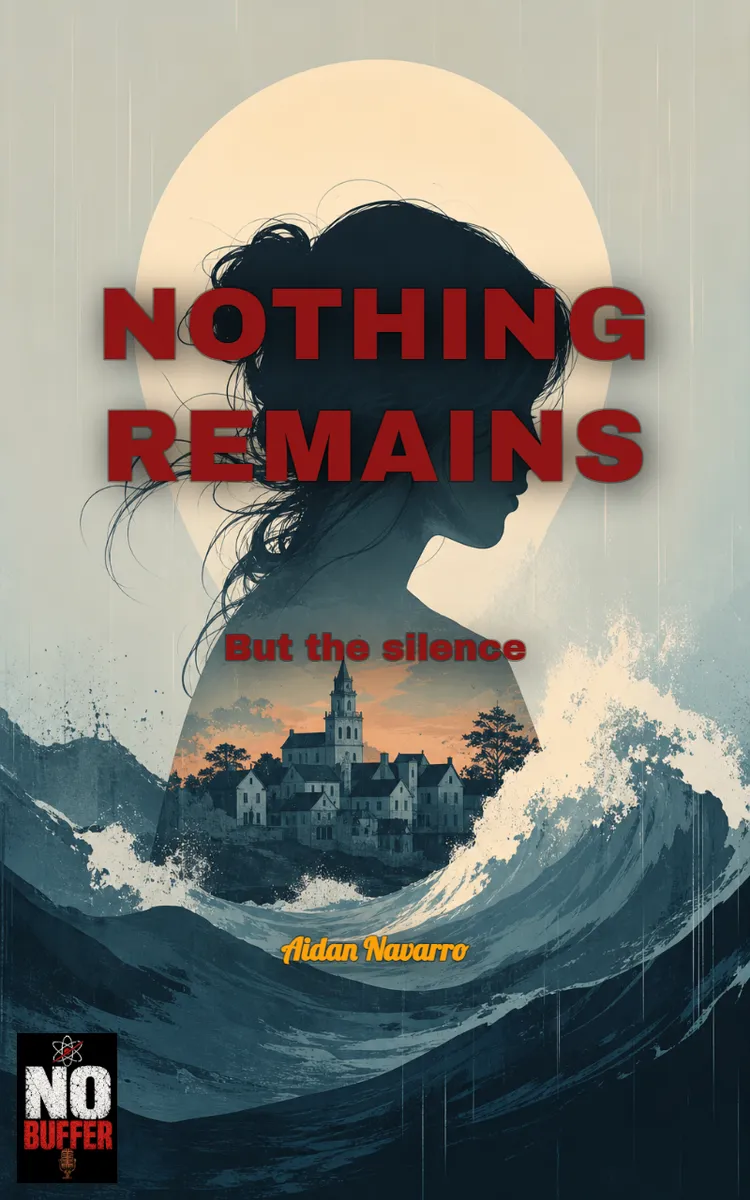
"Nothing remains" is a true crime book by Aidan Navarro with 13 chapters and approximately 63,404 words. The lake is giving up Bellweather, one roof at a time, and the first thing it reveals is a lie. When the reservoir drops, submerged streets reappear in pieces, smelling of rot and rust, with buildings that should not exist and records that insist they never did.
This book was created using Inkfluence AI, an AI-powered book generation platform that helps authors write, design, and publish complete books. It was made with the AI True Crime Book Writer.
Frequently Asked Questions
What is "Nothing remains" about?
The lake is giving up Bellweather, one roof at a time, and the first thing it reveals is a lie. When the reservoir drops, submerged streets reappear in pieces, smelling of rot and rust, with buildings that should not exist and records that insist they never did. Elias Mercer, a reporter with a camera and a stubborn need for proof, follows the town back into the dry summer. But the closer he gets, the more the evidence turns human and specific, down to a ledger page of names and a list of who was left behind. Someone is trying to keep him out, and the town is not done speaking. Read now, and decide what is uncovered and what is waiting.
How many chapters are in "Nothing remains"?
The book contains 13 chapters and approximately 63,404 words. Topics covered include The First Roof, Do Not Remove Material, The Active Void, The Vance Resonator, and more.
Who wrote "Nothing remains"?
This book was written by Aidan Navarro and created using Inkfluence AI, an AI book generation platform that helps authors write, design, and publish books.
How can I create a similar true crime book?
You can create your own true crime book using Inkfluence AI. Describe your idea, choose your style, and the AI writes the full book for you. It's free to start.
Write your own true crime book with AI
Describe your idea and Inkfluence writes the whole thing. Free to start.
Start writingCreated with Inkfluence AI


