
Read the first chapter
The whole of chapter one, free. About 23 min. Turn the pages with the arrows, your keyboard, or a swipe.
Chapter 1
The First Quiet Death Goes Public
The brass bell chimed as Jim Holloway stepped into the dim foyer, rain mottling his coat. Jim peeled off his damp coat, kept his worn notebook in his hand like a talisman, and said, “I’m here about Evelyn Voss,” careful of the hush in places built around endings. The woman at the desk kept her head bent over a ledger, pen pausing. “Family hours are posted outside,” she said without looking up. “I’m not family,” he replied dryly. “That makes two of us.” Jim slid his card across the varnished counter: PRIVATE INVESTIGATOR, block letters that meant less where gossip policed the town. He’d arrived less than an hour earlier with a contact number, a rented room over a bait shop, and an editor’s warning: don’t expect cooperation.
Evelyn Voss had died three nights before. The Gazette had printed “natural causes” in neat, indifferent type - the same phrasing used for three other deaths last year and one the year before it. Jim wanted the first one looked into before he chased the pattern; small towns hid their rot under language as ordinary as newspaper type. The woman finally lifted her eyes and let them travel down his card, linger on the letters, then across his face as if cataloguing him for future annoyance. “Mr. Holloway, the death certificate is filed.”
“I’m not asking for the certificate yet. I want to know who found her.” He kept his tone even, the way a line of questioning can be a slow, cold poker pressed to skin.
“Why?” Her fingers stilled, a faint vein ticking at the base of her thumb. Outside, a delivery truck groaned over the wet pavement; somewhere toward the rear of the building metal wheels clattered across tile, a domestic, mundane noise that sounded obscene in a place meant for silence.
“Because the notice says she died alone, but the sheriff’s report says a neighbor heard someone in the house.” He watched her reaction like a reader watching for a key phrase in a confession.
She gave him a look that was mostly industry and little curiosity. “People hear things.”
“Then someone can tell me what they heard.” He slid the card back as if it held more questions than answers. “You should speak with Sheriff Greywater.”
“I plan to.” She pushed the card away like a small, finished chore. “Then you’ve wasted your morning.”
Jim picked it up, the paper edges soft from other hands. “Where is the morgue?” Her face tightened in a way that made the room colder. “Down the service road. Gray door. No sign.”
“Who can release the records?” “Sheriff Greywater.” “And who can explain the body?” Her eyes flicked toward the corridor that led past folding chairs and pamphlets; the murmur of distant radios seeped through the plaster. “The morgue attendant.” “Name?” The clock clicked once; the second hand shivered, and for a breath the town and its small, patient cruelties hung between beats.
“You’ll find out.” Jim left before she could add anything else. The service road ran narrow and begrimed behind the funeral home, hemmed by stacked lobster crates that smelled of brine and bait and a chain-link fence crusted with salt. He walked among the crates, the air thick with the harbor’s dampness, until he reached a squat concrete building pressed against the seawall. Waves thudded below with a leaden boom; each impact made the morgue’s small windows quiver like eyelids. The gray door stood unlocked as if nobody expected visitors who weren’t family.
Inside, the cold hit with the authority of an accusation - air that stung the tips of his fingers and made the skin at his knuckles prickle. Fluorescent tubes hummed in a narrow, institutional chorus, casting everything a sickly white. A drain ran down the center of the floor where a rust-colored line marked where water had once collected and dried in a slow, spreading bruise. A man in a white coat stood beside a stainless-steel table, reading a clipboard with the slow concentration of someone whose hands had memorized grief.
“Evelyn Voss,” Jim said, stepping so his shadow didn’t fall across the sheet.
The man glanced up once, professional, guarded. “You’re not family.”
“Private investigator.” The words felt small in the room. “I need to verify the cause of death.”
“Cause is on the certificate.” The attendant’s voice was papered over with procedure. Jim held his ground. “Heart failure.”
“That’s right.” The man’s thumb pressed harder into the clipboard, a small, private pressure. “Her doctor said she had no heart condition.” Jim watched the line of the man’s face for any slip of surprise.
The attendant’s expression stayed even, but the clipboard stopped moving. “Doctors miss things,” he said, the kind of statement that could be true about both bodies and towns.
“Who examined her?”
“Dr. Salvatore Perez.”
“Did he“No.” The attendant set the clipboard down with a little finality. “You have questions that belong to the sheriff.”
“I’m asking about the body.” Jim’s voice narrowed, not loud but sharpened by the cold and by a habit of pushing at precise seams.
“You’re asking about a dead woman.” The attendant’s reply was flat, a professional wall.
Jim stepped closer to the table. The sheet had been drawn up to Evelyn Voss’s chin; the photograph in the Gazette - her neat gray hair, that tight, lined smile - felt like a promise unkept. In person she looked smaller, paper-thin where the photograph had given weight. Her skin held a gray, almost translucent quality, and a faint dark mark shadowed the angle beneath her left ear, partly swallowed by the soft fall of hair that lay against the sheet. Jim leaned in until the fluorescent light washed every line and valley on her face.
“What’s that?” he asked quietly.
The attendant moved between him and the table, the simple authority of a body blocking an argument. “Postmortem discoloration,” he said, as if that phrase could close the whole thing.
“From heart failure?” Jim asked. The question was a wedge.
“From being dead.” The man’s tone suggested the world reduced to fact and form.
“Her neck is bruised.” Jim kept his voice low, the way you speak when you don’t want to startle whatever is listening in the corners.
The attendant’s mouth thinned. “You’re not qualified to make that call.” It wasn’t an accusation so much as a professional closing of ranks.
“No. That’s why I’m asking who did.” He needed a name that could be tracked, a set of hands to follow back through appointments and phone logs and small-town favors. The door opened behind them and the shape of the sheriff filled the frame - Sheriff Harvey Greywater, broad-shouldered under a wet wool coat, his hat in his hands like a man who carries the weather of the county on his lap.
Greywater’s face was all wind and courthouse; the town had built its sheriff from practical materials. He let his gaze move from the sheet to Jim, slow and assessing, then to the attendant. “I heard you had company,” he said, voice the rasp of someone who had lived with cold facts a long time.
“You’re a little late for chitchat,” the attendant said. “He’s asking things you should answer.”
Sheriff Greywater nodded once at the table, then at Jim. “Mr. Holloway.” He sounded as if he’d been given the name before the night was out and had filed it away for future displeasure. “You’ve been poking around the Gazette’s obituary?”
“I’m asking questions about Ms. Voss.” Jim kept his notebook closed in his fist; he didn’t need a paper to make trouble - just to record it.
Greywater glanced past Jim to the window where cranes slouched in the morning. “She lived alone on Cedar Lane. Neighbor called it in. Said she heard someone moving inside at two in the morning.” His fingers splayed on the countertop as if bracing against the town itself. “By the time we got there, no sign of forced entry. Door was locked from the inside. Death looked natural. Coroner signed it off.”
“Who found her?” Jim pushed.
“The neighbor, Mrs. Leland.” The sheriff’s
• sheriff’s voice carried a softness that didn’t match the firmness in his jaw. Jim felt the gears in his head begin to turn, the private investigator’s small calculus: motives, gaps, what people didn’t say. He thought of the Gazette headline, the neatness of "natural causes" printed like a bandage. He thought, too, of how towns protect their own by pretending there is nothing to protect.
He watched Greywater’s hands, thick and steady, the way they folded around his hat as if the felt could keep secrets. Jim noticed the absence of tremor in those hands and the presence of it in the attendant’s thumb - small signals he filed away. If Evelyn’s neck bore a bruise, if a neighbor swore she heard someone moving at two, then the story as told by the coroner didn’t fit the edges. The thought was stark and simple: either someone had overlooked what mattered, or someone had smoothed it away.
Jim’s mind pitched between possibilities like a boat in a chop. Procedural failures happened; fatigue, understaffing, small-town benevolence. Or there was the other explanation - neater, uglier - the one that required an agreement to be silent. He remembered the way the funeral home woman had looked at his card, the way everyone’s eyes slid away when his name came up. He had not been invited into whatever conversation the town had been keeping.
He needed a record. He needed a trail. Facts on their own were thin; to make them stick you needed witnesses, paper, moments when someone let a truth slip. Dr. Salvatore Perez’s name was a hinge. If Perez had examined Evelyn and signed off, where did his notes go? If he hadn’t, why was his name attached? Jim could already hear the town’s defense - doctors make calls, neighbors hear things they imagine, grief complicates memory - but the bruise under the ear pushed at him like a persistent itch. It wanted scratching.
The sheriff’s eyes flicked to him. “We ran her history,” Greywater said. “No meds missing, no prior complaints. Dr. Perez signed. Coroner - county handled it. We closed it.” The delivered lines were smooth rehearsals; Jim could imagine the mayor’s mouth shaping the same phrases in a meeting room where the blinds were always half-drawn.
Close it. The word settled in Jim’s chest like a stone. He thought of other deaths, of the pattern that had taken shape in his notebook: elderly names, "natural causes," doors locked from inside, no forced entry, a town that treated the word "accident" as a ledger entry. He had come to Harborview to verify one death, because one verified misfit could wedge open a door. If he left this room with the sheriff’s version intact, the ledger would close again and the pattern would stay a riddle for someone else to puzzle over years from now.
He watched Greywater’s profile, the way the sheriff’s mouth pressed thin. There was a look of tiredness, but also calculation. Jim tried to imagine the sheriff at home - paperwork on a kitchen table, bills paid; perhaps a civic pride in keeping chaos away. That could be the whole of Greywater, or it could be the armor worn by men who stood between a town’s tidy face and its rot. Either way, pushing the sheriff would bring consequences; people in Harborview had ways of inconveniencing outsiders. Jim had been warned.
He opened his notebook, not for the sake of the pencil marks - he had tightened and blunted more than one writing instrument in his life - but because the gesture made his aim visible. He flipped to a clean page and wrote, in deliberate block letters: EVIDENCE: NECK BRUISE. WITNESS: MRS. LELAND. EXAMINER: PEREZ. TIME: 2 A.M. The act of writing arranged the chaos into something he could pursue.
Greywater’s voice dropped. “We don’t need - you know how this town is. People jump to conclusions. We don’t make a habit of turning over every pebble.” There was a warning in the words, the kind that meant push too hard and the town would respond by closing its doors and frying him with indifference.
That was the cost Jim had expected. He remembered the editor’s instruction about not expecting cooperation. He also remembered why he had become a private investigator after years of reporting: because there were questions that needed someone who would keep asking until someone answered. He had a stubbornness that sometimes looked like foolishness and a stubbornness that sometimes looked like courage. Today it would need to look like both.
He shifted, letting the cold edge of the room sharpen his resolve. “Mrs. Leland’s contact information,” he said. Simple. Concrete. He wanted a name that could be rung, a voice that might contradict Greywater, an alibi to test.
The sheriff hesitated, the split-second pause like the flaking of a varnish. “We gave her the option to say she was mistaken,” Greywater said. “People fumble at night. She was upset. We told her to keep to herself.” The answer was polite, bordering on dismissive. Jim felt the push of the town’s agreement at that phrase: keep to yourself. It sounded less like counsel than a rule.
If the town had an agreement, it had teeth. He imagined an invisible list with names - deaths written down and sealed. Maybe it was only habit, maybe it was fear, maybe it was darker bookkeeping. His notebook held the beginnings of a map and the rusted key he’d found days before - that object with red thread tied to it - sat now in his pocket like an accusation. He thought of the kids: Leon and Mary and Phil and Stacy and William, all five of them orbiting this mystery like bright, stubborn moons. They would press and prod where adults smoothed things over. They had the advantage townsfolk resented: curiosity with no resignation.
“Let me talk to Mrs. Leland,” Jim said. He was aware of how the words landed - a demand dressed as a request. It would put him in the neighbor’s kitchen, listening to the story from the woman who had called it in. Small-town stories always started in kitchens. He pictured the chair and the chipped mug and the ring of steam. It would be ordinary, intimate, and possibly revealing.
Greywater’s mouth tightened. “We don’t need a circus,” he said.
“So call it an interview.” Jim’s voice was flat. He could feel the little seam of anger rise - the sense that people treated families like props and deaths like items on a ledger. “If she heard someone, I need to know what she heard.”
The sheriff looked at him as if weighing whether Jim was a man or a nuisance. Finally, he tapped the brim of his hat and said, “All right. But you don’t make trouble, Holloway. You keep this town’s nerves still, you hear? I don’t want rumors spread around like cast-off clothes.”
The words were a promise and a threat. Jim stored them the way he stored other small warnings. He thought of the black sedan that had trailed him the night before, of the mayor’s smile when he’d mentioned Evelyn’s name, of the way the funeral home woman had shut down like a drawn window. The town wanted stillness. He wanted questions.
He left the morgue with the winter air hitting him like a slap. The harbor smelled of metal and old bait; gulls attacked a stray smudge of film on the water. His hands were numb except for the pocket where the rusted key warmed against his palm. He could see Mrs. Leland’s porch in his mind already - a battered welcome mat, a geranium, the creak of an old screen door. He thought of the kids and their bright, impatient faces eager to test any loose thread. He felt simultaneously older and more foolish than they, and he liked that contradiction.
As he walked back toward the funeral home, his inner voice filed the next steps with a methodic calm. Get Mrs. Leland’s account. Find Dr. Perez’s notes. Cross-check time of death with call logs. Locate any sign of forced entry in police records. And above all, don’t let the town’s tidy phrases wrap Evelyn into neatness without complaint.
The town wanted silence. He had come to break it, or at least to pry at the seams until a creak betrayed what lay beneath.
for future annoyance. “Mr. Holloway, the death certificate is filed.”
“I’m not asking for the certificate yet. I want to know who found her.” He kept his tone even, the way a line of questioning can be a slow, cold poker pressed to skin.
“Why?” Her fingers stilled; a faint vein ticked at the base of her thumb. Outside, a delivery truck groaned over the wet pavement; somewhere toward the rear of the building metal wheels clattered across tile - a domestic, mundane noise that sounded obscene in a place meant for silence.
“Because the notice says she died alone, but the sheriff’s report says a neighbor heard someone in the house.” He watched her reaction like a reader watching for a key phrase in a confession.
She gave him a look that was mostly industry and little curiosity. “People hear things.”
“Then someone can tell me what they heard.” He slid the card back as if it held more questions than answers. “You should speak with Sheriff Greywater.”
“I plan to.” She pushed the card away like a small, finished chore. “Then you’ve wasted your morning.”
Jim picked it up, the paper edges soft from other hands. “Where is the morgue?” Her face tightened in a way that made the room colder. “Down the service road. Gray door. No sign.”
“Who can release the records?”
“Sheriff Greywater.”
“And who can explain the body?”
“The morgue attendant.”
“Name?” The clock clicked once; the second hand shivered, and for a breath the town and its small, patient cruelties hung between beats.
“You’ll find out.” Jim left before she could add anything else. The service road ran narrow and begrimed behind the funeral home, hemmed by stacked lobster crates that smelled of brine and bait and a chain-link fence crusted with salt. He walked among the crates, the harbor’s dampness clinging to his coat, until he reached a squat concrete building pressed against the seawall. Waves thudded below with a leaden boom; each impact made the morgue’s small windows quiver like eyelids. The gray door stood unlocked as if nobody expected visitors who weren’t family.
Inside, the cold hit with the authority of an accusation - air that stung the tips of his fingers and made the skin at his knuckles prickle. Fluorescent tubes hummed in a narrow, institutional chorus, casting everything a sickly white. A drain ran down the center of the floor where a rust-colored line marked where water had once collected and dried in a slow, spreading bruise. A man in a white coat stood beside a stainless-steel table, reading a clipboard with the slow concentration of someone whose hands had memorized grief.
“Evelyn Voss,” Jim said, stepping so his shadow didn’t fall across the sheet.
The man glanced up once, professional, guarded. “You’re not family.”
“Private investigator.” The words felt small in the room. “I need to verify the cause of death.”
“Cause is on the certificate.” The attendant’s voice was papered over with procedure. Jim held his ground. “Heart failure.”
“That’s right.” The man’s thumb pressed harder into the clipboard, a private pressure. “Her doctor said she had no heart condition.” Jim watched the line of the man’s face for any slip of surprise.
The attendant’s expression stayed even, but the clipboard stopped moving. “Doctors miss things,” he said - the kind of statement that could be true about both bodies and towns.
“Who examined her?”
“Dr. Salvatore Perez.”
“Did he - ”
“No.” The attendant set the clipboard down with a little finality. “You have questions that belong to the sheriff.”
“I’m asking about the body.” Jim’s voice narrowed, not loud but sharpened by the cold and by a habit of pushing at precise seams.
“You’re asking about a dead woman.” The attendant’s reply was flat, a professional wall.
Jim stepped closer to the table. The sheet had been drawn up to Evelyn Voss’s chin; the photograph in the Gazette - her neat gray hair, that tight, lined smile - felt like a promise unkept. In person she looked smaller, paper-thin where the photograph had given weight. Her skin held a gray, almost translucent quality, and a faint dark mark shadowed the angle beneath her left ear, partly swallowed by the soft fall of hair that lay against the sheet. Jim leaned in until the fluorescent light washed every line and valley on her face.
“What’s that?” he asked quietly.
The attendant moved between him and the table, the simple authority of a body blocking an argument. “Postmortem discoloration,” he said, as if that phrase could close the whole thing.
“From heart failure?” Jim asked. The question was a wedge.
“From being dead.” The man’s tone suggested the world reduced to fact and form.
“Her neck is bruised.” Jim kept his voice low, the way you speak when you don’t want to startle whatever is listening in the corners.
The attendant’s mouth thinned. “You’re not qualified to make that call.” It wasn’t an accusation so much as a professional closing of ranks.
“No. That’s why I’m asking who did.” He needed a name that could be tracked, hands to follow back through appointments and phone logs and small-town favors. The door opened behind them and the sheriff filled the frame - Sheriff Harvey Greywater, broad-shouldered under a wet wool coat, his hat in his hands like a man who carries the weather of the county on his lap.
Greywater’s face was all wind and courthouse; the town had built its sheriff from practical materials. He let his gaze move from the sheet to Jim, slow and assessing, then to the attendant. “I heard you had company,” he said, voice the rasp of someone who had lived with cold facts a long time.
“You’re a little late for chitchat,” the attendant said. “He’s asking things you should answer.”
Sheriff Greywater nodded once at the table, then at Jim. “Mr. Holloway.” He sounded as if he’d been given the name before the night was out and had filed it away for future displeasure. “You’ve been poking around the Gazette’s obituary?”
“I’m asking questions about Ms. Voss.” Jim kept his notebook closed in his fist; he didn’t need paper to make trouble - just to record it.
Greywater glanced past Jim to the window where cranes slouched in the morning. “She lived alone on Cedar Lane. Neighbor called it in. Said she heard someone moving inside at two in the morning.” His fingers splayed on the countertop as if bracing against the town itself. “By the time we got there, no sign of forced entry. Door was locked from the inside. Death looked natural. Coroner signed it off.”
“Who found her?” Jim pushed.
“The neighbor, Mrs. Leland.” The sheriff’s voice carried a softness that didn’t match the firmness in his jaw. Jim felt the gears in his head begin to turn - the private investigator’s small calculus: motives, gaps, what people didn’t say. He thought of the Gazette headline, the neatness of "natural causes" printed like a bandage. He thought, too, of how towns protect their own by pretending there is nothing to protect.
He watched Greywater’s hands, thick and steady, the way they folded around his hat as if the felt could keep secrets. Jim noticed the absence of tremor in those hands and the presence of it in the attendant’s thumb - small signals he filed away. If Evelyn’s neck bore a bruise, if a neighbor swore she heard someone moving at two, then the story as told by the coroner didn’t fit the edges. The thought was stark and simple: either someone had overlooked what mattered, or someone had smoothed it away.
Jim’s mind pitched between possibilities like a boat in a chop. Procedural failures happened; fatigue, understaffing, small-town benevolence. Or there was the other explanation - neater, uglier - the one that required an agreement to be silent. He remembered the way the funeral home woman had looked at his card, the way everyone’s eyes slid away when his name came up. He had not been invited into whatever conversation the town had been keeping.
He needed a record. He needed a trail. Facts on their own were thin; to make them stick you needed witnesses, paper, moments when someone let a truth slip. Dr. Salvatore Perez’s name was a hinge. If Perez had examined Evelyn and signed off, where did his notes go? If he hadn’t, why was his name attached? Jim could already hear the town’s defense - doctors make calls, neighbors hear things they imagine, grief complicates memory - but the bruise under the ear pushed at him like a persistent itch. It wanted scratching.
The sheriff’s eyes flicked to him. “We ran her history,” Greywater said. “No meds missing, no prior complaints. Dr. Perez signed. Coroner - county handled it. We closed it.” The delivered lines were smooth rehearsals; Jim could imagine the mayor shaping the same phrases in a meeting room where the blinds were always half-drawn.
Close it. The word settled in Jim’s chest like a stone. He thought of other deaths, of the pattern that had taken shape in his notebook: elderly names, "natural causes," doors locked from inside, no forced entry, a town that treated the word "accident" like a ledger entry. He had come to Harborview to verify one death because one verified misfit could wedge open a door. If he left this room with the sheriff’s version intact, the ledger would close again and the pattern would stay a riddle for someone else to puzzle over years from now.
He opened his notebook, not for the sake of the pencil marks - he had tightened and blunted more than one writing instrument in his life - but because the gesture made his aim visible. He flipped to a clean page and wrote in deliberate block letters: EVIDENCE: NECK BRUISE. WITNESS: MRS. LELAND. EXAMINER: PEREZ. TIME: 2 A.M. The act of writing arranged the chaos into something he could pursue.
Greywater’s voice dropped. “We don’t need - you know how this town is. People jump to conclusions. We don’t make a habit of turning over every pebble.” There was a warning in the words, the kind that meant push too hard and the town would respond by closing its doors and frying him with indifference.
That was the cost Jim had expected. He remembered the editor’s instruction about not expecting cooperation. He also remembered why he had become a private investigator after years of reporting: because there were questions that needed someone who would keep asking until someone answered. He had a stubbornness that sometimes looked like foolishness and a stubbornness that sometimes looked like courage. Today it would need to look like both.
“Let me talk to Mrs. Leland,” Jim said. The words landed as a demand dressed as a request. It would put him in the neighbor’s kitchen, listening to the story from the woman who had called it in. Small-town stories always started in kitchens. He pictured the chair and the chipped mug and the ring of steam. It would be ordinary, intimate, and possibly revealing.
Greywater’s mouth tightened. “We don’t need a circus,” he said.
“So call it an interview.” Jim was flat. He could feel the seam of anger rise - the sense that people treated families like props and deaths like items on a ledger. “If she heard someone, I need to know what she heard.”
The sheriff looked at him as if weighing whether Jim was a man or a nuisance. Finally, he tapped the brim of his hat and said, “All right. But you don’t make trouble, Holloway. You keep this town’s nerves still, you hear? I don’t want rumors spread around like cast-off clothes.”
The words were a promise and a threat. Jim stored them the way he stored other small warnings. He thought of the black sedan that had trailed him the night before, of the mayor’s smile when he’d mentioned Evelyn’s name, of the way the funeral home woman had shut down like a drawn window. The town wanted stillness. He wanted questions.
He left the morgue with the winter air hitting him like a slap. The harbor smelled of metal and old bait; gulls attacked a stray smudge of film on the water. His hands were numb except for the pocket where the rusted key warmed against his palm. He could see Mrs. Leland’s porch in his mind already - a battered welcome mat, a geranium, the creak of an old screen door. He thought of the kids and their bright, impatient faces eager to test any loose thread. He felt simultaneously older and more foolish than they, and he liked that contradiction.
As he walked back toward the funeral home, his inner voice filed the next steps with methodic calm: get Mrs. Leland’s account, find Dr. Perez’s notes, cross-check time of death with call logs, locate any sign of forced entry in police records. Above all, don’t let the town’s tidy phrases wrap Evelyn into neatness without complaint.
The town wanted silence. He had come to pry at the seams until a creak betrayed what lay beneath.
End of chapter one. 12 more chapters and about 23,309 words in the full book.
Swipe or use the arrows to turn the page
What's inside: 13 chapters
- 1. The First Quiet Death Goes Public
- 2. Leon, Mary, Phil, Stacy Test the Story
- 3. The Town’s Agreement Has a Name
- 4. Jim Forces One Death Onto Record
- 5. William’s Case Breaks the Silence
- 6. The Children’s Ledger
- 7. Seaborn Scars
- 8. The Ledger in the Light
- 9. Thin Paper, Thick Truth
- 10. The Shot That Broke the Night
- 11. The Ledger Bleeds Open
- 12. The Man at the Pier
- 13. The Ledger’s Last Page
About this book
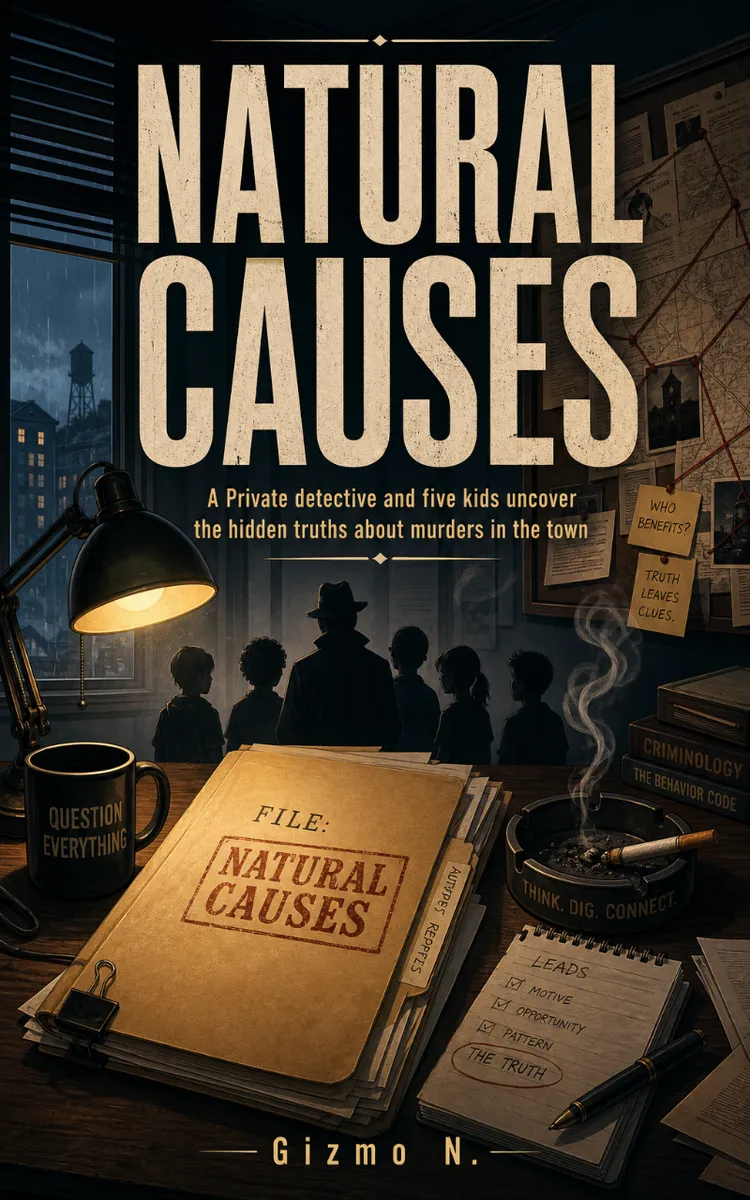
"Natural Causes" is a true crime book by Gizmo N. with 13 chapters and approximately 23,309 words. “Natural causes” is what they wrote, and it kept working. In a coastal town where everyone knows everyone, a journalist arrives to chase a pattern of deaths that look ordinary on paper and disappear from conversation in person.
This book was created using Inkfluence AI, an AI-powered book generation platform that helps authors write, design, and publish complete books. It was made with the AI True Crime Book Writer.
Frequently Asked Questions
What is "Natural Causes" about?
“Natural causes” is what they wrote, and it kept working. In a coastal town where everyone knows everyone, a journalist arrives to chase a pattern of deaths that look ordinary on paper and disappear from conversation in person. Jim Holloway is hired to start with the first case, Evelyn Voss. But he is not alone for long. A group of child allies follows him into the places adults will not go, listening at the edges, testing every story, and pulling at threads that lead to a locked records room. When the town’s agreement finally has a name, it is not just a secret. It is a price, and someone paid it in lives. Read now, before the next “ordinary” death makes the paperwork too clean.
How many chapters are in "Natural Causes"?
The book contains 13 chapters and approximately 23,309 words. Topics covered include The First Quiet Death Goes Public, Leon, Mary, Phil, Stacy Test the Story, The Town’s Agreement Has a Name, Jim Forces One Death Onto Record, and more.
Who wrote "Natural Causes"?
This book was written by Gizmo N. and created using Inkfluence AI, an AI book generation platform that helps authors write, design, and publish books.
How can I create a similar true crime book?
You can create your own true crime book using Inkfluence AI. Describe your idea, choose your style, and the AI writes the full book for you. It's free to start.
Write your own true crime book with AI
Describe your idea and Inkfluence writes the whole thing. Free to start.
Start writingCreated with Inkfluence AI


