

Read the first chapter
The whole of chapter one, free. About 8 min. Turn the pages with the arrows, your keyboard, or a swipe.
Chapter 1
The Door in the Conservatory
The key to the conservatory was warm from Mina Viera ’s hand, though the iron gate beneath the porch stood cold enough to sting her fingers.
She tried it once. The lock gave with a reluctant click.
Beyond the gate, the conservatory crouched against the abandoned estate, its glass roof black with rain and its panes filmed in green. Dead vines had threaded themselves through the brass framework. Somewhere inside, a loose shutter tapped at regular intervals, patient as a fingernail against a door.
Mina lifted her torch.
“I’m only looking,” she said, and disliked how quickly the house seemed to answer with silence.
The solicitor had given her until Friday to inspect the property before the sale. After that, the estate would belong to strangers, and whatever lay behind the sealed gallery would become someone else’s problem. She had expected dust, broken furniture, perhaps the usual evidence of neglect. She had not expected the key to feel warm. She had not expected the conservatory doors to be unlocked.
She pushed them open.
The hinges made a low, wet groan. Rain ticked against the glass overhead. Ferns had grown wild in cracked stone beds, their fronds brushing her coat as she entered. The air was colder than outside, carrying the mineral damp of earth and the faint metallic scent of old water.
At the far end stood a pair of oak doors.
A brass plate above them had been polished recently.
MIRROR GALLERY.
Mina stopped beneath it.
The solicitor had mentioned the gallery only once, in an irritated aside while sorting through the estate papers. It had been sealed for decades, he’d said. No one had a key. The room was not included in the sale inventory because it was structurally unsafe.
Yet the doors had no dust on their handles.
Mina crossed the conservatory. Her boots crushed something brittle underfoot. A white moth, dead and papery, broke apart beneath her heel.
The right-hand door carried three iron bolts. All three had been drawn back.
She touched the handle.
From beyond the door came a small sound.
Not a knock. Not movement.
A breath drawn through teeth.
Mina pulled her hand away.
“Hello?”
The conservatory gave her voice back in pieces. Hello. Hello.
She waited, torch raised.
Nothing answered.
Her reflection appeared faintly in the dark glass beside the doors: pale face, wet hair escaping from its tie, one hand clenched around the torch. The reflected hand seemed slower to settle. It lowered a moment after hers.
Mina turned sharply.
The glass showed only her.
She looked at the gallery doors again. The sale papers were folded inside her coat. She had come for an inventory, for photographs, for proof that the room contained nothing worth preserving. That was all. If she left without seeing it, she would spend the night imagining what she had missed, and the thought of that was worse than entering.
She drew back the bolts.
The first slid free with a shriek. The second dropped heavily into its socket. The third was already open.
The door swung inward.
Her torch beam entered a long corridor lined with mirrors.
Not a gallery. A corridor.
The ceiling should have been visible beyond the doorway, but the beam found only a narrowing passage of dark wood and silvered glass. Mirrors rose from floor to ceiling on both sides, their frames different in age and style: black lacquer, carved oak, tarnished gilt, plain white plaster. Their surfaces were dim, clouded, or entirely black.
Mina stood at the threshold.
Behind her, the conservatory remained exactly where it had been. Ferns. Rain. The dead moth beneath her boot.
Ahead, somewhere far inside the impossible corridor, a door stood open.
She stepped through.
The temperature fell at once. Cold pressed through her coat and settled along her neck. Behind her, the conservatory doors clicked shut.
Mina spun and seized the handle.
It would not move.
She pulled harder. The wood shuddered under her grip, but the latch held fast.
“Fine,” she whispered. “I’ll go through.”
Her voice traveled down the corridor. The mirrors caught it. For an instant, she heard several versions of herself speaking at once, each one softer than the last.
She forced herself to face forward.
Her torch beam trembled across the nearest glass. Her reflection stood there in the same dark coat, the same damp hair, the same strained mouth. It watched her with a delay of less than a second.
Mina raised her left hand.
The reflection raised its right.
She lowered her hand.
The reflection kept its arm lifted.
Mina’s pulse struck once, hard enough to hurt. She backed away. The reflected figure lowered its hand then, but not before its fingers had curled slowly into a fist.
A dull thump sounded farther down the corridor.
Mina moved toward it.
The gallery changed as she walked. The first passage had been narrow, barely wide enough for two people. After twenty steps, it opened into a room with a domed ceiling and a tiled floor. She glanced back.
The door to the conservatory was gone.
Mirrors filled the walls. Some reflected the room. Others showed fragments of places she did not recognize: a staircase drowned in blue light, a dining room with its chairs turned toward the wall, a garden under snow.
In one mirror, Mina saw the back of her own head.
She was standing in the room.
The image stood in a corridor.
It faced away from the glass, looking down an unseen passage. Something moved behind it, low and pale, slipping past the edge of the frame.
Mina stepped closer.
The image did not react.
She lifted the torch toward the mirror. The beam struck the silvered surface and split into a pale star.
“Where is the door?” she asked.
In the glass, her reflected head turned.
Mina did not.
The figure looked over its shoulder at her. Its face was hers, but older around the eyes, stretched thin by a grief Mina had never felt. The mouth opened.
No sound emerged.
Mina stumbled backward.
The reflection turned away and began walking.
She followed before she could stop herself.
The mirror’s corridor extended beyond its frame, each step of the reflected Mina carrying her deeper into a version of the gallery that could not exist. The real room remained still around her, but the image moved farther away, shrinking beneath a ceiling crossed with black beams.
Then it stopped before a door.
The door was painted red.
Mina looked to her left. A red door stood in the actual gallery.
It had not been there a moment earlier.
Its paint was blistered. A narrow line of light showed beneath it.
Mina approached. The floor tiles changed beneath her boots, white becoming gray, gray becoming a pattern of small black diamonds. The air carried a faint warmth now, and beneath it the smell of dust disturbed after years.
She placed her hand on the red door.
From the other side came three knocks.
Mina withdrew her hand.
Three more knocks.
“Who is there?”
A voice answered.
Her voice.
“Open it.”
The words came through the wood in a whisper, but the whisper had an impatient edge. Mina pressed her ear to the door. Something breathed on the other side.
“Show yourself.”
“Open it.”
She should have gone back. She knew that with the clear, practical part of her mind that had made lists for the solicitor and checked the estate maps twice. Instead, she reached for the handle.
The door opened inward.
Beyond it was the conservatory.
Rain streaked the glass roof. Ferns crowded the stone beds. The outer gate stood open.
Mina stared at the scene, unable to move.
Then she saw herself standing inside it.
The reflected Mina was at the far end of the conservatory, beside the oak doors. She faced the gallery, though the angle should have shown her back. Her face was turned toward Mina through the open red doorway.
She was smiling.
Not widely. Not with joy.
With recognition.
Mina slammed the red door.
The sound cracked through the gallery. Every mirror answered. Glass rang in its frames. Somewhere behind her, a latch lifted.
She ran.
The room stretched as she crossed it. The mirrors multiplied, their frames pressing close enough to catch her sleeves. In each one, she appeared at a different distance. In one, she was still standing by the red door. In another, she was kneeling. In a third, she was looking directly at something behind her.
Mina refused to turn.
Her torch flickered.
The gallery floor tilted. She struck the wall, palm scraping over cold gilt. A mirror beside her showed a narrow wooden door with a brass handle. She reached for the place where it should have been.
Her fingers met glass.
Inside the mirror, her reflection stood with its hand pressed against the opposite side.
Mina stared at it.
The reflection’s smile had vanished. Its face was frightened now.
It mouthed a warning.
Mina leaned closer.
Behind the reflected figure, the gallery door opened.
A tall shape entered the corridor. It had no face, only a pale oval where one should have been.
The reflection looked past Mina, toward the thing in the mirror, and began to pound on the glass.
Mina turned.
The corridor behind her was empty.
When she faced the mirror again, the reflected Mina was gone.
The shape remained.
It lifted one hand.
Mina struck the glass with her torch.
The mirror cracked from corner to corner. A shriek burst through the gallery - not from the glass, but from every mirror at once. The floor bucked under her feet. The hidden door appeared in the wall beside her, narrow and real, its brass handle cold against her palm.
She seized it and pulled.
A rush of warm, wet air struck her face.
The conservatory lay beyond.
Mina fell through the doorway and hit the tiled floor on both hands. The oak doors slammed behind her. She crawled away as the bolts dropped into place one after another.
The conservatory had changed.
The rain had stopped. Water still slid down the glass roof, though no drops struck above. The ferns stood motionless. Her torch had gone out.
Mina pushed herself upright.
Across the conservatory, the outer gate was open.
She crossed the room without looking at the gallery doors. Her hand closed around the gate, and this time the iron was warm.
Outside, the estate grounds waited under a bruised evening sky. Gravel shifted beneath her boots. She made it three steps before she saw the glass.
The conservatory windows reflected the dark garden.
They also reflected Mina.
All of them showed her standing outside the gate.
All except one.
In the highest pane, beyond the oak doors, a second Mina remained inside the gallery.
She stood perfectly still, one hand resting against the cracked mirror.
Her face was turned toward the glass.
Toward the place where Mina stood.
And though the real Mina had begun to run, the reflection did not follow.
End of chapter one. 39 more chapters and about 77,328 words in the full book.
Swipe or use the arrows to turn the page


What's inside: 40 chapters
- 1. The Door in the Conservatory
- 2. The Face at the Window
- 3. The Missing Inventory
- 4. The Staircase That Ends
- 5. The Face She Practiced
- 6. The House Loses Its Power
- 7. A Name Beneath the Silver
- 8. The Corridor of Reversed Doors
- 9. The Woman in the Glass
- 10. The Shattered Lantern
- 11. The Portrait Behind the Wall
- 12. The Conservatory Glass Gives Way
- 13. The Self She Could Become
- 14. The Bell Rings Below
- 15. Rusk's Last Measurement
- 16. The Passage Under the Pantry
- 17. The Name She Forgot
- 18. The House Repeats Her Voice
- 19. The Mirror in the Well
- 20. The Room That Was Never Built
- 21. The Face She Chose
- 22. The Laundry Door Seals
- 23. Ivo's Marks on Stone
- 24. The Hall Turns Inward
- 25. The Memory Behind Her Eyes
- 26. The Glass Floor Breaks
- 27. The Ledger of Borrowed Faces
- 28. The Maze Without a Horizon
- 29. The Double Opens the Gate
- 30. Mara's Face Goes Missing
- 31. The Mother in the Silver
- 32. The Exit Behind the Veil
- 33. The Name She Keeps
- 34. Rusk's Final Instruction
- 35. The Central Mirror Falls
- 36. The Face in the Dust
- 37. The Stairway to Morning
- 38. Ivo at the Orchard Gate
- 39. The Estate Changes Hands
- 40. A Reflection Without a Room
About this book
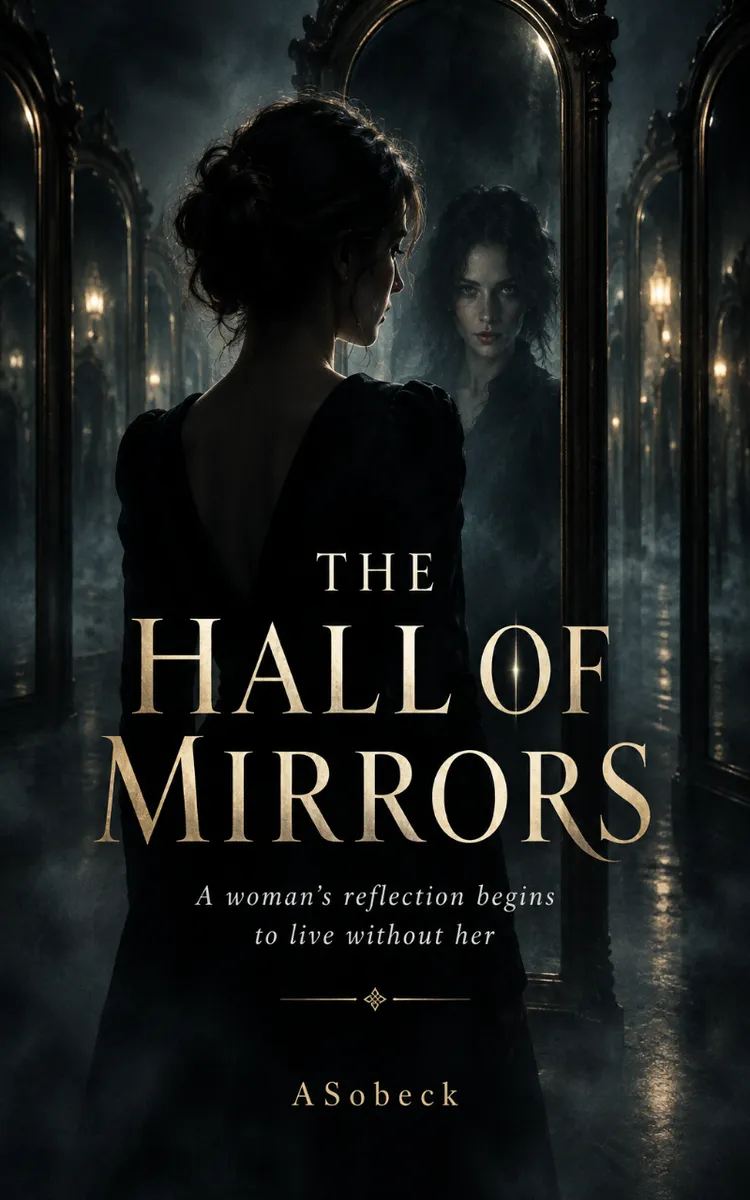
"The Hall Of Mirrors" is a fiction book by ASobeck with 40 chapters and approximately 77,328 words. Mina Viera has until Friday to inspect the abandoned estate before it is sold. Behind its locked conservatory, a reflection wears her face and makes an expression she has never made.
This book was created using Inkfluence AI, an AI-powered book generation platform that helps authors write, design, and publish complete books. It was made with the AI Novel Writer.
Frequently Asked Questions
What is "The Hall Of Mirrors" about?
Mina Viera has until Friday to inspect the abandoned estate before it is sold. Behind its locked conservatory, a reflection wears her face and makes an expression she has never made. She tries to blame the rain, the warped glass, the long-empty rooms. Then the image follows her to the west sitting room. With Ivo beside her and a brass poker in hand, Mina searches the house for the mirror and the reason it chose her. Behind them, something taps on the door in the same patient rhythm as before. The sale is coming. The house is answering. And Mina’s reflection is no longer content to stay behind the glass.
How many chapters are in "The Hall Of Mirrors"?
The book contains 40 chapters and approximately 77,328 words. Topics covered include The Door in the Conservatory, The Face at the Window, The Missing Inventory, The Staircase That Ends, and more.
Who wrote "The Hall Of Mirrors"?
This book was written by ASobeck and created using Inkfluence AI, an AI book generation platform that helps authors write, design, and publish books.
How can I create a similar fiction book?
You can create your own fiction book using Inkfluence AI. Describe your idea, choose your style, and the AI writes the full book for you. It's free to start.
Write your own fiction book with AI
Describe your idea and Inkfluence writes the whole thing. Free to start.
Start writingCreated with Inkfluence AI


