

Read the first chapter
The whole of chapter one, free. About 9 min. Turn the pages with the arrows, your keyboard, or a swipe.
Chapter 1
The First Landing at Qui Nhon
The first tire sank to its axle before the landing party had finished unloading.
Kane watched the truck lurch sideways in the pale sand, its canvas cover snapping in the sea wind. Beyond it, the South China Sea flashed between rows of palms, bright and indifferent. Behind him, Hueys settled onto the Qui Nhon strip in pairs, rotor wash flattening the grass and driving grit against the men’s faces.
“Get the winch,” Kane shouted. “And keep the next truck off this road.”
The driver climbed down, boots disappearing into the sand. Men from Kane’s company moved around him with the uncertain speed of soldiers who had trained for movement but not for this ground. Crates of ammunition, mortar baseplates, water cans, radios, and canvas rolled through the blowing dust. Their equipment had arrived by ship and aircraft in separate pieces. The company existed in theory. On the coast, it was a collection of men and heavy objects waiting to be joined.
Ray Delgado came up beside Kane, one hand shielding his eyes.
“That road to An Khe?” he asked.
Kane looked inland. The route began as a strip of packed earth between paddies and low huts, then disappeared toward the dark shoulders of the mountains. Trucks stood nose to tail along it, some military green, some civilian, all overloaded. A bulldozer had broken down ahead of them. Vietnamese laborers watched from beneath conical hats while American soldiers tried to direct traffic with arm signals no one understood.
“That’s the road,” Kane said.
Delgado studied the traffic. “Looks more like a suggestion.”
Kane had been told the division could lift a battalion, move it twenty miles, and put it on the ground before a conventional unit had finished loading its trucks. He had believed the arithmetic. Helicopters were supposed to make distance behave differently.
But the company’s first movement had begun with trucks.
“Get the company moving,” Kane said. “I want the heavy gear loaded first. Anything that can’t make the road goes on a bird.”
Delgado glanced toward the Hueys. Their crews were already shutting down, crouched beneath the slowing blades.
“Birds aren’t taxis, Captain.”
“No. They’re what we have.”
“They’re what somebody else has scheduled.”
Kane ignored the warning and walked toward the stranded truck. The winch cable came snaking from a second vehicle, its steel hook clattering over the sand. The driver looked young enough to be one of Kane’s riflemen. His face was gray with embarrassment.
“Sir, she’s buried.”
“I can see that.”
“We’ll have her out.”
“Then get her out.”
The cable tightened. The truck’s rear wheels spun, throwing wet sand against the men’s trousers. For a moment nothing moved but the tires. Then the vehicle jerked free, rose crookedly, and rolled backward onto firmer ground. A cheer went up from the soldiers nearby, more relief than celebration.
Kane climbed onto the running board and looked down the line. The company’s vehicles were packed with gear lashed under tarps. Men sat on ammunition boxes or leaned against tires, rifles between their knees. Heat pressed through his fatigues. The sea wind had dropped, leaving the air thick with diesel fumes and the sour odor of mud.
“Move!” he called. “We’re burning daylight.”
The convoy crawled inland.
For the first few miles, the road ran flat and open. Rice paddies spread on either side, their water trembling whenever a truck passed. Children stood along the dikes and waved. Women watched without expression. Kane saw no enemy, but the lack of cover made him uneasy. A rifleman could fire from a hut, a hedgerow, or the green wall beyond the fields and vanish before anyone found the muzzle flash.
The convoy halted behind a bridge made of timber and optimism.
A Vietnamese engineer crew had removed half the planks. The remaining span bowed over a brown canal. On the far side, a bulldozer waited beside a mound of earth, its blade sunk in the bank. Trucks idled behind Kane, exhaust drifting low across the road.
Delgado came forward. “We can take the gear off and hand-carry it.”
“Not the mortars.”
“Then we leave the mortars and come back.”
Kane looked at the bridge. A company without its mortars was a company asking someone else for protection. He could already hear the radio traffic that would follow: delayed movement, incomplete load, no established position. The division had landed with a promise of speed. He did not intend to arrive at An Khe as a disassembled unit.
“Get the engineers,” Kane said.
“They’re already working.”
“Then find out what they need.”
Delgado gave him a flat look. “They need a bridge.”
Kane stepped onto the first plank. It flexed beneath his boot. Below, brown water moved through reeds and floating trash. He crossed three steps and stopped where the boards ended.
A Huey thundered overhead, low enough that Kane saw the crew chief crouched in the open doorway. The helicopter banked inland toward the mountains, its shadow racing over the paddies. Men along the road looked up automatically.
“That,” Kane said, pointing after it, “is how we’re supposed to move.”
Delgado squinted into the sky. “That bird doesn’t have to carry a bridge.”
Kane turned to him. “Can we get the mortar tubes across?”
“With enough men.”
“Then do it.”
The men formed a line. Crates passed from hand to hand. The mortar tubes came next, awkward and slick with grease. A rifleman lost his footing and went knee-deep into the canal. Laughter broke out, nervous and brief. Delgado hauled him up by the web gear and sent him back to work.
The bridge held.
By late afternoon the mountains had drawn close. The road narrowed between scrub and low forest, climbing in uneven bends toward An Khe. Trucks overheated. One threw a fan belt. Another lost a tire. Each delay stretched the column, leaving gaps large enough for trouble. Kane rode in the lead jeep, radio handset pressed to his ear, listening to the convoy commander report failures in a voice that grew less patient with every mile.
“Truck fourteen is down.”
“Tell them to push it.”
“Truck fourteen has no power.”
“Then unload it.”
“We’re already unloading truck nine.”
Kane looked back. The road behind him was empty except for dust. The last vehicles were somewhere beyond the bend, their position unknown. He imagined a handful of enemy soldiers watching the column string itself through the hills, counting trucks, noting where the intervals opened.
“Delgado,” he said, “take a squad back to the rear.”
“Which squad?”
“The nearest one.”
“That would be the one carrying the company radios.”
Kane hesitated.
The radio sets were not yet distributed. The batteries were packed in a convoy truck behind them, along with medical supplies and spare dressings. He had known that before leaving the coast, but the knowledge had been abstract, buried beneath manifests and loading instructions.
“Take another squad,” he said.
Delgado nodded. “That one will be carrying the mortar ammunition.”
“Ray.”
“I’m going.”
He moved off, calling for men. Kane watched him disappear into the dust, then turned toward the mountains.
A burst of static snapped in the handset. “Kane, this is convoy control. We have a report of a blocked road ahead. Civilian traffic, unknown obstruction.”
“How far?”
“Less than two miles.”
Kane looked at the fading light. “Send a security team forward. Have the trucks close up.”
The answer came through broken by interference. “Security team is with the rear element.”
Kane felt the first clean edge of fear. Not panic. Not yet. Something colder: the realization that the company’s parts could not all be in the same place at once.
He grabbed the driver’s shoulder. “Take us forward.”
The jeep climbed. The road bent around a granite outcrop and entered a stand of trees. A line of ox carts blocked the way, their drivers shouting at one another. A dead truck sat sideways across the road. No one could explain who had abandoned it or why.
Kane jumped down and moved among the carts. Chickens scattered beneath his boots. A boy stared at his rifle. The American convoy pressed from behind, engines growling, men yelling for room.
“Clear this road!” Kane shouted.
Nobody understood him.
He found a Vietnamese policeman near the ditch and pointed toward the truck, then toward the shoulder. The policeman argued. Kane drew his pistol, not quite raising it, and pointed again. The argument ended. Men began dragging sacks from the carts.
A rifle cracked somewhere in the trees.
The sound was single and sharp. Every soldier on the road dropped or turned toward it. For several seconds the convoy became still except for the ticking engines.
Another shot did not come.
Delgado appeared through the dust with eight men behind him. “You all right?”
“Fine. Get the rear moving.”
“Shot came from the left.”
“I heard it.”
“Could be a hunter.”
“Could be.”
Delgado looked toward the trees. “Hunters usually don’t shoot once.”
Kane raised the handset. “All vehicles, close the interval. Weapons ready. No one leaves the road without permission.”
The convoy began moving again, slower now. Riflemen stood in the beds of the trucks, scanning the brush. Kane kept his pistol loose in his hand until the road widened and the last light drained from the sky.
They reached the An Khe site after dark.
There was no camp waiting for them. Only a scraped patch of red earth, a few engineer vehicles, and stakes marking where tents would go. Floodlights threw hard white cones across the clearing. Beyond them, the jungle rose black and close.
The men climbed down stiffly. Some had spent twelve hours sitting on ammunition boxes. Others had walked sections of the road to keep trucks moving. They began unloading by lantern light, laying crates in rough rows while engineers shouted measurements and bulldozers coughed in the darkness.
Kane stood beside the company command post, which consisted of a folding table and a radio operator trying to raise someone with a working set.
“Captain,” the operator said, “we’re missing the battery boxes.”
Kane turned. “How many?”
“All of them.”
“Check the other trucks.”
“We did.”
Delgado came up carrying a medical chest. He set it on the table and opened it. Inside were two rolls of gauze, a bottle of iodine, and a handful of syringes.
“Medical stores,” he said. “This is the whole lot.”
Kane stared at the chest. “Where’s the rest?”
“Still at Qui Nhon, or between here and there.”
The radio operator looked up. “Sir, we can’t reach battalion without batteries.”
For a moment the noise of the site seemed to recede. Men drove stakes into the red earth. A bulldozer pushed dirt over the first latrine trench. Somewhere in the trees, a night insect shrilled and stopped.
Kane looked toward the dark road they had come up. The company was inland. The mortars were present. Most of the men and vehicles had made it. The first move had succeeded, if success could be measured by arrival.
Delgado shut the medical chest.
“Could be worse,” he said.
Kane looked at him.
Delgado shrugged. “We could have left the ammunition behind.”
A Huey came in low over the clearing, rotors beating dust across the men and tents. Its landing lights swept over the raw camp, the waiting crates, the rifles stacked beside sleeping rolls. For a few seconds the helicopter hovered above them, powerful enough to lift men from the coast and set them down among the mountains.
Then it settled, and the dust swallowed everything.
Kane watched the crew chief jump out and wave the pilot clear. The helicopter had brought something - orders, perhaps, or officers from division - but not the batteries his company needed to speak beyond the perimeter, and not the medical supplies they would need if the road gave them a reason.
He turned to Delgado. “At first light, send a team back.”
“With what radio?”
“Messenger. Jeep. Whatever works.”
Delgado nodded toward the black ridgeline. “And tonight?”
Kane looked at the men digging fighting positions around their unfinished camp. “Tonight we guard what made it here.”
Delgado gave a dry, humorless smile. “That’s the First Team.”
Kane listened to the rotors wind down. In the sudden quiet, the mountains seemed nearer than they had from the road.
End of chapter one. 39 more chapters and about 90,828 words in the full book.
Swipe or use the arrows to turn the page


What's inside: 40 chapters
- 1. The First Landing at Qui Nhon
- 2. A Camp Built from Rotor Wash
- 3. Tracks Beyond the Perimeter
- 4. The Ridge That Wouldn't Hold
- 5. The Horsehead Patch
- 6. The Lift to Plei Me
- 7. The Missing Platoon
- 8. The Valley's Narrow Door
- 9. A Letter from Home
- 10. The Empty Extraction Zone
- 11. The Gunship's Warning
- 12. The Rain-Sealed Trail
- 13. The Cost of the Patch
- 14. The Rear Guard's Silence
- 15. The Scout's Unmarked Map
- 16. The Village Under Canopy
- 17. Delgado's Old War
- 18. The Plei Me Debrief
- 19. The First Binh Dinh Lift
- 20. The Count That Didn't Add Up
- 21. Mercer's First Night Watch
- 22. The Rice Cache Blast
- 23. The Village Ledger
- 24. Monsoon on the Landing Zone
- 25. Brooks Names the Insult
- 26. The Broken Radio Net
- 27. The Scout's Second Account
- 28. The Ravine Crossing
- 29. The Orders for Thayer
- 30. The Men Left Behind
- 31. The Thayer Signal
- 32. The Clouded LZ
- 33. A Captain's Unsent Letter
- 34. The Question at the Fire Base
- 35. The Northbound Lift
- 36. Brooks Takes the Platoon
- 37. The Hue Roadblock
- 38. The Medevac Under Fire
- 39. Pegasus Through the Pass
- 40. The Valley Without an Exit
About this book
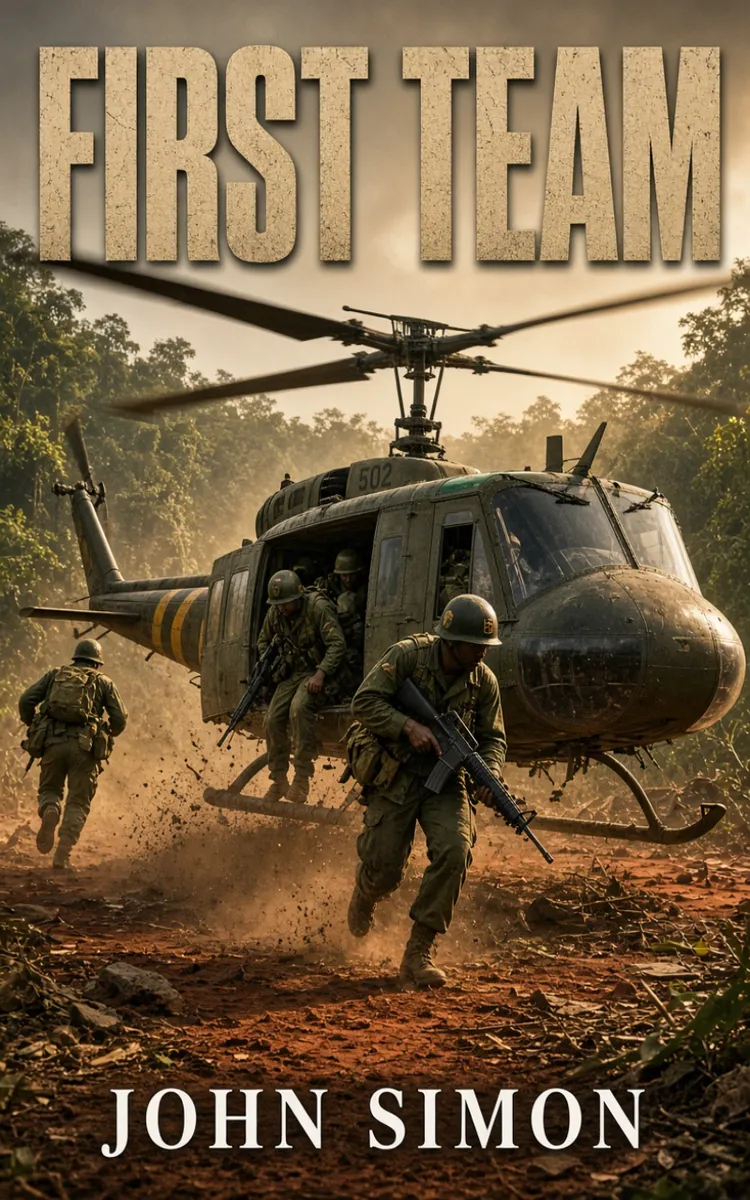
"First Team" is a fiction book by John Simon with 40 chapters and approximately 90,828 words. A 1st Cavalry company confronts the promise and limits of helicopter warfare in Vietnam.
This book was created using Inkfluence AI, an AI-powered book generation platform that helps authors write, design, and publish complete books. It was made with the AI Novel Writer.
Frequently Asked Questions
What is "First Team" about?
A 1st Cavalry company confronts the promise and limits of helicopter warfare in Vietnam
How many chapters are in "First Team"?
The book contains 40 chapters and approximately 90,828 words. Topics covered include The First Landing at Qui Nhon, A Camp Built from Rotor Wash, Tracks Beyond the Perimeter, The Ridge That Wouldn't Hold, and more.
Who wrote "First Team"?
This book was written by John Simon and created using Inkfluence AI, an AI book generation platform that helps authors write, design, and publish books.
How can I create a similar fiction book?
You can create your own fiction book using Inkfluence AI. Describe your idea, choose your style, and the AI writes the full book for you. It's free to start.
Write your own fiction book with AI
Describe your idea and Inkfluence writes the whole thing. Free to start.
Start writingCreated with Inkfluence AI


