
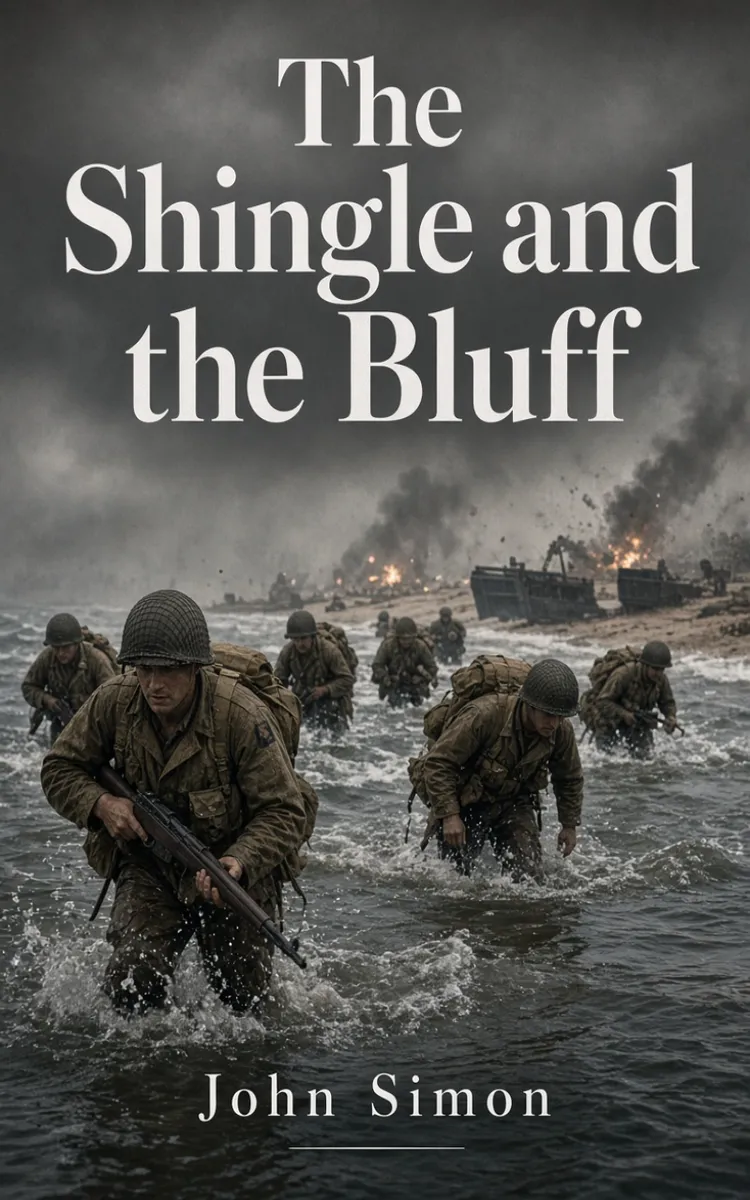

Read the first chapter
The whole of chapter one, free. About 10 min. Turn the pages with the arrows, your keyboard, or a swipe.
Chapter 1
The Ramp Drops Offshore
The coxswain’s hand signal came through the red light: five minutes.
Ray “Red” Kovacs checked the men by touch because there was too little light to see them clearly. Rifle stocks, web gear, helmet rims, the hard metal of ammunition boxes. The LCVP pitched beneath them, rising on a black swell and dropping into the trough with a jar that drove shoulders together. Water slapped against the hull. Somewhere forward, a man retched into his hands.
“Keep your weapons up when the ramp drops,” Kovacs said. “No one steps on anybody. Move straight ahead.”
The words sounded thin under the engine and the distant concussion of the fleet’s guns. They had been told the beach would be under fire, but the bombardment would have broken the German positions. The Navy would flatten the guns. The tanks would come in ahead of them and give the men something to follow.
Kovacs had stopped believing in the tanks when he saw the empty water around them.
A flash opened on the horizon. Another followed, farther inland, followed by the low rolling concussion that reached the boat after the light had gone. The shells were falling beyond the bluffs. He could see no fire on the beach, no wrecked bunkers, no smoke rising from the wire. The German positions remained a dark, unbroken line above the surf.
Danny Ellis sat two men away, pale beneath the rim of his helmet. He had vomit dried on one sleeve. His rifle was clutched between his knees, muzzle pointed at the deck.
“Ellis,” Kovacs said.
Danny looked up.
“Check your safety.”
“It’s on.”
“Check it.”
Danny fumbled with the lever. “Off.”
“Good. Keep it that way.”
The lieutenant crouched near the ramp, one hand braced against the side. His face was young and tight, the stripes of water on his helmet shining in the red light. He had been given the platoon in England and still carried the habit of looking toward someone else before making a decision.
“How far?” he asked.
Kovacs looked toward the bow. Through the open slit in the canvas, Omaha was a strip of gray beneath a low sky.
“Too far,” he said.
The lieutenant heard him. “The coxswain says he has to drop us.”
“He drops us where he can.”
Another burst of gunfire stitched across the water. Red tracer rose from the shore, level and deliberate, then vanished into the morning haze. Men shifted in the boat. The sound went through them before the bullets did.
Kovacs counted faces. Not because counting would save them, but because he needed to know who he was losing.
Danny. The BAR gunner with his weapon wrapped in a shelter half. The medic hunched over his bag. The engineer carrying the heavy charges against his chest. Three men from his squad whose names Kovacs knew. A replacement from another company pressed against the far bench. The rest were bodies in the dark, breathing too fast.
The ramp chain clanked.
“Stand up,” Kovacs said.
The boat climbed a wave. Men rose as one, swaying. The ramp began to lower.
Kovacs saw the beach.
It was not close. It lay beyond a broad stretch of broken water, more than a hundred yards away, with the shingle bank no bigger than a thin gray seam at its foot. Obstacles stood in the surf: stakes, hedgehogs, lengths of timber, all waiting for the tide to carry men into them. Beyond the shingle, the bluffs rose dark and steep. German machine guns flashed from somewhere among the earth and concrete.
The lieutenant stared at it.
“That’s not the beach,” Danny said.
“No,” Kovacs told him. “It is.”
The ramp struck the water.
The first men went down hard. Water surged through the opening and struck Kovacs at the waist, cold enough to lock his breath. He stepped off the ramp and found no bottom. His pack dragged him backward. For an instant the boat was above him, a dark wall of steel, and the men behind him were spilling into the water.
“Drop the packs!” someone shouted.
A machine gun opened from shore.
The surface around Kovacs erupted. Men disappeared without cries. A rifle floated past with its sling trailing beneath it. The LCVP’s ramp slammed upward behind him, cutting off the men still inside. He heard the coxswain shouting, then the engine surged, and the boat pulled away toward the flank.
Kovacs kicked free of his pack. The straps caught once around his arm. He tore at them until the weight came loose and sank. His helmet filled with water. He broke the surface and saw Danny ten yards away, flailing beneath the weight of his gear.
“Ellis!” Kovacs shouted. “Turn over!”
Danny turned the wrong way. A wave rolled him onto his back. His rifle slipped from his hand.
Kovacs reached him and seized the front of his jacket. Danny’s eyes were wide, fixed on something behind Kovacs.
“Don’t look at the beach,” Kovacs said. “Look at me.”
“I can’t - ”
“You can. Kick.”
A burst passed over them. The bullets snapped against the water. Kovacs dragged Danny forward, one hand at his collar, the other working his own rifle above the surface. The current pushed them sideways. Men and equipment drifted in the same direction, toward the eastern end of the sector and the obstacles.
The beach seemed to retreat.
Kovacs saw the engineer rise beside a steel hedgehog. He was carrying the charges still. A wave broke over his helmet. He vanished. The medic surfaced near him, one hand gripping his bag, and then a burst struck the water between them. The medic went under without letting go.
“Keep moving!” Kovacs yelled.
Danny coughed and swallowed seawater. “Where?”
“Shingle.”
“Where is it?”
Kovacs pointed. “There.”
A mortar round landed in the surf. The blast lifted water and men together. Kovacs lost Danny’s collar. The cold closed over him. He struck something hard with his knee and came up beneath a tangle of webbing. A man’s hand was caught in it, fingers opening and closing.
Kovacs tore at the straps. The hand went still before he freed it.
He found Danny by the sound of him choking.
“Here!” Danny gasped.
Kovacs turned and saw the replacement’s helmet bobbing beside a wooden obstacle. Danny had one hand on the timber and the other around his rifle, as if the weapon could keep him afloat.
“Leave the rifle,” Kovacs said.
Danny shook his head.
“Leave it.”
“I need it.”
“You need air.”
Danny looked at the beach. Another line of fire swept the water, and a man near the shingle folded forward. Danny released the rifle. It sank immediately.
Kovacs got him moving again. They crawled through the surf by inches, swimming when their feet left the bottom, stumbling when the stones rose beneath them. The shingle was closer now. It was not cover, only a narrow ridge of stones and sand at the base of the bluff, but men were pressed against it, helmets and shoulders barely visible.
A shell struck somewhere inland. The concussion rolled down the face of the bluff and shook loose bits of chalk. Kovacs reached the ridge on his hands and knees. The stones cut through his trousers. He pulled himself up, then hauled Danny after him by the webbing at his chest.
They collapsed behind the shingle.
For several seconds Kovacs could hear nothing but his own breathing. Then the beach returned in pieces: machine-gun fire, men crying for medics, the slap of waves against the stones. Smoke drifted low over the water. The landing craft were gone. No tanks moved through the surf. The beach held only wreckage and bodies.
Danny lay beside him, coughing until he vomited seawater onto the stones.
Kovacs rolled onto one elbow. “You hit?”
Danny shook his head.
“Check.”
Danny searched himself with both hands. “No.”
“Then get your rifle.”
“I lost it.”
Kovacs looked toward the water. A rifle lay half buried in the shallows, its sling caught around a body. He pointed.
“Go.”
Danny stared at him.
“Go now.”
The boy crawled from cover. Kovacs wanted to stop him, but the thought lasted less than a second. A man without a weapon was another burden. Danny reached the rifle, cut the sling with his bayonet, and dragged it back by the stock. He returned with his face gray and his lips trembling.
“Bolt’s jammed,” he said.
Kovacs took it, worked the action, and cleared sand from the receiver with his thumb. “Try it.”
Danny pulled the bolt. It moved.
A voice called from farther along the shingle. “Easy Company! Anybody from Easy?”
Kovacs raised his head. A man in a torn life preserver crouched behind a section of timber, his shoulder bleeding through his jacket.
“Second Battalion,” Kovacs shouted. “Sixteenth.”
“Fox Company,” the man replied. “Where’s your lieutenant?”
Kovacs looked back toward the water.
The lieutenant had made it to the shingle. He was on his knees near the edge, one hand clamped to his throat. Blood ran between his fingers. He tried to rise and fell against the stones.
Kovacs crawled to him. The lieutenant’s eyes found his.
“Get them moving,” he said.
“Medic!”
The medic’s bag floated face down in the wash. Kovacs looked for the man who had carried it and saw only helmets shifting in the surf.
The lieutenant tried to speak again. Blood bubbled at his mouth.
Kovacs pressed a hand against the wound, though he knew the pressure was useless. The lieutenant gripped his sleeve with surprising strength.
“Move them,” he said.
Then his grip loosened.
Kovacs stayed there one second longer than he could afford. A burst struck the stones above his head, spraying grit across his face. He rolled behind the ridge and grabbed Danny by the shoulder.
“Get the men together.”
Danny looked at the lieutenant. “Sir?”
“He’s gone.”
The words did not sound like anything. They were only another fact, as plain as the distance to the water.
Kovacs rose into a crouch and looked along the beach. The platoon had become scattered pieces. A BAR gunner lay behind a wrecked obstacle, beating sand from the weapon’s feed cover. Two men from Fox Company crawled toward the same patch of shingle. Farther west, a group tried to move and was driven flat by fire from the bluff.
Kovacs pointed to the men nearest him. “You. Bring him in. You, get that BAR working. Ellis, ammunition.”
Danny stared. “We don’t have any.”
“Find some.”
He moved before fear could stop him. That was enough.
Kovacs crawled to the edge of the shingle and looked inland. The bombardment had done almost nothing. The German positions remained intact, rifles and machine guns firing from the bluff and the houses above it. The beach was packed with men who had nowhere to go. Behind him, the sea carried away the last of the platoon’s equipment.
A voice came from his left.
“Sergeant.”
It was the Fox Company man. He had crawled close, still clutching his wounded shoulder.
“Where do we go?”
Kovacs looked at the wire, the bluff, the open stretch of stones between them. The plan had ended in the water. There was no officer to point inland, no tank line to follow, no clear lane through the obstacles.
He picked up a rifle from beside a dead man and checked the magazine.
“Up,” he said.
The man stared at the bluff. “Up there?”
“That’s where the beach ends.”
The BAR began to fire, short angry bursts. Danny returned with two ammunition pouches and a face that had aged in the minutes since the ramp fell.
Kovacs gathered the men close enough that they could hear him.
“When I move, you move. Stay below the crest. Don’t stop for anything that can’t move with you.”
Danny gripped the recovered rifle. “And if we can’t get up?”
Kovacs looked toward the water. Bodies rolled in the wash. More men were still trying to reach the shingle, but the distance had taken most of them.
“Then we die here,” he said. “So get up.”
He rose first.
The machine guns found them at once. Stones snapped against Kovacs’s boots. The men surged behind him, stumbling over the shingle, dragging the wounded and leaving the dead where they lay. Danny came beside him, firing toward the bluff without aiming, the rifle bucking against his shoulder.
Kovacs reached the first length of wire and threw himself flat. The others piled in behind him. The shingle was theirs, if that word meant anything. It held only a handful of men, a jammed BAR, two rifles, one wounded Fox Company soldier, and Danny Ellis breathing hard beside him.
Below them, the surf kept taking men.
Above them, the German guns waited.
End of chapter one. 39 more chapters and about 87,622 words in the full book.
Swipe or use the arrows to turn the page


What's inside: 40 chapters
- 1. The Ramp Drops Offshore
- 2. Ellis Finds the Shingle
- 3. Shells Fall Too Far Inland
- 4. The Platoon Leader Falls
- 5. Kovacs Counts the Living
- 6. The Next Wave Breaks
- 7. A Lieutenant Takes the Fragments
- 8. The Wire Blocks the Draw
- 9. Ellis Cannot Move
- 10. The BAR Goes Silent
- 11. The Medic Leaves Cover
- 12. The Engineer Finds a Charge
- 13. Ellis Holds the BAR
- 14. The Bluff Answers Back
- 15. A Stranger Knows the Gap
- 16. The Obstacles Close In
- 17. Ellis Carries the Charge
- 18. The Lieutenant Loses Contact
- 19. The Wire Gives Way
- 20. The Ridge Still Fires
- 21. Kovacs Chooses the Climb
- 22. The First Climb Fails
- 23. The Fox Soldier Returns
- 24. The Draw Becomes a Funnel
- 25. Ellis Returns to Kovacs
- 26. The Medic Is Cut Off
- 27. The Strongpoint’s Blind Side
- 28. The Orchard Offers No Cover
- 29. The BAR Fires One Last Burst
- 30. Kovacs Cannot Save Everyone
- 31. A Runner Knows the Village Road
- 32. The Roadside Ditch Fails
- 33. Ellis Takes the Wounded Man
- 34. The Hedge Hides No Exit
- 35. The Strongpoint Falls Silent
- 36. Ellis Rejoins the Survivors
- 37. Colleville’s Edge Holds
- 38. The Names at Dusk
- 39. The Foothold Narrows
- 40. Nightfall on Easy Red
About this book
"The Shingle And The Bluff" is a fiction book by John Simon with 40 chapters and approximately 87,622 words. A fictional platoon’s fight from Omaha Beach to the bluffs on D-Day.
This book was created using Inkfluence AI, an AI-powered book generation platform that helps authors write, design, and publish complete books. It was made with the AI Novel Writer.
Frequently Asked Questions
What is "The Shingle And The Bluff" about?
A fictional platoon’s fight from Omaha Beach to the bluffs on D-Day
How many chapters are in "The Shingle And The Bluff"?
The book contains 40 chapters and approximately 87,622 words. Topics covered include The Ramp Drops Offshore, Ellis Finds the Shingle, Shells Fall Too Far Inland, The Platoon Leader Falls, and more.
Who wrote "The Shingle And The Bluff"?
This book was written by John Simon and created using Inkfluence AI, an AI book generation platform that helps authors write, design, and publish books.
How can I create a similar fiction book?
You can create your own fiction book using Inkfluence AI. Describe your idea, choose your style, and the AI writes the full book for you. It's free to start.
Write your own fiction book with AI
Describe your idea and Inkfluence writes the whole thing. Free to start.
Start writingCreated with Inkfluence AI


