
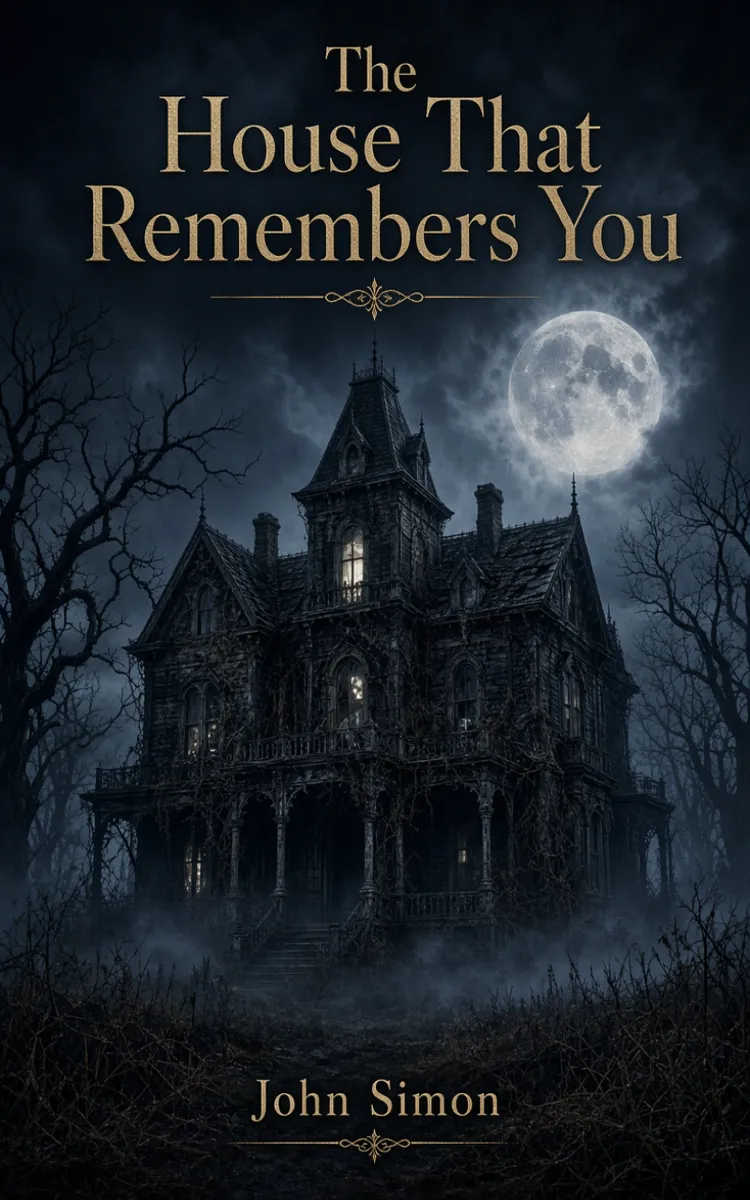

Read the first chapter
The whole of chapter one, free. About 9 min. Turn the pages with the arrows, your keyboard, or a swipe.
Chapter 1
The Inheritance Road
The gate opened before Mara touched it.
Its iron leaves dragged through the weeds with a long, reluctant shriek, revealing a drive almost swallowed by foxglove, nettles, and waist-high grass. Mara stopped at the roadside, one hand tight around the leather folder containing the deed and her renovation plans.
Beyond the gate, the house waited beneath a tangle of black branches.
Grandmother’s house had been built to be seen from a distance. Three stories of dark brick, steep gables, white-trimmed windows, and a central tower rose above the overgrown grounds. Yet the drive turned sharply after the gate, vanishing into vegetation before it reached the front steps.
Mara checked her phone. No signal. The last bar had disappeared ten miles back, along with the paved road.
“Fine,” she said aloud.
Her voice sounded too small in the open country.
She lifted the folder under her coat and started up the drive.
Gravel shifted beneath her boots. Thorn branches caught at her sleeves, and once, something hard scraped her calf through her trousers. She pushed forward without looking down. The property had been empty for eleven years. The survey photographs had shown neglect, but photographs had limits. They could not show the way the trees leaned across the road as if narrowing it. They could not show the wet slap of leaves against her face or the pale moths rising from the grass in a sudden, silent cloud.
At the bend, the house vanished.
Mara halted.
The drive ahead was clear for perhaps twenty feet, then disappeared beneath a wall of ivy and young birch. She looked back. The gate was still visible, a thin black shape between the trees.
She could turn around. Call the estate solicitor from the road. Ask for a grounds crew, a locksmith, a structural engineer. She had made the trip to inspect the place, not to hack through a wilderness with a folding knife.
But the folder pressed against her ribs.
Inside it was the deed bearing her name.
Mara Voss, sole beneficiary.
She had expected anger when the solicitor read the clause. Instead, she had felt only a blankness that had begun after her mother’s funeral and had not yet lifted. Her grandmother had been dead for six weeks. Mara had not seen her in eighteen years.
She stepped off the drive and forced her way through the ivy.
The leaves were cold and slick. Beneath them, the ground dipped without warning. Mara grabbed a branch, caught herself, and felt the folder slide from under her arm. It struck the earth. Papers spilled into the mud.
“No.”
She dropped to her knees.
The deed landed face down, its corner darkening with water. Her sketches fanned across the roots of a tree: a new kitchen wall, restored east windows, a service entrance widened for deliveries. She snatched them up one by one, wiping mud from the margins with her sleeve.
The last page was not hers.
It showed the front elevation of the house, but the proportions were wrong. The tower rose higher, the windows narrower. Someone had drawn a dark rectangle over the front door.
Mara stared at it.
A pencil line ran from the rectangle down through the porch and into the ground, as though the house had been pinned to the earth.
She turned the page over. Blank.
A branch cracked behind her.
Mara spun around.
Nothing moved among the birches. The drive lay empty. Above the trees, the house had reappeared, closer than it should have been.
She stood, gathered the papers, and walked faster.
The front steps were buried under dead leaves. Their stone edges had split from frost, but the iron railings were clean, almost polished. Mara ran her fingers over one. Cold metal bit into her skin.
The front door was painted a dull green. At its center, beneath a brass knocker shaped like a closed hand, someone had scratched a shallow line.
Not a word. A height mark.
Mara looked at it until she understood. The mark reached her shoulder.
She pulled out the key the solicitor had given her.
It was old, long-shanked, and warm from her pocket.
The lock turned before she inserted it.
Mara froze.
The door opened inward by an inch.
A darkness waited beyond the gap, not the ordinary dimness of an unoccupied house but a dense, layered dark that seemed to fill the hall from floor to ceiling. Somewhere inside, a clock ticked. Its rhythm was irregular: three quick beats, then a pause, then one.
Mara pushed the door wider.
“Hello?”
The word traveled into the hall and came back altered, thinner.
She stepped over the threshold.
The temperature dropped at once. Her hands prickled. The air carried the dry scent of old plaster, cedar, and something faintly medicinal. A runner stretched toward a staircase, its pattern worn nearly white. Portraits crowded the walls, their faces dim beneath a film of dust.
Mara shut the door behind her.
The latch clicked.
She turned the key in the lock, testing it. It moved easily. The door opened onto the porch.
Good. A way out.
She left it ajar while she entered the hall.
Her boots made small sounds against the floorboards. The front hall was narrower than it appeared from outside. The staircase should have been directly ahead, according to the listing photographs, but now it stood to the left beneath a tall window. On the right, where she remembered seeing a coat closet, there was a corridor leading toward the back of the house.
Mara stopped.
She had never been inside. Not truly. Her childhood visits had ended before she learned the floor plan, and every memory of them was broken into fragments: a yellow dress, a red glass in a sunlit window, her grandmother’s hand closing around her wrist.
Still, the house was not supposed to be arranged this way.
She unfolded her renovation plans and checked the ground-floor sketch. Front hall. Staircase ahead. Parlor to the right. Dining room behind it. Kitchen at the rear.
She looked up.
The corridor on the right breathed cold air over her ankles.
Mara walked toward it, counting doors. One. Two. The second opened onto a parlor, but the room beyond was not the one shown in the survey. The fireplace occupied the wrong wall. A sheet-covered sofa sat beneath a window that should have looked east.
She backed out.
The hall had lengthened.
The front door was now at the far end, half obscured by shadow. The staircase stood where the corridor had been.
Mara blinked hard.
Her pulse thudded once in her throat. She unfolded the plans again, as if paper could settle the matter.
“Old house,” she said. “Different sight lines.”
The explanation sounded like something she would say to a client who had begun to panic inside a failing building.
She took a photograph with her phone. The screen showed the hall exactly as she saw it: staircase to the left, corridor to the right, green front door behind her.
When she lowered the phone, the corridor had vanished.
In its place stood a wall of dark wood paneling.
Mara stepped back. The floorboard beneath her boot gave a soft creak.
From somewhere above, a woman’s voice said, “You’re late.”
Mara looked up.
The staircase rose into darkness. No one stood on it.
“Grandmother?”
The name came out before she could stop it.
Silence followed. Then the clock began ticking again, three quick beats, a pause, one.
Mara’s grief had always been strangely physical around her grandmother’s name. It gathered behind her breastbone, not sharp enough to be pain, not distant enough to be absence. She had not cried at the funeral. She had not cried when the solicitor handed her the keys.
Now her eyes burned.
“Mrs. Voss?” she called, hating herself for the tremor in her voice.
A floorboard creaked overhead.
Mara climbed the stairs.
The banister felt damp beneath her palm. Halfway up, she passed a portrait she had not noticed from below: a young woman in a high-collared black dress, her face turned slightly away. Grandmother, perhaps, though Mara had never seen a photograph of her that young.
The portrait’s eyes were painted toward the staircase.
Toward Mara.
She kept climbing.
At the landing, three doors stood open. The first revealed a narrow room lined with shelves. The second opened onto a bedroom with a brass bed. The third showed only darkness.
Mara stepped into the bedroom.
The furniture was covered, but the bed itself had been made. White sheets. A gray quilt folded at the foot. On the bedside table, a glass of water stood beneath a small lamp.
The lamp was on.
Mara approached slowly. Dust lay everywhere except on the table, the bed, and the floor beside it. A pair of slippers waited there, pointed toward the mattress.
Her size.
She touched the water glass. It was cold. Condensation shone on its sides.
A sound came from the hall.
The front door closing.
Mara rushed out.
The landing was empty. She took the stairs two at a time, the folder clutched against her chest. At the bottom, the green door stood shut.
She crossed the hall and seized the handle.
It did not turn.
Mara pulled harder. The brass bit into her palm.
“Open.”
The house gave no answer.
She tried the key. It slid into the lock but would not rotate. She twisted until her wrist hurt. Nothing.
Behind her, something scraped lightly across the floor.
Mara turned.
The dark wood wall where the corridor had been now held a narrow door. It had not been there before. Its paint was the same dull green as the front door.
A line had been scratched into it at shoulder height.
She backed toward the entrance, still holding the useless key.
“No,” she whispered.
The new door opened inward.
Beyond it was not a passage but the same overgrown drive, seen from the far side of the gate. The gate stood open. Her car waited beyond it, small and silver under the trees.
Mara took one step toward the opening.
The floor shifted beneath her.
Not moved. Shifted - boards sliding with a deep wooden groan. The doorway narrowed. Ivy pressed through the gap, wet leaves brushing the threshold.
Mara lunged.
Her fingers caught the edge of the door just before it slammed shut. The impact jolted her shoulder. She cried out and pulled back, clutching her hand.
The green door was gone.
Only paneling remained.
Mara stood in the center of the hall, breathing hard. Her palm had split where the brass handle cut it. A bright bead of blood rolled down her wrist and dropped onto the floor.
The clock stopped.
For a moment, the house was utterly still.
Then, from upstairs, came the sound of a child laughing.
Mara looked toward the staircase.
The lamp in the bedroom above flickered on, illuminating the landing. At the far end, the portrait of the young woman had changed. The painted figure now faced forward.
Her mouth was open.
Mara could not hear the words, but she knew the shape of them.
Come in.
She looked at the sealed front door, then at the stairs.
Her plans lay scattered beneath her feet. The top page had turned over.
On the reverse, in a hand she did not recognize, someone had written a single sentence in pencil.
Mara Voss has come home.
She bent, picked up the page, and read it again.
Behind her, the lock turned.
End of chapter one. 39 more chapters and about 81,730 words in the full book.
Swipe or use the arrows to turn the page


What's inside: 40 chapters
- 1. The Inheritance Road
- 2. A Room Made Ready
- 3. The Ledger’s Missing Years
- 4. The Sealed Nursery
- 5. The Easier Memory
- 6. The First Wall Opened
- 7. A Name in the Plaster
- 8. The Stair That Wasn’t There
- 9. The Childhood She Preferred
- 10. The House Takes the Plans
- 11. Grandmother’s Repair Notes
- 12. The Conservatory Passage
- 13. The Grief Beneath the Grief
- 14. The Finished Parlor
- 15. A Letter Without Anger
- 16. The Hall of Wrong Doors
- 17. The Name She Forgot
- 18. The House Moves the Exit
- 19. The House’s Old Blueprint
- 20. The Room Beneath the House
- 21. The Memory She Chose
- 22. The Windows Go Blind
- 23. The Grandmother’s Last Account
- 24. The Floor That Gives Way
- 25. The Comfort of Staying
- 26. The House Reopens the Hall
- 27. The Missing Pages Found
- 28. The Attic Without Stairs
- 29. The Unfinished Room
- 30. Mara’s Borrowed Childhood
- 31. The Plan in Her Own Hand
- 32. The Service Core
- 33. The Grief She Keeps
- 34. The House’s First Blueprint
- 35. The Wall Left Open
- 36. The Road Beyond the Gate
- 37. The House from the Road
- 38. The Memory She Writes Down
- 39. The Inheritance Put on Hold
- 40. The Door in the Photograph
About this book
"The House That Remembers You" is a fiction book by John Simon with 40 chapters and approximately 81,730 words. Haunted houses that transform residents through memory, history, and supernatural rules.
This book was created using Inkfluence AI, an AI-powered book generation platform that helps authors write, design, and publish complete books. It was made with the AI Novel Writer.
Frequently Asked Questions
What is "The House That Remembers You" about?
Haunted houses that transform residents through memory, history, and supernatural rules
How many chapters are in "The House That Remembers You"?
The book contains 40 chapters and approximately 81,730 words. Topics covered include The Inheritance Road, A Room Made Ready, The Ledger’s Missing Years, The Sealed Nursery, and more.
Who wrote "The House That Remembers You"?
This book was written by John Simon and created using Inkfluence AI, an AI book generation platform that helps authors write, design, and publish books.
How can I create a similar fiction book?
You can create your own fiction book using Inkfluence AI. Describe your idea, choose your style, and the AI writes the full book for you. It's free to start.
Write your own fiction book with AI
Describe your idea and Inkfluence writes the whole thing. Free to start.
Start writingCreated with Inkfluence AI


