

Read the first chapter
The whole of chapter one, free. About 9 min. Turn the pages with the arrows, your keyboard, or a swipe.
Chapter 1
The Locked Conservatory
The iron gate struck the stone post behind Eleanor with the same sharp report it had made when she was seventeen and taken away.
She did not turn to watch the motorcar disappear. Its tyres hissed over the wet drive, carrying her strained visit and its careful silences back toward London. Ahead, the Vale house rose pale and orderly beneath a November sky, every shutter fastened, every window reflecting the colourless afternoon. At the far end of the lawn, the conservatory stood like a glass box set apart from the house.
A light moved behind its panes.
Eleanor stopped beneath the dripping branches of the yew. The light travelled from left to right, vanished, then returned higher up, as if someone were carrying a lamp along the gallery inside.
“Mrs Vale?”
Hobbs, the butler, had come down the steps. His black coat was buttoned to the throat despite the mildness of the day. Behind him, two maids waited with Eleanor’s cases, their eyes lowered.
“Take those upstairs,” Eleanor said. “I’m going to the conservatory.”
Hobbs’s face altered by no more than a tightening beside the mouth. “Your father gave orders that it is to remain locked.”
“I heard you.”
“Then you understand.”
The light moved again behind the glass.
Eleanor looked past him. “Who is in there?”
“No one, madam.”
“Then why is there a lamp?”
Hobbs glanced toward the lawn. The gesture was small, but it betrayed him. “The conservatory has not been used since spring.”
“Have the windows begun carrying lamps by themselves?”
One of the maids made a frightened sound and immediately disguised it as a cough.
Hobbs descended the steps. “Your father does not wish you going there.”
“My father is in Washington.”
“He left instructions.”
“My father left instructions about a locked room before he left the country?”
“He left instructions about you.”
The words settled between them with the weight of something rehearsed.
Eleanor felt the old heat rise beneath her collar. It was always the same. A room would be made ready for her, a tray placed at the proper hour, her name spoken gently, and beneath every kindness lay the firm hand that had once signed her admission papers. When Eleanor had laughed too loudly at dinner, refused to receive a minister’s wife, and slept through three mornings in succession, her father had called it a distressing indiscretion. The physicians at St. Agnes had called it agitation. The nurses had strapped her wrists when she asked to go home.
She had returned polished, quiet, and obedient.
No one had asked whether she was better.
“I am no longer a child,” she said.
“No, madam.”
“Then move aside.”
Hobbs did not move. “I cannot.”
The light passed across the conservatory once more. This time Eleanor saw the shape of a hand against the upper pane. It pressed there, pale and narrow, then withdrew.
She stepped off the path.
“Madam.”
The wet grass soaked through the thin leather of her shoes. Behind her, Hobbs called for the gardener, but Eleanor kept walking. The conservatory had always been her mother’s refuge, filled with palms, orange trees, and white iron furniture. As a girl, Eleanor had hidden there during her father’s diplomatic receptions, listening to laughter spill through the open doors while the adults praised the Vale family for its composure.
She had not seen it since before St. Agnes.
The nearer she came, the colder the air became. The glass panes were filmed with condensation from within. The brass handles had been bound together with a chain, and a new padlock shone beneath the rust.
Eleanor placed her palm against the door.
Warmth met her skin.
Someone was inside.
She leaned closer. Water ticked from the roof gutter. Somewhere beyond the glass, a branch scraped softly against a pane.
“Who is there?” she called.
No answer.
A figure moved between the palms. Eleanor saw a shoulder, then the wavering glow of a lamp. The plants had grown wild against the ceiling, their leaves black and shining. Something knocked over a pot.
Eleanor stepped back.
Hobbs reached her, breathing hard but still composed. “Please come inside.”
“Open it.”
“I have no key.”
“Fetch one.”
“I cannot.”
“Then fetch my father.”
“He is not here.”
“Fetch someone who can tell me why a person is walking around in a locked room.”
Hobbs’s eyes flicked toward the glass. His colour had drained.
“There is no person,” he said.
The lamp went out.
Darkness filled the conservatory, though the afternoon had not yet faded. Eleanor remained facing the glass. Her reflection hovered there, pale and indistinct, the brim of her hat making a black line across her forehead. Behind it, the room seemed to deepen.
Then something tapped on the pane.
Three times.
Eleanor’s breath caught. She raised her hand and tapped once in reply.
Hobbs seized her wrist.
“Do not,” he said.
His fingers were cold and strong. For an instant she was back in St. Agnes, with the nurse pinning her shoulder and saying, Be still, Mrs Vale. Be reasonable. The memory passed through her body before her mind could refuse it.
She tore free. “You will not touch me again.”
“I beg your pardon.”
“You have been told to keep me away from this place. Why?”
“I know only that Mr Vale considers it unsafe.”
“Unsafe for whom?”
Hobbs looked at the conservatory door. “For you.”
There it was again: the careful concern, the protection that meant confinement. Her father had used the same voice when he had sent her to St. Agnes. Albert had used it when he arranged for the nursery windows to be latched at night because Eleanor had been “overwrought.” Men made a prison and called it shelter.
She walked around the conservatory, searching the walls. The stone foundation was slick with moss. At the rear, a narrow service door had been painted shut. Its lower edge showed a dark smear, as if mud had been dragged across it from inside.
Eleanor knelt.
The smear was fresh.
She touched it with one finger. The mud was soft and cold. A small green leaf clung to it, torn from one of the conservatory’s ferns.
Hobbs stood behind her. “Madam, you should come indoors.”
“Who has been using this door?”
“No one.”
“Who has been inside?”
“No one.”
“Which answer am I to believe?”
His silence answered for him.
Eleanor rose. Through the nearest pane, her reflection shifted. For half a second she thought another face had appeared beside hers, a woman’s face turned toward the lawn. She spun around.
Nothing stood there but wet grass and the dark line of the yew hedge.
Hobbs had backed away.
“Tell me what happened here,” Eleanor said.
“I have nothing to tell.”
“Was it my mother?”
He stiffened.
Eleanor had not intended to ask it. Her mother had been dead six years, and yet the house still arranged itself around her absence. Her desk remained locked. Her gowns remained packed in cedar. Even the servants lowered their voices when passing the room.
Hobbs said, “Your mother has nothing to do with this.”
“Then you know what this is.”
“I know your father wishes the conservatory left alone.”
“My father wishes the whole family left alone, provided we continue to look immaculate from the road.”
“Please, madam.”
“Did he send you to watch me?”
“No.”
“Did he tell you what to do if I came here?”
Hobbs’s mouth opened, then closed.
From inside the conservatory came the faint scrape of something being dragged across the floor.
Eleanor turned toward the sound.
Hobbs caught her arm again. This time she struck his hand away. “Get out of my way.”
“You cannot enter.”
“I can.”
“You have no key.”
“Then I shall find one.”
She returned to the house before he could answer. The servants parted for her in the entrance hall, their faces carefully blank. Rainwater darkened the carpet beneath her shoes. On the table, beside a silver bowl of white roses, lay a telegram addressed to her father. Eleanor picked it up, but the clerk’s handwriting revealed nothing beyond the foreign office seal.
“Where is my mother’s desk?” she asked.
Hobbs had followed her inside. “In the blue room.”
“Bring me the conservatory key.”
“I have told you - ”
“Then I will search the house until I find it.”
A maid dropped a spoon in the dining room.
Hobbs lowered his voice. “Your father will be informed.”
“He may inform whom he likes.”
She went upstairs.
The blue room had been closed since her mother’s funeral. Dust lay over the writing desk, but the drawers had been disturbed recently; their brass pulls were brighter than the wood around them. Eleanor took a hairpin from her hat and worked it into the lock.
The drawer opened with a soft click.
Inside were old letters, theatre programmes, a packet of lavender gone grey with age. Beneath them lay a folded paper bearing the seal of St. Agnes.
Eleanor unfolded it.
The physician’s report described her as excitable, resistant to correction, and incapable of appreciating the distress caused by her conduct. She read the words standing beside the desk, one hand braced against its edge.
At the bottom, the page ended abruptly.
The final sheet had been removed.
A sound came from the corridor.
Eleanor folded the report and slipped it into her sleeve.
“Madam?” called a maid. “Your tea is ready.”
“I don’t want tea.”
“The cook says you must eat.”
“Tell the cook I am not ill.”
The maid hesitated. “No, madam.”
Eleanor opened the door. The girl stood with her hands clasped at her waist.
“Did you see anyone near the conservatory?”
The girl’s eyes darted toward the staircase. “No, madam.”
“Think carefully.”
“I saw Mr Pell there yesterday.”
“The gardener?”
“Yes, madam. He was carrying a lantern.”
“Why?”
“I don’t know.”
“Where is he now?”
The girl’s lips trembled. “He went home.”
Eleanor descended to the back passage. The servants had begun to gather in the kitchen, whispering beneath the clatter of pans. Mr Pell’s tools were kept in a narrow shed beyond the scullery. His key ring hung from a peg beside the door.
She took it.
“Madam,” Hobbs said behind her.
Eleanor did not look back. “If you follow me, I shall tell my father you prevented me from entering his property.”
“It is your father’s property.”
“Then he will be pleased to know I am trespassing.”
She crossed the lawn alone.
At the rear of the conservatory, the service door yielded after three turns of the smallest key. The paint cracked along the frame. Eleanor pushed her shoulder against it, and the door opened inward with a groan.
A damp, green darkness waited inside.
The air smelled of wet soil, rotting leaves, and something faintly metallic. The lamp had been left on a table near the central path, its flame extinguished but its chimney warm. Water dripped from the glass roof. The palms crowded close, their fronds brushing Eleanor’s sleeves as she entered.
She shut the door behind her.
A single footprint marked the tiled floor.
Then another.
They led between the orange trees toward the far wall.
Eleanor lifted the lamp. Her hand shook, but the light held steady. The footprints were narrow and wet, as if someone had walked barefoot through the soil beds. They ended at a locked interior door concealed behind a curtain of vines.
On the floor before it lay a child’s red wooden horse.
Eleanor knew it at once. It had belonged to her younger brother, though he had been dead for more than twenty years.
Behind the locked door, something moved.
Not a lamp this time.
Breathing.
Eleanor stood among the overgrown plants, holding the old toy in one hand and the warm lamp in the other, while the conservatory breathed with the patience of a living thing.
End of chapter one. 39 more chapters and about 95,972 words in the full book.
Swipe or use the arrows to turn the page


What's inside: 40 chapters
- 1. The Locked Conservatory
- 2. The Ambassador’s Dinner
- 3. The Missing Physician’s Note
- 4. The Ward Behind the Iron Gate
- 5. A Ring Like a Promise
- 6. The Wedding Without Questions
- 7. The House in the Rain
- 8. The Nursery With No Sun
- 9. The Key She Kept
- 10. The Departure at Dawn
- 11. The Doctor’s Ledger
- 12. The Road to Mercy House
- 13. The Rooms She Cannot Change
- 14. The First Night Alone
- 15. The Nurse Who Remembered
- 16. The Locked Telephone Room
- 17. The Child She Feared
- 18. The Letter Returned
- 19. The Village Midwife
- 20. The Report in the Attic
- 21. A Name for the Baby
- 22. The Birth at the Clinic
- 23. The Cradle’s Empty Side
- 24. The Housekeeper’s Rules
- 25. The Second Cradle
- 26. The Doctor’s Prescription
- 27. The Missing Case Page
- 28. The Flooded Cellar
- 29. The Second Birth
- 30. The Night of No Sleep
- 31. The Neighbor’s Testimony
- 32. The Locked Nursery Door
- 33. The Choice to Leave
- 34. The Doctor’s Warning
- 35. The Children’s Last Morning
- 36. The Statement They Wanted
- 37. The Ward Without Windows
- 38. The Nurse’s Carbon Copy
- 39. The Family’s Public Silence
- 40. The Page That Remained
About this book
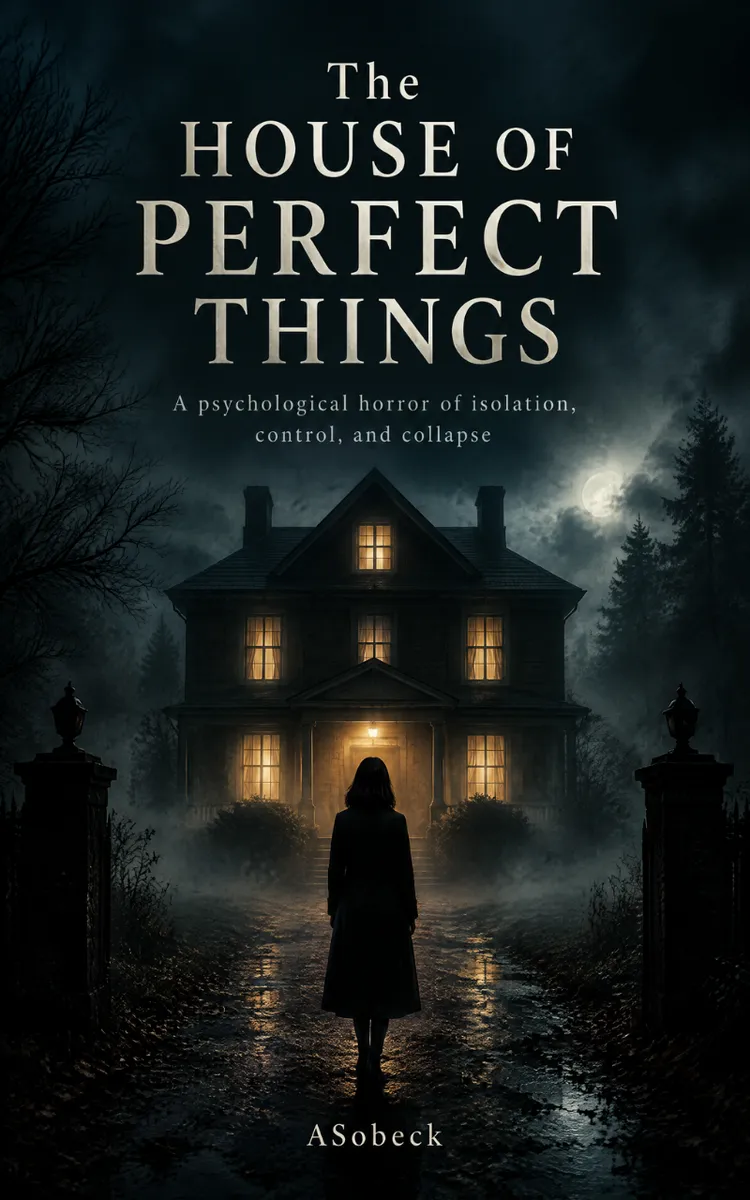
"The House Of Perfect Things" is a fiction book by ASobeck with 40 chapters and approximately 95,972 words. A lamp moves through the locked conservatory, though the Vale house insists no one is inside. Eleanor has come back to her father’s estate after years away, to fastened shutters, careful silences, and a butler who says the conservatory must remain locked.
This book was created using Inkfluence AI, an AI-powered book generation platform that helps authors write, design, and publish complete books. It was made with the AI Novel Writer.
Frequently Asked Questions
What is "The House Of Perfect Things" about?
A lamp moves through the locked conservatory, though the Vale house insists no one is inside. Eleanor has come back to her father’s estate after years away, to fastened shutters, careful silences, and a butler who says the conservatory must remain locked. Behind its glass, something breathes in the dark. A red wooden horse appears where it should not be. And in her dead mother’s study, Eleanor finds a physician’s report her father does not want her to read. If she speaks of what she hears, Lionel may have her examined again. If she stays quiet, the house keeps its secrets. The light is moving once more behind the glass.
How many chapters are in "The House Of Perfect Things"?
The book contains 40 chapters and approximately 95,972 words. Topics covered include The Locked Conservatory, The Ambassador’s Dinner, The Missing Physician’s Note, The Ward Behind the Iron Gate, and more.
Who wrote "The House Of Perfect Things"?
This book was written by ASobeck and created using Inkfluence AI, an AI book generation platform that helps authors write, design, and publish books.
How can I create a similar fiction book?
You can create your own fiction book using Inkfluence AI. Describe your idea, choose your style, and the AI writes the full book for you. It's free to start.
Write your own fiction book with AI
Describe your idea and Inkfluence writes the whole thing. Free to start.
Start writingCreated with Inkfluence AI


