

Read the first chapter
The whole of chapter one, free. About 8 min. Turn the pages with the arrows, your keyboard, or a swipe.
Chapter 1
Identity in Christ Reframing
Seeing the Lie Beneath the Mirror
> “I am not what I see when I look at myself through fear; I am who God says I am.”
A body-image distortion often begins with a believable sentence: “I am unattractive,” “My body proves I have failed,” or “I will be acceptable when I look different.” The sentence may sound like an observation, but it carries a verdict about identity and worth. Counseling becomes more effective when the counselor helps the counselee separate what is visible from what has been concluded, then brings that conclusion under the truth of Scripture.
The Worth-Truth Reframe is the working framework for this process. It does not deny physical concerns, personal preferences, or the effects of shame. It identifies the lie, examines its source and consequences, and replaces it with a Scripture-grounded understanding of worth in Christ. The goal is not forced positivity or a promise that difficult feelings will disappear immediately. The goal is a steadier identity that is not controlled by appearance.
Who this is for: This material is for Christian counselors beginning work with counselees who criticize their bodies, avoid mirrors or photographs, compare themselves constantly, or base acceptance on appearance. It is also suitable for counselees using it alongside appropriate pastoral, medical, or mental-health care.
Counselors should expect growth in several areas:
• clearer recognition of appearance-based thoughts and their spiritual meaning; - greater ability to test thoughts rather than obey them; - reduced shame-driven checking, comparison, and avoidance; - increased participation in ordinary responsibilities, relationships, worship, and service; - a more stable understanding of identity as received from Christ rather than earned through appearance.
How Appearance Lies Take Root
A body-image distortion is a persistent or exaggerated interpretation of the body that produces distress or changes behavior. It may involve focusing on a perceived flaw, assuming others notice it, or treating appearance as proof of personal value. The concern may involve a real feature, a change in weight, scarring, aging, disability, or ordinary variation. The distortion occurs when the feature is assigned a meaning that exceeds the available evidence: “Because this part of me is unacceptable, I am unacceptable.”
The first lie is often learned through repetition. A critical family comment, bullying, sexual objectification, church shame, social-media comparison, or a painful relationship can teach a person to monitor appearance for danger. Advertising and edited images can strengthen the false standard. Trauma, grief, major life changes, and perfectionistic habits may make the mind more watchful. None of these factors proves a single cause, and counselors should ask rather than assume.
Several processes commonly maintain the distortion:
1. Selective attention directs the counselee toward one feature while filtering out the whole person. A mirror becomes a search for defects rather than a neutral reflection. 2. Comparison turns another person’s appearance into a measuring stick. The counselee compares a private, unedited life with a public image that may be posed, filtered, or carefully selected. 3. Safety behaviors provide brief relief but strengthen fear over time. Repeated mirror checking, covering the body, seeking reassurance, retaking photographs, or avoiding social events teaches the brain that appearance must be controlled. 4. Identity fusion joins appearance to worth. The thought shifts from “I dislike this feature” to “This feature defines me.” 5. Spiritual misinterpretation treats shame as humility or assumes God is disappointed because the body does not match a desired image.
The counselor can name these patterns without shaming the counselee. Genesis 1:27 grounds human dignity in being made in the image of God, not in meeting a cultural appearance standard. Psalm 139:14 supports gratitude for God’s intentional work, but it should not be used to silence grief or pressure a counselee to admire every physical feature. The body may be difficult to accept while the person remains fully worthy of care and belonging. First Samuel 16:7 redirects attention from outward appearance to the heart, while Ephesians 1:3-8 and Romans 8:1 locate the believer’s standing in God’s grace and union with Christ.
Risk increases when appearance thoughts consume substantial time, produce repeated checking or avoidance, restrict eating, lead to compulsive exercise, or interfere with work, relationships, worship, or sleep. Ask directly about hopelessness, self-harm, purging, severe food restriction, misuse of medication, and unsafe exercise. These questions are not accusations. They are part of responsible care. When such concerns are present, coordinate with qualified mental-health and medical professionals rather than treating the issue through spiritual counsel alone.
Practicing the Worth-Truth Reframe
Begin with a calm assessment during the first appointment. Ask the counselee to describe one recent episode in detail: what happened, what they noticed in their body, what they thought it meant, what feeling followed, and what they did next. Record the sequence without debating the appearance claim. “I saw my stomach in the mirror, thought I looked disgusting, felt panic, and changed clothes three times” gives the counselor a workable pattern.
During the first week, have the counselee complete one brief Worth-Truth Reframe record each day. It should take five to ten minutes and include five lines:
• Trigger: What happened? - Appearance lie: What did the mind say? - Cost: What feeling and behavior followed? - Truth: What does Scripture say about identity and worth? - Faithful action: What small action agrees with that truth?
A completed entry might read: “A photograph was posted. The lie said, ‘No one will respect me because of my face.’ The cost was twenty minutes of zooming in and asking for reassurance. The truth is that my standing before God is grounded in Christ’s grace, not a photograph (Ephesians 1:3-8). I will leave the image, speak with a trusted friend about my day, and attend the planned meal.”
The counselor should distinguish a biblical truth from a replacement slogan. “I am beautiful” may feel untrue and create resistance. “My worth is received from God through Christ; my appearance does not determine my standing or my right to participate in life” is more stable and can be practiced even during distress. Romans 8:1 can address condemnation. Galatians 2:20 can support identity in union with Christ. Colossians 3:1-4 can redirect attention toward the believer’s life hidden with Christ. First Corinthians 6:19-20 can support respectful stewardship of the body without turning stewardship into appearance control.
For the first two weeks, schedule a ten-minute daily Scripture-and-reframe practice. Read one selected passage slowly, write one sentence about identity, and identify one behavior that will not be governed by appearance fear. Do not require the counselee to repeat the exercise for hours or use it as reassurance after every mirror glance. Excessive repetition can become another checking ritual.
In appointments one and two, establish the pattern and assess safety. In appointments three and four, review the records and select one manageable behavior change, such as looking in a mirror once for grooming rather than repeatedly scanning for flaws, remaining in a planned social setting for thirty minutes, or wearing an appropriate item of clothing without repeated reassurance. Progress should be reviewed weekly, not judged by whether the counselee feels confident. Track time spent checking, avoidance episodes, distress rated from 0 to 10, and participation in valued activities.
After four to six weeks, review whether distress, rituals, and avoidance are changing. If the counselee remains highly impaired, develops eating-related danger signs, reports self-harm thoughts, or cannot interrupt compulsive behaviors, seek consultation and refer to a licensed clinician with relevant experience. If there is immediate danger, follow local emergency procedures and do not leave the person to manage the risk alone. Pastoral prayer and deliverance ministry may accompany care when welcomed, but they should not replace assessment, referral, or coordinated treatment.
A useful closing prayer is specific: “Lord Jesus, expose the lie that appearance determines worth. Establish this person in the truth of Your grace, give wisdom for faithful care of the body, and strengthen the next obedient step.” Ask permission before prayer, avoid promising instant deliverance, and leave room for ongoing healing through truth, community, wise habits, and professional care.
Errors That Keep the Lie in Place
Using Scripture to argue away pain
Why it happens: The counselor wants to defend biblical truth quickly and may say, “You should know you are fearfully and wonderfully made.” The statement is true, but delivered too soon it can sound like correction rather than care.
What to do instead: First reflect the experience: “You felt exposed and concluded that your appearance made you unworthy.” Then ask what the conclusion has cost. Introduce Psalm 139:14 or Romans 8:1 as a foundation for identity, not as a demand to feel positive immediately. Truth should be applied with patience and precision.
Treating reassurance as the solution
Why it happens: The counselee asks, “Do I look normal?” or “Do you think I am ugly?” Reassurance briefly lowers distress, so both people may repeat it.
What to do instead: Answer with compassion, then redirect to the reframe: “I hear that you want certainty. Let us examine the thought that your worth depends on this answer.” Limit reassurance conversations to one planned check per day when clinically appropriate, and record whether repeated reassurance decreases or increases distress. The aim is trust in God’s truth, not dependence on the counselor’s verdict.
Calling appearance control good stewardship
Why it happens: Christian language about discipline, modesty, health, or stewardship can unintentionally reward excessive restriction, compulsive exercise, or constant grooming.
What to do instead: Ask whether the behavior serves ordinary care or attempts to purchase acceptance. Healthy care allows rest, nourishment, flexibility, and participation in life. When eating, exercise, or medication use becomes unsafe or rigid, involve qualified professionals. The body is to be honored as God’s creation, not managed as a condition for belonging.
The Worth-Truth Reframe teaches the counselee to meet the lie at its deepest point: not merely “Do I look acceptable?” but “Who has the authority to define my worth?” Scripture answers that question in Christ. As counselors help people practice that answer in mirrors, photographs, meals, relationships, and worship, identity becomes less captive to appearance and more firmly rooted in grace.
End of chapter one. 7 more chapters in the full book.
Swipe or use the arrows to turn the page

Spirit-Led Whole-Person Renewal

ChurchBased Christian Biblical Counseling Ministry

Anxiety And Panic Counseling Desk Reference
What's inside: 8 chapters
- 1. Identity in Christ Reframing
- 2. Body Image Symptom Mapping
- 3. Trigger Chains and Shame Loops
- 4. Cognitive Restructuring with Scripture
- 5. Exposure to Avoidance Behaviors
- 6. Prayer, Lament, and Deliverance Readiness
- 7. Appointment Flow and Homework Tools
- 8. Relapse Prevention and Ongoing Renewal Plans
About this book
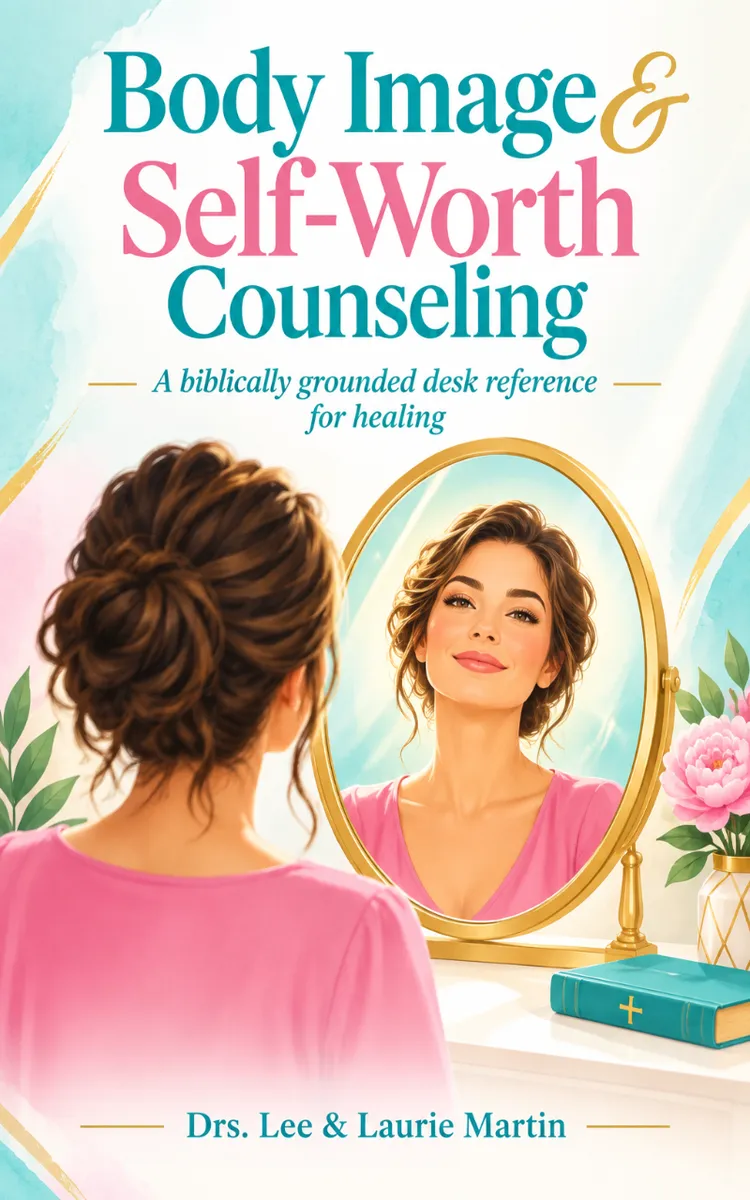
"Body Image & Self-Worth Counseling" is a clinical guide book by Drs. Lee & Laurie Martin with 8 chapters and approximately 14,587 words. Biblical clinical counseling guidance for body image and self-worth.
This book was created using Inkfluence AI, an AI-powered book generation platform that helps authors write, design, and publish complete books. It was made with the AI Health Book Generator.
Frequently Asked Questions
What is "Body Image & Self-Worth Counseling" about?
Biblical clinical counseling guidance for body image and self-worth
How many chapters are in "Body Image & Self-Worth Counseling"?
The book contains 8 chapters and approximately 14,587 words. Topics covered include Identity in Christ Reframing, Body Image Symptom Mapping, Trigger Chains and Shame Loops, Cognitive Restructuring with Scripture, and more.
Who wrote "Body Image & Self-Worth Counseling"?
This book was written by Drs. Lee & Laurie Martin and created using Inkfluence AI, an AI book generation platform that helps authors write, design, and publish books.
How can I create a similar clinical guide book?
You can create your own clinical guide book using Inkfluence AI. Describe your idea, choose your style, and the AI writes the full book for you. It's free to start.
Write your own clinical guide book with AI
Describe your idea and Inkfluence writes the whole thing. Free to start.
Start writingCreated with Inkfluence AI


