

Read the first chapter
The whole of chapter one, free. About 8 min. Turn the pages with the arrows, your keyboard, or a swipe.
Chapter 1
Biblical Foundations for Administration
Why Faithful Administration Matters
A church treasurer opens the monthly report and finds a $4,800 difference between the bank balance and the accounting records. The building fund contains restricted gifts, but the church used part of that money to cover an unexpected payroll shortage. No one intended theft. The leaders prayed, served faithfully, and assumed the records would work themselves out. Yet good intentions did not protect the congregation, the donors, or the ministry.
Scripture treats this kind of responsibility as spiritual work. Paul instructed the churches to handle collections carefully and transparently: “We take this course so that no one should blame us about this generous gift” (2 Corinthians 8:20-21). The issue involved money, but the deeper concern involved trust. Faithful administration protects people, honors promises, supports ministry, and gives the church a credible witness before its members and community.
The Stewardship Roots Framework gives leaders a practical way to define faithful administration. It begins with God’s ownership, grows through trustworthy people, takes shape in clear responsibilities, produces orderly records, and bears fruit in ministry. After working through it, you should be able to examine a church process and ask better questions: Who owns these resources? Who may approve this decision? What record proves that we handled it properly? What ministry purpose does this process serve?
The Stewardship Roots Framework
The framework begins with a theological truth: God owns the church and everything the church receives. “The earth is the Lord’s and the fullness thereof” (Psalm 24:1). A church does not own offerings in the same way a private person owns personal spending money. The congregation receives funds as a trust. Leaders therefore manage resources on behalf of Christ, the members who give, ministry recipients, employees, and the wider community.
Jesus made this principle practical in the parable of the talents (Matthew 25:14-30). The servants received different amounts, but each servant answered to the master for his use of what he received. The parable does not require every church to pursue the same budget size or ministry model. It does require responsible action. A small congregation with a $90,000 annual budget must exercise the same honesty as a large congregation with a $900,000 budget.
Use the Stewardship Roots Framework through five connected parts:
• God’s ownership. Begin every major decision by identifying whose resources the church manages and what promises surround them. A gift marked “building fund” carries a different responsibility from an unrestricted offering. This step prevents leaders from treating all cash as interchangeable.
• Trustworthy character. Select people who demonstrate honesty, competence, confidentiality, and willingness to accept review. Exodus 18:21 describes leaders as capable, trustworthy, and opposed to dishonest gain. A person may love the church and still lack the skills needed to reconcile accounts. Character and ability both matter.
• Clear responsibility. Write down who approves spending, who receives money, who records transactions, and who reviews the records. Nehemiah assigned specific workers to specific portions of the wall (Nehemiah 3). Clear assignments reduce confusion and make neglected duties visible.
• Orderly evidence. Keep receipts, approvals, deposit records, bank reconciliations, minutes, and reports in a consistent system. Paul told the Corinthians to do things “decently and in order” (1 Corinthians 14:40). Records do not replace trust; they help the church demonstrate trustworthiness.
• Ministry fruit. Connect administrative work to the church’s mission. A timely payroll process protects staff. A careful benevolence record protects recipients and donors. A sound budget helps leaders fund worship, discipleship, missions, and care without making promises the church cannot keep.
Church history reinforces this pattern. The early church appointed seven servants in Acts 6 after widows experienced unequal distribution. The apostles did not dismiss the complaint as a distraction from preaching. They created a structure that addressed the need while protecting the ministry of the Word. Centuries later, Christian communities developed rules for handling common property, caring for the poor, and supervising charitable funds. Their methods differed, but the concern remained familiar: resources must serve people faithfully, and leaders must make their work visible enough for the church to trust it.
Ask yourself: if a new board member received the church’s records tomorrow, could that person understand who approved each major expense and why? If not, the church has a stewardship weakness, not merely a filing problem. Begin by mapping one process, such as Sunday offerings, from collection to deposit to recording to review. That exercise shows where the roots are strong and where they need attention.
Applying the Framework to a Church Building Fund
Consider a congregation that receives a $30,000 gift designated for roof repairs. The church also faces a $7,500 heating repair during winter. Leaders want to use $5,000 from the building gift and replace it later. Faithful administration requires more than asking whether the church can repay the money. Leaders must determine whether the donor restricted the gift, whether the church’s governing documents permit a change, and whether the donor should approve the change.
Follow these steps:
• Confirm the gift’s purpose. Review the pledge card, letter, electronic giving record, and any board minutes. Record whether the gift says “roof,” “building,” or “where most needed.” Expected outcome: leaders know the restriction before spending the money.
• Check the church’s governing documents. Read the bylaws, gift-acceptance policy, and applicable state requirements. Ask a qualified attorney when the documents do not answer the question. Expected outcome: the board understands its authority and its limits.
• Separate the funds in the records. Create a restricted building-fund account or accounting class. Record the $30,000 receipt and show every later expense against that purpose. Expected outcome: the church can report the remaining balance without guesswork.
• Evaluate the heating repair separately. Prepare a short cash-flow report showing unrestricted cash, expected offerings, payroll, utility costs, and the repair estimate. If unrestricted cash cannot cover the repair, present lawful options such as delaying nonessential work, requesting an unrestricted emergency gift, or arranging a documented loan approved under church policy. Expected outcome: leaders solve the emergency without silently changing the donor’s purpose.
• Document the decision. Record the discussion, votes, conflict disclosures, and follow-up assignments in the board minutes. Send the donor a clear update when appropriate. Expected outcome: the church preserves an accurate history and reduces later disagreement.
• Review completion. When the roof work ends, match invoices to payments, record the final cost, and report the remaining restricted balance. Expected outcome: donors and members can see that the gift reached its intended ministry purpose.
A practical review table can help:
Stewardship question
Evidence to check
Expected result
What purpose did the donor state?
Gift record and correspondence
Written restriction identified
Who may authorize spending?
Bylaws and board policy
Proper approval documented
Where does the money appear?
Bank statement and ledger
Balance agrees
What did the church purchase?
Invoice and payment record
Expense matches purpose
Who reviewed the work?
Minutes and reconciliation
Independent review completed
Quick checklist
• Confirm every restricted gift in writing.
• Keep restricted and unrestricted activity separate in the records.
• Require approval before changing a gift’s purpose.
• Match invoices to payments before reporting expenses.
• Reconcile the bank account each month.
• Include restricted balances in regular leadership reports.
• Preserve minutes, receipts, donor records, and contracts.
• Ask for legal or accounting advice when authority remains unclear.
This process does not guarantee that every decision will feel easy. It gives leaders a reliable path through difficult decisions. The expected result is not merely a balanced account. It is a church that can explain what it did, why it did it, and how the action served its calling.
Mistakes That Weaken Faithful Administration
Treating trust as a substitute for controls
A pastor may trust the treasurer completely, yet the treasurer should not count offerings, make the deposit, enter the transaction, and reconcile the bank account alone. Separation of duties protects both people. It prevents one mistake from passing through the entire system and protects an honest worker from suspicion.
Do this: Assign at least two unrelated people to count offerings, require two signatures or documented approvals for larger payments, and have someone outside the payment process review the bank reconciliation each month.
Not this: Give one person every financial key because that person has served faithfully for years.
The reason matters. Controls do not accuse faithful servants; they recognize human limits and reduce opportunities for error.
Confusing spiritual authority with unlimited financial authority
Church leaders carry real spiritual responsibility, but a leader’s position does not erase donor restrictions, board procedures, employment obligations, or civil law. Acts 5 shows the seriousness of truthful financial dealings, while Romans 13:1-7 reminds believers to respect lawful authority.
Do this: Before approving an unusual payment, identify the governing document, policy, donor instruction, or legal rule that applies. Record the basis for the decision.
Not this: Say, “The pastor approved it, so no further explanation is needed.”
When leaders document authority, they protect the church from informal decisions that later create conflict.
Keeping records that report activity but not purpose
A ledger may show that the church spent $2,400 on “repairs,” but that description may not explain whether the expense involved the roof fund, the parsonage, or ordinary maintenance. A report without purpose makes stewardship difficult to evaluate.
Do this: Use clear account names, attach invoices, note the ministry purpose, and compare actual spending with the approved budget each month.
Not this: Enter every building expense under one broad category and rely on memory at year-end.
Clear records help leaders answer the biblical question of faithfulness: Did the church use what it received according to its stated purpose?
Faithful administration grows from the right roots. God owns the resources, trustworthy people manage them, clear responsibilities guide them, orderly records support them, and ministry purpose directs them. Church history and Scripture show that administration never stands outside discipleship. It expresses whether the church keeps promises, protects the vulnerable, and handles shared resources in the light. As you review your own systems, start with one fund, one responsibility, and one monthly report. Small acts of order can give the whole congregation a clearer path toward faithful governance.
Bibliography
• Calvin, John. Commentaries on the Four Last Books of Moses Arranged in the Form of a Harmony. Translated by Charles William Bingham. Edinburgh: Calvin Translation Society, 1854-1857.
• Fee, Gordon D. The First Epistle to the Corinthians. New International Commentary on the New Testament. Grand Rapids: Eerdmans, 1987.
• Grudem, Wayne. Systematic Theology: An Introduction to Biblical Doctrine. Grand Rapids: Zondervan, 1994.
• Keener, Craig S. The IVP Bible Background Commentary: New Testament. Downers Grove, IL: InterVarsity Press, 1993.
• Marshall, I. Howard. The Acts of the Apostles: An Introduction and Commentary. Tyndale New Testament Commentaries. Leicester: InterVarsity Press, 1980.
• Stott, John. The Message of Acts. The Bible Speaks Today. Downers Grove, IL: InterVarsity Press, 1990.
• The Holy Bible, English Standard Version. Wheaton, IL: Crossway, 2016.
End of chapter one. 7 more chapters and about 15,242 words in the full book.
Swipe or use the arrows to turn the page


What's inside: 8 chapters
- 1. Biblical Foundations for Administration
- 2. Designing Church Governance
- 3. Running Effective Church Meetings
- 4. Managing Church Records and Policies
- 5. Meeting Legal and Compliance Duties
- 6. Building a Faithful Church Budget
- 7. Protecting Donations and Financial Controls
- 8. Leading Through Risk and Renewal
About this book
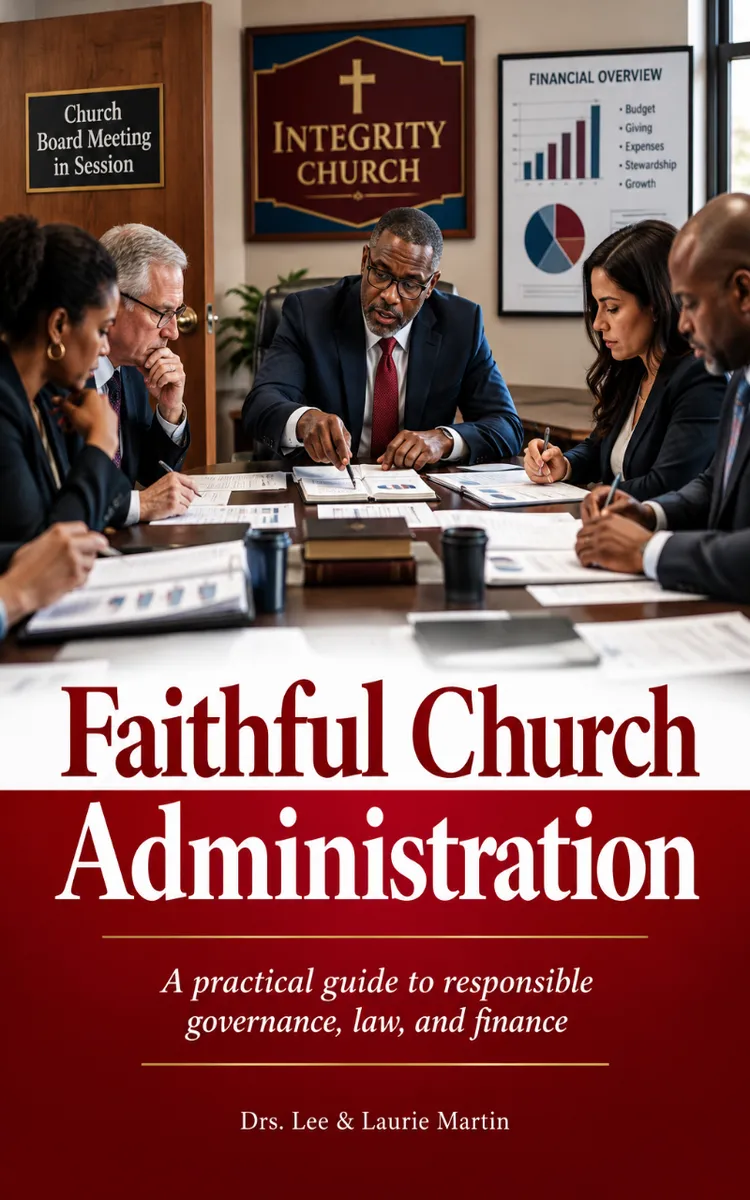
"Faithful Church Administration" is a how-to guide book by Drs. Lee & Laurie Martin with 8 chapters and approximately 15,242 words. Biblical principles and practical systems for church governance, legal compliance, and ministry finances.
This book was created using Inkfluence AI, an AI-powered book generation platform that helps authors write, design, and publish complete books. It was made with the AI Ebook Generator.
Frequently Asked Questions
What is "Faithful Church Administration" about?
Biblical principles and practical systems for church governance, legal compliance, and ministry finances
How many chapters are in "Faithful Church Administration"?
The book contains 8 chapters and approximately 15,242 words. Topics covered include Biblical Foundations for Administration, Designing Church Governance, Running Effective Church Meetings, Managing Church Records and Policies, and more.
Who wrote "Faithful Church Administration"?
This book was written by Drs. Lee & Laurie Martin and created using Inkfluence AI, an AI book generation platform that helps authors write, design, and publish books.
How can I create a similar how-to guide book?
You can create your own how-to guide book using Inkfluence AI. Describe your idea, choose your style, and the AI writes the full book for you. It's free to start.
Write your own how-to guide book with AI
Describe your idea and Inkfluence writes the whole thing. Free to start.
Start writingCreated with Inkfluence AI


