

Read the first chapter
The whole of chapter one, free. About 9 min. Turn the pages with the arrows, your keyboard, or a swipe.
Chapter 1
The Biblical Calling to Preach
A preacher once read a difficult passage, gathered several interesting facts about it, and delivered a sermon that sounded impressive. Afterward, a church member asked, “What did God want us to do?” The preacher had explained the passage but had not proclaimed its message. That question exposes the central task of preaching: not displaying what the preacher knows, but faithfully bringing God’s truth to God’s people.
Preaching matters because the church does not gather merely for advice, entertainment, or religious conversation. The church gathers under the authority of God’s Word. A sermon should help people see what Scripture says, understand what it means, and respond with faith and obedience. This purpose protects the preacher from two opposite failures: saying whatever seems clever and saying something true but unrelated to the text.
The goal here is practical. You will learn how to understand your calling, test your message against Scripture, and serve listeners with humility. You will also use the Commission-to-Community Map, a simple framework that traces a sermon from Christ’s command to the needs of a real congregation. Ask yourself as you read: “If I preach this message, will people hear God’s truth clearly, or only hear my personality?”
Preaching Begins with God’s Commission
The Bible presents preaching as a task God gives, not a platform a person takes. Jesus commanded His disciples to make disciples of all nations, teaching them to obey everything He had commanded (Matthew 28:18-20). Paul told Timothy to “preach the word” and to remain ready whether the opportunity felt convenient or difficult (2 Timothy 4:2). These commands show both the source and the content of preaching. God sends the preacher, and God’s Word supplies the message.
The word preach often means to announce or proclaim publicly. A preacher does not invent a private message and attach God’s name to it. The preacher opens the Scriptures, explains their meaning, and calls people to respond. In Acts 2, Peter announced the death and resurrection of Jesus, connected those events to Scripture, and urged his hearers to repent and believe. His sermon had a clear center: God had acted in Christ.
The Commission-to-Community Map keeps this calling visible through four movements:
1. Commission: Begin with God’s command to proclaim His truth. This prevents personal ambition from directing the sermon. 2. Text: Identify what the biblical passage actually says and means. This keeps the message under Scripture’s authority. 3. Christ and response: Show how the passage points to God’s saving work and what faithful response it requires. This keeps preaching from becoming mere moral advice. 4. Community: Apply the truth to the actual people listening. This makes the sermon pastoral rather than distant.
These movements do not replace careful study. They guide it. For example, a sermon on Mark 4:35-41 should not become a general speech about staying calm. The text shows Jesus calming the storm and confronting the disciples’ fear. The preacher must explain the passage, connect it to Jesus’ authority, and then address how believers trust Him in suffering. The application grows from the text instead of being pasted onto it.
A useful comprehension check comes at the end of preparation: state the sermon’s main claim in one sentence. If you cannot say, “Because this passage teaches, we should,” you probably need more work. The preacher’s first responsibility does not involve vocal energy or memorable illustrations. It involves truthful handling of God’s Word.
The Preacher’s Responsibility Before God and People
James 3:1 warns that teachers will receive a stricter judgment. That warning should produce carefulness, not paralysis. The preacher handles words that shape belief, worship, repentance, comfort, and conduct. A careless sentence can confuse a doctrine; a careless application can burden people whom Scripture intends to strengthen.
Humility gives the preacher the right posture. Humility does not mean pretending to know nothing. It means refusing to place personal opinions above Scripture. Paul told the Corinthians that he resolved to know nothing among them except Jesus Christ and Him crucified (1 Corinthians 2:2). He did not mean that he lacked knowledge of other subjects. He meant that Christ’s gospel governed his ministry.
Before preaching, work through these actions:
1. Pray for submission before insight. Ask God to correct you before He uses you to correct others. This matters because an unsubmitted preacher can twist a passage to defend a favorite opinion. 2. Read the whole passage repeatedly. Read it at least five times in different settings, noting repeated words, commands, contrasts, and promises. Repeated reading helps you observe what a quick glance misses. 3. Separate the text from your reaction. Write two sentences: “The passage says…” and “I feel…” Keep them distinct. Your feelings may guide questions, but Scripture must govern conclusions. 4. Check your interpretation. Compare your findings with the surrounding context, a reliable Bible dictionary, and trusted commentaries. These tools do not replace the Bible; they help expose blind spots. 5. Name the required response. Decide whether the passage calls for faith, repentance, endurance, worship, wisdom, comfort, or another response. A sermon without a clear response often leaves listeners with information but no direction. 6. Examine your motive. Ask whether you want people to admire your cleverness or encounter God’s truth. This question can sting, which is one reason it helps.
Suppose you preach Philippians 4:10-13. A careless approach might say, “You can accomplish anything if you believe strongly enough.” A faithful approach notices Paul’s contentment in both abundance and need. “I can do all things through Christ” refers to enduring changing circumstances through Christ’s strength, not receiving unlimited success. Humility makes the preacher willing to reject a popular interpretation when the text does not support it.
The preacher also carries responsibility toward listeners. Do not use the pulpit to settle personal arguments, embarrass a family, or display private information. Do not promise what God has not promised. Do not call every difficult circumstance a punishment or every success a reward. Speak with courage, but keep your claims tied to Scripture.
A practical test helps: underline every major claim in your manuscript and write the biblical reason beside it. If a claim has no clear support, remove it, soften it, or investigate it further. The result should sound less like a personal lecture and more like a faithful explanation of God’s Word.
From Commission to Community: A Worked Example
Consider a Sunday sermon from James 1:19-27, a passage that calls believers to hear God’s Word, obey it, control their speech, and care for the vulnerable. The congregation includes new believers, parents under pressure, and older members who have followed Christ for decades. The preacher has forty-five minutes for final preparation on Saturday evening and plans a twenty-five-minute sermon.
1. Read the passage five times. On the first reading, note the main command: be quick to hear, slow to speak, and slow to anger. On the second, mark the contrast between hearing and doing. On the third, circle “bridle,” “doers,” “religion,” and “orphans and widows.” Expected outcome: a list of observable features, not yet a sermon outline. 2. Read the surrounding context. James 1 connects trials, wisdom, temptation, and the implanted Word. Expected outcome: the sermon will present obedience as a response to God’s Word, not a method for earning salvation. 3. Write the Commission-to-Community Map. - Commission: proclaim God’s Word faithfully. - Text: hearing without doing deceives the hearer. - Christ and response: receive God’s Word and live it through humble obedience. - Community: practice listening, restrained speech, and care for people in need. 4. Form one main sentence. “Because God’s Word must shape our lives, we must receive it humbly and practice it visibly.” Expected outcome: every point can serve one direction. 5. Build three movements. First, receive the Word; second, control speech; third, care for the vulnerable. Expected outcome: a simple structure listeners can remember. 6. Add one concrete application to each movement. Ask members to pause for ten seconds before answering during conflict, to review one command from the passage at lunch, and to identify one practical way the church can support a widow, orphan, or isolated neighbor during the coming week. 7. Check the gospel connection. Explain that obedience does not purchase God’s acceptance. God’s grace creates a people who obey. Expected outcome: the sermon avoids both legalism and vague encouragement. 8. Pray and revise. Remove any sentence that sounds like a political speech, personal complaint, or unsupported promise. Expected outcome: a focused sermon that serves the congregation instead of the preacher’s mood.
The expected result is not that every listener remembers the outline perfectly. The result is clearer hearing and more faithful action. One person may listen before answering in a tense conversation. Another may notice a neglected neighbor. The preacher cannot control every response, but the preacher can make the biblical command plain.
Quick checklist
• Read the passage in context. - Identify the main claim and main response. - Connect the message to Christ without forcing a connection. - Write the Commission-to-Community Map. - Use applications that listeners can practice this week. - Check every major claim against Scripture. - Remove personal attacks and unsupported promises. - Pray for humility before preaching.
Finish by asking, “What would obedience look like by next Sunday?” That question turns a sermon from a speech into a summons.
Mistakes That Distort the Calling
Treating preaching as personal performance
A preacher may spend more time polishing jokes than clarifying the text. Humor can serve a sermon, but it cannot carry one. The pulpit is not a talent show with a cross in the background.
Do this: Use an illustration or light joke only when it helps listeners understand or remember the biblical truth. Not this: Add humor because silence makes you nervous or because the sermon feels thin.
If the message collapses when the funny line disappears, the preacher needs stronger biblical structure.
Confusing confidence with authority
Some new preachers think a loud voice proves conviction. Others speak so cautiously that listeners cannot tell what Scripture requires. Biblical authority comes from faithful explanation, not volume, clothing, personality, or dramatic gestures.
Do this: State clearly what the passage teaches, show why it teaches that, and distinguish biblical commands from your own advice. Not this: Say, “God told me,” when you mean, “I have an impression.”
This distinction protects both the congregation and the preacher. Scripture carries God’s authority; the preacher serves beneath it.
Using application without understanding the passage
A preacher may jump from “love your neighbor” to a list of personal causes without explaining the text. Another may give excellent advice that the passage never addresses. Application must grow from interpretation.
Do this: Write the meaning of the passage before writing its applications. Then ask how that meaning addresses the church’s actual life. Not this: Start with a problem you want to discuss and search for a verse that seems to support it.
When a passage challenges your preferred conclusion, submit your conclusion to the passage. That practice may make the sermon less flashy, but it makes the preacher more trustworthy.
Preaching begins when God’s Word takes first place, continues when the preacher studies with care, and reaches its purpose when the community hears and obeys. Carry the Commission-to-Community Map into every sermon: God commissions, Scripture speaks, Christ saves, and the church responds. That order keeps the preacher humble and gives the congregation something far better than a performance - truth they can hear, trust, and live.
End of chapter one. 28 more chapters and about 53,640 words in the full book.
Swipe or use the arrows to turn the page


What's inside: 29 chapters
- 1. The Biblical Calling to Preach
- 2. Theology of the Word
- 3. The Preacher’s Character and Preparation
- 4. Prayerful Sermon Direction
- 5. Choosing a Sermon Text
- 6. Reading the Passage in Context
- 7. Hermeneutics: Interpreting Scripture
- 8. Recognizing Biblical Genres
- 9. Word Studies Without Misuse
- 10. Researching Reliable Sources
- 11. From Exegesis to Big Idea
- 12. Connecting Text to Congregation
- 13. Homiletics: Shaping the Sermon
- 14. Writing a Clear Sermon Outline
- 15. Crafting Sermon Introductions
- 16. Explaining the Passage Clearly
- 17. Illustrations That Illuminate
- 18. Applications for Everyday Life
- 19. Preaching Christ Faithfully
- 20. Choosing a Sermon Structure
- 21. Preparing Topical Sermons
- 22. Preparing Expository Sermons
- 23. Writing the Sermon Manuscript
- 24. Rehearsing and Timing the Message
- 25. Voice, Presence, and Delivery
- 26. Preaching Across Different Settings
- 27. Handling Difficult Texts Responsibly
- 28. Building Complete Sermon Examples
- 29. Growing Through Feedback and Study
About this book
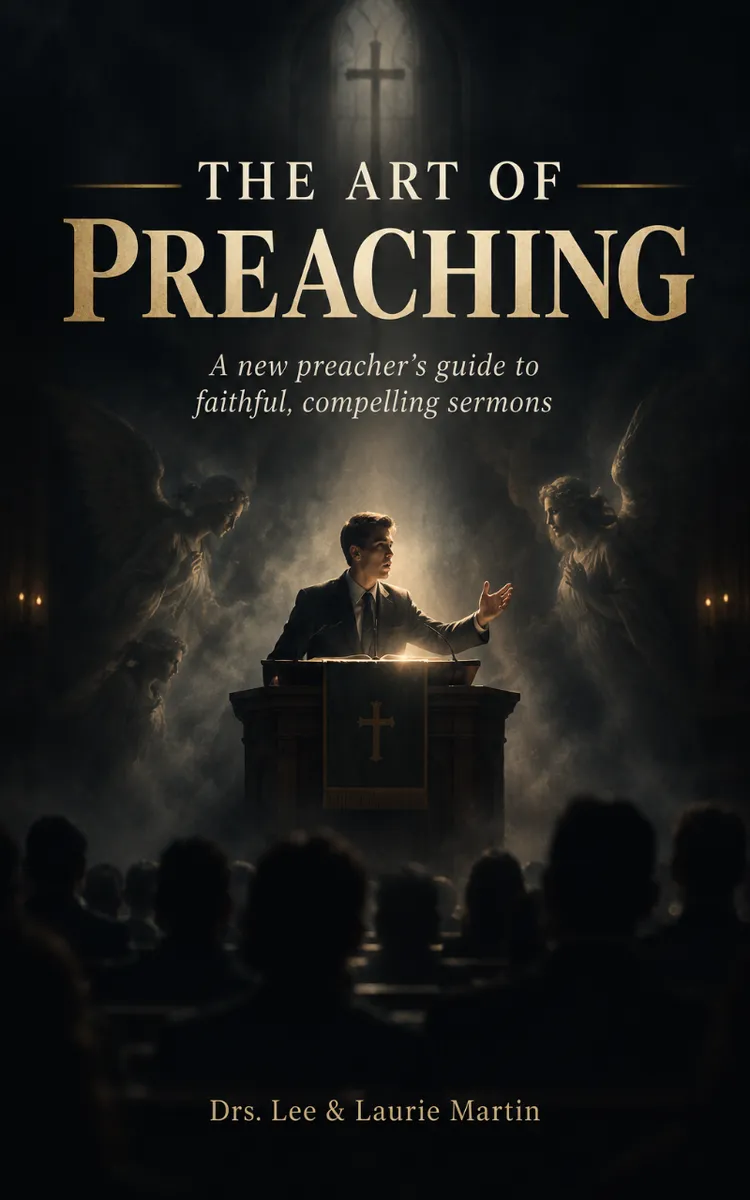
"The Art Of Preaching" is a how-to guide book by Drs. Lee & Laurie Martin with 29 chapters and approximately 53,640 words. Biblical preaching, sermon preparation, hermeneutics, homiletics, and delivery.
This book was created using Inkfluence AI, an AI-powered book generation platform that helps authors write, design, and publish complete books. It was made with the AI Ebook Generator.
Frequently Asked Questions
What is "The Art Of Preaching" about?
Biblical preaching, sermon preparation, hermeneutics, homiletics, and delivery
How many chapters are in "The Art Of Preaching"?
The book contains 29 chapters and approximately 53,640 words. Topics covered include The Biblical Calling to Preach, Theology of the Word, The Preacher’s Character and Preparation, Prayerful Sermon Direction, and more.
Who wrote "The Art Of Preaching"?
This book was written by Drs. Lee & Laurie Martin and created using Inkfluence AI, an AI book generation platform that helps authors write, design, and publish books.
How can I create a similar how-to guide book?
You can create your own how-to guide book using Inkfluence AI. Describe your idea, choose your style, and the AI writes the full book for you. It's free to start.
Write your own how-to guide book with AI
Describe your idea and Inkfluence writes the whole thing. Free to start.
Start writingCreated with Inkfluence AI


