

Read the first chapter
The whole of chapter one, free. About 9 min. Turn the pages with the arrows, your keyboard, or a swipe.
Chapter 1
Biblical Authority and Theological Method
Scripture, History, and the Question of Authority
A single sentence from Romans 9, Ephesians 1, or 1 Timothy 2 can become the center of an entire doctrine of salvation. The difficulty is not merely finding verses. It is learning how Scripture speaks as a whole, how earlier Christians read those passages, and how later theological systems organized their conclusions. Arminianism and Calvinism both claim biblical authority, yet they often give different weight to particular texts, interpretive patterns, and theological questions.
The study therefore requires more than collecting proof texts. It requires attention to literary context, the meaning of key terms, the history of interpretation, and the difference between what Scripture clearly states and what a theological system infers. The Reformation principle of sola Scriptura - Scripture alone as the final infallible authority - does not mean that history, reason, or church teaching are useless. It means that they remain accountable to Scripture.
Readers will also need to distinguish historical description from theological judgment. John Calvin, Jacob Arminius, Augustine, and the delegates at the Synod of Dort all mattered greatly, but none replaces the biblical text. Calvin’s Institutes and the Remonstrants’ articles are important witnesses to interpretation; they are not additional books of the Bible.
Learning Objectives
• Define Scripture’s authority and explain how historical theology assists biblical interpretation. - Compare major interpretive principles used by Calvinist and Arminian theologians. - Practice a fair, context-sensitive reading of a disputed salvation text.
A useful starting question is: What does this passage say, and what must be inferred from it? That distinction will guide the work that follows.
Definitions and Interpretive Principles
Biblical authority - the right of Scripture to govern Christian faith, worship, and obedience because it is God’s inspired Word. Paul says that “all Scripture is breathed out by God” and is useful for teaching and correction (2 Timothy 3:16). The Greek term often translated “breathed out by God” is theopneustos, joining the ideas of God and breath. Scripture’s authority rests first on God’s action, not on the church’s ability to explain every passage.
Sola Scriptura - the Reformation conviction that Scripture is the final infallible rule for doctrine. It does not mean that Christians should read the Bible without teachers, creeds, or historical knowledge. Luke praises the Bereans for examining Paul’s teaching in light of Scripture (Acts 17:11), while Paul also instructs Timothy to preserve received teaching (2 Timothy 2:2). Both careful examination and responsible tradition matter.
Theological method - the ordered way a theologian gathers, interprets, and relates biblical claims. Calvinist and Arminian methods begin with Scripture but tend to organize its testimony differently. Calvinism commonly stresses God’s sovereign initiative, election, and the coherence of salvation as a unified divine work. Arminianism commonly stresses God’s universal saving will, genuine human response, prevenient grace, and the repeated biblical calls to faith and repentance.
Neither description should become a caricature. Historic Calvinism does not teach that human beings are machines, and historic Arminianism does not teach that sinners save themselves by unaided willpower. Both traditions affirm humanity’s need for grace. The debate concerns the nature and extent of that grace, the basis of election, and the relation between divine sovereignty and human responsibility.
Contextual interpretation - reading a statement according to its literary, historical, and canonical setting. Romans 9, for example, follows Paul’s grief over Israel’s unbelief in Romans 9:1-5 and leads into a discussion of Israel, Gentiles, faith, and God’s covenant purposes. A reader who isolates “Jacob I loved, but Esau I hated” from Romans 9-11 may reach a conclusion before considering Paul’s full argument.
Canonical reading - interpreting one passage in conversation with the whole Bible. A Calvinist may place Romans 9 beside John 6:37-44, Ephesians 1:3-11, and Acts 13:48. An Arminian may place those texts beside John 3:16, 1 Timothy 2:4, 2 Peter 3:9, and Revelation 22:17. Responsible interpretation asks how all these texts can be honored rather than allowing one group of passages to silence the other.
Exegesis - drawing meaning from the text. Eisegesis - bringing a preferred meaning into the text. If a reader begins with the conclusion that every use of “world” means every individual without exception, that reader may be practicing eisegesis. If the reader examines how kosmos (“world”) functions in John’s Gospel and in the specific sentence, that is exegesis.
Historical context helps prevent modern assumptions. Augustine of Hippo, writing against Pelagius in the fifth century, strongly emphasized humanity’s dependence on grace. His writings later influenced both Protestant traditions, though they drew different conclusions from Augustine. During the Reformation, Calvin developed a systematic account of election and grace in Geneva. Arminius, a Dutch theologian who died in 1609, challenged certain Calvinist conclusions while affirming original sin and the necessity of grace. After his death, his followers presented the Five Articles of Remonstrance in 1610. The Synod of Dort, meeting from 1618 to 1619, answered them with the Canons of Dort.
These events should be placed on a simple timeline:
| Date | Event | Importance | |---|---|---| | 354-430 | Augustine’s life | Major western teaching on sin and grace | | 1509-1564 | John Calvin’s life | Development of Reformed theology | | 1560-1609 | Jacob Arminius’s life | Critique of certain Reformed conclusions | | 1610 | Five Articles of Remonstrance | Formal statement of early Arminian objections | | 1618-1619 | Synod of Dort | Reformed response and formulation of the Canons | | 1644 | Westminster Confession completed | Later influential Calvinist confession | | 1738 onward | John Wesley’s Methodist revival | Major development of evangelical Arminianism |
Confessions are valuable because they show how communities understood Scripture at particular moments. Yet they must be tested by Scripture. The Westminster Confession’s teaching on divine decree and the Remonstrants’ teaching on conditional election are historical formulations, not substitutes for reading Ephesians or Romans.
A fair comparison also requires symmetrical questions. Ask of Calvinism and Arminianism alike: What texts support this claim? What texts create difficulty? Is the claim explicit or inferred? Does the system preserve both divine initiative and human responsibility? How does it explain warning passages, prayer, evangelism, and assurance?
The practical takeaway is simple: read the text first, locate it in its setting, compare Scripture with Scripture, then examine how the tradition has organized the evidence.
A Worked Reading of 1 Timothy 2:1-6
First Timothy 2:4 says that God “desires all people to be saved and to come to the knowledge of the truth.” This passage is a useful test case because it raises questions about God’s saving will, the meaning of “all,” Christ’s ransom, and the relation between divine desire and actual salvation.
1. Read the immediate paragraph. Paul urges “supplications, prayers, intercessions, and thanksgivings” for “all people” (1 Timothy 2:1). He specifically names kings and those in authority, including rulers who might not be Christian. The first decision is to recognize that “all” has a broad social and political setting, not merely a private reference to every member of the Ephesian church.
2. Observe the repeated terms. The word “all” appears in verses 1, 2, 4, and 6. The Greek term is pas, whose range can mean all without exception or all kinds and classes, depending on context. The repeated word matters, but repetition alone does not settle its precise scope.
3. Notice the theological reason Paul gives. God is one, and there is one mediator between God and humanity, “the man Christ Jesus” (verse 5). Christ “gave himself as a ransom for all” (verse 6). The passage connects prayer for all people with the universal scope of God’s saving concern and Christ’s mediating work.
4. State the Calvinist reading fairly. Many Calvinists understand “all” as all kinds of people - kings and subjects, Jews and Gentiles, socially powerful and socially weak. They point to the context, to passages describing God’s particular saving purpose, and to the distinction between God’s revealed will and his decretive will. On this reading, God genuinely commands prayer and expresses compassion toward all, while his effective saving purpose is directed toward the elect.
5. State the Arminian reading fairly. Arminians commonly understand “all” in its ordinary universal sense: God desires the salvation of every human being, and Christ’s ransom is provided for all. They connect the passage with John 3:16, 2 Peter 3:9, and the universal invitations to repent and believe. On this reading, God’s saving desire does not guarantee that every person will be saved because grace may be resisted.
6. Test both readings against the wider canon. The Calvinist interpretation must account for the force of universal language and God’s expressed desire. The Arminian interpretation must account for passages describing election, effectual calling, and God’s purpose in salvation. Neither position is permitted to ignore inconvenient texts.
7. Separate conclusion from inference. The passage clearly teaches that Christians should pray for all people, that God is one, that Christ is the unique mediator, and that God’s saving concern reaches beyond a narrow social or ethnic group. Whether “all” means every individual in exactly the same saving sense remains an interpretive judgment shaped by wider theology.
Final result: 1 Timothy 2:1-6 clearly supports universal Christian prayer and the unique mediatorship of Christ; its precise relation to individual election must be established by comparing this passage with the entire biblical witness, not by this passage alone.
Ask yourself why Paul begins with prayer before discussing God’s desire. The order matters. Theology here is not detached speculation; it directs the church’s public life, its attitude toward rulers, and its confidence in Christ’s sufficiency. Interpretation should therefore preserve both the passage’s doctrinal claims and its pastoral purpose.
Guided Practice and Answer Key
1. Compare Romans 9:14-24 and Romans 10:9-13. What interpretive danger appears if one passage is used without the other? Hint: Look for divine mercy and human confession. Ask whether Paul presents only one side of salvation.
2. Read Ephesians 1:3-11. Which statements are explicit, and which conclusions require theological inference? Hint: Mark the verbs connected with God’s action - chosen, predestined, adopted, and purposed. Then ask what the passage says about the basis and timing of election.
3. How might a Calvinist and an Arminian each explain John 6:44? Hint: Focus on the verb “draw.” Compare its meaning here with the surrounding claims about coming, believing, and resurrection.
4. Why should the Five Articles of Remonstrance and the Canons of Dort be read after Scripture rather than before it? Hint: They are historical interpretations formed during a controversy. Identify what they clarify and what they cannot replace.
5. Evaluate this claim: “If God desires all to be saved, universal salvation must follow.” Hint: Distinguish desire, command, provision, and effective accomplishment. Then compare 1 Timothy 2:4 with warning passages such as Matthew 7:13-14.
Answer Key: Romans 9 and 10 together hold divine mercy and human response in tension. Ephesians 1 explicitly stresses God’s initiative; debates about the basis of election involve wider biblical and theological inference. John 6:44 requires attention to the meaning of divine drawing and its relation to faith. The Remonstrance and Dort documents help identify historical arguments but remain subordinate to Scripture. God’s saving desire does not, by itself, settle whether grace is irresistible or resistible; that conclusion requires comparison across the canon.
The central discipline is intellectual and spiritual: neither tradition should be judged by its weakest slogan, and neither should be protected from the strongest biblical questions. Scripture remains the court of appeal, history supplies the setting, and careful comparison helps the reader hear both traditions accurately before deciding where the biblical evidence leads.
End of chapter one. 39 more chapters and about 82,925 words in the full book.
Swipe or use the arrows to turn the page


What's inside: 40 chapters
- 1. Biblical Authority and Theological Method
- 2. Grace, Freedom, and Salvation
- 3. The Reformation’s Historical Setting
- 4. Luther, Erasmus, and the Will
- 5. Calvin’s Life and Reformed Theology
- 6. Reformed Confessions Before Dort
- 7. Jacob Arminius and His Context
- 8. The Remonstrance of 1610
- 9. The Synod of Dort
- 10. The Canons of Dort
- 11. The Five Points of Calvinism
- 12. Human Depravity and Inability
- 13. Prevenient Grace in Arminian Theology
- 14. Unconditional Election and Foreknowledge
- 15. Predestination in Romans 9
- 16. Atonement’s Extent and Intent
- 17. The Meaning of Christ’s Death
- 18. Effectual Calling and Conversion
- 19. Faith, Repentance, and Regeneration
- 20. Perseverance and Apostasy
- 21. Assurance of Salvation
- 22. Divine Sovereignty and Human Responsibility
- 23. Biblical Narratives of Calling
- 24. Greek Terms in Salvation Texts
- 25. Hebrew Backgrounds to Election
- 26. Early Church Views of Grace
- 27. Augustine and Pelagius
- 28. Medieval Predestination Debates
- 29. Arminianism After Dort
- 30. John Wesley and Methodist Arminianism
- 31. Reformed Theology After Dort
- 32. Calvinism and Arminianism in Revival
- 33. Modern Arminian Traditions
- 34. Modern Calvinist Traditions
- 35. Councils, Confessions, and Authority
- 36. Calvinist Apologetics and Objections
- 37. Arminian Apologetics and Objections
- 38. Pastoral Practice and Christian Unity
- 39. Comparative Timeline to the Present
- 40. Evaluating the Evidence and Conclusions
About this book
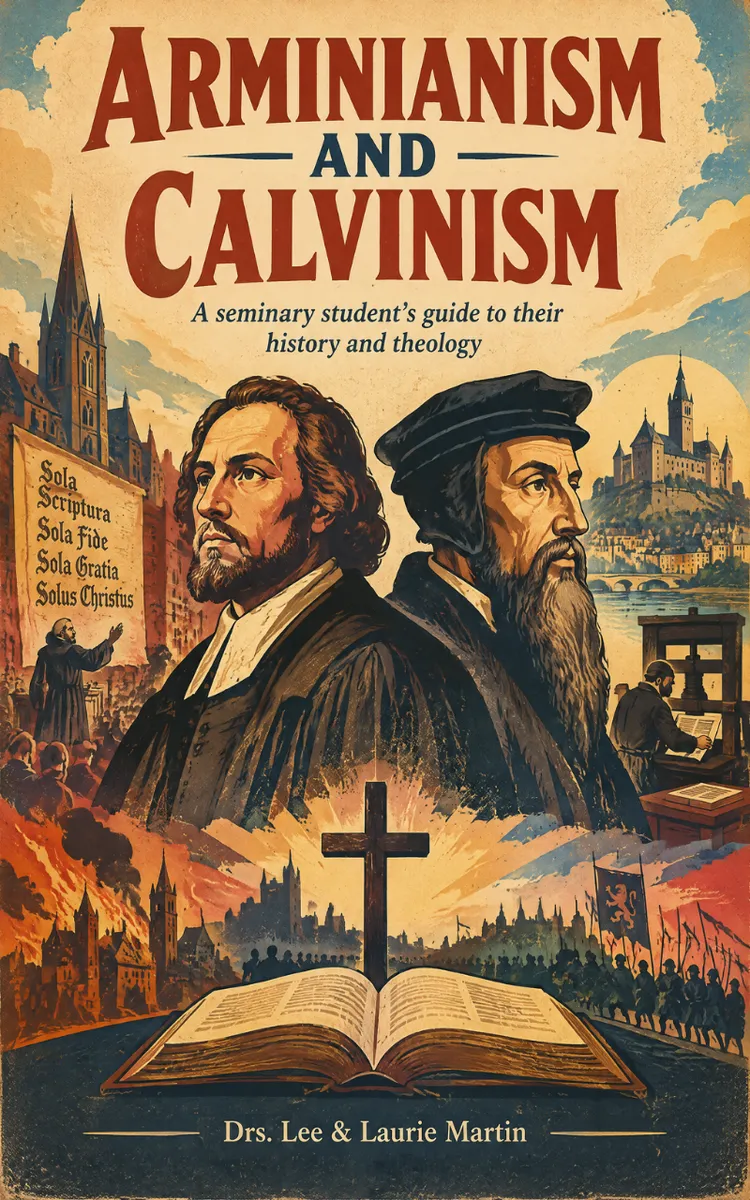
"Arminianism And Calvinism" is a education book by Drs. Lee & Laurie Martin with 40 chapters and approximately 82,925 words. The history, doctrines, arguments, and development of Arminianism and Calvinism.
This book was created using Inkfluence AI, an AI-powered book generation platform that helps authors write, design, and publish complete books. It was made with the AI Lesson Plan Generator.
Frequently Asked Questions
What is "Arminianism And Calvinism" about?
The history, doctrines, arguments, and development of Arminianism and Calvinism
How many chapters are in "Arminianism And Calvinism"?
The book contains 40 chapters and approximately 82,925 words. Topics covered include Biblical Authority and Theological Method, Grace, Freedom, and Salvation, The Reformation’s Historical Setting, Luther, Erasmus, and the Will, and more.
Who wrote "Arminianism And Calvinism"?
This book was written by Drs. Lee & Laurie Martin and created using Inkfluence AI, an AI book generation platform that helps authors write, design, and publish books.
How can I create a similar education book?
You can create your own education book using Inkfluence AI. Describe your idea, choose your style, and the AI writes the full book for you. It's free to start.
Write your own education book with AI
Describe your idea and Inkfluence writes the whole thing. Free to start.
Start writingCreated with Inkfluence AI


