
Read the first chapter
The whole of chapter one, free. About 8 min. Turn the pages with the arrows, your keyboard, or a swipe.
Chapter 1
What Reiki Is and Isn’t
Why Reiki’s Purpose and Limits Matter
What would change if you could use ten quiet minutes to settle your body and attention, while still knowing exactly when to seek medical care? That question captures Reiki’s proper place. Reiki offers a structured form of gentle, focused relaxation. It can support calm, self-awareness, and personal well-being, but it does not diagnose illness, repair injuries, or replace treatment from a licensed health professional.
Many beginners feel unsure about what should happen during a Reiki session. They may expect dramatic sensations, wonder whether they must follow a belief system, or worry that they will do something incorrectly. Clear expectations remove much of that confusion. Reiki practice does not require you to force energy, produce a special feeling, or accept claims that make you uncomfortable. You can learn a simple routine, observe your response, and make sensible choices about your care.
After reading this section, you should be able to describe Reiki in plain language, explain its supportive purpose, and set a safe boundary between Reiki and medical care. You will also have a practical way to decide what to expect from a session: relaxation may occur, sensations may vary, and no sensation does not mean failure. Ask yourself: can I describe Reiki as a wellness practice rather than a cure? If yes, you have the right starting point.
The Reiki Compass Model
The Reiki Compass Model gives you four directions for understanding and using Reiki safely: purpose, presence, practice, and professional care. These directions keep Reiki practical instead of mysterious. Traditional Usui Reiki, developed in Japan by Mikao Usui in the early twentieth century, teaches a hands-on system for personal development and supportive care. Usui Reiki includes meditation, ethical principles, self-treatment, and treatment for others after suitable training.
Reiki uses the Japanese word ki for life energy. You may also see rei translated as spiritual or universal. Translations vary, so focus on the practice rather than trying to prove an invisible mechanism. In Traditional Chinese Medicine, Qi means vital energy or life activity. Reiki and Traditional Chinese Medicine are distinct traditions, but both use energy language to discuss balance, vitality, and the relationship between body, mind, and daily habits. Reiki does not require you to diagnose your Qi, meridians, or organs.
Use the four directions in this order:
1. Purpose: Decide what you want Reiki to support. Choose a clear aim, such as ten minutes of quiet after work or a calmer bedtime routine. A clear purpose prevents you from treating Reiki as a search for a cure. 2. Presence: Notice your breathing, body sensations, emotions, and thoughts without trying to control them. Presence helps you recognize relaxation without turning every sensation into a medical conclusion. 3. Practice: Use a repeatable self-Reiki routine. Consistency matters because it lets you compare how you feel before and after practice. 4. Professional care: Keep medical, mental-health, dental, and emergency care in their proper place. Reiki can accompany that care, but it cannot replace examination, testing, medication, surgery, counseling, or urgent treatment.
A Reiki session often lasts between 20 and 60 minutes. You usually remain fully clothed, either sitting or lying comfortably. A practitioner may place hands lightly on or just above several areas, or may invite you to place your own hands on your body. You can request no-touch practice at any time. You can also stop the session, ask questions, or change position. Common experiences include warmth, coolness, heaviness, lightness, relaxation, emotion, or no noticeable sensation. These responses do not prove that Reiki has treated a condition. They simply describe your experience.
Traditional Usui Reiki also includes five principles, often practiced as daily reminders: do not anger, do not worry, be grateful, work honestly, and be kind to every living thing. Their value lies in daily behavior, not in repeating them as a cure. For example, “do not worry” does not mean you must suppress fear. It can prompt you to notice worry, take one useful step, and seek support when needed.
Energy traditions can add helpful language without replacing ordinary care. Yin and Yang describe complementary qualities, such as rest and activity. The Five Elements - Wood, Fire, Earth, Metal, and Water - offer a traditional way to reflect on patterns in life and nature. Meridians are pathways described in Traditional Chinese Medicine through which Qi is said to move. The Three Treasures are Jing, associated with foundational vitality; Qi, associated with active life energy; and Shen, associated with spirit or awareness. Use these ideas as cultural and reflective frameworks, not as tools for diagnosing yourself.
Your practical takeaway: choose one modest wellness purpose, remain curious about your experience, and keep professional care separate from Reiki’s supportive role.
Applying the Compass: Nora’s Ten-Minute Practice
Nora is 34, works full time, and cares for a young child. She has never practiced Reiki or meditation. After several rushed evenings, she wants a short routine that helps her pause before bedtime. She does not use Reiki to explain her tiredness or decide whether she needs medical care. She chooses Reiki as a quiet self-care practice.
Nora follows these steps:
1. She checks her purpose at 8:30 p.m. She writes, “I want ten quiet minutes to settle after a busy day.” This specific goal gives her a realistic way to judge the practice. 2. She checks safety and comfort. She sits in a chair with both feet on the floor, silences her phone, and keeps the room comfortably lit. She avoids practicing while driving, supervising a bath, or handling hot cookware. 3. She takes three natural breaths. She does not force deep breathing, because forcing the breath can create dizziness or tension. She notices whether her shoulders feel tight and whether her jaw is clenched. 4. She places her hands gently. For two minutes, she rests them over her upper chest without pressing. For two minutes, she rests them over her abdomen. For two minutes, she places them on her thighs. She keeps the touch comfortable and avoids any painful or injured area. 5. She practices presence. When thoughts about tomorrow appear, she silently says, “thinking,” and returns attention to the warmth or weight of her hands. She does not judge the thought or try to empty her mind. 6. She closes the practice. She removes her hands, looks around the room, and records one sentence: “Before: restless; after: quieter, still tired.” This honest note prevents exaggerated conclusions.
After seven days, Nora reviews her notes. She notices that the practice does not remove tiredness, but it helps her transition into bedtime on several evenings. She also notices that one evening she feels dizzy. She stops, drinks water, and tells her health professional if the symptom continues or returns. Reiki remains a supportive routine, not an explanation for the dizziness.
Use the same approach when attending a session. Tell the practitioner that you are new, state your comfort preferences, and share only information you choose to share. A responsible practitioner explains the session, respects consent, and avoids promising to cure disease. The expected outcome should remain modest: you may feel more relaxed, more aware of your body, or simply unchanged.
Quick checklist
• Choose one clear wellness purpose. - Practice in a safe, quiet place for 5-10 minutes. - Keep your hands comfortable and use no pressure. - Notice sensations without diagnosing them. - Record how you felt before and after. - Continue prescribed medical care. - Contact a qualified professional about persistent, severe, or worrying symptoms. - Stop Reiki if it causes distress, pain, dizziness, or fear.
Reflection prompt: What would a useful ten-minute Reiki practice support in your actual day, and what problem would require a different kind of help?
What to Watch For and How to Stay Safe
Expecting a cure from a strong sensation
Warmth, tingling, emotion, or deep relaxation can feel meaningful. However, a strong sensation does not show that Reiki has removed a disease or corrected a physical problem. Treating sensation as proof may delay appropriate care.
Do this: Record the sensation as an experience: “My hands felt warm for three minutes.”
Not this: Conclude, “The warmth cured my inflammation.”
If you have new or worsening symptoms, contact a licensed health professional. Seek urgent help for emergencies such as severe chest pain, trouble breathing, sudden weakness, serious injury, or thoughts of harming yourself.
Using Reiki instead of prescribed treatment
A person may feel calmer after Reiki and decide to stop medication or skip an appointment. That choice can create real risk, especially when a condition requires monitoring. Reiki cannot replace diagnosis, laboratory testing, medication management, surgery, physical therapy, or mental-health treatment.
Do this: Tell your clinician that you practice Reiki if you want to discuss how it fits alongside your care. Follow the treatment plan you received.
Not this: Change medication, cancel treatment, or delay urgent help because a Reiki session felt reassuring.
Ignoring consent and personal boundaries
A practitioner should explain where they plan to place their hands, ask permission, and accept “no” without pressure. You never need to tolerate touch, spiritual language, or a claim that makes you uncomfortable.
Do this: Before a session, ask, “Will you use touch, and can I choose no touch?” Agree on a stop signal and keep your clothing on. Leave if the practitioner promises guaranteed cures, tells you to abandon medical care, or pressures you to buy services.
Not this: Assume a practitioner has medical authority because they use Reiki language or describe themselves as an energy healer.
Reiki works best within clear boundaries: a quiet practice for awareness and relaxation, guided by consent and supported by responsible self-care. The Northern New York Reiki Association can deepen that education by teaching Traditional Usui Reiki alongside foundational Traditional Chinese Medicine concepts such as Qi, Yin and Yang, the Five Elements, meridians, and the Three Treasures. That combination helps learners compare traditions carefully while keeping Reiki practice grounded, respectful, and safe. As you continue, the Reiki Compass Model can guide each session back to its essential question: what support can this practice offer today, and what care belongs with a qualified professional?
End of chapter one. 32 more chapters and about 58,021 words in the full book.
Swipe or use the arrows to turn the page


What's inside: 33 chapters
- 1. What Reiki Is and Isn’t
- 2. A Gentle Safety and Comfort Setup
- 3. Traditional Usui Reiki Origins
- 4. The Five Reiki Principles (Gokai)
- 5. Reiki Energy, Plain Language
- 6. Qi, Yin, Yang for Beginners
- 7. Five Elements and Emotional Weather
- 8. Meridians: Pathways of Flow
- 9. The Three Treasures (Jing, Qi, Shen)
- 10. What Happens in a Reiki Session
- 11. How to Hold Intention and Attention
- 12. Breathwork for Reiki Readiness
- 13. Meditation Basics: Stillness Without Pressure
- 14. Mindfulness During Hand Placement
- 15. Energy Awareness: Grounding and Centering
- 16. Self-Reiki: Your First Full Routine
- 17. Reiki Hand Positions: Head, Neck, and Shoulders
- 18. Reiki Hand Positions: Chest, Abdomen, and Back
- 19. Reiki Hand Positions: Arms, Hands, and Legs
- 20. Reiki Symbols: Respectful Beginner Approach
- 21. Attunement: What It Means for Beginners
- 22. Daily Self-Reiki Plan: 10-20 Minutes
- 23. 30-Day Reiki Challenge Calendar
- 24. Habit Tracking and Weekly Checkpoints
- 25. Self-Care Worksheets for Emotional Balance
- 26. Energy Awareness Journal Prompts
- 27. Mindfulness Breaks Between Sessions
- 28. Common Beginner Challenges and Fixes
- 29. When to Seek Medical Support
- 30. Your Next Steps: Continuing with Confidence
- 31. Glossary of Reiki and TCM Terms
- 32. Northern New York Reiki Association Benefits
- 33. Final Review Checklist and Journal
About this book
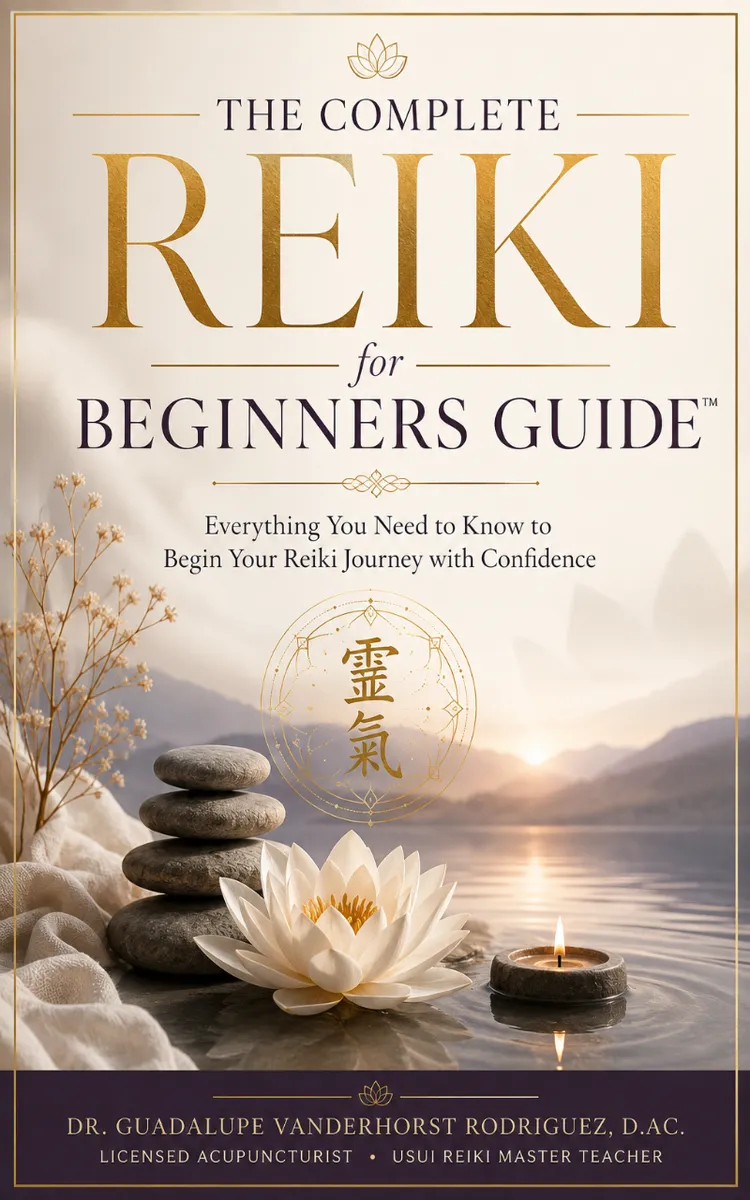
"The Complete Reiki For Beginners Guide" is a how-to guide book by Dr. Guadalupe Vanderhorst Rodriguez, D.Ac with 33 chapters and approximately 58,021 words. Beginner Reiki training with Usui principles and 30-day plan.
This book was created using Inkfluence AI, an AI-powered book generation platform that helps authors write, design, and publish complete books. It was made with the AI Ebook Generator.
Frequently Asked Questions
What is "The Complete Reiki For Beginners Guide" about?
Beginner Reiki training with Usui principles and 30-day plan
How many chapters are in "The Complete Reiki For Beginners Guide"?
The book contains 33 chapters and approximately 58,021 words. Topics covered include What Reiki Is and Isn’t, A Gentle Safety and Comfort Setup, Traditional Usui Reiki Origins, The Five Reiki Principles (Gokai), and more.
Who wrote "The Complete Reiki For Beginners Guide"?
This book was written by Dr. Guadalupe Vanderhorst Rodriguez, D.Ac and created using Inkfluence AI, an AI book generation platform that helps authors write, design, and publish books.
How can I create a similar how-to guide book?
You can create your own how-to guide book using Inkfluence AI. Describe your idea, choose your style, and the AI writes the full book for you. It's free to start.
Write your own how-to guide book with AI
Describe your idea and Inkfluence writes the whole thing. Free to start.
Start writingCreated with Inkfluence AI


