

Read the first chapter
The whole of chapter one, free. About 5 min. Turn the pages with the arrows, your keyboard, or a swipe.
Chapter 1
Identifying Self-Esteem Triggers
The “Trigger Map”: pinpoint what sets you off, then name what follows Self-esteem doesn’t usually drop for no reason. Most of the time, it’s reacting to a specific situation - an email, a glance, a missed step, a social moment - then your brain runs a quick script. That script usually includes a few common parts: a trigger (what happened), a thought (what you told yourself), a feeling (what it did to your body), and an action (what you did next).
To get traction, you don’t need to “fix yourself.” You need to spot the moment your self-doubt starts, and map what happens right after. That makes it easier to interrupt the pattern later, because you’re no longer guessing. You’re watching the chain as it forms.
Key takeaway: A self-esteem trigger is a specific situation that reliably kicks off predictable thoughts and feelings in you.
Use this chapter’s simple trigger map steps: 1. Trigger: What exact situation happened? (Be specific: “boss asked for updates,” not “work stress.”) 2. Immediate thought: What sentence did your mind spit out? (Even if it’s ugly.) 3. Feeling + body signal: What did you feel, and where did you notice it? (Tight chest, hot face, shaky hands.) 4. Action: What did you do next? (Avoid, overexplain, freeze, snap back, scroll, say yes too fast.) 5. After-effect: What happened to your confidence right after? (Down 1-10, or “I felt smaller.”)
If you can fill those five parts, you’ve got your starting point. No mystery fog required.
---
Guided Practice: build your first Trigger Map (with a real example) Time required: 15-25 minutes Materials needed: A notebook or notes app, a pen, and your phone (optional, for a quick clock timer)
Grab one recent moment when you felt self-doubt. It can be small - like worrying you sounded “stupid” - or bigger - like messing up a job task. The goal is accuracy, not drama.
Your Turn: Create one Trigger Map 1. Pick one moment (the trigger). Write one sentence starting with: “This happened…” Include the setting and who was there. Example: “I sent my estimate to the client and didn’t feel confident.” 2. Write the exact thought that showed up right away. Use this format: “My mind said: ______.” If you’re not sure, pick the first phrase that comes to you. 3. Name the feeling and the body signal. Use two short blanks: - “I felt: ____.” - “In my body, I noticed: ____.” 4. Record what you did next. Choose one: avoided, overexplained, apologized, froze, worked faster, checked your phone, got angry, went silent, or something else (write it). 5. Rate the confidence drop. On a 0-10 scale, where 0 = no confidence and 10 = fully confident, write: “Confidence before: /10, after: /10.” 6. Label the pattern. Finish the sentence: “This trigger usually leads to ____ (thought), which leads to ____ (feeling), and then ______ (action).”
Completed example (so you can copy the structure) > Trigger Map Example > This happened: I posted a gym schedule update in the group chat and waited for replies. > My mind said: “They’ll think I’m careless.” > I felt + body: anxious; tight chest and hot face. > What I did next: I kept checking the chat and rewrote the message twice. > Confidence rating: before 7/10, after 3/10. > Pattern label: This trigger leads to “They’ll think I’m careless,” which leads to anxiety, and then to overchecking and editing.
When you finish step 6, you’ll have more than a “bad mood.” You’ll have a repeatable map.
Quick check (measurable) - You wrote one specific situation (not a general theme). - You wrote one exact thought (even if it’s harsh). - You wrote one action you did next. If any of those are missing, go back and fill the blank - don’t move on until the map is complete.
---
Real-World Application: use your Trigger Map in everyday moments Now let’s aim this at real life. The trick is catching the trigger early enough that it still feels trackable. You’re not trying to “be positive.” You’re trying to notice the chain while it’s happening.
Scenario 1: Work or business communication. Picture you send a follow-up email and then your confidence dips. Your trigger might be: “I hit send and didn’t get a reply in 2 hours.” Your mind thought could be: “I’m annoying.” Your feeling might be anxious with a stomach drop. Your action could be sending another message or overexplaining. Expected outcome from using the map: you’ll start seeing that the trigger isn’t “time passing” - it’s the meaning your brain assigns (“I’m annoying”). That’s a huge difference, because it turns a vague dread into a labeled pattern you can challenge later.
Scenario 2: Small social moments. Maybe you tell a joke, and someone pauses. Your trigger: “They didn’t laugh right away.” Your thought: “I embarrassed myself.” Feeling: heat in your face and a prickly throat. Action: you talk faster to recover or you shut down and stop sharing. Expected outcome: you’ll notice that your confidence drop begins before you “know” anything. You’re reacting to the trigger + thought combo, not to proof.
Scenario 3: Home life or errands. You’re at the counter, you fumble your words, and suddenly you feel like you’re failing as a person. Trigger: “The cashier asked a question and I stumbled.” Thought: “I’m incompetent.” Feeling: shame with a clenched jaw. Action: you rush through the rest of the interaction. Expected outcome: your map will show you that the trigger is the stumble, but the confidence crash comes from the thought “I’m incompetent,” not from the stumble itself.
Apply It (2-minute catch test): The next time self-doubt hits, do this mini-version: - Write the trigger in under 10 words. - Write the thought in under 12 words. - Rate confidence before/after.
When you can consistently do that, you’re training your brain to spot triggers faster. That’s how self-esteem work starts to feel less like guessing and more like steering.
---
Reflect: lock in what you learned and plan your next Trigger Map Let’s turn your notes into something you can actually use. You’ll answer a few questions that force clarity (and keep you out of vague “I guess I feel bad” territory).
Reflect Question 1: What is the most specific trigger you wrote down (include setting + who/where)? ________________________________________________________________________________ ________________________________________________________________________________
Reflect Question 2: Which thought showed up most clearly in your map - what exact sentence did your mind use? ________________________________________________________________________________ ______________________________________________________________________________ ________________________________________________________________________________
Reflect Question 3: If that trigger happened again tomorrow, what action would you like to do instead of your usual one? (Write one replacement action.) ________________________________________________________________________________ ________________________________________________________________________________
Your next step (measurable): Pick a day/time and commit to making one more Trigger Map within the next 48 hours. Choose a realistic window like “tonight after work” or “tomorrow at lunch.” Then write the time here: ________________________________
One small map can change how you see the rest of your day. Because once you can name the trigger and map the chain, self-doubt stops being this invisible boss and starts being a pattern you can train around.
End of chapter one. 6 more chapters in the full book.
Swipe or use the arrows to turn the page


What's inside: 7 chapters
- 1. Identifying Self-Esteem Triggers
- 2. Challenging Thoughts with Evidence
- 3. Rewriting Your Inner Critic Script
- 4. Building Self-Respect Boundaries
- 5. Creating a Confidence Morning Routine
- 6. Tracking Wins with Proof Lists
- 7. Maintaining Progress Through Setbacks
About this book
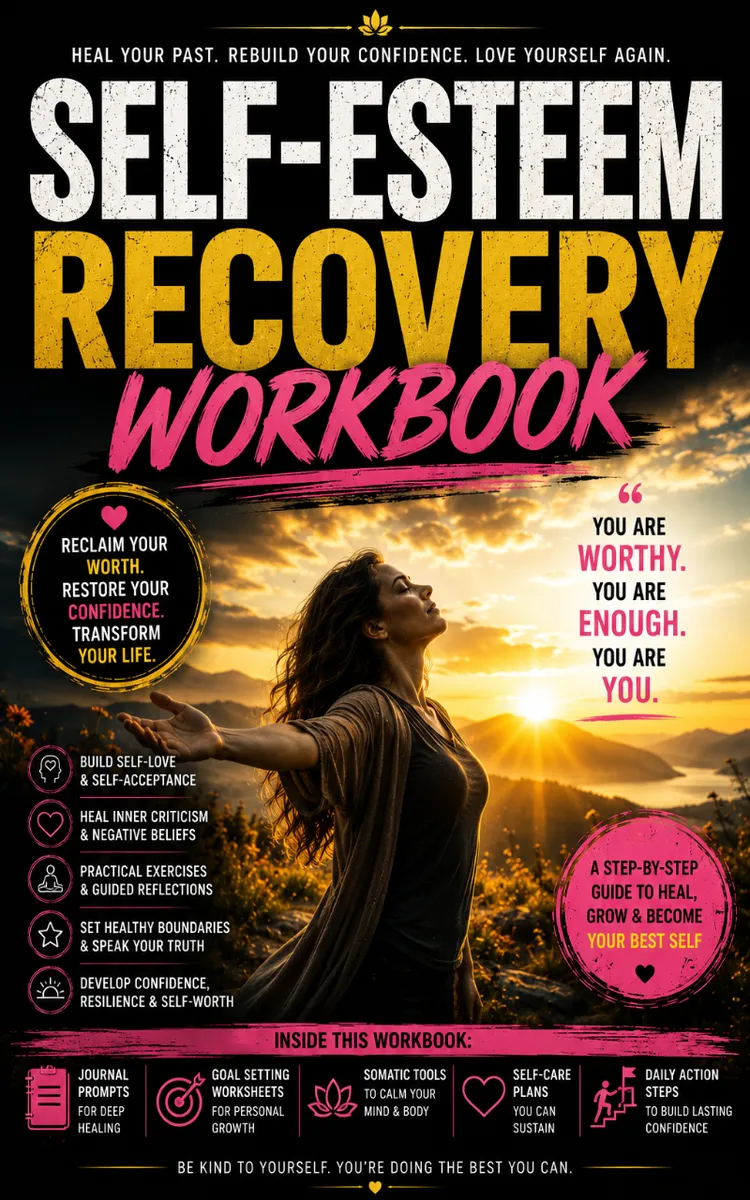
"Self-Esteem Recovery Workbook" is a workbook by NextGen PDF with 7 chapters and approximately 9,353 words. Guided workbook exercises for rebuilding self-esteem.
This book was created using Inkfluence AI, an AI-powered book generation platform that helps authors write, design, and publish complete books. It was made with the Workbook Generator.
Frequently Asked Questions
What is "Self-Esteem Recovery Workbook" about?
Guided workbook exercises for rebuilding self-esteem
How many chapters are in "Self-Esteem Recovery Workbook"?
The book contains 7 chapters and approximately 9,353 words. Topics covered include Identifying Self-Esteem Triggers, Challenging Thoughts with Evidence, Rewriting Your Inner Critic Script, Building Self-Respect Boundaries, and more.
Who wrote "Self-Esteem Recovery Workbook"?
This book was written by NextGen PDF and created using Inkfluence AI, an AI book generation platform that helps authors write, design, and publish books.
How can I create a similar workbook?
You can create your own workbook using Inkfluence AI. Describe your idea, choose your style, and the AI writes the full book for you. It's free to start.
Write your own workbook with AI
Describe your idea and Inkfluence writes the whole thing. Free to start.
Start writingCreated with Inkfluence AI


